


What Helps a Slipped Disc, and the Habits That Set It Back
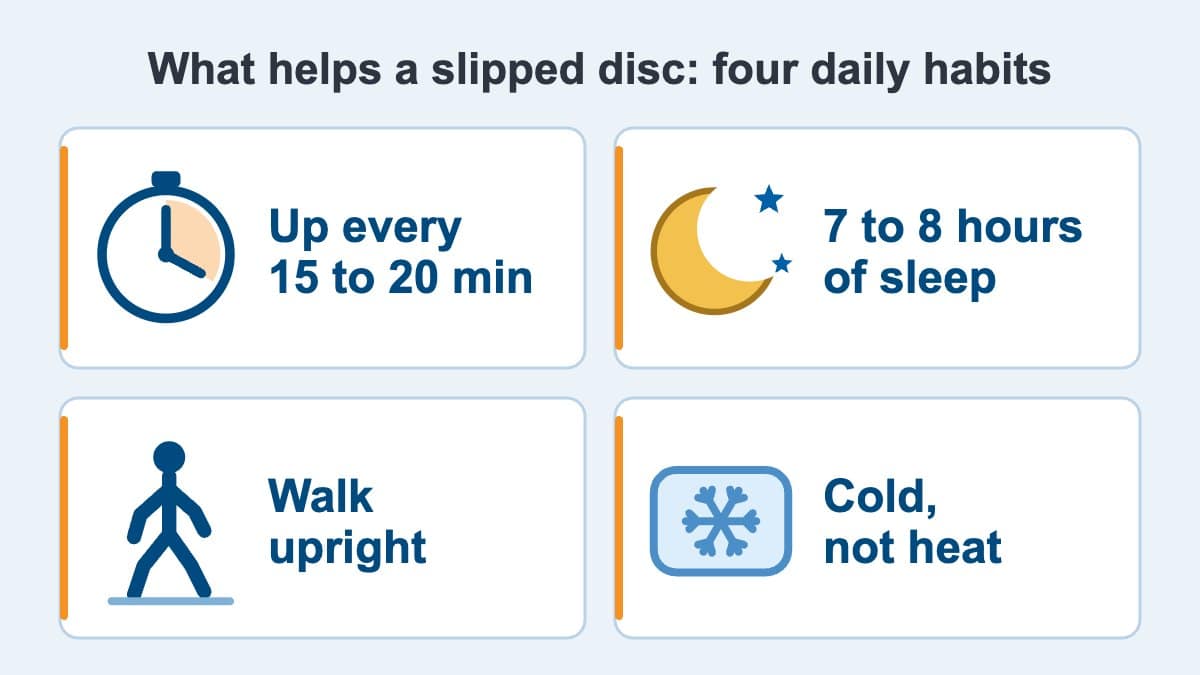
What helps a slipped disc is mostly ordinary, and most of it happens in the 22 hours a day spent away from treatment. A slip disc needs short spells of sitting, enough sleep in the right position, and upright walking on level ground. Lifting stops for a while, cold replaces heat, and three gentle exercises start on the first day.
What sets a slipped disc back is just as consistent. Long, slumped sitting does, above all in a car, and so do bending to lift and days of complete rest. Stretching hard into the painful direction feels productive and is not. Yoga must be avoided too, even in classes described as gentle.
Leg symptoms that pull back up toward the spine are progress, even when the back aches more for a time. Symptoms that move further down the limb are not. Reviews of trials point the same way. Staying active did slightly better than bed rest for acute low back pain, and exercise with education lowered the risk of a new episode. The sections below cover that research, lifting, cold or heat, the first exercises, the neck, and when to be examined.
This guide, What Helps a Slipped Disc: Home Care and 8 Habits to Avoid, is published by Chiropractic Specialty Center, Bukit Damansara (KL) main center: WhatsApp+60 17 269 1873 Call+603 2093 1000
What Helps a Slipped Disc: Key Takeaways
| Question | Short answer |
|---|---|
| What is the best sitting position for a slipped disc? | Upright in a firm chair, buttocks and belt line touching the backrest, knees slightly above the hips and the screen at eye level. With back pain, every 15 to 20 minutes, stand or walk for 30 seconds to a minute. |
| Is rest helpful for a slipped disc? | Sleep is, because a disc takes in fluid while the body lies down. A short rest in the first day or two is reasonable, but days in bed weaken the support around the spine and add stiffness. |
| Can walking help a slipped disc? | Yes, on level ground, upright, in shoes that still absorb shock. A walk is too long if it brings on leg pain, numbness or tingling, during it or in the three days after. |
| Does cracking the back help a slipped disc? | No. The soft center of the disc has moved out through torn fibers in its outer wall, and cracking or twisting the spine can tear more of that wall. Some of that damage always remains. |
| How can a slip disc be kept from coming back? | By keeping the habits after the pain has gone, adding exercises once the spine is stable, and leaving out deadlifts, swimming laps and heavy bending. Recurrence is common, so the prevention work starts as soon as the symptoms settle. |
| Which signs need a hospital straight away? | New numbness around the genitals or anus, new difficulty passing urine, or loss of bladder or bowel control needs urgent medical attention. Go to a hospital emergency department straight away, within hours. |
| What does the research add? | In a 2016 review of 21 trials, exercise combined with education cut the risk of a new low back pain episode by about 45 percent. In a 2024 trial, a walking program after recovery from low back pain pushed the next episode back from a median of 112 days to 208. |
Page Guide: The Habits and Sections
- Slip Disc Self-Care: What Back Pain Studies Found
- Arranging an Assessment for a Slipped Disc
- Sitting With a Slip Disc: Breaks, Posture and Set-Up
- Driving and Long Trips: Time Limits & Car Posture
- Sleep: Hours, Positions & Pillows
- Walking With a Slip Disc: Shoes, Posture and Hills
- Bending and Lifting: Why a Disc Gives Way at the Back
- Cold or Heat on a Damaged Disc?
- Early Slip Disc Exercises and the Ones That Wait
- What Helps a Slipped Disc in the Neck
- Habits That Often Make Disc Problems Worse
- How to Tell Whether a Slip Disc Is Settling
- Beyond Home Care: Focused Treatment for a Slip Disc
- When a Slipped Disc Needs Prompt Assessment
- Slip Disc Habits: Common Questions Answered (FAQ)
Slip Disc Self-Care: What Back Pain Studies Found
No trial in these reviews tested slip disc self-care as one set of habits. Trials of low back pain have tested its main parts, though: staying active, walking, exercise and education. What they found points the same way as the habits on this page.
A Cochrane review of ten trials compared advice to rest in bed with advice to stay active. For acute low back pain, two trials with 401 people found small gains in pain and in daily function for those told to stay active. For sciatica, the two kinds of advice made little or no difference (Dahm and colleagues, 2010).
A 2016 review pooled 21 trials with 30,850 people to find out what prevents an episode of low back pain. Exercise combined with education lowered the risk of an episode by about 45 percent, on moderate-quality evidence. Exercise alone may lower it too, on weaker evidence, while education on its own made no difference (Steffens and colleagues, 2016).
The WalkBack trial followed 701 adults in Australia who had recently recovered from low back pain with no specific diagnosis. Half were given a walking program that built up step by step, with education and six physiotherapy sessions over six months. Their next episode came later, after a median of 208 days against 112 with no program. The walking group also recorded more adverse events in the legs and feet, 100 against 54 (Pocovi and colleagues, 2024).
A 2012 review looked at centralization, where pain moves back toward the spine and out of the arm or leg with repeated movements. It appeared in 44 percent of 4,745 people with back or neck pain, and in 74 percent of recent cases. In 21 of 23 studies, it pointed to a better outlook (May and Aina, 2012).
These studies looked at back pain in general, not at slipped discs alone, and none of them tested care at CSC. They support the direction of this page. Keep moving within what the back tolerates, and change the habits early instead of waiting for the pain to pass.
Arranging an Assessment for a Slipped Disc
To arrange an assessment for a slipped disc, see the Bukit Damansara contact page and the Bandar Sri Damansara contact page, or call either center. The first visit is an examination of the spine, the nerves of the arms or legs, and any scans already taken. Bring the films or the CD as well as the reports.
- Bukit Damansara (KL, main center): Call +603 2093 1000 or WhatsApp +60 17 269 1873 to see the Bukit Damansara / KL center.
- Bandar Sri Damansara (KL): Call +603 6262 5777 or WhatsApp +60 12 455 6939 to see the Bandar Sri Damansara center.
Opening hours, directions and parking for both centers are on the page listing CSC's Kuala Lumpur locations.
Sitting With a Slip Disc: Breaks, Posture and Set-Up
Sitting with a slip disc loads it more than standing or lying down, so the first change is how long each spell lasts. My order for patients is habits first, then posture and the set-up of the desk, and the furniture last.
With back pain, I ask patients to get up every 15 to 20 minutes. They stand or take a few steps for 30 seconds to a minute, then sit again. Once the back pain has gone, every 30 to 40 minutes is enough. Each step moves the joints of the spine and takes off the pressure that built up while sitting.
My Back Pain to Leg Pain talk gives the pressure inside a lower back disc in millimeters of mercury. It is about 25 lying on the back and 100 standing. Leaning forward takes it to 150 to 200 and sitting to 250, and leaning forward while seated pushes it higher still. The guide to raised pressure inside the disc explains why that load matters.
How to sit, in any chair:
- Sit upright with the buttocks and the belt line pressed against the back support.
- Keep the knees at hip height or a little above, with the feet flat and straight under the knees.
- Leave a gap between the backs of the knees and the edge of the seat.
- Set the screen at eye level, about 20 to 24 inches (50 to 60 cm) away, with the eyes at its center.
- Open the elbows past 90 degrees, to about 100 to 110, with the keyboard close enough to reach without leaning.
- With two screens used equally, place the join between them straight ahead, both at eye level.
- Keep the phone on the left if the right hand works the mouse, or use a headset.
- Raise a laptop, or connect it to a monitor, so the head does not bend down to it.
- At home, choose a firm chair over a sofa.
A good ergonomic chair comes last. Many people buy one first and change nothing else, and in my experience the chair alone then does little. All three can change together.
Slumping costs more than the back. In Neck and Back Self-Help Tips I show how it squeezes the stomach and the organs above it toward the lungs and heart.
Prayer With an Acute Slip Disc
For many patients, the deepest forward bend of the day comes in prayer. My Back Pain to Leg Pain talk names the prayer bow when it gives the 150 to 200 figure for leaning forward.
For acute disc patients whose spine is unstable, I usually advise a mini ruku', a shallow bow, with the sujood performed seated. The instability may come from a slipped vertebra or another form of slipped disc. I may adjust that for overall health, the knees and hips, and how worn the spine is.
Video: How Posture Affects the Spinal Disc
In this eight-minute video, I use a spine model to show what years of poor posture do to the disc's rings and center. It opens and closes with the same point: "The one thing that I want you to get from this video is that posture matters." The video applies it to sitting, standing, sleeping, home and the car, the same ground this page covers.
The chapters and an edited transcript of this video are on the Poor Posture Spine video page.
Duration: 8 minutes | Posture, the disc's outer rings and center, and how wear spreads from muscle to disc.
Driving and Long Trips: Time Limits & Car Posture
Driving is sitting with no chance to stand up, so its limits are set before the trip begins. With acute, intense back pain, about 15 minutes at the wheel is the limit. No drive goes past 20 to 30 minutes before a break, wherever it is safe to stop. Get out at each break and walk for a minute.
Once the acute phase has passed, breaks every 45 to 60 minutes are enough, and a gentle calf stretch can be added at each one. Long road trips are worth postponing while the disc is irritable. When a trip cannot wait, the front passenger seat, reclined, is the better place to be.
In the driver's seat:
- Sit upright with the backrest reclined only slightly, to 100 to 110 degrees.
- Keep the hips and knees level, with the knees slightly bent.
- Set the headrest at the middle of the head, not behind the neck.
- Hold the wheel at nine and three o'clock with the arms bent.
- Avoid leaning to one side or twisting during the drive.
Sleep: Hours, Positions & Pillows
Sleep is when a damaged disc draws in fluid and nourishment, because the pressure inside it is lowest while lying down. My Back Pain to Leg Pain talk asks: "Did you know that you're taller in the mornings than you are in the evenings? Which is why sleep is important."
Six hours is the minimum, and seven to eight unbroken hours are better where possible. A nap does not make up a short night. In Neck and Back Self-Help Tips I ask viewers: "do not shortchange and say, I will take a nap in the afternoon."
- In the first days, the least painful position comes first, even if it is not one of those below.
- My order in Neck and Back Self-Help Tips: the right side, then the left, and last the back, a bolster beneath the knees.
- On either side, pick a pillow height that keeps the head in line with the spine, and hold a bolster between the knees.
- Heartburn when lying on the right side is a reason to sleep on the left.
- On the back, a rolled towel under the neck goes with the bolster under the knees.
- Avoid the half-turned position, rolled partly onto the stomach, which twists the spine all night.
No pillow is perfect for everyone. A towel rolled up and tied at both ends works under the neck. So does a latex pillow covered with memory foam, with a thin side and a thick side to choose the height. The mattress has to hold the spine in that line all night. The page on mattress firmness and support for back pain covers how to choose one.
Walking With a Slip Disc: Shoes, Posture and Hills
Walking suits a slip disc from the start, on level ground and within what the back tolerates. My Back Pain to Leg Pain talk gives the reason: with every step, the joints between the spinal segments move. "It depressurizes them. Mobility is good."
A walk is the right length when it brings on no leg pain, numbness or tingling. The test runs through the walk and the 72 hours after it, because inflammation can take that long to show.
Shoes matter more than most people expect. Anyone who walks two or three times a week does well with a good running shoe. Most have an arch support, which many walking shoes lack. I suggest replacing the pair every year, since worn shoes lose the shock absorption they had.
Keep the head over the shoulders and the gaze ahead while walking. Look down for potholes only now and then, not at the feet the whole way. Standing still, keep the feet shoulder-width apart, the weight even on both and the knees soft rather than locked. Drawing the navel gently toward the spine while standing and walking keeps the deep abdominal muscles working.
Uphill walking is where I draw a line. Leaning into a slope bends the lower back forward and puts more of the body's weight on the damaged level. It also presses the disc's soft center backward, into a wall that may already be torn. So with a disc problem, steep climbs wait, and with acute back pain, so does any uphill walk. A treadmill is set flat, with no incline.
Water is gentler than laps. In the same talk I tell the audience that walking in water suits a damaged disc better than swimming. The kicking and turning of each stroke bend and twist the spine over and over.
Bending and Lifting: Why a Disc Gives Way at the Back
Bending and lifting load a damaged disc where it is weakest. For a while, the waist neither bends nor twists, and nothing is lifted. Most people believe a bend happens at the hips. In my Back Pain to Leg Pain talk I correct that: "95% of this movement is at L4-L5." That is also why L4-L5 is the most common level for a slipped disc, with L5-S1 second.
The back of the disc is its weak side. A ligament runs down the front of the spine and another down the back, and both back up the disc's outer wall. The front one is thick. The back one has to stay thin to leave room for the spinal cord, so a damaged disc pushes backward, toward the nerves.
- No bending or twisting at the waist. To reach something low, bend the knees and keep the back upright.
- Lift nothing at first. When something must be lifted, keep it under 2 kg, close to the body, with no bend and twist together.
- Leave deadlifts and free weights out. My advice in the same talk is short: "when you go to the gym, do not do dead lifts."
- Leave heavy shopping and bags to someone else for now, or split them into light loads.
The 72-Hour Rule for Sport and Chores
Sport and heavier chores come back one at a time, after recovery. An activity passes only if it causes no pain during it and none in the three days after. Inflammation can take up to 72 hours to appear.
Cold or Heat on a Damaged Disc?
Cold, not heat, goes on a damaged disc. Heat feels good on a tight back, and that is the trap. In my Back Pain to Leg Pain talk I grant that heat improves blood flow, then add: "It also increases inflammatory processes." Inflammation inside and around a damaged disc is one of the first things that happens to it.
Wrap a cold pack in a cloth and leave it on for 10 to 15 minutes. Use it no more than three times a day, with two hours or more in between, and set a timer so it is never forgotten.
Hot packs, heating pads and hot water bottles stay off the back while a disc is damaged or the area is inflamed. At CSC, cold therapy is used on the spine. The heat setting of the cold and heat device stays off any spine with a disc or facet joint problem. Laser and ultrasound are different: their warmth is mild and reaches deeper tissue, unlike a hot pack on the skin.
Early Slip Disc Exercises and the Ones That Wait
Exercise for a slip disc starts small and only when the body is ready for it. Three can begin on the first day: Kegel exercises for the pelvic floor, buttock contractions, and side-lying leg raises.
For a Kegel, tighten the pelvic floor and hold it for 5 to 10 seconds. Let go, then do it again, 5 to 15 times in all. For anyone with a lower back problem I consider them essential. Drawing the navel toward the spine while breathing out adds a small Kegel at the same time.
The rest of the program starts once the spine is stable. For most patients that is around the fifth to seventh session, and for a few it is the third. Then come squats with the back against a wall, a slow cat and camel, and the dead bug, all done with core canister breathing. Anyone with an intestinal problem checks with their healthcare provider before core canister work, a caution I give in Neck and Back Self-Help Tips.
Stretching waits longest. Side bends and hard hamstring pulls press on the irritated disc and the nerve. In Sciatica vs Slipped Disc, my warning is against yanking the leg up to stretch the hamstrings. The sciatic nerve runs right behind them: "It's gonna become flared."
I set each program from the examination, because the joints, muscles and nerves around the disc differ from person to person. Photos of the posture, retaken every two to four weeks from the same angle and distance, show whether anything is changing. When nothing changes, the program is reviewed.
What Helps a Slipped Disc in the Neck
What helps a slipped disc in the neck follows the same rules. Keep spells at a screen short, support the neck in sleep, use cold rather than heat, and avoid anything that cracks or twists it. A screen at eye level, and a laptop raised or connected to a monitor, keep the head from hanging forward for hours.
Neck cracking, self-cracking and hard pulls on the head are out. Neck Cracks Are Dangerous shows what sudden force can do to a disc in the neck. In it I warn: "A small degenerated disc can result in torn discal fibers, often reported on your MRI findings as annular tears." Side stretches that pull the head down toward a shoulder wait as well.
The first neck exercises are isometric. Press the head into one's own hand without letting it move, hold for five seconds, and repeat 5 to 15 times. In Neck Trigger Points and Exercises I insist on the hand: "Do not get someone else to push on you. It has to be your own hand."
Once the neck is stable, the W, Y, T and L exercises work the muscles between the shoulder blades. Keep the shoulders down, squeeze the shoulder blades together and open the chest. In Neck Trigger Points and Exercises, each is held for five seconds, or three if that is too much, then repeated 5 to 15 times.
Arm pain that turns into numbness, tingling or weakness in the hand needs an examination rather than more home care. The guides to neck pain treatment in Kuala Lumpur and neck and upper back care cover the neck in full.
Habits That Often Make Disc Problems Worse
These habits keep a slipped disc irritated, and each has a reason:
- Prolonged sitting without movement: the pressure inside the disc builds and stays high.
- Leaning forward over phones or laptops: the head-forward load falls on the neck, and a bent lower back raises the disc pressure further.
- Poor workstation ergonomics: a low screen or a chair far from the desk keeps the spine bent all day.
- Sudden heavy lifting with poor posture: the load meets the disc at its thin back wall.
- Repetitive bending or twisting: most of each bend happens at L4-L5, where slipped discs are most common.
- Inactivity and reduced spinal movement: a disc that rarely moves misses the pressure changes that carry fluid in and out.
- Aggressive traction or uncontrolled pulling: a neck yanked while the ankles are pulled, hard massage on the damaged level, or someone walking on the back.
- Swimming laps, yoga and general stretching: each one bends or twists the spine over and over.
Many of these feel good at the time. My Back Pain to Leg Pain talk warns: "So what may feel good for the muscle is not good for the joint or disc." So judge a habit by how the leg or arm feels over the next three days, not by how good it feels at the time.
Why Spinal Discs Become Damaged
A spinal disc sits between two vertebrae as a shock absorber and lets the spine bend, turn and carry load. Its soft center, the nucleus, is held in place by an outer wall of crisscrossed rings, the annulus. That wall also binds one vertebra to the next.
What damages a disc, in my Back Pain to Leg Pain talk, is mostly lifestyle and poor habits. The Poor Posture Spine video shows the sequence: poor posture "stresses the muscles, stresses your joints, stresses the ligaments, and over time stresses the discs."
Over years, long sitting, forward-leaning posture and little movement keep the pressure inside the disc high. The outer fibers weaken, and the center starts to push outward as a bulge, a protrusion or a herniation.
A disc gets almost no blood of its own. It takes in fluid and nourishment through the bone above and below it as the pressure on it rises and falls. That is why long spells in one position starve it. The pages on degenerative disc disease and how spinal discs become damaged follow those changes stage by stage.
Supplements and the Disc
Many patients ask whether glucosamine, chondroitin, MSM, hyaluronic acid or similar products feed the disc. My Back Pain to Leg Pain talk answers that, taken by mouth, they may help the muscles, ligaments and joints, not the disc. The disc lets in little more than oxygen, amino acids, sugar and water, and builds its own compounds from them. My summary there: "There's really no compound that you can take that boost the disc up."
A Norwegian trial tested glucosamine in 250 adults with chronic low back pain and worn lumbar joints. They took 1,500 mg a day or a dummy pill for six months. Disability was the same in both groups at six months and again at one year (Wilkens and colleagues, 2010).
Bone health matters more, because the disc draws its nourishment through the bone beside it. In the same talk I put it plainly: "You cannot have an osteoporotic bone and then have a perfectly healthy disc." There I also discuss vitamin D3 taken with K2 and magnesium glycinate, with the advice to check with a doctor first.
Video: My Full Talk on Spinal Disc Stress
In this talk, I explain how the discs carry load through sitting, bending, lifting and walking. I also cover why disc damage reaches the nerves and which habits to change. Most of the advice on this page comes from it.
To jump to a part of this talk, see the chapter list on the Back Pain to Leg Pain video page.
Duration: 1 hour 47 minutes | Talk on spinal discs, sciatica and daily habits
How to Tell Whether a Slip Disc Is Settling
A slip disc is settling when the symptoms shrink back toward the spine. The back may ache more for a while as that happens. Leg pain that pulls up from the foot to the calf, then to the thigh or buttock, is that pattern. So is arm pain that draws back toward the neck. In the review described above, this kind of retreat pointed to a better outlook in 21 of 23 studies.
It is getting worse when the pain spreads further down the limb, or when pain turns into numbness and tingling and then weakness. Sciatica vs Slipped Disc follows that sequence, where the pain "turns into numbness and tingling, and eventually becomes weak."
Simple measures show the trend. Note how long sitting is possible before the leg symptoms start, and how far a walk goes. Note too how the night went, and whether a cough or sneeze still sends pain down the leg. A walk that shrinks over the weeks, or legs that tire sooner, is a reason to be examined.
Slipped Disc Symptoms: Signs That a Nerve Is Involved
A disc sits close to the spinal canal and the nerve openings between the vertebrae. A change in its shape can therefore press on a nerve root. The symptoms then follow that nerve away from the spine, a pattern of nerve pain called radicular pain. In the neck, the nerves run to the shoulders, arms and hands. In the lower back they run through the buttock into the legs and feet, the pattern of sciatica.
Not every disc change gives the same picture. Some people feel it only in the neck or lower back, and others in an arm or a leg, depending on the level. Common signs:
- Neck pain or neck stiffness
- Neck pain spreading into the shoulder or upper back
- Burning or tingling between the shoulder blades
- Tingling, numbness or unusual sensations in the arm, wrist, hands & fingers
- Lower back pain near the pelvis
- Back pain near the waist that grows with sitting or bending
- Sciatica pain and numbness traveling through the buttock into the leg
- Heaviness or unusual sensations in the thigh, calf or foot
- Weakness in the leg, or difficulty keeping balance
- A difference in strength or feeling between one side of the body and the other
Which of these appear, and how strongly, depends on the spinal level and on how the nerves around it respond to the pressure.
Beyond Home Care: Focused Treatment for a Slip Disc
Home measures carry a slip disc a long way, but they do not examine it. When symptoms persist, keep coming back or start to limit daily movement, an examination comes next, and it decides which methods suit the disc.
When I say conservative care, I mean care that is focused. It is planned from what the scans and the examination show and aimed at the causes they point to. It covers the whole region around the disc and does no harm. A routine repeated without a plan is something else, and many routines achieve nothing for a damaged disc.
Conservative Spine Care at CSC in Kuala Lumpur
In Is Chiropractic Safe? 13 Questions Answered, I name the chiropractic methods a damaged disc can take: "the Activator method, the SOT method, Flexion-Distraction method, or the Thompson technique." Depending on the findings, a plan at CSC can bring together:
- Chiropractic manipulation that is non-rotatory using the Activator instrument, among other gentle chiropractic methods such as Thompson and SOT. The guide to Activator approaches explains how they differ from twisting methods.
- Flexion-distraction, on a moving table that opens the segment with slow, small bends
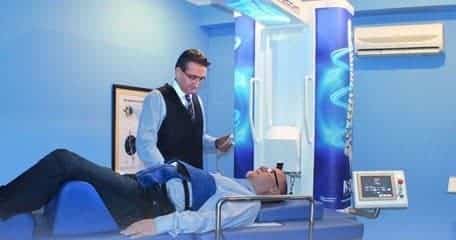
- Spinal decompression therapy, a slow, controlled pull set for one level of the spine
- High-intensity laser therapy, whose mild warmth reaches deep tissue
- Shockwave therapy for long-standing soft-tissue tightness around the spine
- Therapeutic ultrasound for the deep soft tissues around the joints and discs
- Interferential current therapy for the muscles and nerves
- Cold therapy with a machine, in place of heat
- Guided rehabilitation exercises, one to one with a physiotherapist
- Spinal and core strengthening in the physiotherapy gym once the spine is stable
- Posture and ergonomic advice, the same advice this page gives
Chiropractors and physiotherapists work on the same case at CSC, because each profession reaches parts of the problem the other does not. The pages on disc-specific chiropractic care in Kuala Lumpur, physiotherapy for discs, nerves, muscles and joints and the two professions working together explain each part.
Care is kept within what the patient can comfortably tolerate, and the patient tells the clinician at once if anything hurts. Discomfort during care means it is being done too aggressively. My motto has always been "No pain, more gain."
The guide to slipped disc treatment without surgery in five steps sets out the order of that care, from the first examination to maintenance. I keep surgery in reserve, for when focused conservative care, properly given, has failed. The exceptions are the urgent signs below and the few cases that need surgery from the start.
Each item of care is priced on its own. The chiropractic price in Kuala Lumpur page lists every chiropractic fee from the first examination onward. The physiotherapy price list in Kuala Lumpur page does the same for physiotherapy, including anything charged separately. The fee for a plan is explained and agreed before care begins.
When a Slipped Disc Needs Prompt Assessment
If you are using home measures, exercises or stretches for a slipped disc with back or leg pain, get urgent medical attention, a thorough assessment at a hospital emergency department straight away, within hours, if you develop new or worsening numbness around your genitals, between your genitals and anus, or around your anus. New difficulty passing urine, or any loss of bladder or bowel control, needs the same urgent assessment. These symptoms can have several causes. Some may call for an invasive procedure, but being assessed helps clarify the next step and does not automatically mean surgery is needed.
Leg weakness that keeps getting worse should not be ignored. It calls for a careful assessment by a competent provider, and conservative care can continue only while the weakness itself is improving. Weakness in an arm or a hand that keeps getting worse needs the same careful assessment.
Slip Disc Habits: Common Questions Answered (FAQ)
What actually helps a slipped disc the most?
The habits that fill the rest of the day matter most. A patient spends far more hours at a desk, in a car and in bed than with any clinician. In Sciatica vs Slipped Disc I point out that a visit lasts 30 minutes to two hours, then ask about the other 22 hours.
In Neck and Back Self-Help Tips I name the two that come first: "two things are most critical: posture and sleep." After them come a break from sitting every 15 to 20 minutes and a pause on lifting, and on bending or twisting at the waist. Cold packs and the Kegel, buttock and side-lying exercises can start on the same day.
What habits make the damage worse, and which movements should wait?
Long, slumped sitting, bending and lifting, sudden heavy loads and repeated twisting add the most strain, along with days of inactivity. The movements that wait while symptoms are present are sudden twisting, heavy loading and uncontrolled bending, and anything that cracks the back or neck.
Swimming laps, yoga, side bends and hard hamstring stretches wait as well, even when they feel good at the time. Hot packs belong on the same list, because heat adds to the inflammation around a damaged disc.
Do exercises help spinal discs recover?
Exercises do not rebuild a damaged disc, which in my experience keeps part of its damage. What they do is strengthen the muscles that share the disc's load and steady the spine. Daily life then places less strain on it.
The timing decides whether they serve the disc. Kegel exercises, buttock contractions and side-lying leg raises can start at once. Squats against a wall, cat and camel, and the dead bug wait until the spine is stable, usually around the fifth to seventh session. Stretching waits longer still.
Why does sitting increase disc pressure?
Sitting puts the weight of the head, arms and trunk on the lower discs. The pelvis rolls back, and the lower back loses its curve. Leaning forward adds to it. The figures in my Back Pain to Leg Pain talk show the pattern. The pressure is about 100 millimeters of mercury standing and 250 sitting, and higher when leaning forward while seated.
Under that pressure, the disc takes in little fluid or nourishment, and the pressure stays high for as long as the sitting lasts. That is why, for a painful back, standing up every 15 to 20 minutes matters more than the price of the chair.
Can posture changes improve disc health?
Posture changes lower the load a damaged disc carries every hour of the day, and that is where most of their value lies. The damage already done stays. What changes is how much more is added.
Upright sitting with the back supported takes load off the disc and the joints beside it. So do side sleeping with the spine in one line and walking with the head above the shoulders. Over months, those habits decide how the disc behaves.
Can a slipped disc affect nerves?
Yes. A slipped disc often presses on, or inflames, a nerve root as it leaves the spine, and that is when symptoms travel. In the neck they go to the shoulder, arm and hand; in the lower back, through the buttock into the leg.
In Sciatica vs Slipped Disc I explain that every case of sciatica I have seen has involved a disc to some degree. Pain that turns into numbness and tingling, then weakness, means the nerve is under more pressure, and that change needs an examination. New numbness around the genitals or anus, new difficulty passing urine, or loss of bladder or bowel control needs urgent medical attention. Go to a hospital emergency department straight away, within hours.
When should I get checked for a slipped disc?
Arrange an examination when symptoms persist, keep coming back, travel into an arm or a leg, or start to limit sitting, walking or sleep. Numbness, tingling or weakness are reasons not to wait for the next flare.
New numbness around the genitals or anus, new difficulty passing urine, or loss of bladder or bowel control needs urgent medical attention. Go to a hospital emergency department straight away, within hours. Otherwise, surgery waits until focused conservative care, properly given, has been tried and has not worked.
Can a damaged disc heal on its own?
A damaged disc changes with time, yet in my experience it is never again the disc it was, and part of the damage stays. What happens over the years depends largely on daily habits and on keeping up the home exercises.
My Back Pain to Leg Pain talk describes disc damage as progressive. Left to itself, it can advance a stage in a matter of days, or take years to do so. Mild symptoms are still a reason to act, not to wait. The page on what changes in a slipped disc and what remains covers this in more depth.
How to Read This Guide
This guide gathers my daily advice for a slipped disc, in the first person. Any view taken from my videos or talks has the video's name beside it. Studies appear by first author and year, with their full records listed below. A page cannot examine anyone, so where your own examination says otherwise, follow it.
Peer-Reviewed References
- Dahm KT, Brurberg KG, Jamtvedt G, Hagen KB. Advice to rest in bed versus advice to stay active for acute low-back pain and sciatica. Cochrane Database Syst Rev. 2010;(6):CD007612.
- Steffens D, Maher CG, Pereira LS, et al. Prevention of Low Back Pain: A Systematic Review and Meta-analysis. JAMA Intern Med. 2016;176(2):199-208.
- Pocovi NC, Lin CC, French SD, et al. Effectiveness and cost-effectiveness of an individualised, progressive walking and education intervention for the prevention of low back pain recurrence in Australia (WalkBack): a randomised controlled trial. Lancet. 2024;404(10448):134-144.
- May S, Aina A. Centralization and directional preference: a systematic review. Man Ther. 2012;17(6):497-506.
- Wilkens P, Scheel IB, Grundnes O, Hellum C, Storheim K. Effect of glucosamine on pain-related disability in patients with chronic low back pain and degenerative lumbar osteoarthritis: a randomized controlled trial. JAMA. 2010;304(1):45-52.
These references describe low back pain, sciatica and back and neck pain in general. None of them tests a care program at Chiropractic Specialty Center.
The Author of What Helps a Slipped Disc: Home Care and 8 Habits to Avoid
What Helps a Slipped Disc: Home Care and 8 Habits to Avoid was written by Yama Zafer, D.C., who has 30+ years in chiropractic and physiotherapy and founded Chiropractic Specialty Center in Kuala Lumpur in 2006.
Last Updated: What Helps a Slipped Disc, and the Habits That Set It Back
What Helps a Slipped Disc, and the Habits That Set It Back was last reviewed and updated on October 18, 2026.