


Slipped Disc Treatment in KL: From First Exam to Maintenance
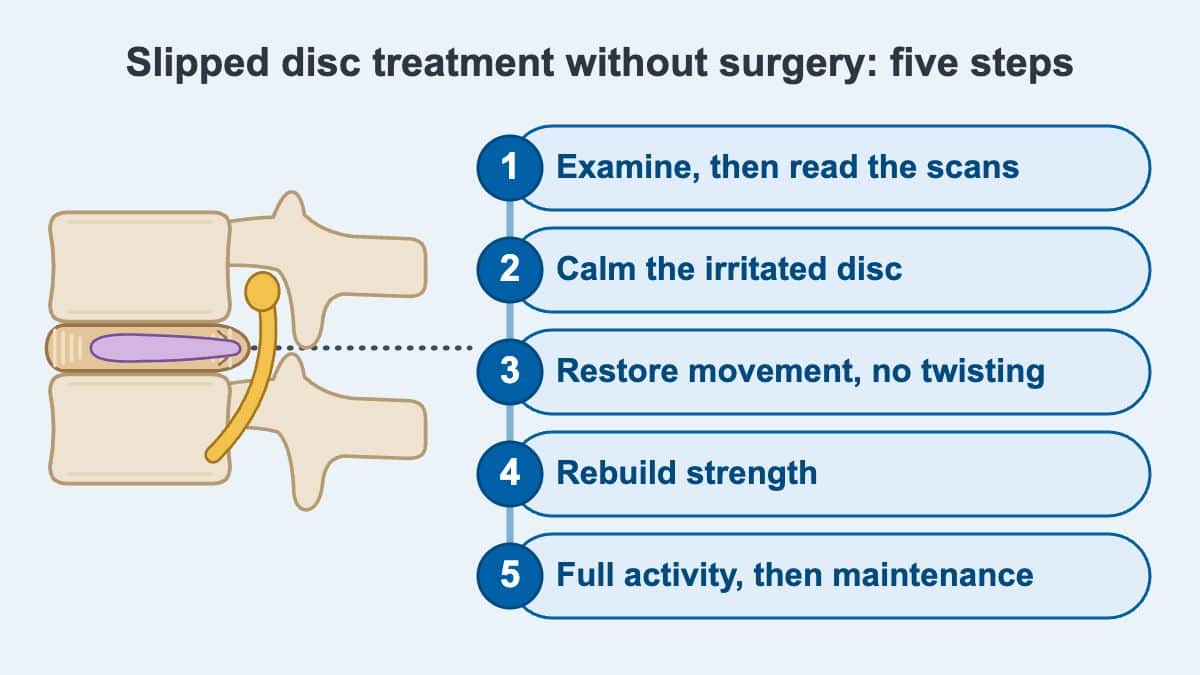
Slipped disc treatment without surgery works in a set order, and in my plans the order matters as much as the methods. Slip disc treatment at CSC in Kuala Lumpur begins with an examination and a reading of any scans, and nothing is treated before that. Then the irritated disc is calmed, movement comes back without twisting, strength is rebuilt, and full activity returns last.
The same order serves a slipped disc in the neck or the lower back, at any stage from a bulge to an extrusion. The exception is when the examination finds signs that call for a hospital first. The methods are non-rotatory chiropractic care, flexion-distraction, spinal decompression, physiotherapy and exercise, each matched to its step. A plan that jumps ahead, with stretching in the first days or a manipulation that twists the spine, can irritate the disc further. Stopping too early is the other common mistake.
The sections below cover the research, each step, progress checks, how long treatment takes, the signs that need a hospital, and the fees.
For more information about slipped disc treatment, contact the Bukit Damansara (KL) main center: WhatsApp+60 17 269 1873 Call+603 2093 1000
Slipped Disc Treatment Without Surgery: Key Takeaways
| Question | Short answer |
|---|---|
| Can it be treated without surgery? | Yes, as a first plan, unless the examination finds a reason for a hospital first. Surgery is my last resort, reserved for cases where focused conservative care, given properly, has not worked. |
| Which signs need a hospital first? | New numbness around the genitals or anus, new difficulty passing urine, or loss of bladder or bowel control needs urgent medical attention at a hospital emergency department straight away, within hours. |
| Can treatment cure a slip disc? | No one can promise that, with surgery or without it, because a damaged disc keeps some of its damage. How it behaves over the years rests on daily habits, home exercises and maintenance care. |
| How long does it take? | There is no fixed timeframe. Progress is reviewed at the fifth and tenth sessions. Active treatment ends at maximum medical improvement (MMI), when a further two or three weeks of care stop changing the results of the retests. |
| When can exercise start? | Kegel exercises can start on the first day, with buttock squeezes and side-lying leg raises soon after. The rest waits until the spine is stable, usually between the fifth and seventh session. |
| Is a slip disc in the neck treated differently? | The steps and the no-twisting rule stay the same. Nothing cracks or twists the neck, and decompression is set for the neck instead of the lower back. |
| What does the research say? | A 2010 review of 18 trials found moderate evidence for stabilization exercises and, where symptoms were recent, for manipulation over a sham. A 2004 review put the risk of manipulation worsening a lumbar disc herniation at less than 1 in 3.7 million. |
Page Guide: The Steps and Sections
- Non-Surgical Slip Disc Treatment: What the Reviews Found
- Starting Treatment at a CSC Center in Kuala Lumpur
- Step 1: Examining the Slip Disc and Reading Scans
- Step 2: Calming an Irritated Slipped Disc
- Step 3: Restoring Movement Without Twisting the Spine
- Step 4: Rebuilding Strength Around the Disc
- Step 5: Back to Full Activity, Then Maintenance
- Why Neck and Back Problems Often Return
- How Progress Is Checked Between Steps
- How Long Slipped Disc Treatment Takes
- What Slip Disc Treatment Has to Address
- Video: Bulging vs Herniated Disc
- When Hospital Care or Surgery Comes First
- What Does Non-Surgical Slipped Disc Treatment Cost?
- Slip Disc Treatment Without Surgery: FAQ
Non-Surgical Slip Disc Treatment: What the Reviews Found
Reviews of non-surgical slip disc treatment for a lumbar disc herniation found moderate evidence for several kinds of method used in these steps. Their authors asked for more high-quality trials before firmer conclusions.
A 2010 review pooled 18 trials with 1,671 people who had a lumbar disc herniation with radiculopathy. That means leg pain, numbness or weakness from an irritated nerve root. Seven of the trials were judged high in quality. They gave moderate evidence that stabilization exercises do better than no treatment. They also favored manipulation over sham manipulation, a pretend version used for comparison. That finding held for people whose symptoms were recent and whose outer disc wall was intact (Hahne and colleagues, 2010).
In the same review, adding mechanical traction to medication and electrotherapy brought some extra benefit. Traction, laser and ultrasound did not differ from one another. Some trials recorded side effects with traction: pain, anxiety, leg weakness and fainting. Before care begins at CSC, its possible effects and risks are explained.
A 2004 review looked at safety. From published reports, it estimated the risk of a manipulation clinically worsening a lumbar disc herniation or causing cauda equina syndrome. That syndrome is severe pressure on the bundle of nerve roots at the lower end of the spinal canal. The risk came to less than 1 in 3.7 million. The review set this against the risks of anti-inflammatory medication and surgery. It concluded that this apparent safety should encourage the use of manipulation in conservative care for a lumbar disc herniation (Oliphant, 2004).
These reviews looked at the methods in general, and none of them tested CSC's own program. The steps below show how I use each method, and what I leave out.
Starting Treatment at a CSC Center in Kuala Lumpur
Both CSC centers in Kuala Lumpur take a slip disc through these steps in the same order. The first visit is the examination of step one below. It checks how the spine moves, how the nerves respond and what the scans show. Bring the scans on CD or film, with their reports.
- Bukit Damansara (KL, main center): Call +603 2093 1000 or WhatsApp +60 17 269 1873 to see the Bukit Damansara / KL center.
- Bandar Sri Damansara (KL): Call +603 6262 5777 or WhatsApp +60 12 455 6939 to see the Bandar Sri Damansara center.
The main center sits in Damansara Heights, close to Sri Hartamas. The Bandar Sri Damansara center is nearer for Kepong, Desa ParkCity and the areas around them. For directions, parking and hours, see CSC's Kuala Lumpur locations, or the Bukit Damansara center details and the Bandar Sri Damansara center details.
Step 1: Examining the Slip Disc and Reading Scans
Step one of slip disc treatment is the examination, and no method is used until it is done. Before I meet a new patient, I read the history form and go through any scans and reports they have brought. That way my questions fit the problem.
Then I ask how the pain began, where it travels, and what eases it or makes it worse. The answers point to the likely source. It may be a muscle, a ligament, a joint, a disc, a narrowed canal, a slipped vertebra or a pinched nerve root. Often it is more than one. People's own questions tend to be the same. How did this happen? Why is it worse when I sit? Why does a cough hurt? Is this sciatica?
The examination comes next. I check how the spine moves and run orthopedic and muscle tests. For a lower back disc these include Milgram's test, in which the patient lifts both legs off the table. I also use the straight leg raise and the crossed straight leg raise, where lifting the good leg brings on the pain. The knee and ankle reflexes are tested too, with the feeling and strength in the arms or legs.
Not every patient needs imaging. In Is Chiropractic Safe? 13 Questions Answered, I put the rule for X-rays plainly. "If X-rays are ever needed, they should only be ordered after a thorough assessment and only when it is indicative." When the findings point to a disc, I ask for an MRI, the gold standard for a slipped disc. I never guess a final diagnosis.
An X-ray answers questions of alignment or a facet joint. Sometimes palpation finds a step-off between the bony points at the back of two vertebrae. Then I suspect a slipped vertebra and ask for both an X-ray and an MRI. Otherwise one scan is the rule, and both are rare.
Earlier scans belong at the first visit, the films or the CD as well as the reports. I read the images myself and weigh them with the examination and the patient's own account. The same words on a report can mean different things in different people. A full MRI of the spine also shows the health of the muscles beside it, which matters again in step four.
Before care begins, I explain the findings, the plan and its fees in plain words. Some first visits end with a referral instead, to a medical doctor or to a hospital, when that is what the findings call for.
When to Have a Slipped Disc Examined
A check is worth arranging if you notice any of these:
- Pain, tingling or numbness that travels into an arm or a leg
- Numbness or tingling that is not settling
- Trouble sitting, standing or walking for ordinary lengths of time
- A change in strength or coordination
- Symptoms that keep coming back or getting worse
The signs that call for a hospital before any of these steps are set out in the section on hospital care and surgery below.
Step 2: Calming an Irritated Slipped Disc
Step two calms an irritated slipped disc by taking load off it, so the tissues around it can settle. Most of this step happens at home, between visits, and it starts on the day of the first visit. Care at the center runs alongside it from the first session, as step three describes.
Habits change from the first day, not once the pain has passed. "So it's best to change when you're hurting," I tell the audience near the end of my Back Pain to Leg Pain talk. Once the pain eases, the changes tend to be forgotten. This is what I ask for in this step:
- Cold, not heat. Cold goes on for 10 to 15 minutes at a time, as a pack with a cloth around it. Do it two or three times a day, with at least two hours between sessions. Set a timer so it is never left on. Hot packs stay off a damaged disc, since heat adds to the inflammation around it.
- Short spells of sitting. With back pain, sit for 15 to 20 minutes at most, then stand or walk for 30 seconds to a minute before sitting again. Without back pain, rise every 30 to 40 minutes.
- Short drives. If the back pain is acute and intense, about 15 minutes behind the wheel is the limit. No drive should pass 20 to 30 minutes without a stop where it is safe. Walk a little at each stop. Sit upright with the seat reclined only slightly, at 100 to 110 degrees, and the hips and knees level.
- Enough sleep. Six hours at the very least, and seven to eight without waking where you can. The right side is the best position, the left side the next, then the back with a bolster under the knees. Lost sleep cannot be banked back. My Back Pain to Leg Pain talk compares it to a bank account that does not work like one: "It's all or none. You cannot make up for what you've lost."
- No bending or twisting at the waist, and no lifting. If something has to be lifted, keep it under 2 kg.
- No stretching yet. Hamstring stretches and other stretches that round the lower back wait until the disc has settled.
- Three exercises that do not wait. Kegel exercises for the pelvic floor start at once: squeeze, hold for 5 to 10 seconds, relax, and repeat 5 to 15 times. My patients "can start the Kegel exercises right away," I tell viewers of Neck and Back Self-Help Tips. Squeezing the buttocks, and lifting the leg while lying on the side, can begin early as well. The calf stretch comes back only after the acute phase.
A few everyday habits keep a disc irritated, and this is the step to drop them. They include slouching over a phone or laptop and starting exercises without guidance. Sleeping in a poor position, or on a surface that gives no support, is another. So is taking up yoga, which I ask everyone with a slipped disc, or with any other spinal disc problem, to avoid.
Step 3: Restoring Movement Without Twisting the Spine
Step three restores the movement the injured segment has lost, with methods that never twist, crack or forcefully pull the spine. With disc damage or a compressed nerve, care has to be "without twisting your spine." I set that rule in Is Chiropractic Safe? 13 Questions Answered. It comes with a warning: "Anything more than that is going to create inflammatory processes or perhaps even worsen the disc damage you already have."
These are the methods I combine, each chosen from the findings:
- Chiropractic manipulation that is non-rotatory using the Activator instrument, the first method I use for a damaged disc. The Activator is a small hand-held instrument whose force can be set very low.
- Flexion-distraction, in which the table takes the lower back through a slow, gentle bend while the segment is eased apart.
- Spinal decompression on a decompression table, with a controlled pull set for one level of the spine.
- Physiotherapy: ultrasound, electrotherapy, shockwave therapy, high-intensity laser therapy and cold therapy. Heat therapy is kept off any spine with a disc problem. Muscles that have tightened around the disc, and the fascia covering them, get trigger point and myofascial work.
For a moderate or severe slip disc, I set sessions on alternate days in the early weeks, or three times a week at the least. Two visits a week is an option, though a plan at that pace generally takes more sessions overall.
Care is kept within what the patient can comfortably tolerate, and the patient tells the clinician at once if anything hurts. Discomfort during care means it is being done too aggressively. My motto has always been "No pain, more gain."
Chiropractors and physiotherapists share each case at CSC, because neither profession reaches everything a damaged disc needs. My reason, from Is Chiropractic Safe? 13 Questions Answered: "Holistic not meaning natural. Holistic meaning comprehensive." The way the two professions divide the work has its own page.
Older patients, and anyone with a narrowed canal or worn joints, get a gentler version. Decompression sessions are lighter and shorter, manual and myofascial care is softer, balance work increases, and stretching starts later. The page on what I check before any chiropractic method on a disc covers the chiropractic side in more depth.
Which Spinal Decompression Device Is Commonly Used in Malaysia?
Spinal decompression is one of several conservative methods used for disc problems. The machine applies a controlled mechanical pull to the spine, meant to lower the pressure inside the affected segment.
One system used in structured rehabilitation is the RxDecom®, a computerized spinal decompression device. Its computer guidance lets the clinician set the force and timing for a specific spinal level in each session.
At CSC, decompression is one part of the plan, never all of it. It is combined with chiropractic care, physiotherapy and exercise rehabilitation, neuromuscular re-education, soft-tissue therapy, and electrotherapy or ultrasound. The page on how a decompression session is set up explains the rest.
Step 4: Rebuilding Strength Around the Disc
Step four rebuilds the strength around the disc, and it waits until the spine is stable and ready. That point usually comes somewhere from the fifth to the seventh session, and for a few people as early as the third. In Sciatica vs Slipped Disc, I warn: "Only when you're ready. If you're not ready and you do these exercises, you create more problems."
The first exercises are simple, and how far each goes depends on the severity:
- Kegel exercises, which have been running since the first day.
- Wall squats, with the back resting against the wall.
- Cat and camel on the hands and knees, slowly.
- Strengthening for the buttocks, hamstrings, calves and thighs.
- Core canister breathing, which trains the deep trunk muscles together with the breath. Breathe in and let the belly relax. Then breathe out, draw the lower ribs gently toward the pelvis and the navel toward the spine, and keep breathing softly while you hold.
None of this is a standard program. Each one is built for the person, because a damaged disc rarely comes alone. Worn joints, tight muscles and the other findings are weighed with it before any exercise is set.
When the exercises bring no change over time, I look at three things. Are they being done correctly? Are the time and the repetitions enough? Or has the muscle itself wasted or filled with fat? That last one limits strengthening until it is addressed, and an MRI can show it.
Stretching comes last, once the strength is back. For older patients, and anyone whose balance has slipped, I add balance and stability work. It uses a gym ball, a wobble board or a rocker board, always with someone close enough to steady them. The chapter list of my sciatica and slipped disc video shows where these points come up.
Step 5: Back to Full Activity, Then Maintenance
Step five brings back full activity in stages, and each stage is tested before the next. My rule for sport is simple. Leave out anything that hurts now, or that raises the pain within 72 hours afterward, because inflammation can take that long to show. With a moderate or severe slipped disc, sport and high-impact activity wait one to two months.
Swimming surprises people most. From my Back Pain to Leg Pain talk: "If you have spinal disc damage, swimming is not good for you." The gym is discouraged at first, and free weights wait two to six months. Even once the spine is stable, deadlifts, leg presses and free weights stay out.
Many people can use machines once the spine is stable. These include the leg curl and leg extension, lat pulldowns, light rows, the adductor and abductor machines and, for some, the chest press. On the treadmill the incline stays at zero, because walking uphill adds load to the lower back discs.
I end the active plan at MMI, which stands for maximum medical improvement. By then, a further two or three weeks of care would bring no more change when the first tests are repeated. From then on, care is as-needed. It means preventive visits when they are useful, the daily-living advice, and the home exercises and stretches from the end of the active plan.
The home program changes over time. I review the exercises and update them every three to six months so that progress continues. With a lower back disc, they work the core, the pelvic floor and the muscles beside the spine. With a neck disc, they work the neck, upper back, chest and shoulders.
What happens over the years depends far more on habits than on visits. My Back Pain to Leg Pain talk comes back to this near its close: "The most important thing is not the treatment. The most important thing is to make lifestyle changes." Treatment without those changes is, as I put it there, "like buying a sports car and not having a driver's license."
In my experience, care that leaves part of the problem untouched can bring improvement that does not last, and then the pain comes back. That is why the plan covers the joints, ligaments, muscles and habits around the disc as well as the disc itself.
Why Neck and Back Problems Often Return
Why do neck and back problems come back even when care seemed to help at first? In this four-minute video, I use a plumbing analogy and three steps. They cover how shortcuts let the same problem return and why a patch is not the same as finding what lies behind it. The last step is why an informed decision matters when choosing care.
Key Moments from the Video: Why Neck and Back Issues Keep Returning
- 00:00 Why neck and back issues keep coming back
- 00:25 Why results may not last
- 00:45 Step 1: Why shortcuts can lead to recurrence
- 01:00 The plumbing analogy
- 01:30 Why the body is different from plumbing
- 01:55 Step 2: Moving beyond the patch
- 02:05 Assessment and identifying the causes
- 02:35 Single vs multifaceted care
- 03:00 Step 3: Making an informed decision
- 03:25 Patch vs focused care
- 03:45 Final thoughts and viewer questions
Spinal disc health talks are held in Kuala Lumpur from time to time, though none is scheduled now. The topics the talks have covered are listed on their own page.
How Progress Is Checked Between Steps
Progress between the steps is checked against the first examination, never by one good or bad day. At set points, I repeat its tests and compare the results. I also ask for a pain score from 0 to 10 and listen to what the patient says has changed.
Two review points come from Is Chiropractic Safe? 13 Questions Answered. The first: "if improvements are not present by the fifth session, your chiropractor should assess you." With no change by the tenth, going on or stopping is "A decision and a discussion that you will have to have with your chiropractor."
What you did between visits matters too. In the same video, I give the example of a patient who felt better and went for a run. "Let them know you felt better, you went for a run, and now you're back to where you were." Moving on to the next step follows the retests and that account, not the calendar.
How Long Slipped Disc Treatment Takes
How long slipped disc treatment takes differs from person to person, and I cannot promise a timeframe; no one honestly can. In Is Chiropractic Safe? 13 Questions Answered, I list what decides it. "The speed at which you recover depends on multitude of factors, including the severity of your symptoms, the underlying conditions."
The stage of the disc, the conditions found with it, posture, muscle strength and daily habits all change the pace. So does attendance: a plan can do its part only when the sessions are kept and the advice between them is followed.
Pain is a poor guide to the end point. My Back Pain to Leg Pain talk puts the reason in nine words: "Pain is not a yardstick. Pain is a symptom." Pain often settles well before the muscles supporting the segment have recovered. In my experience, stopping at that point is the most common reason the same problem returns within the year.
The question I hear most is whether a full recovery is possible. Each person heals differently. In my experience, a problem that was neglected for a long time is more likely to leave some symptoms behind. It is also more prone to flare up after recovery.
What Slip Disc Treatment Has to Address
Slip disc treatment has to address a damaged spinal disc in the neck or the lower back, and the joints, muscles and nerves around it. Discs are the cushions between the bones of the spine. Once one is damaged, the load spreads less evenly, which strains the tissues beside it. That is why the steps above treat the whole segment and not only the disc.
The names on a report describe how far the damage has gone. "A disc bulge is a progression of a degenerated or a damaged disc," I explain in Bulging Disc vs Herniated Disc. A herniation, in turn, progresses from a bulge, and an extrusion from a herniation. The stages of a slip disc, from the first wear to a loose fragment have their own overview.

The five steps stay the same for each of these. What changes is the pace, how gently each method is set and how closely the urgent signs are watched. The stage pages explain each one: the disc bulge, the protrusion, the prolapse, the herniation and the extrusion. The guide to how a KL treatment plan changes from stage to stage takes that further.
Common Causes of Spinal Disc Damage
Disc damage usually builds up over time rather than from one event. In my view, axial loading, the weight of the body coming down through the spine, is the most common cause. Most tears follow an injury, sudden or repeated, or strain repeated over months. The common causes:
- Long hours of sitting, above all in a slouch
- Bending or lifting again and again with poor form
- A sudden strain during daily activity or exercise
- Weak core and spinal stabilizing muscles
- Stiff hips and a stiff lower back
- Disc wear built up over the years from posture, habits, past injuries and genetics
- Work that repeats bending or twisting
- An earlier back or neck strain that was never fully dealt with
Common Signs Linked to Spinal Disc Damage
The signs depend on the level and on whether a nerve is involved. A slip disc, whether bulging, herniated, protruded, prolapsed, extruded or fragmented, often brings one or more of these:
- Pain in the neck or lower back, or neck or back pain that lasts or keeps returning
- A cramping or deep ache, or a dull, sharp or shooting pain
- Pain, numbness or tingling down the shoulder or arm (upper limbs)
- Pain, numbness or tingling down the leg (lower limbs)
- Leg pain or sciatica-like pain
- Tingling or numbness along the path of a nerve
- More pain when coughing or sneezing
- Pain with long sitting or standing, or more pain after light activity
- Stiffness after sitting or resting
- Difficulty bending, standing upright or turning
- Muscle tightness or a loss of control
- Weakness in an arm or a leg, in some cases
In the research I have read, about 85 to 90 percent of sciatica starts with a slipped disc pressing on the nerve. A slipped vertebra (spondylolisthesis), a narrowed spinal canal (stenosis) or the spinal joints account for the rest.
A slipped disc can happen at almost any age, and often without one clear injury. CSC has cared for people from their teens to their 90s, and in my experience the most common age is between 25 and 45. Anyone under 18 is examined and treated only with a parent, guardian or adult family member present throughout.
What Causes Degenerative Disc Disease?
Disc wear (degeneration) is a common finding in people with a herniated disc. In my view, a completely healthy disc is unlikely to bulge or herniate. That is why treatment looks at the load on the disc, not just the pain. Age is only one of the factors. A seven-year-old girl is the youngest I have seen with a desiccated disc, and some people in their 80s still have healthy discs.
Family history plays a part, and some people's discs wear earlier than others. Scoliosis, a short leg, tight muscles and differences in the shape of the spine add load too. So do extra body weight, poor posture, poor sleep habits and past injuries. Read more about the stages of disc degeneration and desiccation and how spinal discs are built.
Video: Bulging vs Herniated Disc
In this short video, I show how a spinal disc works. I also show how changes in its outer ring (the annulus) and its center (the nucleus) lead to bulges and herniations.
The video's key moments and an edited transcript have their own page: the video guide to Bulging Disc vs Herniated Disc.
Key Moments from the Video: Bulging vs Herniated Disc Explained
- 00:00 What is a slipped disc? Clear explanation of spinal disc damage and why terms like bulge and herniation are used.
- 00:23 How common are spinal disc issues? Overview of how often disc-related problems affect the neck and lower back.
- 00:35 What spinal discs do: How discs allow bending, twisting and other everyday movement.
- 00:46 Disc structure explained: Simple breakdown of the inner and outer parts of a disc and how they work together.
- 01:01 Early spinal disc damage: How disc wear can begin before a bulge or herniation develops.
- 01:28 How disc damage happens: Explanation of how the outer layer of the disc weakens or tears over time.
- 01:45 Bulge vs herniation: Key differences between a disc bulge and a herniated disc.
- 02:09 Stages of disc damage: Progression from bulge to herniation to extrusion.
- 02:43 Why symptoms vary: How disc location can affect the arm or leg depending on the nerve involved.
When Hospital Care or Surgery Comes First
At any step of non-surgical slipped disc treatment for back or leg pain, get urgent medical attention, a thorough assessment at a hospital emergency department straight away, within hours, if you develop new or worsening numbness around your genitals, between your genitals and anus, or around your anus. New difficulty passing urine, or any loss of bladder or bowel control, needs the same urgent assessment. These symptoms can have several causes. Some may call for an invasive procedure, but assessment helps determine which care options are appropriate and does not automatically mean you need surgery.
Leg weakness that keeps getting worse should not be ignored. It calls for a careful assessment by a competent provider, and conservative care can continue only while the weakness itself is improving.
Some cases need surgery from the outset. A sequestered disc is one, where a piece has broken off and lies loose in the spinal canal, and an infection is another. For the rest, I keep surgery as the last option. Discectomy removes the part of the disc that presses on a nerve, and spinal fusion joins two vertebrae. These and other operations come only after a careful clinical evaluation. They come into the picture only when focused conservative care has been tried properly without success.
Focused care is what I mean by conservative care. It is built on the scan and examination findings, aimed at their causes, and it covers the whole region and does no harm. Plenty of what passes for back treatment is not that, and much of it is of no use to a damaged disc.
The research on surgery is mixed. A Cochrane review found that, for carefully selected patients with sciatica from a lumbar disc prolapse, discectomy eased the acute attack faster than non-surgical management. Whether it changes the long-term course of the disc remained unclear, and only four trials compared the two directly (Gibson and Waddell, 2007).
The 2010 review pooled two high-quality trials that compared advice with microdiscectomy, the same operation done through a small opening. People given advice did less well in the short term, and as well over the long term (Hahne and colleagues, 2010).
A smaller incision is still an operation. A Cochrane review of 11 trials compared minimally invasive discectomy with standard microdiscectomy or open discectomy. The minimally invasive methods brought slightly more leg and back pain and more readmissions for a recurrent herniation. They also brought fewer wound and other infections, and the pain differences were small (Rasouli and colleagues, 2014).
After an operation, rehabilitation still matters. A Cochrane review covered 22 trials of rehabilitation after lumbar disc surgery. Exercise programs that began four to six weeks after the operation reduced pain and disability faster than no treatment. The evidence was of low quality, and none of the trials reported more repeat operations (Oosterhuis and colleagues, 2014).
The page on weighing an operation against non-surgical care goes through that decision. The page on what heals in a damaged disc explains what changes and what remains.
What Does Non-Surgical Slipped Disc Treatment Cost?
Non-surgical slipped disc treatment at CSC is priced item by item, not as a set fee. The examination at the first visit costs RM100. A chiropractic adjustment costs RM150, which drops to RM110 when physiotherapy is given at the same visit (CSC quotation dated June 25, 2026). The examination and an adjustment together therefore come to RM250.
| Item | On its own | With chiropractic and physiotherapy in one visit |
|---|---|---|
| Examination, new or returning patient | RM100 | RM100 |
| Report on an MRI you bring (one area), or up to two X-ray films | RM50 | RM50 |
| Chiropractic adjustment | RM150 | RM110 |
| Flexion-distraction | RM45 | RM35 |
| Lumbar or cervical decompression, per unit | RM130 | RM100 |
| Other physiotherapy, per standard unit, by service | RM57 to RM180 | RM27 to RM150 |
The total depends on what the examination finds, the methods each step uses and how many visits the plan needs. The chiropractic fee list and the physiotherapy price table set out every item, with any separate charges. The fee for a plan is explained and agreed before care begins.
Slip Disc Treatment Without Surgery: FAQ
Can a Slipped Disc Be Cured Without Surgery?
No one can promise a cure, with surgery or without it. A damaged disc never returns fully to its original state, and in my experience some level of damage always remains. Non-surgical treatment aims to calm the irritated disc and restore the movement and strength around it. Daily habits and home exercises then keep it settled.
Surgery stays the last option, kept for when focused conservative care has been given properly and still not worked. A few cases need it from the outset. New numbness around the genitals or anus, new difficulty passing urine, or loss of bladder or bowel control needs urgent medical attention at a hospital emergency department straight away, within hours.
Will a Slipped Disc Come Back After Treatment?
It can. The disc keeps some of its damage, so whether it flares again depends on what happens after treatment. That means the daily habits, the home exercises and the maintenance care after MMI, the point where more care stops changing the retested findings. In my experience, flare-ups are more likely in people who neglected the problem for a long time. They are also more likely in those who stop once the pain settles, before the supporting muscles have recovered.
Is Walking Good for a Slip Disc?
Yes, as long as it does not raise the pain or send pain, numbness or tingling down a leg. That holds during the walk and for the 72 hours after it. With every step, the joints of the spine move, which takes pressure off them. Hence the three words from my Back Pain to Leg Pain talk: "Mobility is good." Walk upright, with the head above the shoulders and the eyes looking ahead, in shoes that still absorb shock. Steep hills are best avoided with a disc problem, and any uphill walking while the back pain is acute. On a treadmill, keep the incline at zero.
Is Treatment Different for a Slipped Disc in the Neck?
The order of the steps is the same, and so is the rule against twisting: nothing cracks the neck. In Neck Cracks Are Dangerous, I warn that "A mild disc bulge can become a severe disc herniation." Cervical decompression takes the place of the lumbar setting. Later, the exercises turn to the deep and outer muscles of the neck, then the upper back, chest and shoulders.
Can I Live Normally With a Slip Disc?
With a true disc bulge, in nearly all cases, yes, provided it is not ignored. A herniation, or a bulge that presses on a nerve once you sit or drive, is more serious. Normal life then waits until long sitting and driving are free of symptoms. The aim is to keep them that way with the home program and the daily changes.
What Happens If a Slip Disc Is Left Untreated?
In my view, disc damage is progressive, and it can move from one stage to the next within days or over years. Left unaddressed, a seemingly simple ache can become a severe, life-altering condition. That is why I ask people not to ignore a slip disc, even when the symptoms are mild. Those who neglect it for a long time are, in my experience, more likely to keep some symptoms.
Leg weakness that keeps getting worse should not be ignored. It calls for a careful assessment by a competent provider, and conservative care can continue only while the weakness itself is improving.
How to Read This Guide
The steps and positions here are mine, written in the first person. Every quotation from my videos and talks carries the title it comes from. Studies are named by first author and year and listed below with their published records. A guide cannot examine anyone, so take these steps as the shape of a plan; your own plan follows your examination.
Peer-Reviewed Medical Citations
- Hahne AJ, Ford JJ, McMeeken JM. Conservative management of lumbar disc herniation with associated radiculopathy: a systematic review. Spine (Phila Pa 1976). 2010;35(11):E488-504.
- Oliphant D. Safety of spinal manipulation in the treatment of lumbar disk herniations: a systematic review and risk assessment. J Manipulative Physiol Ther. 2004;27(3):197-210.
- Gibson JN, Waddell G. Surgical interventions for lumbar disc prolapse. Cochrane Database Syst Rev. 2007;(2):CD001350.
- Rasouli MR, Rahimi-Movaghar V, Shokraneh F, et al. Minimally invasive discectomy versus microdiscectomy/open discectomy for symptomatic lumbar disc herniation. Cochrane Database Syst Rev. 2014;(9):CD010328.
- Oosterhuis T, Costa LO, Maher CG, et al. Rehabilitation after lumbar disc surgery. Cochrane Database Syst Rev. 2014;(3):CD003007.
These references describe slipped disc treatment, surgical and non-surgical, in general. None of them tests a care program at Chiropractic Specialty Center.
The Author of Slipped Disc Treatment Without Surgery in KL: 5 Steps
Slipped Disc Treatment Without Surgery in KL: 5 Steps was written by Yama Zafer, D.C., who has 30+ years in chiropractic and physiotherapy and founded Chiropractic Specialty Center in Kuala Lumpur in 2006.
Last Updated: Slipped Disc Treatment in KL: From First Exam to Maintenance
Slipped Disc Treatment in KL: From First Exam to Maintenance was last reviewed and updated on October 18, 2026.
How much for the treatment of lumbar spine disc bulge with degeneration?
A disc bulge with degeneration describes what the scan shows rather than what needs treating, so it does not set the cost by itself. What the examination finds does that, and care is priced item by item rather than as one set fee.
The largest single factor is whether a nerve root is involved. Pain that stays in the lower back usually settles faster and needs fewer visits. Pain that travels below the knee with numbness or weakness needs a longer, more carefully progressed course. How long you have had it matters next, because older problems have lost more strength and movement. So does what your day asks of the spine, because long sitting and repeated bending are what these levels tolerate least.
Leg weakness that keeps getting worse should not be ignored. It calls for a careful assessment by a competent provider, and conservative care can continue only while the weakness itself is improving.
From the CSC quotation dated June 25, 2026, the items that apply to a lumbar disc are:
The examination is priced on its own and takes longer than a treatment visit. Follow-up visits are priced separately again, by what each one includes. The total is the cost of a visit multiplied by the number of visits, and the examination sets that number, not the diagnosis. That number is then checked against retested findings as care goes on. Both price pages, for chiropractic charges at CSC and physiotherapy charges at CSC, list every item, including anything billed separately, and the reception team gives the current figures on request.
When comparing anywhere, ask four things: what the first visit covers and whether it is an assessment or a treatment, what a follow-up costs, whether a set number of sessions must be paid for in advance or each visit can be paid as you go, and what the plan progresses to over six weeks. That last question matters most for the total cost. Pain usually settles well before the muscles supporting the segment have recovered, and stopping at that point is the most common reason people pay for a second course within the year.
Cover under Malaysian insurance policies varies widely, so check your own terms with your insurer before starting. The fee for a plan is explained and agreed before care begins.