

Sciatica Treatment: What the First Weeks Involve
Sciatica treatment starts by identifying what is irritating or compressing a nerve root and whether the symptoms are improving, stable or worsening. Sciatica describes nerve-related symptoms that travel from the lower back or buttock into the leg. A disc herniation is one possible cause, but spinal narrowing, vertebral slippage and other conditions can produce a similar pattern.
Care should follow the findings rather than a generic stretch routine. The distribution of pain, numbness or weakness, the movements that change the symptoms, reflexes and strength all help guide the next step. The material below covers the first weeks of sciatica care, what usually gets measured, when imaging is useful, and when referral becomes more important than continued conservative care.
This guide to sciatica treatment, what the first weeks involve and why the cause matters, is published by Chiropractic Specialty Center, Bukit Damansara (KL) main center: WhatsApp+60 17 269 1873 Call+603 2093 1000
Key Takeaways About Sciatica Treatment in Kuala Lumpur
| Point | What to know |
|---|---|
| What sciatica means | Sciatica usually refers to nerve-related leg symptoms. |
| Where it starts | The source may begin in the lower back, even when symptoms are mainly felt in the leg. |
| Common spine factors | Common spine-related factors include slipped disc, spinal stenosis, spondylolisthesis, bone spurs, and ligamentum flavum thickening. |
| Daily triggers | Sitting, bending, lifting, coughing, walking, or standing may change symptoms. |
| MRI | MRI may be discussed when disc, nerve, or spinal canal findings need closer review. |
| X-rays | Upright X-rays or flexion-extension lumbar X-rays may be discussed when listhesis or instability is suspected. |
| Care options | Chiropractic care, physiotherapy, rehabilitation, movement advice, or referral may be considered depending on assessment findings. |
What Is Sciatica and Why Does the Cause Matter?
Sciatica is a symptom pattern. It usually refers to symptoms that travel along the sciatic nerve pathway. These symptoms may begin in the lower back and move into the buttock, thigh, calf, ankle, foot, or toes.
Common symptoms may include:
| Symptom | What a person may notice |
|---|---|
Leg pain | Pain traveling from the lower back or buttock into the leg |
Tingling | Pins-and-needles sensations |
Numbness | Reduced feeling in the thigh, calf, foot, or toes |
Weakness | Difficulty walking, pushing off, or lifting the foot |
Burning or electric pain | Sharp, hot, or electric-like nerve sensations |
The cause matters because sciatica may be linked to different spine and nerve-related findings. These may include slipped disc, herniated disc, disc bulge, spinal stenosis, foraminal narrowing, spondylolisthesis, bone spurs, ligamentum flavum thickening, facet joint enlargement, muscle guarding, or pregnancy-related posture changes.
A care plan should not be based on the word “sciatica” alone. It should consider the person’s symptoms, neurological signs, daily movement, imaging findings when available, and safety factors.
In the Sciatica vs Slipped Disc video, Yama Zafer, D.C., explains why sciatica describes a symptom rather than a diagnosis, and his recorded talk Back Pain to Leg Pain explains how a damaged disc can irritate the nerves that form the sciatic nerve.
The sections below cover the symptoms of sciatica, the spine conditions that can cause it, when imaging helps, how chiropractic and physiotherapy assessment works, fees, pregnancy, the signs that need prompt assessment, and the research behind this guide.
Sciatica Assessment at Our Two Kuala Lumpur Centers
Sciatica is assessed at both centers of Chiropractic Specialty Center. When you get in touch, a team member can explain appointment availability, the assessment fee and which documents are worth bringing, such as previous MRI reports, X-rays, referral letters or medication lists. Directions are on the Bukit Damansara contact page and the Bandar Sri Damansara contact page.
- Bukit Damansara (KL, main center): Call +603 2093 1000 or WhatsApp +60 17 269 1873 to see the Bukit Damansara / KL center.
- Bandar Sri Damansara (KL): Call +603 6262 5777 or WhatsApp +60 12 455 6939 to see the Bandar Sri Damansara center.
Sciatica Treatment Kuala Lumpur: What to Know Before Booking
Before booking an appointment for sciatica-related symptoms, it helps to understand that sciatica is not always caused by one structure. Some people may have disc-related findings. Others may have spinal stenosis, spondylolisthesis, joint changes, muscle guarding, or several findings at the same time.
A careful first appointment may include:
| Assessment area | Why it matters |
|---|---|
Symptom history | Helps identify when symptoms started and how they behave |
Helps understand whether symptoms follow a nerve pathway | |
Strength, sensation, and reflex checks | May help identify neurological involvement |
Lower back and hip movement | Shows how movement affects symptoms |
Walking, sitting, and bending tolerance | Helps relate symptoms to daily life |
Imaging review when available | Helps compare MRI or X-ray findings with symptoms |
Safety screening | Helps identify when medical review may be needed |
Not every patient needs the same care. The next step depends on the assessment findings.
Sciatica Chiropractor KL: What a Careful Assessment May Include
People searching for a sciatica chiropractor KL often want to know whether their lower back, spine, discs, joints, pelvis, or nerve pathway may be involved.
A chiropractic assessment may look at:
- Lower back and pelvic movement
- Posture and daily movement habits
- Disc-related symptom behavior
- Nerve-related leg symptom patterns
- Muscle guarding around the lower back and hips
- Sitting, standing, bending, and walking tolerance
- Previous MRI or X-ray findings when available
- Signs that may require referral or medical review
For sciatica, the aim of assessment is not to force one fixed method. The aim is to understand what may be contributing to the symptoms, whether the case is suitable for conservative care discussion, and whether another healthcare pathway should be considered.
Sciatica Treatment Near Me: KL Location and Local Appointment Information
Many people search for sciatica treatment near me when symptoms make sitting, walking, working, driving or sleeping difficult. Travel time matters too, because a long car ride is often one of the things that aggravates the leg.
Chiropractic Specialty Center has two centers in Kuala Lumpur. The main center is in Bukit Damansara (Damansara Heights), which is usually the shorter trip from Bangsar, Mont Kiara, Sri Hartamas and KL Sentral. The second center is in Bandar Sri Damansara, which suits readers in Kepong, Desa ParkCity, Sri Damansara and Kota Damansara. Readers in TTDI and Petaling Jaya can choose whichever is more convenient.
Phone and WhatsApp numbers for both centers are listed earlier on this page, and each center’s page has directions and opening hours.
Common Spine Factors Linked to Sciatica: Disc, Stenosis, Listhesis, Bone Spurs and Ligament Thickening
Sciatica may be linked to several lower-spine findings. Herniated or bulging lumbar discs are common causes of sciatica, while lumbar spinal stenosis and spondylolisthesis may also contribute to sciatic symptoms.
In many real cases, more than one finding may be present. For example, a person may have a disc bulge together with facet joint enlargement, bone spurs, ligamentum flavum thickening, or mild vertebral slippage.
| Spine factor | How it may relate to sciatic symptoms |
|---|---|
Slipped disc / herniated disc | Disc material may affect a nearby nerve root |
A broad disc change may reduce space near the nerve | |
Spinal stenosis | The spinal canal becomes narrower |
Foraminal stenosis | The nerve exit opening becomes narrower |
Extra bone growth may reduce space near nerve tissue | |
Ligamentum flavum thickening | Thickened ligament tissue may contribute to canal narrowing |
One vertebra shifts compared with another | |
Enlarged joints may contribute to narrowing or irritation |
Because these findings can overlap, care planning should be based on the person’s presentation, not the condition name alone.
Slipped Disc Treatment KL and Sciatica: How They May Be Connected
People searching for slipped disc treatment KL often also search for sciatica because disc-related findings may affect nearby nerve roots.
A slipped disc, disc bulge, or herniated disc may be discussed when symptoms travel into the buttock, thigh, calf, ankle, foot, or toes. Disc-related symptoms may change with sitting, bending, lifting, coughing, sneezing, driving, standing, or walking.
Disc findings can vary. A small disc bulge may be very different from a large herniation, extrusion, or sequestered fragment. Symptoms also depend on the nerve level involved, the person’s movement pattern, and whether weakness, numbness, or other neurological signs are present
Spondylolisthesis, Anterolisthesis, Retrolisthesis and Sciatic Symptoms
Spondylolisthesis means one vertebra has shifted compared with the vertebra below it. Related terms include anterolisthesis, retrolisthesis, and lateral listhesis.
This shift may affect spinal alignment, joint loading, disc stress, or nerve space. Some people may notice back pain, leg symptoms, walking difficulty, or symptoms that change with posture and movement.
When listhesis is suspected, assessment may include posture review, movement testing, neurological screening, and imaging review. Upright lumbar X-rays or flexion-extension views may be discussed when spinal movement or instability needs closer review.
Because listhesis can vary in type and severity, care planning should avoid one-size-fits-all recommendations.
Spinal Stenosis, Bone Spurs and Ligamentum Flavum Thickening
Spinal stenosis means narrowing within the spinal canal or nerve exit spaces. This narrowing may be linked to disc changes, bone spurs, facet joint enlargement, or ligamentum flavum thickening.
Symptoms may not behave the same way as a simple disc-related pattern. Some people notice symptoms that change with standing or walking. Others may feel more comfortable when sitting or bending slightly forward.
Assessment should consider walking tolerance, balance, neurological signs, imaging findings, age, activity level, and overall health.
Chiropractic and Physiotherapy Considerations for Sciatica in Kuala Lumpur
When people search for sciatica physiotherapy Kuala Lumpur or chiropractic information, they are often comparing conservative care options.
Depending on assessment findings, care planning may discuss:
| Area | What it may involve |
|---|---|
Education | Understanding symptoms, triggers, and warning signs |
Movement advice | Adjusting sitting, bending, lifting, walking, or sleeping habits |
Physiotherapy | Mobility, strength, control, and rehabilitation exercises |
Chiropractic care | Spine and joint-focused assessment and selected hands-on methods |
Low-force methods | Gentler options when force or position needs caution |
Referral | Medical review when symptoms or findings suggest the need |
At CSC, hands-on care for back pain with or without sciatica is not used on its own. It sits alongside movement, education, strength work and changes to daily habits.
Why Force, Position and Rotation Should Be Considered Carefully
Sciatica linked to disc, stenosis, or listhesis-related findings may be sensitive to load, position, and movement direction.
For this reason, force and rotation should be considered carefully before selecting any hands-on method. Some cases may require lower-force options, non-rotatory positioning, physiotherapy, rehabilitation, movement advice, or referral for medical review.
The key point is simple: the method should match the assessment.
Careful reasoning comes before any hands-on technique, exercise, or movement plan is chosen, and the choice is made for each person.
Sciatic Nerve Pain Relief: First Steps to Discuss
People often search for sciatic nerve pain relief when the leg symptom becomes hard to tolerate. Until you can be assessed, the aim is straightforward: settle the irritated nerve and keep moving within comfort.
What tends to help in the first few days:
- Change position every 20 to 30 minutes rather than sitting through it.
- Take short, gentle walks as often as you can manage.
- Favor the sitting and lying positions that ease the leg symptom, even if the back still aches.
- Keep any load light and hold it close to your body.
- Move through a comfortable range instead of stretching into the pain.
- Turn slowly and in one piece rather than twisting the low back.
- Arrange an assessment if the symptom lasts beyond a week, spreads further down the leg, or affects your strength.
These are general points, not a care plan. What is right for you depends on what is irritating the nerve and whether there are neurological signs.
How to Relieve Sciatic Nerve Pain Fast: What to Avoid First
Many people search how to relieve sciatic nerve pain fast when symptoms flare. A safer way to think about this question is to first ask what not to do.
During active sciatic symptoms, avoid forcing movements that increase leg pain, numbness, tingling, or weakness. Also avoid heavy lifting, sudden twisting, aggressive stretching, and long sitting without position changes. When sciatica comes from a disc problem, yoga must be avoided altogether, during a flare-up and after it settles.
Some people tolerate gentle walking, position changes, and supported rest positions. Others may need assessment sooner, especially if symptoms are worsening or spreading further down the leg.
Symptoms such as worsening weakness, foot drop, new numbness, fever, unexplained weight loss, severe night pain, or pain after trauma are worth getting assessed by a competent provider rather than ignored. If sciatica or pain traveling down a leg is part of your back pain, get urgent medical attention, a thorough assessment by a competent clinician the same day, if you develop new or worsening numbness around your genitals, between your genitals and anus, or around your anus. New difficulty passing urine, or any loss of bladder or bowel control, needs the same urgent assessment. These symptoms can have different causes. Some may call for an invasive procedure, but an assessment helps determine the appropriate care and does not mean you necessarily need surgery.
Sciatic Nerve Symptoms Leg Pain: What Patterns May Mean
Sciatic symptoms do not always stay in the lower back, buttock, or thigh. Depending on which nerve root is involved, symptoms may travel into the calf, ankle, heel, sole of the foot, top of the foot, or toes.
| Symptom pattern | Possible discussion point |
|---|---|
Buttock to back of thigh | Lower lumbar or sacral nerve pathway |
Outer leg and top of foot | Often discussed with L5-type patterns |
Back of calf and sole of foot | Often discussed with S1-type patterns |
Weakness lifting the foot | Needs prompt assessment |
Balance changes | Needs careful review |
Bladder or bowel changes | Urgent medical assessment |
These patterns do not confirm a diagnosis on their own. They help guide assessment and decide whether imaging, referral, or a specific care pathway should be discussed.
How L4, L5, S1 and S2 Nerve Roots Relate to Sciatica
The sciatic nerve commonly includes nerve roots from L4, L5, S1, and S2. These nerve roots help control sensation and movement in different areas of the leg.
| Nerve level | Common symptom area |
|---|---|
L4 | Front or inner thigh, knee area, inner leg |
L5 | Outer leg, top of foot, big toe area |
S1 | Back of calf, heel, sole of foot |
S2 | Back of thigh and deeper leg sensations |
This explains why some people mainly feel symptoms in the calf, foot, or toes even though the source may begin in the lower back.
Can Sciatica Happen Without Strong Lower Back Pain?
Yes, some people notice leg symptoms even when lower back pain is mild or not obvious.
This can happen because the sciatic nerve pathway begins from nerve roots in the lower spine. A person may feel symptoms in the buttock, thigh, calf, foot, or toes even when the lower back itself does not feel very painful.
This is one reason assessment should consider both the lower back and the leg symptom pattern.
How Sitting, Bending, Lifting and Driving May Affect Sciatic Symptoms
Sciatic symptoms may change during daily activities. Sitting, bending, lifting, driving, standing, walking, and sleeping positions can all influence how the lower back and nerve pathway feel.
Long sitting may increase symptoms in some people. Others may notice symptoms during walking or standing. Some feel changes after lifting, coughing, sneezing, or bending forward.
Tracking these patterns can help during assessment. It gives useful information about whether the symptoms may be more disc-related, stenosis-related, posture-related, or movement-related.
Chiropractor for Sciatica Price Malaysia: Assessment Fees and Cost Considerations
People often search chiropractor for sciatica price Malaysia when comparing appointment options. Cost can vary because each patient’s symptoms, condition, and care needs are different.
At Chiropractic Specialty Center, the initial examination fee is RM100, as listed on our chiropractic price page. For the latest fee, send a WhatsApp message to the Bukit Damansara main center at +60 17 269 1873. This assessment fee is for evaluation only. It may include history taking, physical assessment, review of available MRI or X-ray reports, and discussion of suitable next steps.
The assessment fee does not include chiropractic care, physiotherapy, rehabilitation, imaging fees, or other services. If care is considered suitable after assessment, the recommended care plan and related session fees will be explained before the patient decides how to proceed.
For current fee information, contact the Kuala Lumpur team directly. Fees may change, and the final cost depends on the individual case and the care plan discussed after assessment.
Choosing a Chiropractor in KL for a Slipped Disc: What to Compare
When choosing a chiropractor in KL for a slipped disc, practical factors tell you more than promotional wording.
Consider asking:
| What to compare | Why it matters |
|---|---|
Assessment process | A clear assessment should come before care planning |
Imaging review | MRI or X-ray reports may matter in disc, stenosis, or listhesis cases |
Safety screening | Warning signs should be discussed |
Technique selection | Force, position, and rotation should be considered carefully |
Physiotherapy support | Rehabilitation may be important for function |
Fee clarity | Assessment fees and care fees should be explained clearly |
Claims | Plain explanations rather than promises or pressure |
Watch Video: Why Sciatic Symptoms Often Start in the Lower Spine
Sciatic symptoms are often felt in the leg, but the source may begin in the lower spine. This is because the sciatic nerve forms from nerve roots in the lower back before traveling through the pelvis and down the leg.
In this video, Yama Zafer, D.C. explains how lower-spine anatomy may relate to sciatic symptoms.
What this video covers:
- How the sciatic nerve pathway begins in the lower spine
- Why symptoms may travel into the leg
- How disc and joint changes may relate to nerve irritation
- Why movement and posture may affect symptoms
Why individual assessment matters
Watch Video: Common Spine Factors Linked to Sciatica
Back and leg symptoms can be linked to several lower-spine factors. These may include disc changes, joint changes, spinal narrowing, muscle guarding, or nerve sensitivity.
In this video, Yama Zafer, D.C. explains how sciatic symptoms may relate to the lower spine and why symptoms can vary from person to person.
What this video covers:
- Sciatica as a symptom pattern
- How disc changes may relate to leg symptoms
- Why symptoms may move or change
- How lower-spine nerve roots relate to the leg
- When symptoms should be assessed carefully
Sciatic Symptoms During Pregnancy in Kuala Lumpur
Pregnancy can change posture, weight distribution, pelvic loading, and lower back movement. Some people notice symptoms that travel into the buttock, thigh, or leg during pregnancy or after delivery.
Pregnancy-related symptoms should be assessed carefully. Any care or movement advice should be adapted to the stage of pregnancy, symptom pattern, and safety needs.
Seek medical advice promptly if symptoms are severe, worsening, linked with weakness or numbness, or associated with any other concerning changes.
Pregnancy-Related Back and Leg Symptoms: Safety Notes
During pregnancy, symptoms may change as the body adapts to weight distribution, pelvic movement, sleep position, and daily activity.
Care during pregnancy is assessed case by case. Positioning, the techniques used, and the amount of load are all adjusted for the stage of pregnancy, and some approaches are set aside entirely.
If you are pregnant, tell us when you book, and keep your obstetrician or midwife informed, particularly if the symptom is new, severe, or accompanied by any change in the pregnancy itself.
When Sciatica Symptoms Should Be Assessed
Most sciatica is not a medical emergency. Sciatic pain, traveling down the back of the thigh or into the leg, is worth attention, and a competent provider can usually help; conservative care can still be a reasonable route for as long as it keeps producing results. Progressive leg weakness, worsening numbness, difficulty walking or foot drop should not be ignored and are worth getting assessed. New numbness around the genitals or anus, new difficulty passing urine, or loss of bladder or bowel control needs urgent medical attention the same day. Short of that, conservative care is often a reasonable route for as long as it produces results.
The Sciatic Nerve Pathway: Lower Back, Pelvis, Leg and Foot
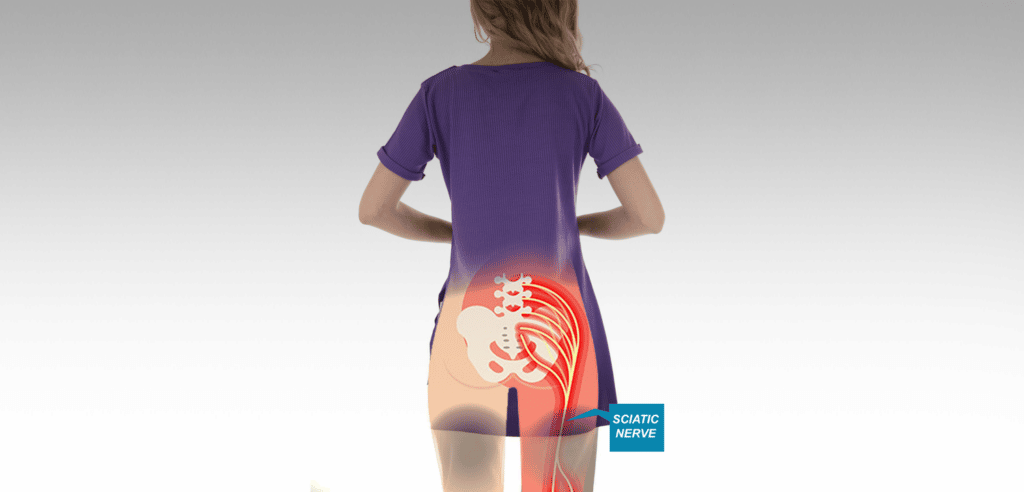
The sciatic nerve forms from nerve roots in the lower spine, commonly involving L4, L5, S1, and S2. These nerve fibers come together in the pelvic region before traveling through the buttock and down the back of the thigh.
Near the knee, the sciatic nerve divides into branches that continue into the lower leg and foot. This pathway explains why lower-spine changes may be felt far away from the lower back.
Main Branches of the Sciatic Nerve
Near the back of the knee, the sciatic nerve divides into two main branches.
| Branch | General pathway |
|---|---|
Tibial nerve | Travels down the back of the lower leg and into the sole of the foot |
Common fibular nerve | Travels along the outer part of the lower leg and into the top of the foot |
This is why sciatic symptoms may be felt in different areas of the calf, ankle, foot, or toes.
Leg pain in a child or teenager is assessed with growth in mind, and the guide to chiropractic care for children explains the first visit and the signs that call for a doctor first.
When Medical Procedures May Be Discussed for Sciatica
Some people with sciatica may be advised to discuss medication, injections, imaging, specialist review, or surgery with a medical practitioner.
These decisions usually depend on symptom severity, neurological findings, imaging results, response to conservative care, and the person’s overall health.
The aim here is to explain common terms and the importance of proper assessment; decisions about a procedure belong to the discussion with the medical practitioner.
Lifestyle, Movement and General Health Considerations
Lifestyle works alongside proper assessment: sleep, hydration, gentle movement, posture awareness, and general health habits may support day-to-day comfort.
People with sciatic symptoms should avoid forcing painful movements, aggressive stretching, sudden twisting, or heavy lifting when symptoms are active.
Before taking supplements, speak with a qualified healthcare professional, especially if you are pregnant, taking medication, or managing another health condition.
Educational Research Notes on Sciatica, Disc Herniation and Conservative Care
The studies listed below are included for education. They describe research findings in general rather than individual results, clinic outcomes, promised improvement, medication avoidance, or surgery avoidance.
The references cover a randomized trial comparing spinal manipulation with microdiskectomy, two retrospective cohort studies on spinal manipulation, discectomy and opioid-related adverse events, a case report on manipulation forces, a trial comparing flexion-distraction with active exercise, a systematic review on safety, a practitioner survey and an early clinical report on the Activator technique.
The practical takeaway is cautious: conservative care may be discussed for selected patients, but suitability depends on assessment, red-flag screening, neurological findings, imaging when relevant, and individual circumstances.
Sciatica Treatment Kuala Lumpur: Quick Recap
Sciatica refers to symptoms that may travel from the lower back into the buttock, thigh, calf, ankle, foot, or toes.
Common spine-related factors include slipped disc, herniated disc, disc bulge, spinal stenosis, spondylolisthesis, bone spurs, facet joint enlargement, and ligamentum flavum thickening.
People searching for sciatica treatment Kuala Lumpur, sciatica chiropractor KL, sciatica physiotherapy Kuala Lumpur, or slipped disc treatment KL should understand that the right next step depends on assessment findings.
Fees for this and related services are listed on our chiropractic price in Kuala Lumpur and physiotherapy fees in Kuala Lumpur pages.
Explore Sciatica Guides: Nerves, Discs and Back Pain
These guides go further into sciatica and the nerve, disc and spine conditions behind it, with leg pain as a closely related topic and the back pain guide bringing the lower back, pelvis and leg topics together in one place.
Sciatica and Nerve Pain
Disc and Spine Conditions
- Increased Intradiscal Pressure and Slipped Disc Damage
- What Is an Extruded Disc? Meaning, Symptoms and Care in KL
- Fragmented Disc: Partial or Sequestered, Symptoms and Treatment
- Spinal Stenosis Care: Why Walking Distance Matters
- Spondylolisthesis: Causes, Grades and Non-Invasive Management
- L4-L5 Back Issues: Slip Disc, Sciatica, Stenosis & Nerve Symptoms
- L5-S1 Disc Problems: Symptoms, MRI Findings and Care
Frequently Asked Questions About Sciatica in Kuala Lumpur
What is sciatica, and what causes it?
What should I know before booking sciatica treatment in Kuala Lumpur?
What do a sciatica chiropractor and a physiotherapist in KL assess?
Do I need an MRI or X-ray before sciatica care?
Why are non-rotatory methods discussed for sciatica?
What is the price for a chiropractor for sciatica in Malaysia?
How can I relieve sciatic nerve pain fast safely?
When should sciatica be assessed?
This page is general education about sciatica and cannot assess an individual reader’s own situation or replace medical advice. It describes options rather than promising any particular result, and the right next step comes from an individual assessment.
Educational References
The references below are included for general education on sciatica, lumbar disc herniation, radiculopathy, imaging, conservative care, manual therapy and spine-related research.
- McMorland G, Suter E, Casha S, du Plessis SJ, Hurlbert RJ. Manipulation or microdiskectomy for sciatica? A prospective randomized clinical study. J Manipulative Physiol Ther. 2010;33(8):576-584.
- Trager RJ, Cupler ZA, Srinivasan R, Harper EG, Perez JA. Association between chiropractic spinal manipulation for sciatica and opioid-related adverse events: a retrospective cohort study. PLoS One. 2025;20(1):e0317663.
- Trager RJ, Daniels CJ, Perez JA, Casselberry RM, Dusek JA. Association between chiropractic spinal manipulation and lumbar discectomy in adults with lumbar disc herniation and radiculopathy. BMJ Open. 2022;12(12):e068262.
- Siciliano TB, Gudavalli MR, Kruse R. Spinal manipulation and mobilization forces delivered treating sciatica: a case report. Front Integr Neurosci. 2024;18:1356564.
- Gudavalli MR, Cambron JA, McGregor M, et al. A randomized clinical trial and subgroup analysis to compare flexion-distraction with active exercise for chronic low back pain. Eur Spine J. 2006;15(7):1070-1082.
- Oliphant D. Safety of spinal manipulation in the treatment of lumbar disk herniations: a systematic review and risk assessment. J Manipulative Physiol Ther. 2004;27(3):197-210.
- Clijsters M, Fronzoni F, Jenkins H. Chiropractic treatment approaches for spinal musculoskeletal conditions: a cross-sectional survey. Chiropr Man Therap. 2014;22(1):33.
- Polkinghorn BS, Colloca CJ. Treatment of symptomatic lumbar disc herniation using Activator Methods Chiropractic Technique. J Manipulative Physiol Ther. 1998;21(3):187-196.
These references describe sciatica and its care in general. None of them evaluates care at Chiropractic Specialty Center. Each one can be checked through the linked publisher or PubMed record.
The Author of Sciatica Treatment: What the First Weeks Involve
Sciatica Treatment: What the First Weeks Involve was written by Yama Zafer, D.C., who has 30+ years in chiropractic and physiotherapy and founded Chiropractic Specialty Center in Kuala Lumpur in 2006.
Last Updated: Sciatica Treatment: What the First Weeks Involve
Sciatica Treatment: What the First Weeks Involve was last reviewed and updated on October 3, 2026.