


Chiropractic and Physiotherapy Centers in KL & Selangor
Chiropractic and physiotherapy at Chiropractic Specialty Center (CSC) are provided by registered chiropractic practitioners and registered physiotherapists at five centers in Kuala Lumpur and Selangor. Chiropractic care and physiotherapy sessions can be received separately or coordinated after an assessment, together with guided rehabilitation, exercise and movement education.
CSC opened its first center in Kuala Lumpur, Malaysia, in 2006. Two of the five centers are in Kuala Lumpur: Bukit Damansara, the main center, and Bandar Sri Damansara. The other three are Kota Kemuning and Setia Alam in Shah Alam, and Bandar Baru Bangi. Every first visit begins with a consultation and assessment. Care is then planned for the individual, with referral when another healthcare pathway is more appropriate.
The sections below cover where to start, the five centers, the services, the first visit, the patient guides, safety and common questions.
For more information about chiropractic and physiotherapy in KL and Selangor, contact the Bukit Damansara (KL) main center: WhatsApp+60 17 269 1873 Call+603 2093 1000
Chiropractic and Physiotherapy at CSC: Key Takeaways
| Point | What to know |
|---|---|
Opening hours | Bukit Damansara, Bandar Sri Damansara and Bandar Baru Bangi open 8:00 AM to 8:00 PM on weekdays and 8:00 AM to 6:00 PM on weekends. Kota Kemuning and Setia Alam keep shorter hours, listed in the center directory below. |
Fees | An examination is RM100 and a chiropractic adjustment RM150, or RM110 when physiotherapy is part of the same visit; these chiropractic fees are the same at every center. |
First visit | From arrival to leaving, 30 minutes to two hours, longer for a complex problem. |
What to bring | Past medical records and the scan images themselves, on a CD or film, not only the reports. |
Referral | A medical referral is not normally needed to arrange an assessment. |
Disc problems | Chiropractic for a damaged disc is gentle and done without twisting the spine. |
Languages | English and Bahasa Malaysia; some team members also speak Mandarin and Tamil. |
Chiropractic and Physiotherapy Near Me: The Five CSC Centers
The nearest center depends on where the visit starts:
- Central Kuala Lumpur: Bukit Damansara, the main center
- Northern and northwestern Kuala Lumpur and nearby Selangor: Bandar Sri Damansara
- Parts of Shah Alam and Klang: Kota Kemuning and Setia Alam
- Bangi and the surrounding areas: Bandar Baru Bangi
| Center | Address, hours, and contact route |
|---|---|
Bukit Damansara, Kuala Lumpur | Plaza Damansara, 71, Jalan Medan Setia 1, Bukit Damansara, 50490 Kuala Lumpur. |
Bandar Sri Damansara, Kuala Lumpur | 8-G, Jalan Damar SD 15/1, Bandar Sri Damansara, 52200 Kuala Lumpur. |
Kota Kemuning, Shah Alam | 4-28-1, 14, Persiaran Anggerik Vanilla, Kota Kemuning, 40460 Shah Alam, Selangor. |
Setia Alam, Shah Alam | No. 7, Jalan Setia Utama AT, U13/AT, Setia Alam, 40170 Shah Alam, Selangor. |
Bandar Baru Bangi, Selangor | 11, Jalan Medan Pusat 2D, Bandar Baru Bangi, 43650 Bangi, Selangor. |
Both Kuala Lumpur centers, Bukit Damansara and Bandar Sri Damansara, have the full range of CSC’s chiropractic and physiotherapy equipment and apply NSD Therapy®. Specific practitioners, appointment times, equipment, and services can vary by center, so confirm availability with the location you plan to visit. Public-holiday hours may also differ.
When contacting a center, a brief description of your main concern, your preferred location, and the times you can attend are usually enough for the first message. Send detailed medical histories, identification documents, full imaging reports, and other sensitive health records only through the approved submission process a CSC team member provides. They should not be sent through general WhatsApp or SMS.
Who Is Chiropractic Specialty Center?
Chiropractic Specialty Center is a Malaysian chiropractic and physiotherapy organization. Its first center, in Bukit Damansara, Kuala Lumpur, held its grand opening on December 26, 2006. The five current centers use the same public brand and shared professional standards, while contact details, practitioners, schedules, and service availability are managed for each location.
Chiropractic services are provided by registered chiropractic practitioners. Physiotherapy services are provided by registered physiotherapists. A person may receive chiropractic only, physiotherapy only, or a coordinated plan when both professional services are available and considered appropriate after assessment. Each practitioner remains responsible for services within that practitioner’s professional scope.
Read more about CSC history, governance, locations, and professional roles, or meet the clinical team.
Who Leads CSC Clinical and Editorial Work?
I am Yama Zafer, D.C., the founder and director of Chiropractic Specialty Center. I earned the Doctor of Chiropractic degree from Cleveland University-Kansas City in the United States in 1996 and have 30+ years in chiropractic and physiotherapy. I am registered in Malaysia as a Traditional and Complementary Medicine practitioner in the recognized practice area of chiropractic.
I came to Malaysia in 2006 as a practicing chiropractor, and my work here has included research and development in conservative, non-surgical spine care. I founded CSC that year because I saw a real need for conservative care in Malaysia. From the start, chiropractors and physiotherapists have worked at CSC as one team.
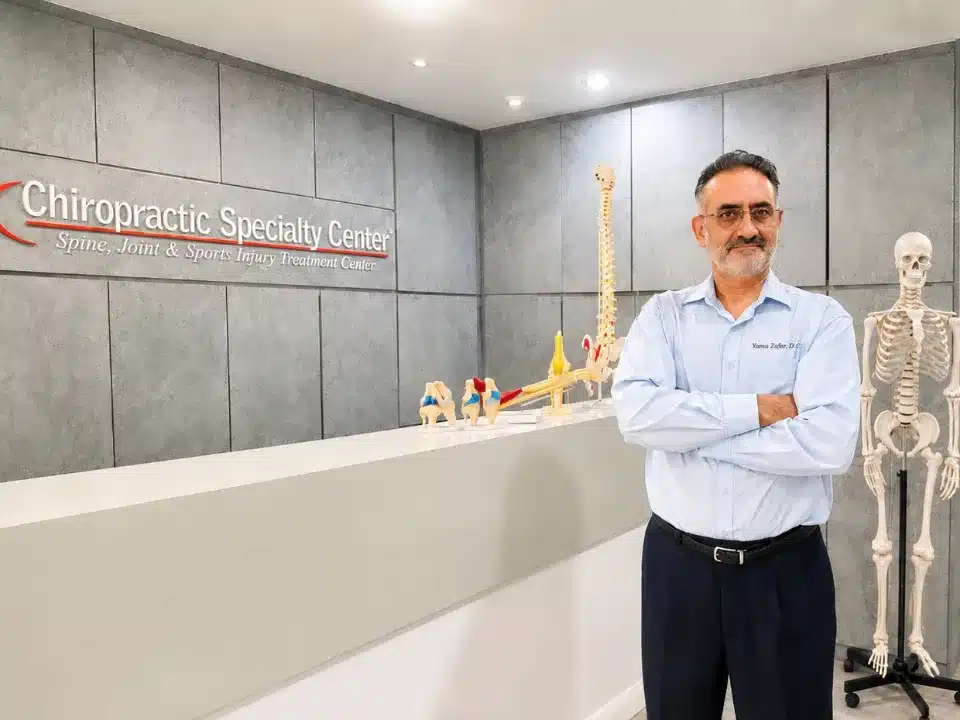
My background includes training and clinical experience in chiropractic and physiotherapy, and physiotherapy at CSC is delivered by registered physiotherapists. My professional profile documents education, Malaysian registration, clinical experience, authorship, commercial disclosures, and editorial responsibility. Read the complete professional profile of Yama Zafer, D.C., or watch CSC educational videos.
What Does Chiropractic Involve, and How Is Suitability Assessed?
Chiropractic is a professional form of musculoskeletal care concerned with the spine, joints, related muscles, movement, and relevant nerve findings. A chiropractic assessment may consider posture, range of motion, joint mechanics, muscle response, daily activities, previous injuries, existing imaging, and selected neurological or orthopedic findings.
Care may include manual joint methods, lower-force instrument-assisted methods, mobility work, exercise guidance, and education when appropriate for the individual person. For a damaged disc, chiropractic at CSC is gentle and non-rotatory, done without twisting the spine. I use rotary (twisting) manipulation only when I am 100 percent sure the disc is not damaged.
Back pain, neck pain, headaches, numbness, tingling, weakness, dizziness, and joint symptoms can have several possible explanations. Assessment helps determine whether chiropractic, physiotherapy, another healthcare pathway, further investigation, or referral should be considered.
For a detailed explanation of how chiropractic is provided at the flagship center, visit the chiropractor in Kuala Lumpur page for CSC Bukit Damansara.
What Is Physiotherapy at CSC?
Physiotherapy is a distinct professional service that may assess movement, mobility, muscle performance, balance, coordination, activity tolerance, and function. Depending on the assessment and the physiotherapist’s scope, services may include guided exercise, mobility or strengthening work, hands-on methods, movement retraining, balance work, education, and a progressive rehabilitation plan.
Physiotherapy may be provided on its own by a registered physiotherapist, without chiropractic first. The precise content, equipment, practitioner, and appointment availability vary by center. Explore physiotherapy in Kuala Lumpur and CSC spine and joint rehabilitation.
How Can Chiropractic and Physiotherapy Work Together?
Chiropractic and physiotherapy are distinct professional services with overlapping goals related to movement and function. Chiropractic commonly emphasizes joint motion and manual approaches within the chiropractic practitioner’s scope. Physiotherapy commonly emphasizes muscle function, mobility, strength, balance, exercise, and rehabilitation. Guided exercise and self-management education may support daily activity and longer-term movement capacity.
My advice has always been to combine the two: “Don’t choose between one or the other. Choose both.” Some problems call for an experienced chiropractor, and physiotherapists bring an equal range of skills of their own. As I see it, holistic care must be comprehensive, and care “cannot be comprehensive if it is a singular approach.”
Chiropractic and physiotherapy may still be provided separately, or coordinated when assessment indicates that both are relevant. Any device or technique is chosen for the individual person. A coordinated plan may involve different professionals at different stages, with progress reviewed rather than assumed. When medical, dental, obstetric, pharmaceutical, injection, surgical, or another specialist pathway may be more appropriate, the practitioner explains the limitation and recommends referral.
Explore the complete CSC services hub for service descriptions and the appropriate center pathway.
What Happens at the First Chiropractic or Physiotherapy Visit?
The first visit is primarily a consultation and structured assessment; any adjustment, procedure, or number of sessions is decided from its findings. The exact process depends on the reason for the visit and the practitioner involved.
History and goals.
The practitioner asks when the concern began, what changes it, how it affects work, sleep, walking, exercise, school, sport, or daily activity, what you have already tried, and what you hope to improve.
Relevant health information.
You may be asked about previous injuries, surgery, pregnancy, bone health, medications, cardiovascular or neurological history, and other factors that could affect assessment, modification, or referral.
Physical assessment.
Depending on the concern, this may include posture and movement review, joint motion, muscle response, functional testing, balance, and selected neurological or orthopedic checks. A test may be modified or deferred when provoking it would be inappropriate.
Review of existing imaging and reports.
Imaging is considered alongside your symptoms, history, examination, and function rather than interpreted in isolation.
Explanation and options.
The practitioner explains what the findings may suggest, what remains uncertain, which options may be suitable, what the limitations are, and whether further investigation or referral may be appropriate.
Consent, fees, and review.
Recommended services, expected fees, alternatives, and relevant limitations are explained before care proceeds. Progress is reviewed over time rather than assuming an open-ended schedule in advance.
Time and comfort.
A first assessment runs from 30 minutes to two hours, arrival to leaving, because a complex problem takes longer to assess. It is not rushed. A complaint that looks mild can prove more serious and call for a closer look at other parts of the body.
Every test stays within what you can comfortably tolerate. Report any discomfort during the examination, even if it seems minor. As I tell patients, “The more information I have, the better care I can provide.”
How Should You Prepare to See a Chiropractor or Physiotherapist?
Before the first visit, my advice to every new patient is:
- Bring your past medical records, with any laboratory result or referral letter. For an MRI, X-ray or CT scan, bring the images themselves on a CD or film, not only the written report. Arrange new imaging for the appointment only when a qualified provider has advised it.
- Take a few minutes at home to note how the problem began and how it has changed since. List what you have tried so far: on your own, from online videos, or with a doctor, specialist, therapist or other practitioner.
- Note the questions you want answered and anything you want the examination to focus on, because these are easy to forget once the visit starts.
- Bring a current medication list when relevant, including blood-thinning medication, osteoporosis medication, or other information that may affect assessment and technique selection.
- Wear comfortable clothing that allows the relevant area to be examined and movement to be observed.
- If it suits you, bring a family member, since two people remember more of what was discussed when deciding next steps at home.
- Mention pregnancy, recent surgery, significant trauma, fever, unexplained weight change, rapidly changing weakness, altered balance, dizziness, or other important health changes before physical testing begins.
- Tell the center your language preference when booking because language and practitioner availability vary by location.
Which Patient Guides Can Help You Understand Common Concerns?
CSC patient guides explain common terms, symptom patterns, assessment questions, imaging language, care boundaries, and possible next steps.
Lower Back Pain and Sciatica
Back pain may involve joints, muscles, discs, nerves, activity tolerance, or several factors at once. Leg pain, numbness, tingling, or weakness may be described as sciatica when the sciatic nerve pathway is involved, but not every leg symptom is sciatica. In my experience, every case of sciatica has involved the disc to some degree, from mild to moderate. My video Sciatica vs Slipped Disc explains how the two differ. Read the lower-back pain guide and the sciatica and nerve symptom guide.
Slipped Disc and MRI Report Terms
People use “slipped disc” for any stage of disc damage. I list six stages, from mildest to most advanced: bulge, protrusion, prolapse, herniation (also called a rupture), extrusion and fragmentation. In a true bulge, the disc’s outer fibers are only swollen, and the disc does not press on a nerve. In each later stage, the soft center pushes further out, until in a fragmentation a piece breaks off into the spinal canal.
An MRI finding alone does not show where symptoms come from. Jensen and colleagues found a disc bulge in 52 percent of 98 adults without back pain [1]. So a report is always read with the history and the physical examination. Start with the slipped-disc terminology and care guide, then review the disc bulge guide.
L4-L5 & L5-S1 Disc, Joint and Nerve Findings
The lower lumbar levels are frequently discussed in MRI reports. The dedicated L4-L5 guide and L5-S1 guide explain disc changes, facet joints, spinal narrowing, nerve signs, and why the scan must be considered together with the examination.
Neck Pain, Headaches, and Desk-Related Strain
Neck pain and stiffness may be associated with sustained screen use, work posture, cervical disc changes, joint irritation, muscle fatigue, nerve involvement, or other causes. Some headaches involve the neck, while others require medical, neurological, dental, or visual assessment. Read the neck pain and cervical care guide and the headache and migraine information.
Shoulder, Knee, and Other Joint Concerns
Joint concerns may affect movement, loading, work, sport, and daily activities. The shoulder pain and frozen-shoulder guide and the knee pain, meniscus, ACL, and osteoarthritis guide explain common patterns and the roles of assessment, physiotherapy, exercise, and joint-focused care.
Pregnancy-Related Back and Pelvic Concerns
Pregnancy can change posture, load, movement, and pelvic mechanics, while abdominal, pelvic, urinary, bleeding, fever, or other pregnancy symptoms call for obstetric or medical review rather than automatic musculoskeletal care. Care stays individualized and works alongside obstetric assessment. The pregnancy back and pelvic guide explains common musculoskeletal concerns, care boundaries, and warning signs that require obstetric or medical review.
Scoliosis-Related Posture and Jaw or TMJ Concerns
Scoliosis varies by age, curve pattern, cause, progression, symptoms, and functional effect; more significant or changing curves may require specialist monitoring. Jaw or temporomandibular joint concerns may involve joint motion, muscles, dental factors, habits, or neck and upper-back function. Both topics call for individual assessment and realistic expectations. Read the scoliosis guide and the TMJ and jaw guide.
Parents can read the guide to chiropractic care for children. It explains the first visit for a child, the gentle methods suited to each age and when a doctor comes first. The checklist of questions to ask before chiropractic care for a child helps prepare for the consultation.
What Does Evidence-Informed Chiropractic and Physiotherapy Mean?
Evidence-informed chiropractic and physiotherapy care combines relevant research, individual assessment, practitioner judgment, professional scope, the person’s preferences, practical service availability, and response over time. At CSC, a plan for low back pain usually brings together gentle, non-rotatory chiropractic, physiotherapy, education and changes to daily habits. Exercise is added once the body is ready, and no single treatment is used for everyone.
I put the aim of care this way: a person gives recovery a better chance by increasing what is beneficial for the condition and decreasing what is harmful. Any care depends on an accurate diagnosis, a proper plan, execution with no flaws or the fewest possible, and changes to posture, habit and daily activity.
That is why plans at CSC are built from the assessment, decided together with the patient, and reviewed as the person responds. As I often say, “In a day, there’s 24 hours. I see a patient 30 minutes, two hours. What about the other 22 hours? You have to mind your posture, your habits.”
- Improvement may be gradual and may fluctuate.
- Active participation may be an important part of the plan, including suitable exercise, activity, sleep, workload and self-management.
- Two people with similar MRI findings may have different symptoms, limitations, examination findings, and care needs.
- Some concerns can be managed within chiropractic or physiotherapy scope; others require co-management, further investigation, or referral.
Chiropractic and Physiotherapy: Safety, Limits & Referral
Every form of healthcare carries some risk. The methods and their possible effects are explained before care begins. These can include temporary soreness, stiffness, tiredness or a brief change in symptoms after a session. Care is kept within what the patient can comfortably tolerate. Any discomfort should be mentioned at once, because in my view it means the care is too aggressive.
My motto has always been “No pain, more gain.” Responsible chiropractic and physiotherapy practice includes a relevant history, assessment, explanation of options and limitations, consent, selection or modification of methods, progress review, and referral when the presentation falls outside routine musculoskeletal care.
When to Seek Prompt Medical Care
Seek urgent medical care as usual for a genuine emergency, stroke-like symptoms, chest pain, breathing difficulty, severe trauma, inability to bear weight, fever with severe spinal pain, or a sudden severe headache unlike your usual pattern.
Before or between visits to any CSC center, if you have back or leg pain and develop new or worsening numbness around your genitals, between your genitals and anus, or around your anus, get urgent medical attention: a thorough assessment at a hospital emergency department straight away, within hours. The same applies to new difficulty passing urine, even if you have not lost bladder or bowel control, and to any loss of bladder or bowel control. These symptoms can have several causes, and an assessment helps identify the right care. Some causes may call for an invasive procedure, but being assessed does not mean you need surgery.
Leg weakness that keeps getting worse should not be ignored. It calls for a careful assessment by a competent provider, and conservative care can continue only while the weakness itself is improving. Short of that, symptoms can be assessed calmly, and conservative care is often a reasonable route for as long as it produces results.
Medical, pharmaceutical, injection, and surgical services are outside CSC’s service scope. Depending on the findings, a practitioner may recommend consultation with a medical doctor, dentist, obstetric provider, radiologist, neurologist, orthopedic specialist, or another qualified healthcare professional.
Why Is Bukit Damansara the Flagship CSC Center?
Bukit Damansara was the first CSC location, opening in 2006, and remains the flagship and main Kuala Lumpur center. At this location, chiropractic is provided by registered chiropractic practitioners, physiotherapy is provided by registered physiotherapists, and guided rehabilitation and a dedicated exercise and rehabilitation environment are available. Some structured exercise programs and operational functions are available only at this location, so patients who need a particular program should confirm availability when booking.
| Flagship detail | Current information |
|---|---|
Public name | Chiropractic Specialty Center in Bukit Damansara, Kuala Lumpur |
Address | Plaza Damansara, 71, Jalan Medan Setia 1, Bukit Damansara, 50490 Kuala Lumpur |
Telephone | +603 2093 1000 |
+60 17 269 1873 | |
Regular hours | Monday-Friday, 8:00 AM-8:00 PM; Saturday-Sunday, 8:00 AM-6:00 PM |
Landmark | Beside CIMB Bank and Caring Pharmacy in Plaza Damansara |
Nearby areas | Damansara Heights, Bangsar, Mont Kiara, Sri Hartamas, TTDI, Mid Valley, KL Eco City, and nearby Petaling Jaya |
Center and directions | Bukit Damansara center page | Address, map, and contact details |
How Does CSC Support Patient Education?
CSC publishes chiropractic and physiotherapy guides and videos about spine, joint, disc, nerve, movement, posture, rehabilitation, imaging terminology, assessment questions, and care boundaries.
Browse the CSC patient guide library, watch the CSC video library, or check CSC talks and events for current schedules and topic information.
CSC Patient Education Videos
These short videos from the CSC YouTube channel explain common spine and joint questions in plain language.
Each of these videos also has its own page with the chapters and an edited transcript: spine and joint care in Kuala Lumpur, why forceful neck cracks are risky, how poor posture affects the spine and 13 questions on chiropractic safety.
Which Languages Are Available?
Chiropractic and physiotherapy care is routinely available in English and Bahasa Malaysia. Some clinical team members also communicate in Mandarin and Tamil. Language, practitioner, and schedule availability vary by center, so mention your preference when arranging the appointment.
Explore Chiropractic and Physiotherapy Topics at CSC
Pages on spine, back, joint and jaw concerns, and on the conditions, treatment methods and exercise covered at CSC.
Spine, Back and Nerve Pages
- Back Pain Treatment in Kuala Lumpur: Symptoms, Causes and Care
- Slip Disc Explained: Causes, Stages, Symptoms and Care
- Herniated Disc Treatment in Kuala Lumpur: Signs, Causes and Care
- Spinal Stenosis Care: Why Walking Distance Matters
- Scoliosis: What the Curve Is and How It Is Measured
- Sacroiliac Joint Care in KL: Non-Invasive Care for SI Joint
- Leg Pain: Causes and Nerve-Related Signs
Joint and Jaw Pages
Current fees are listed on the chiropractic price in Kuala Lumpur and physiotherapy fees in Kuala Lumpur pages. Chiropractic fees are the same at every CSC center, and physiotherapy fees are the same at both Kuala Lumpur centers.
Frequently Asked Questions
More questions are answered in the chiropractic and physiotherapy FAQs in Kuala Lumpur.
What services does Chiropractic Specialty Center provide?
How many CSC centers are currently open?
Which center should I choose?
Are the same services available at every center?
Is the former Sri Petaling center still open?
Do I need a medical referral?
Can I receive physiotherapy without chiropractic?
What happens during the first visit?
Do I need an MRI or X-ray before the first visit?
What should I bring to the first visit?
How many sessions will I need?
How much do chiropractic or physiotherapy services cost?
Is chiropractic suitable for sciatica, a slipped disc, or back and neck pain?
Is chiropractic suitable during pregnancy?
Is chiropractic suitable for older adults?
What if I take blood thinners, have osteoporosis or a complex medical history?
Does CSC provide medication, injections, or surgery?
When is medical care more appropriate than a routine visit?
Are the centers open on public holidays?
What information should I send through WhatsApp?
What does evidence-informed care mean?
The information on this page is general and educational; it cannot determine the cause of an individual person’s symptoms or replace personal medical advice, diagnosis, obstetric care, dental care, or emergency assessment.
Reference Cited on This Page
The study below supports the homepage statement that an MRI finding alone does not show where symptoms come from. It reports MRI findings in 98 people without back pain.
- Jensen MC, Brant-Zawadzki MN, Obuchowski N, Modic MT, Malkasian D, Ross JS. Magnetic resonance imaging of the lumbar spine in people without back pain. N Engl J Med. 1994;331(2):69-73.
This study does not evaluate care at Chiropractic Specialty Center.
The Author of Chiropractic and Physiotherapy Nearby in KL & Selangor
Chiropractic and Physiotherapy Nearby in KL & Selangor was written by Yama Zafer, D.C., who has 30+ years in chiropractic and physiotherapy and founded Chiropractic Specialty Center in Kuala Lumpur in 2006.
Last Updated: Chiropractic and Physiotherapy Centers in KL & Selangor
Chiropractic and Physiotherapy Centers in KL & Selangor was last reviewed and updated on October 16, 2026.