

This article on : Spinercise® a spine and joint exercise system so readers can understand how adjustable elastic resistance and guided multi-directional movement may support spinal and joint control.
Spinercise® is a guided exercise system that uses elastic tubing and a torso harness to allow controlled movement of the spine and selected joints. The design lets a person move through bending, extension, side-bending, and rotation while resistance changes with the stretch of the tubing.
This page describes how the system works, why multi-directional movement matters for spinal stability, and how the exercise can be adapted for the neck, lower back, hips, and knees. It is educational only. It does not diagnose a condition or determine whether any exercise is suitable for a particular person.
Key Points at a Glance
- Spinercise® uses adjustable elastic resistance and a torso harness.
- Movement can be performed in multiple directions: flexion, extension, side-bending, and rotation.
- The harness allows lower-back exercise without relying on the arms to create the load.
- The same system can be adapted for neck, hip, and knee movement work.
- Exercises are guided and adjusted to individual strength and movement tolerance.
- At Chiropractic Specialty Center® the system is available at the Bukit Damansara and Bandar Sri Damansara centers in Kuala Lumpur.
How the Spinercise® System Works
The core of the system is elastic tubing of different strengths. As the tubing stretches, resistance increases. This creates a variable load throughout the movement rather than a fixed weight.
For spinal exercise a harness is fitted around the upper torso. The person moves the trunk against the resistance of the tubing. Because the harness transmits the load, the arms do not have to pull or push to create the exercise force. This is useful when the goal is to engage the muscles that support the spine itself.
Sessions can be performed seated or standing. Seated work keeps the body more supported and is often used earlier in a program. Standing work adds balance and whole-body coordination demands as capacity improves.
Why Multi-Directional Movement Matters
Daily activity rarely loads the spine in only one direction. Walking, turning, reaching, and lifting combine flexion, extension, side-bending, and rotation. Exercise that trains only a single plane may leave some stabilizing muscles under-challenged.
Spinercise® allows the spine to move through several controlled directions in one session. The elastic resistance can be adjusted so the movement stays within a comfortable range while still providing a meaningful challenge to the muscles that guide spinal control.
Targeted Work for the Muscles Along the Spine
The muscles that run alongside the spine (paravertebral muscles) help maintain segmental control and posture. When these muscles are under-used for long periods they may become less efficient.
Because the harness and tubing allow the trunk to move against resistance, the exercise can be directed toward one side or the other. Combinations such as flexion with rotation or side-bending with slight extension can be used to engage specific regions under guidanceSeated and Standing Exercise Options
Use for the Lower Back
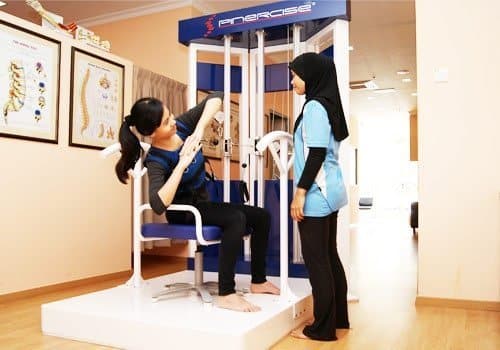
For lower-back work the harness is the key feature. The person does not need to hold handles with the arms to create resistance. The load is applied through the torso, so the focus stays on the muscles that support the lumbar spine and pelvis.
Movement remains within ranges that feel comfortable for the individual. Resistance is chosen so the exercise is challenging but controlled. This approach is often used when the goal is gradual re-engagement of spinal stabilizers after a period of reduced activity.
- Related reading on lower-lumbar segments: L4-L5 disc care and L5-S1 disc problems.
- See also: spondylolisthesis guide and facet hypertrophy.
Use for the Neck and Upper Back
The same principles can be applied to the cervical and thoracic regions. Smaller ranges of motion and lighter tubing are typically selected. The goal is controlled movement that engages the muscles supporting the neck and upper trunk without forcing end-range positions.
Guided multi-directional work may be useful when the aim is to improve coordination and tolerance for everyday head and shoulder movement.
Related reading: neck care in Kuala Lumpur and upper-back care.
Use for the Hips and Knees
Spinercise® is not limited to the spine. The elastic-resistance setup can be adapted for hip and knee movement patterns. Controlled loading through available ranges can support programs that focus on joint control and muscular support around the hip or knee.
As with spinal exercise, the resistance and range are adjusted to the individual’s current capacity. The emphasis remains on controlled, guided movement rather than forcing a position.
How Exercises Are Individualized
No two people start at the same point. Resistance tubing strength, direction of movement, seated versus standing position, and number of repetitions are all adjusted according to strength, mobility, and comfort on the day.
Early sessions may use small ranges and lighter resistance while the person learns the movement pattern. As control improves, resistance or range can be progressed gradually under guidance.
How Spinercise® Fits Within a Broader Program
At Chiropractic Specialty Center® the system is used as one component of structured rehabilitation. It may be combined with other guided exercise, soft-tissue work, and joint-mobilization approaches when the clinical findings support that combination.
The decision to include any specific exercise method is based on assessment findings, movement tolerance, and the goals of the individual plan. The system itself does not replace clinical evaluation.
Where Spinercise® Is Available
The Spinercise® system is used at two Chiropractic Specialty Center® locations in Kuala Lumpur:
- Bukit Damansara (headquarters)
- Bandar Sri Damansara
Availability at a given center can be confirmed when arranging an assessment.
Important Limitations
This page describes an exercise system. It does not claim that any device or method is suitable for every person or every condition. Some situations require medical evaluation before exercise is progressed. Progressive weakness, saddle-area numbness, or changes in bladder or bowel control need urgent medical attention.
An online description cannot determine whether Spinercise® is appropriate for any individual. That decision belongs to a qualified clinical assessment.
Contact Chiropractic Specialty Center®
- Main center (headquarters): Chiropractic Specialty Center – KL in Bukit Damansara
- Headquarters contact details: Bukit Damansara contact page
- Bandar Sri Damansara center: Chiropractic Specialty Center Bandar Sri Damansara
- Bandar Sri Damansara contact details: Bandar Sri Damansara contact page
- Services overview: Services at Chiropractic Specialty Center
- Main WhatsApp: +60 17-269-1873
Visited a CSC location? Readers may share an honest Google review for Bukit Damansara (https://g.page/r/CVDFUc5QK-bcEBM/) or Bandar Sri Damansara (https://g.page/r/CYbzQG9WmMZsEBM/). Reviews should reflect genuine experience; no particular rating is requested.
Author Information
“Spinercise® Spine & Joint Exercise System | MyChiro” was written and reviewed by Yama Zafer, D.C., a registered chiropractic practitioner in Malaysia and the founder and director of Chiropractic Specialty Center®, and readers may review his professional background, registration information, experience, and editorial profile on the official same-domain biography page.
Last Updated
This page was last updated on July 28, 2026, after a substantive review of factual accuracy, clarity, references, internal links, comments, and current information under the H1 title “Spinercise® Spine & Joint Exercise System.”