

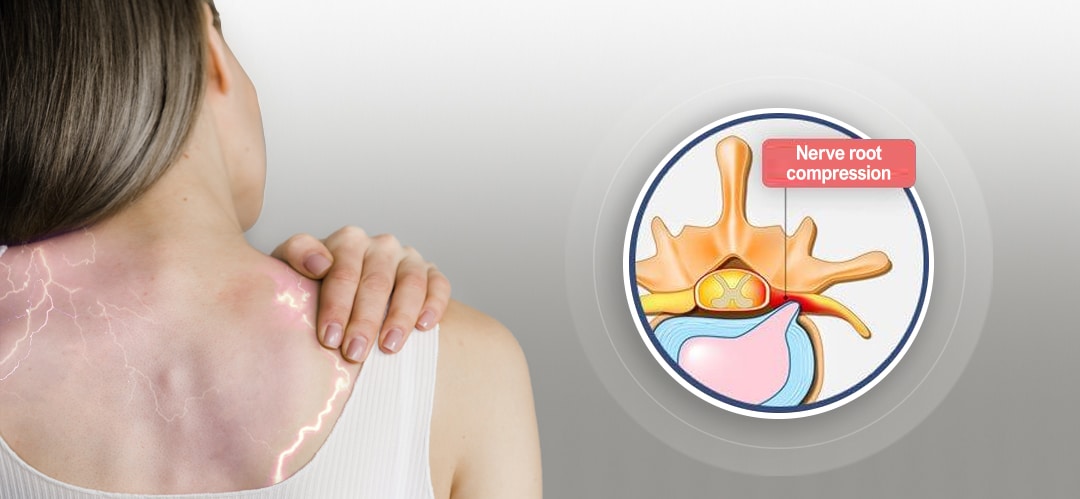
Pinched Nerve in KL: Targeted, Non-Invasive Care
A pinched nerve produces symptoms along a line rather than in a patch, and that distribution is the most useful feature it has. Each nerve root supplies a defined strip of skin and a defined set of muscles, so burning, tingling or numbness running down an arm or a leg traces the path of one nerve and indicates which level is involved.
The second feature is that compression rarely occurs where the symptom is felt. A nerve irritated in the neck is felt in the hand; one irritated in the lower back is felt in the calf. That is why treating the painful area alone so often disappoints.
This guide to a pinched nerve, its common symptoms and how it develops, is published by Chiropractic Specialty Center, Bukit Damansara (KL) main center: WhatsApp+60 17 269 1873 Call+603 2093 1000
Key Takeaways
- A pinched nerve means a nerve is being compressed or irritated, most often by a disc herniation or by narrowing from joint and bone changes near the spine.
- Symptoms follow the nerve: pain, numbness, tingling or weakness in a strip of the arm or leg.
- Nerves can also be compressed away from the spine, for example at the wrist in carpal tunnel syndrome or at the elbow.
- Many cases improve with conservative care over weeks to months. When a pinched nerve causes numbness with back or leg pain, its location and whether it is changing matter. New or worsening numbness around your genitals, between your genitals and anus, or around your anus needs urgent medical attention: a thorough assessment by a competent clinician the same day. New difficulty passing urine needs the same, even if you still control your bladder and bowels, and so does any loss of that control. These symptoms can have several causes. Some may call for an invasive procedure, but an assessment helps explain them and does not automatically mean you need surgery. Progressive weakness needs prompt assessment by a competent provider.
What a Pinched Nerve Is
Spinal nerve roots leave the spine through small openings between the vertebrae. A disc herniation, facet joint enlargement, bone spurs or thickened ligaments can narrow these openings and press on or inflame a root. In the neck this is called cervical radiculopathy; in the lower back it is called lumbar radiculopathy, and when it affects the sciatic nerve pathway it is known as sciatica.
Pinched Nerve Assessment at Two KL Centers
If you have numbness, tingling, burning or weakness traveling into an arm or leg, an assessment can help identify which nerve is involved and where it is being irritated. You can reach either center through the Bukit Damansara contact page and the Bandar Sri Damansara contact page, or call directly:
- Bukit Damansara (KL, main center): Call +603 2093 1000 or WhatsApp +60 17 269 1873 to see the Bukit Damansara / KL center.
- Bandar Sri Damansara (KL): Call +603 6262 5777 or WhatsApp +60 12 455 6939 to see the Bandar Sri Damansara center.
Common Symptoms
- Tingling or pins and needles.
- Burning or shooting pain that travels along a line.
- Numbness in part of the arm, hand, leg or foot.
- Weakness, such as a weak grip or a foot that catches when walking.
- Neck or low back pain, although the limb symptoms are often worse than the spinal pain.
Symptoms may change with posture, sitting, looking up, coughing or sneezing.
Pinched Nerve in the Neck Versus the Lower Back
Neck (Cervical Radiculopathy)
Pain spreads from the neck to the shoulder blade and down the arm, often with numbness or tingling in particular fingers. The C6 and C7 roots are affected most often. Related causes include cervical spondylosis and disc herniation; see also neck pain and neck stiffness.
Lower Back (Lumbar Radiculopathy and Sciatica)
Pain spreads from the lower back or buttock down the leg, often below the knee, with numbness or tingling in the foot. The L5 and S1 roots are affected most often. Related topics include disc bulge, spinal stenosis, sciatic nerve pain, low back pain and back pain treatment.
Nerves That Can Be Pinched Away From the Spine
- Median nerve at the wrist, in carpal tunnel syndrome: numbness in the thumb, index and middle fingers.
- Ulnar nerve at the elbow or wrist: numbness in the ring and little fingers and hand clumsiness.
- Radial nerve in the arm or forearm: weakness lifting the wrist or numbness on the back of the hand.
- Common fibular (peroneal) nerve near the outside of the knee: foot drop.
- Lateral femoral cutaneous nerve at the hip: burning or tingling on the outer thigh, called meralgia paresthetica.
- Tibial nerve at the ankle, in tarsal tunnel syndrome: burning in the sole of the foot.
Some people have compression at more than one point along the same nerve, for example in the neck and at the wrist. Thoracic outlet syndrome and piriformis syndrome can also mimic spinal nerve problems, which is why the whole nerve path is examined.
How a Pinched Nerve Develops
Most spinal nerve compression builds up with age-related changes in the discs and joints, sometimes triggered by a lift, a fall or an awkward movement. Long periods of sitting, looking down at a phone and repeated bending can make symptoms worse, but they are contributors rather than a single cause. Pinched nerves are most common in middle age, although disc herniations also affect younger adults.
How the Cause Is Identified
Assessment includes the history, a movement examination, and a neurological examination of strength, reflexes and sensation to identify which nerve is involved. Tests that stretch or load the nerve help separate nerve pain from muscle or joint pain. MRI is considered when the findings are unclear, when symptoms are severe or not improving, or when surgery is being considered, and a referral can be arranged. Nerve conduction studies may be used for nerves compressed in the arm or leg.
Conservative Care Options
Care depends on where the nerve is compressed and how irritable it is. A plan may include advice on positions and activity, graded exercise, gentle non-rotational chiropractic mobilization, physiotherapy including nerve mobility exercises, decompression-based methods for selected disc-related cases, and modalities such as ultrasound, electrotherapy or laser alongside exercise. Medicines prescribed by a doctor may help with pain in the short term, and injections or surgery are considered as a last resort when there is significant or worsening weakness or when a fair trial of conservative care has not helped.
Forceful Neck and Back Techniques
Fast, forceful neck pulls such as Y-strap or ring-dinger style traction, towel pulls and strong twisting of the lower back are not appropriate for everyone with a pinched nerve. Cervical artery dissection after neck manipulation is rare, and studies have not established that manipulation causes it, but serious adverse events have been reported and people with certain risk factors need extra caution. Rotation also increases load on the discs. For these reasons, care at Chiropractic Specialty Center uses lower-force, non-rotational methods, and any hands-on technique should be chosen after assessment. You can read more about ring-dinger and forceful neck pull risks.
For the chapter list and the transcript, open the Neck Cracks Are Dangerous video page.
When to See a Doctor Promptly
- A loss of bladder or bowel control. This needs same-day medical attention.
- Weakness that is getting worse or a foot that drags. Don't ignore these; have them assessed promptly by a competent provider. Depending on the findings, conservative care may still be a reasonable route.
- Clumsy hands, unsteady walking or symptoms in both arms or both legs, which can point to pressure on the spinal cord.
- Fever, unexplained weight loss or a history of cancer with new nerve pain.
Choosing Between Our Two KL Centers
Readers in the northwest of the city are often nearer to CSC Bandar Sri Damansara. That center provides chiropractic together with physiotherapy under one roof.
The main center sits in Bukit Damansara. You can read about CSC Bukit Damansara in Kuala Lumpur.
Addresses, telephone numbers and opening hours are listed on directions and hours for Bandar Sri Damansara and directions and hours for Bukit Damansara.
Safe care begins with a thorough clinical assessment, not assumptions. Non-rotatory methods that avoid twisting, high-force cracking, or sudden traction are considered safer, especially for disc, joint, or nerve-related conditions. Treatments should be tailored, gentle, and progressive.
Planning a visit? You can review the current chiropractic price in Kuala Lumpur and physiotherapy fees in Kuala Lumpur before you come in.
Frequently Asked Questions
What is the most common cause of a pinched nerve?
In the spine, disc herniation and narrowing from joint and bone changes are the most common causes. Away from the spine, carpal tunnel syndrome is the most common nerve entrapment.
Can a pinched nerve get better without surgery?
Many do. Symptoms from a disc herniation often improve over weeks to months, and many people are managed conservatively. Surgery is considered when weakness is significant or worsening, or when pain persists despite good conservative care.
How do I know if it is a pinched nerve or muscle tension?
A pinched nerve usually causes symptoms that travel along a line into the arm or leg, often with numbness, tingling or weakness. Muscle tension tends to cause local aching and stiffness. An examination is the reliable way to tell them apart.
How long does recovery take?
It varies with the cause and severity. Mild cases may settle in a few weeks, while disc-related or stenosis-related cases can take several months. Progress is judged by function and neurological findings rather than the scan.
References
- Radhakrishnan K, Litchy WJ, O’Fallon WM, Kurland LT. Epidemiology of cervical radiculopathy: a population-based study from Rochester, Minnesota, 1976 through 1990. Brain. 1994;117(Pt 2):325-335.
- Deyo RA, Mirza SK. Herniated lumbar intervertebral disk. N Engl J Med. 2016;374(18):1763-1772.
- Reuter U, Hämling M, Kavuk I, Einhäupl KM, Schielke E. Vertebral artery dissections after chiropractic neck manipulation in Germany over three years. J Neurol. 2006;253(6):724-730.
- Kranenburg HA, Schmitt MA, Puentedura EJ, Luijckx GJ, van der Schans CP. Adverse events associated with the use of cervical spine manipulation or mobilization and patient characteristics: a systematic review. Musculoskelet Sci Pract. 2017;28:32-38.
- Haynes MJ, Vincent K, Fischhoff C, Bremner AP, Lanlo O, Hankey GJ. Assessing the risk of stroke from neck manipulation: a systematic review. Int J Clin Pract. 2012;66(10):940-947.
- Chaibi A, Russell MB. A risk-benefit assessment strategy to exclude cervical artery dissection in spinal manual-therapy: a comprehensive review. Ann Med. 2019;51(2):118-127.
- Wilke HJ, Neef P, Caimi M, Hoogland T, Claes LE. New in vivo measurements of pressures in the intervertebral disc in daily life. Spine. 1999;24(8):755-762.
- Nachemson A. The load on lumbar disks in different positions of the body. Clin Orthop Relat Res. 1966;45:107-122.
- Scannell JP, McGill SM. Lumbar posture: should it, and can it, be modified? A study of passive tissue stiffness and lumbar position during activities of daily living. Phys Ther. 2003;83(10):907-917.
These references describe nerve root compression, disc loading and the safety of neck manipulation in general. None of them evaluates care at Chiropractic Specialty Center.
The Author of Pinched Nerve in KL: Numbness, Tingling and Causes
Pinched Nerve in KL: Numbness, Tingling and Causes was written by Yama Zafer, D.C., who has 30+ years in chiropractic and physiotherapy and founded Chiropractic Specialty Center in Kuala Lumpur in 2006.
Last Updated: Pinched Nerve in KL: Targeted, Non-Invasive Care
Pinched Nerve in KL: Targeted, Non-Invasive Care was last reviewed and updated on September 30, 2026.