


Back Pain Treatment: Assessment, Causes and Care Options
Back pain is pain felt in the back, anywhere between the base of the neck and the pelvis, most often in the lower back (the lumbar spine), and its treatment begins by working out which structure is most likely involved. Muscles, facet joints, sacroiliac joints, spinal discs and nerve roots can all produce overlapping symptoms, and medical conditions can occasionally present as back pain as well.
A useful assessment therefore looks at the history, movement, neurological findings, function, health risks and any existing imaging. Symptoms that remain in the back are approached differently from pain, numbness or weakness traveling into a leg. Imaging becomes useful when trauma, progressive change or persistent unexplained symptoms could alter the plan.
Many mechanical presentations can be managed conservatively once serious causes and progressive neurological deficits are excluded, and the plan is reviewed against measurable changes in function.
This guide to back pain, where it comes from and how each type behaves, is published by Chiropractic Specialty Center, Bukit Damansara (KL) main center: WhatsApp+60 17 269 1873 Call+603 2093 1000
Back Pain: Key Takeaways
| Point | What to know |
|---|---|
| Most back pain is mechanical | It comes from how a structure is loaded and moved, which is why movement-based care is the usual starting point. |
| Scan findings need matching | Disc changes show up on imaging in plenty of people who are free of pain, so a finding has to match the history and examination. |
| Leg pain changes the picture | Pain traveling below the knee is a different problem from pain that stays in the back, and it is assessed differently. |
| Signs that change the plan | A loss of bladder or bowel control needs same-day medical attention. Weakness that keeps getting worse is worth having assessed promptly by a competent provider, and conservative care may still be a reasonable route. Back pain with fever needs medical review. |
| Movement over bed rest | Graded movement within comfort helps most mechanical back pain more than bed rest. |
Where back pain comes from, and how each type behaves
The pattern of the symptoms usually points toward the structure involved before any imaging is ordered.
| Source | What it typically feels like | What tends to aggravate it |
|---|---|---|
| Disc | Deep, central ache that may refer into the buttock or leg | Sitting, bending forward, coughing or sneezing |
| Facet joint | Sharper, more one-sided, close to the spine | Leaning backward, twisting, standing a long time |
| Sacroiliac joint | Localized to one side of the pelvis, near the dimple | Standing on one leg, rolling in bed, stairs |
| Muscle or myofascial | Broad, tight, tender to press | Sustained postures, a sudden unaccustomed load |
| Nerve root | A line of pain, numbness or weakness into the leg | Positions that narrow the nerve space; often worse in the morning |
Patterns overlap, and more than one structure can be involved at once, so the table serves as orientation and an assessment identifies the likely source.
Back pain is a symptom rather than a single diagnosis. It may be associated with muscle or joint loading, spinal-disc changes, nerve irritation, injury, a medical condition, or more than one factor at the same time. People often search online for “back pain treatment in KL,” and the right next step depends on more than the symptom name: warning signs, symptom behavior, medical history, examination findings and, when indicated, imaging all matter.
Chiropractic Specialty Center (CSC) provides assessment-led chiropractic and physiotherapy services at two active centers in Kuala Lumpur: Bukit Damansara and Bandar Sri Damansara. This page is also written for readers in Petaling Jaya and Selangor who may travel to either center; it does not imply that CSC operates a physical center in PJ or elsewhere in Selangor. Care is individualized, suitability is assessed, and no specific result is promised.
Preparation helps the first session. Read the questions patients ask before a first visit, including which records to bring.
Back Pain Assessment at Our Two KL Centers
If back pain, or pain traveling into a leg, is affecting work, sleep or daily activity, an assessment can clarify the likely source and whether conservative care is a reasonable route. You can reach either center through the Bukit Damansara contact page and the Bandar Sri Damansara contact page, or call directly:
- Bukit Damansara (KL, main center): Call +603 2093 1000 or WhatsApp +60 17 269 1873 to see the Bukit Damansara / KL center.
- Bandar Sri Damansara (KL): Call +603 6262 5777 or WhatsApp +60 12 455 6939 to see the Bandar Sri Damansara center.
When Back Pain Needs Medical Attention
Whichever back pain treatment is considered, if you have back or leg pain and develop new or worsening numbness around your genitals, between your genitals and anus, or around your anus, get urgent medical attention: a thorough assessment by a competent clinician the same day. The same applies to new difficulty passing urine, even if you have not lost bladder or bowel control, and to any loss of bladder or bowel control. These symptoms can have several causes, and an assessment helps identify the right care. Some causes may call for an invasive procedure, but being assessed does not mean you need surgery. Short of that, most back and leg symptoms (including pain, stiffness and even some weakness) can be assessed without rushing toward surgery. Progressive weakness is worth getting checked by a competent provider, and even then conservative care is often still a reasonable route for as long as it produces results.
What Back Pain Means and How a Scan Finding Fits
“Back pain” can describe pain in the lower back, mid-back, upper back, or the area around the pelvis. This page focuses mainly on the lower back (the lumbar spine) and symptoms that may extend into the buttock or leg. For other regions, see the guides to neck pain and upper- and mid-back pain.
The symptom may be local and movement-related, or it may occur with stiffness, muscle guarding, tingling, numbness, heaviness, weakness, or pain that travels into the leg. Symptoms can be intermittent or constant, recent or longstanding, mild or severe, and more noticeable with sitting, standing, bending, lifting, walking, coughing, sleeping, or changing position. The pattern provides useful clues, which the examination then tests.
A scan finding such as a disc bulge, degeneration, facet-joint enlargement, ligament thickening, scoliosis, or spondylolisthesis describes anatomy, and its meaning depends on the person. The clinical question is whether the finding matches the location, behavior, neurological signs, function, and timing of the symptoms.
Common Back and Leg Symptom Patterns
Pattern | Features that may be reported | Points to keep in mind |
Local back or muscle pattern | Soreness, tightness, tenderness, or spasm mainly in the back; often changes with movement or load. | May involve muscles, ligaments, joints, or protective muscle guarding, and a disc or another source can sit alongside it. |
Referred pain pattern | Pain may spread into the buttock or thigh without clear numbness, weakness, or reflex change. | Referred symptoms can arise from joints, discs, or soft tissues, and they are distinct from sciatica. |
Nerve-root or sciatica-type pattern | Burning, electric, shooting, tingling, numbness, heaviness, or weakness that may travel below the knee. | Symptoms suggest possible nerve involvement but still require assessment; the hip, peripheral nerves, circulation, and other conditions can overlap. |
Walking- or standing-related leg symptoms | Leg heaviness, aching, numbness, or reduced walking tolerance that changes with posture or rest. | Spinal stenosis is one possibility, but circulation, hip, joint, and neurological causes must also be considered. |
Non-spinal or medical pattern | Back pain with fever, abdominal or pelvic symptoms, urinary symptoms, general illness, trauma, unexplained weight loss, or progressive neurological change. | Medical evaluation may be required. |
It often helps to read about back pain alongside the sacroiliac joint, spinal stenosis, lower back pain, and low back pain explained. Readers in Kuala Lumpur can also see what a back pain assessment in Kuala Lumpur involves.
Possible Contributors to Back Pain
Back pain often has more than one contributor. Posture, an MRI image, or one movement alone seldom identifies a single cause. Factors that may be relevant include:
Load and activity changes
A new lifting task, sport, long drive, repetitive bending, prolonged sitting, or a sudden increase in activity may temporarily exceed current tolerance.
Muscle and soft-tissue response
Muscles may become sore, guarded, or less coordinated after overuse, injury, reduced activity, poor sleep, or stress.
Spinal joints and surrounding structures
Joint irritation or reduced movement may contribute to local or referred symptoms, and terms such as “misalignment” describe a possibility rather than a certain explanation.
Spinal-disc findings
A disc bulge, disc protrusion, disc prolapse, herniated disc, or degenerative disc disease may be relevant or incidental. Disc terminology must be interpreted with symptoms and neurological findings.
Narrowing around nerves
Facet-joint enlargement, bone spurs, reduced disc height, or ligamentum flavum thickening may contribute to spinal-canal or nerve-opening narrowing. The importance depends on the degree and location of narrowing and whether the clinical findings match.
Spinal shape and stability findings
Spondylolisthesis, scoliosis, previous fracture, or postoperative changes may affect assessment and suitability, and the image label is read alongside the symptoms.
Hip, pelvis, and non-spinal sources
Hip-joint conditions, sacroiliac-region symptoms, peripheral nerve problems, vascular conditions, kidney or urinary problems, abdominal or pelvic conditions, infection, inflammatory disease, and other medical concerns can overlap with back pain.
Health, sleep, and life context
Age, osteoporosis, pregnancy, medication use, prior surgery, work demands, sleep, stress, physical conditioning, and confidence with movement may influence the symptom experience and the pace of return to activity.
Is Leg Pain Always Sciatica or a Slipped Disc?
Leg pain is often something other than sciatica or a slipped disc. Sciatica describes a nerve-related symptom pattern rather than a single cause. A disc change is one possible explanation, but leg symptoms may also be referred from spinal joints or soft tissues, arise from the hip, involve a peripheral nerve, or have a vascular or medical cause. “Slipped disc” is an everyday phrase rather than one exact radiology diagnosis.
Nerve involvement becomes more concerning when leg symptoms occur with altered sensation, reduced strength, changed reflexes, foot drop, or a progressively reduced ability to stand or walk. A clinician may review the lower back, hips, gait, balance, strength, reflexes, sensation, and symptom behavior. When the pattern is unclear or outside conservative-care scope, medical or specialist assessment may be recommended.
Related guides include sciatica, sciatic nerve pain, pinched nerve, nerve pain, and sciatica associated with spondylolisthesis.
Lower-Back Disc Levels and Leg Symptoms
Lumbar MRI reports often identify a specific level. Each level lies near nerve pathways that may be associated with different areas of the lower back, buttock, thigh, calf, foot, or toes. These patterns overlap, so the level is confirmed by matching the report with the examination rather than by pain location alone.
For readers reviewing MRI findings, the focused pages on L1-L2 spine care, L2-L3 disc bulge care, L3-L4 spine care, L4-L5 disc care and L5-S1 disc issues explain how each level may relate to sitting tolerance, bending, walking, posture and leg-related symptoms. Each one also shows how the imaging description differs from its clinical significance.
How Back Pain Is Assessed at Chiropractic Specialty Center
The purpose of assessment is to understand the symptom pattern, screen for concerns that require another pathway, identify relevant functional findings, and explain reasonable options and limits, so that each plan fits the person. An assessment may include:
History and goals
When symptoms began, how they have changed, previous episodes, work and driving demands, sleep, medication, health conditions, previous care, and the activities that matter most to the person.
Symptom behavior
What increases or reduces symptoms; whether pain remains local or travels; and whether coughing, sitting, walking, bending, lifting, or changing position alters the pattern.
Movement and functional review
Sitting, standing, walking, balance, bending, lifting, changing position, and other activities relevant to daily life.
Joint and muscle review
Relevant spinal, pelvic, hip, and soft-tissue findings within the practitioner’s professional scope.
Neurological screening
Strength, reflexes, sensation, gait, balance, and nerve-related signs when numbness, tingling, weakness, or leg symptoms are present.
Imaging and report review
Existing MRI, X-ray, or CT findings are considered with the clinical picture. Further imaging is requested only when it could change the plan.
Suitability and referral
The assessment may lead to care, modified care, advice and monitoring, medical evaluation, imaging, specialist referral, or no care at CSC.
Communication and consent
Findings, uncertainty, alternatives, expected process, possible risks, fees, and review points are explained before care begins.
Some tests may be deferred when symptoms are severe, unstable, or likely to be aggravated by testing.
When MRI, X-Ray, or CT May Be Considered
Most uncomplicated episodes are managed without immediate imaging. At CSC, a scan is added when its result will change the plan, such as an MRI to confirm a suspected disc problem rather than guess at it. Imaging may be considered sooner when there is significant trauma, suspected fracture, cancer or infection risk, severe or progressive neurological change, suspected cauda equina syndrome, or another clinical reason.
Test | What it may help show | Points to keep in mind |
X-ray | Shows bones, fractures, some degenerative changes, spinal shape, and movement-related views when specifically indicated. | Shows discs, nerves, and soft tissues in less detail than MRI. |
MRI | Shows discs, nerve roots, the spinal canal, bone marrow, and many soft tissues. | Common age-related findings may be present without symptoms; clinical correlation remains essential. |
CT | Provides detailed bone information and may be used when MRI is unsuitable or for selected trauma, surgical, or bony questions. | Uses ionizing radiation and is kept for specific questions rather than used as a routine first test for uncomplicated back pain. |
A report answers a clinical question rather than creating a diagnosis by itself, and findings that differ from the symptoms may be incidental. Conversely, severe symptoms can occur without a dramatic scan finding. The next step should be based on the whole clinical picture.
Back Pain to Leg Symptoms Video: Slipped Disc and Sciatica Explained
Back symptoms that travel into the buttock, thigh, calf, or foot may sometimes involve spinal disc changes or nearby nerve pathways. This educational video explains how lower back disc changes may relate to sciatica-type symptoms and why leg symptoms are assessed carefully.
It also covers spinal regions, common disc terminology, why scan findings and symptoms can differ, sitting and movement, and the role of assessment before a care pathway is chosen. It is general education, and an individual assessment identifies the cause of a viewer’s own symptoms.
Key Moments From This Video
- 00:00: Common causes of back pain and leg symptoms
- 02:43: Cervical, thoracic, and lumbar spine explained
- 06:22: How spinal discs work
- 18:30: Healthy disc versus degenerated disc on imaging
- 20:50: How spinal discs rehydrate over time
- 28:49: Disc bulge, protrusion, prolapse, and herniation
- 34:53: Disc changes without back symptoms
- 38:00: Why sitting may increase lower back disc pressure
- 45:12: How posture changes spinal loading
- 57:13: Movements to avoid with disc irritation
- 1:12:46: How disc changes may contribute to sciatica symptoms
- 1:33:12: Non-surgical care pathways and when surgery may be discussed
- 1:42:40: Rotational stress and lower back strain during sport
This video is most useful for readers trying to understand whether leg symptoms may be linked to lower back disc changes rather than a muscle-only issue.
Back Pain Care Pathways
Care pathways differ from person to person. At CSC, a back pain plan is built from education, self-care, exercise and selected chiropractic and physical therapies, chosen for the individual rather than taken from a fixed package.
Education and self-management
Understanding the symptom pattern, staying appropriately active, pacing tasks, varying positions, and knowing when to seek review.
Exercise and rehabilitation
Graded movement, strength, endurance, balance, and return-to-activity planning based on tolerance and goals.
Hands-on care
Manual or instrument-assisted approaches may be considered for suitable people as one part of a broader plan, with risks, alternatives, and response reviewed.
Medication and medical management
A doctor or pharmacist can advise on medicines, interactions, pregnancy, medical conditions, and appropriate monitoring. Medicines are prescribed by a doctor.
Specialist, injection, or surgical pathways
These may be considered for selected cases, particularly with progressive neurological findings, severe structural concerns, persistent symptoms, or when conservative care is unsuitable or unsuccessful.
Medical review first
Medical assessment comes first when symptoms suggest a problem outside musculoskeletal care, such as loss of bladder or bowel control, fever or major trauma.
What Back Care at CSC May Include
At CSC, the care plan is based on assessment findings and may involve one service or a coordinated approach. Availability and suitability can vary by center, practitioner, health history, and clinical presentation. Each method is chosen for the person, and none is described as repairing a disc, putting a vertebra back into place, permanently correcting posture, or promising symptom relief. Surgery, injections and medication prescribing sit outside CSC’s service scope, and referral is discussed when another pathway is more appropriate.
Chiropractic care
Lower-force, manual, mobilization, or instrument-assisted methods may be considered within chiropractic scope. The method and force are selected for the individual.
Physiotherapy
Physiotherapy may address movement, muscle function, mobility, strength, balance, graded activity, and rehabilitation goals. It may be provided independently or coordinated with chiropractic when both are relevant.
Guided rehabilitation and exercise
A structured program may progress from tolerable movement and muscle activation to strength, endurance, balance, work, sport, or daily-function goals.
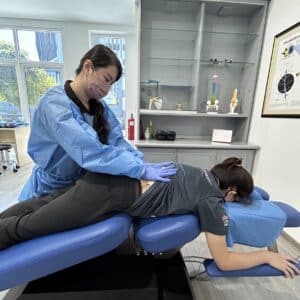
Flexion-distraction and other table-assisted methods
Flexion-distraction, also known as Cox Technic, is a chiropractic method performed on a table that flexes the lower spine in a slow, rhythmic motion while the practitioner guides the movement by hand. It is a lower-force alternative to twisting manipulation and is often used for people with disc-related or facet-related back and leg pain.
The research on flexion-distraction is limited. It is used for selected presentations as one part of a plan that includes exercise and activity guidance, and its use is never presented as decompressing, repairing, rehydrating, restoring or realigning a disc. The separate flexion-distraction guide explains the method’s scope and limitations.
Non-surgical spinal decompression
Non-surgical spinal decompression is another table-assisted method that may be considered for selected people with a disc problem, as one part of a broader plan. Suitability and alternatives are decided at an individual assessment, and the spinal decompression guide explains how the method is used.
Adjunct physiotherapy modalities
Heat, cold, electrotherapy, therapeutic ultrasound, high-intensity laser, or shockwave may be considered for selected associated muscle or soft-tissue symptoms. These are adjunct options that support assessment and rehabilitation, and none is described as repairing a spinal disc.
Related service pages: therapeutic ultrasound; high-intensity laser therapy; and shockwave therapy.
Posture, workstation, and activity guidance
Advice may cover position changes, desk setup, driving, lifting, sleep, pacing, and gradual return to activity. The aim is better task fit and more movement variety rather than one perfect posture.
See the practical guide to desk, screen, and workstation setup.
For an overview of available services, see Services at Chiropractic Specialty Center and spine and joint rehabilitation.
What You Can Do While Waiting for an Assessment
General self-care may be reasonable when the concerning symptoms described on this page are absent. The following suggestions are educational, and each person adapts them to their own situation:
- Continue ordinary activity as tolerated and avoid prolonged bed rest unless a medical professional has advised otherwise.
- Change position regularly during sitting, standing, work, study, driving, or travel. Movement variety matters more than holding one perfect posture all day.
- Temporarily reduce or modify movements that repeatedly intensify symptoms, especially sudden heavy lifting, repeated loaded bending, or twisting while the cause is uncertain.
- Use heat or cold for comfort only when appropriate for your health and with the skin protected. Stop if symptoms worsen or the skin becomes irritated.
- Avoid forceful self-manipulation, repeated “testing” of a painful movement, or aggressive stretching into worsening leg symptoms.
- Discuss medication with a pharmacist or doctor, particularly during pregnancy, with kidney or stomach problems, when taking anticoagulants, or when using other medicines.
- Seek assessment sooner when symptoms are severe, recurrent, worsening, associated with leg weakness or numbness, or affecting sleep, walking, work, school, or daily activity.
How Long Can Back Pain Last?
Many recent episodes improve over time, but the course varies. Some people recover steadily, some improve and then flare again, and others develop persistent symptoms that require a broader review of physical, medical, sleep, work, and psychosocial factors. Recovery time is judged from progress rather than from an online page, a pain score, or an MRI label.
Persistent symptoms can occur without ongoing damage to the spine, and a persistent scan finding may explain only part of the picture. New neurological change, significant trauma, or systemic warning signs are assessed afresh rather than treated as an ordinary recurrence. Progress is judged through function, symptom behavior, neurological findings, daily activity, and agreed goals rather than one isolated measure.
Back Pain in Pregnancy, Older Adults and Children
Pregnancy and after delivery
When to Contact Your Obstetric Team |
Pregnancy and the postnatal period can change load, posture, ligament behavior, sleep, lifting demands, and muscle function. Back or pelvic pain may be musculoskeletal, but obstetric, urinary, abdominal, vascular, and other causes must be considered first when the pattern is unusual or warning signs are present.
When musculoskeletal assessment is appropriate, care is modified for pregnancy stage, comfort, medical history, and obstetric advice, and the method is chosen for each pregnancy.
Related reading includes back pain in pregnancy; lower-back pain and pregnancy; pregnancy-related hip pain; pregnancy pelvic pain; pregnancy-focused chiropractic information; and round ligament pain.
Older adults, osteoporosis, medication use and previous surgery
Suitability depends on more than age. Assessment considers osteoporosis or fracture risk, anticoagulant use, steroid use, cancer history, balance, falls, neurological findings, cardiovascular or vascular concerns, previous surgery, implanted devices, and other health conditions.
Lower-force or modified care may be considered for some people; others may need imaging, medical clearance, specialist review, or a different pathway. Every approach carries some risk and suits some people more than others.
Children and adolescents
Persistent or severe back pain in a child or adolescent deserves age-appropriate assessment. Medical review is particularly important after significant trauma or when pain occurs with fever, night symptoms, unexplained weight change, weakness, numbness, walking difficulty, bladder or bowel change, or other general illness. A child’s care is planned for the child rather than copied from an adult program, with parental or guardian involvement, consent, growth, sport, school demands, and referral needs taken into account.
Back pain in children and teenagers is assessed with growth in mind, and the guide to chiropractic care for children explains the first visit, gentle methods for each age and when a doctor comes first.
Where to Seek Assessment at CSC
Chiropractic Specialty Center currently operates two active centers, both in Kuala Lumpur. Readers from Petaling Jaya and Selangor may choose either location according to travel route and appointment availability. This page does not represent a physical CSC center in Petaling Jaya or elsewhere in Selangor.
Center | Current public details and contact route |
Bukit Damansara, Kuala Lumpur | No. 71, Jalan Medan Setia 1, Plaza Damansara, Bukit Damansara, 50490 Kuala Lumpur. |
Bandar Sri Damansara, Kuala Lumpur | 8-G, Jalan Damar SD 15/1, Bandar Sri Damansara, 52200 Kuala Lumpur. |
Regular hours shown for both centers are Monday to Friday, 8:00 AM to 8:00 PM, and Saturday to Sunday, 8:00 AM to 6:00 PM. Public-holiday hours and practitioner availability may differ, so check the relevant branch page before traveling.
Fees for this and related services are listed on our chiropractic price in Kuala Lumpur and physiotherapy fees in Kuala Lumpur pages.
Related Disc, Nerve, and Spine Topics
These guides explain the disc and MRI terms, the nerve and limb symptoms, and the other spine conditions that often come up alongside back pain.
Disc and MRI terminology
- Spinal Discs: What They Do and How They Change
- Degenerative Disc Disease: What the Term Describes
- Disc Bulge: Causes, Symptoms & Non-Surgical Care
- Prolapsed Disc: What Is Really Happening Inside the Spine?
- Disc Protrusion: What Is Actually Happening Inside the Disc?
- Herniated Disc Care in Kuala Lumpur
- Extruded Disc Non-Surgical Spine Care Strategies
- What Are the Causes of a Herniated Disc?
- Fragmented Disc Care in KL: Non-Surgical Options
- Slip Disc: What the Non-Surgical Options Involve
Nerve and limb symptoms
- Sciatica Treatment: What the First Weeks Involve
- How the Sciatic Nerve Influences Movement and Stability
- Pinched Nerve in KL: Targeted, Non-Invasive Care
- Nerve Pain: Why It Happens and How It Is Assessed
- Leg Pain: Causes and Nerve-Related Signs
- Lower Extremity Care: Hip, Knee, Ankle & Foot Help in Malaysia KL
- Upper Extremity Care: Non-Invasive Methods in KL
Frequently Asked Questions
What can cause back pain?
When does back pain need prompt medical attention?
Is leg pain always sciatica?
Do I need an MRI or X-ray for back pain?
Should I rest or stay active with back pain?
Is chiropractic suitable for everyone with back pain?
What happens at the first visit for back pain?
How many visits will I need for back pain?
Can back pain in pregnancy or older age be assessed at CSC?
Where are CSC’s centers, and how do I choose one?
This page is general education about back pain and cannot assess an individual reader’s own situation. Similar symptoms can arise from different conditions, and several factors can occur together. Diagnosing the cause, deciding whether a particular procedure is suitable, interpreting a scan and predicting an outcome all belong to an individual assessment, which also sets the right next step, whether self-management, routine assessment, medical review, imaging, specialist referral, or emergency care.
References
- Brinjikji W, Luetmer PH, Comstock B, et al. Systematic literature review of imaging features of spinal degeneration in asymptomatic populations. AJNR Am J Neuroradiol. 2015;36(4):811-816.
- Hayden JA, Ellis J, Ogilvie R, Malmivaara A, van Tulder MW. Exercise therapy for chronic low back pain. Cochrane Database Syst Rev. 2021;9:CD009790.
- Schäfer A, Hall T, Briffa K. Classification of low back-related leg pain: a proposed patho-mechanism-based approach. Man Ther. 2009;14(2):222-230.
- Mistry J, Falla D, Noblet T, Heneghan NR, Rushton A. Clinical indicators to identify neuropathic pain in low back related leg pain: a modified Delphi study. BMC Musculoskelet Disord. 2020;21(1):601.
These references describe the assessment and management of back pain in general. None of them evaluates care at Chiropractic Specialty Center.
The Author of Back Pain Treatment in Kuala Lumpur: Assessment and Care
Back Pain Treatment in Kuala Lumpur: Assessment and Care was written by Yama Zafer, D.C., who has 30+ years in chiropractic and physiotherapy and founded Chiropractic Specialty Center in Kuala Lumpur in 2006.
Last Updated: Back Pain Treatment: Assessment, Causes and Care Options
Back Pain Treatment: Assessment, Causes and Care Options was last reviewed and updated on October 3, 2026.
Share with others: