

What Is a Disc Protrusion? Meaning, MRI Locations and Care
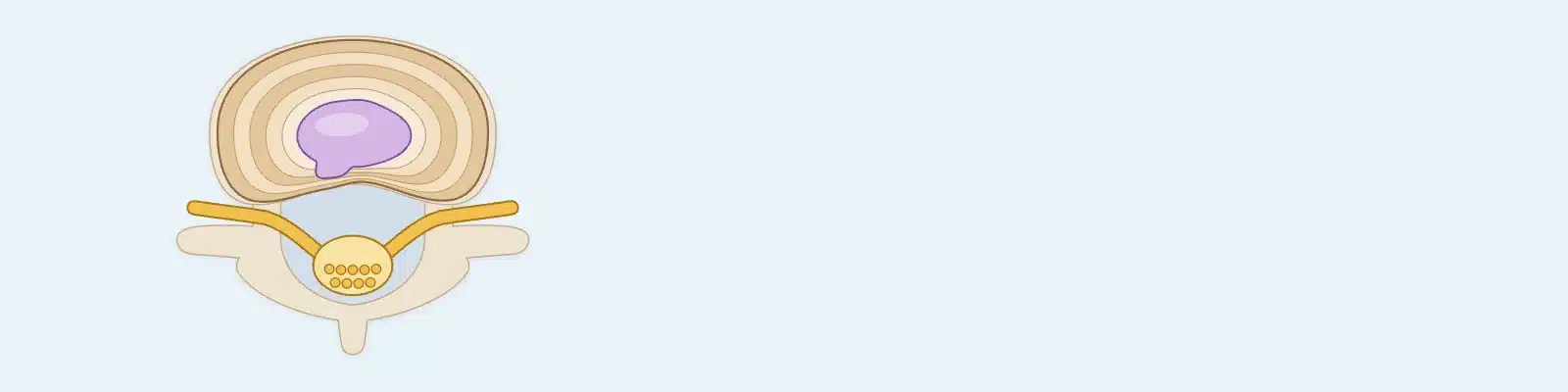
A disc protrusion is a slipped disc whose soft center has migrated toward the canal or a nerve opening, while the outer fibers stay unbroken. A protruded disc is still contained, one stage past a bulge and one short of a prolapse. Contained does not mean harmless: it can press on the nerve sac or a nerve root, depending on whether it points central, subarticular or foraminal. The pain can then follow that nerve into a leg or arm, often with numbness, tingling or weakness.
Degeneration comes first: as my Back Pain to Leg Pain talk makes clear, no disc protrudes without it. Long sitting, slouching over a screen and lifting while bent raise the pressure inside the disc. Its center then drifts back, toward the nerves.
If you bring an MRI, I almost always study its images before examining you, then plan focused care from both. The plan can draw on chiropractic manipulation that is non-rotatory using the Activator instrument, physiotherapy, trigger point work and, once the spine is stable, exercise. Care is kept within what you can comfortably tolerate, with no twisting or cracking. The sections below cover my short video, each direction, symptoms, daily habits and surgery.
For more information about a disc protrusion, contact the Bukit Damansara (KL) main center: WhatsApp+60 17 269 1873 Call+603 2093 1000
Disc Protrusion: Key Takeaways
| Question | Short answer |
|---|---|
| What does protrusion mean in the spine? | Protrusion means pushing outward. In my stages, the word marks where the disc's center starts to move, though some swap it with prolapse. My short video Protruded Disc: What You Need to Know defines it in 15 seconds. |
| Is a disc protrusion serious? | Yes. In my words, “Anytime a disc protrudes beyond its confined normal borders, it becomes serious.” On my 0-to-10 scale, one pressing on the nerve sac or on a nerve root rates 3 to 5. |
| How is a protrusion different from a bulge or a herniation? | In a bulge, the fibers have swollen but the center has not migrated yet. In a protrusion, it has moved outward, still held by the outer fibers. In a herniation, the last fibers tear. |
| What is a subarticular disc protrusion? | A subarticular disc protrusion points to one side of the spinal canal, beneath the facet joint, where the root crossing that disc runs. At L4-L5, that is the L5 root, judged by the pain's path and the MRI. |
| Can a disc protrusion hide on an MRI? | Yes. An MRI is taken lying down, so a protrusion can look like a mere bulge on the report. Upright, after hours of sitting, the body's weight presses down on it, and the truth comes out in the symptoms. |
| Should a disc protrusion be stretched? | Not with general stretching or side bending, which my Back Pain to Leg Pain talk warns can push disc material toward a weak spot. In my words, “That protrusion can end up with a fragmentation or partial tear.” |
| Which signs are urgent? | New numbness around the genitals or anus, new difficulty passing urine, or loss of bladder or bowel control needs urgent medical attention at a hospital emergency department straight away, within hours. |
Disc Protrusion Guide: Sections at a Glance
- Protruded Disc: Past the Bulge, Short of a Prolapse
- Where to Find This Type of Disc Care in Kuala Lumpur
- Video: My 15-Second Definition of a Protruded Disc
- Central, Subarticular or Foraminal: Where a Disc Protrusion Points
- Protruded Disc Symptoms, Near the Spine and Away From It
- When to Pay Closer Attention
- How Disc Problems Develop and Affect Movement: My Full Talk
- Why a Contained Disc Can Still Affect Nerves
- How a Disc Protrusion Develops Over Time
- Daily Habits That Load a Protruded Disc
- How Care Is Structured Around Movement and Function
- How Disc Protrusion Care Is Approached Without Surgery
- Why Muscle Response Matters in Disc Changes
- Related Guides on Discs, Nerves and Care
- Common Questions About Disc Protrusion
- How to Read This Guide
Protruded Disc: Past the Bulge, Short of a Prolapse
A protruded disc is the third step on the path of disc damage, after a damaged disc and a bulge. In my short videos, each stage grows out of the one before it; in a protrusion, the center itself migrates outward. Everyday speech groups all of these stages under slip disc, though each describes a different change.
| Stage | What has happened | Can it press on a nerve? |
|---|---|---|
| Bulge | The outer fibers have swollen more than usual; the center has not moved | No, by my definition |
| Protrusion | The center has migrated toward the spinal canal or a foramen, a nerve's side opening, and the outer fibers still hold it | Yes, once it has grown far enough |
| Prolapse | The center is held in by only its last few outer fibers | Yes |
Before the bulge comes the damaged disc, drying out and losing its elasticity, so it spreads load less evenly. After the prolapse comes the herniation, also known as a rupture, when the last outer fibers tear. In an extrusion, the center is then pushed out to the disc's outer edge, and fragmentation follows. Fragmentation comes in two kinds, partial and full, and the full kind is a sequestered disc.
My Back Pain to Leg Pain talk sets the order out plainly: “One stage follows the other.” In the same talk, I note that the two names are used interchangeably, “depending on who you ask”. My short videos, and this guide, keep the protrusion first.
Not every protrusion causes noticeable symptoms. The stages section of the herniated disc guide follows the whole path in more depth.
Where to Find This Type of Disc Care in Kuala Lumpur
A disc protrusion can be assessed at either CSC center in Kuala Lumpur, where chiropractic, physiotherapy and rehabilitation are combined in one structured plan. The first visit runs in this order:
- I read the history form and any reports or imaging brought along, so my questions fit the case.
- The examination checks movement and uses orthopedic tests, such as the straight leg raise, which lifts the straightened leg to see when pain comes on.
- It tests the reflexes, skin sensation and strength of the nerve a protrusion may reach.
- Without a scan, an MRI is arranged only when the history and examination suggest a disc or joint problem.
Please bring the MRI images themselves, on CD or film, not just the report. The CSC locations page keeps the hours and addresses of both centers.
Chiropractic Specialty Center Bukit Damansara, Kuala Lumpur
Bukit Damansara (KL, main center): Call +603 2093 1000 or WhatsApp +60 17 269 1873 to see the Bukit Damansara / KL center.
This center also serves nearby Bangsar, Sri Hartamas, Mont Kiara and TTDI. A call or a WhatsApp message finds the CSC center nearest you.
Opening hours: Monday to Friday, 8:00 AM to 8:00 PM; Saturday and Sunday, 8:00 AM to 6:00 PM.
Learn more on the Bukit Damansara contact page.
Chiropractic Specialty Center Bandar Sri Damansara, Kuala Lumpur
Bandar Sri Damansara (KL): Call +603 6262 5777 or WhatsApp +60 12 455 6939 to see the Bandar Sri Damansara center.
This center also serves nearby Petaling Jaya.
Opening hours: Monday to Friday, 8:00 AM to 8:00 PM; Saturday and Sunday, 8:00 AM to 6:00 PM.
Learn more on the Bandar Sri Damansara contact page.
Video: My 15-Second Definition of a Protruded Disc
A protruded disc has a center that has moved outward but is still held in. My short video Protruded Disc: What You Need to Know explains it in plain, everyday language, in 15 seconds. These are its words:
“Protruded disc is a description for a slip disc, where the center of the disc migrates outwards towards the spinal canal or foramina, but does not break through the outer fibers of the spinal disc. In essence, it is a progression of the disc bulge and as such, it is still contained.”
Foramina are the side openings through which nerve roots leave the spine; each one is a foramen.
Central, Subarticular or Foraminal: Where a Disc Protrusion Points
Where a disc protrusion points decides which nerve tissue it can reach, so an MRI report names its direction. Location often matters more than size: in my view, it is the tissue a protrusion touches that sets how serious it is. The report words, from the middle outward:
- Central: aimed at the middle of the spinal canal, where the thecal sac, the sac holding the nerves, lies. In the neck, a central protrusion faces the spinal cord itself.
- Subarticular: toward one side of the canal, beneath the edge of the facet joint, where the nerve root crossing that disc runs. Facet joints link each vertebra to the next at the back of the spine.
- Foraminal: into the foramen, the side opening through which the nerve root of that level leaves the spine.
- Extraforaminal: beyond that opening, farther out along the nerve's path.

L4-L5 is the most common level for disc problems, as my Back Pain to Leg Pain talk notes. At that level, a subarticular protrusion can press on the L5 root. I confirm it in two ways: the pain follows the L5 nerve and its skin area, and the MRI shows that root touched or squeezed.
In the neck, I see protrusions most often at C5-C6, the level that moves most, and next at the levels on either side of it. The guides to C4-C5, C5-C6 and C6-C7 cover each of those levels.
Does the Size of a Protruded Disc Matter Most?
Not always; with a protruded disc, what it touches often matters more than its size. A slight protrusion beside a nerve root can matter more than a larger one pointing at nothing sensitive. That is why two people with similar scan findings can have very different symptoms.
Once a protrusion displaces the thecal sac, crowds a foramen or meets a nerve root, it rates 3 to 5 on my seriousness scale. The scale runs from 0, not serious at all, to 10, life-altering and critical.
Focal, Broad-Based and Posterior on a Report
Focal, broad-based and posterior are the words an MRI report uses for a disc protrusion's shape and side. A focal protrusion, as I describe it in my Back Pain to Leg Pain talk, is a single point where disc material is coming out. A broad-based protrusion spreads along a wider stretch of the disc's edge.
Reports measure focal and broad-based by how far the change runs around the disc's rim. A focal protrusion covers less than a quarter of the way around, and a broad-based one more than a quarter. When a report pairs broad-based with foraminal, I often find a larger change, present for months or years or following an injury.
Posterior means toward the back of the disc. In Bulging Disc vs Herniated Disc, I explain why that side matters more than the front: the spinal cord and nerves lie there. Where a protrusion points also shapes the slip disc symptoms people describe, because the nerve it reaches decides where they are felt.
Protruded Disc Symptoms, Near the Spine and Away From It
Protruded disc symptoms depend on whether the disc irritates a nearby nerve, and many protrusions cause none at all. My Back Pain to Leg Pain talk is blunt on this point: “the most common symptom of spinal disc damage is zero.” When a nerve is irritated, the effects are often felt away from the spine, along that nerve's path. The pattern of symptoms says more than the word on the report.
From the lower back, pain often starts as a cramp-like ache around the low back or buttock. I describe it in Bulging Disc vs Herniated Disc. It can then run down the leg like sciatica.
In Sciatica vs Slipped Disc, I set out the usual order: the pain turns into numbness and tingling, and eventually weakness. In the lower back, a protrusion can bring:
- Back or buttock pain, often worse with long sitting or bending forward, and easier when walking.
- Pain, numbness or tingling down one leg, along a single nerve.
- A leg that tires or gives way, or a foot that catches.
- Sitting or walking tolerated for shorter spells than before.
Weakness can come without pain. In my Back Pain to Leg Pain talk, I tell of patients whose only complaint is weak legs, with no back pain at all. Once a damaged disc's pain-sensing nerve stops working, the warning never comes.
From the neck, it can bring:
- Pain, numbness, tingling or burning into the shoulder, arm, hand or fingers.
- Discomfort between the shoulder blades.
- Altered feeling in the hand, or a weaker grip.
- Discomfort when tilting the head up. My Back Pain to Leg Pain talk calls this a common sign of a pinched nerve. The cause is more than likely a disc or wear in the neck joints.
Why Can a Spinal Disc Affect an Arm or Leg?
A spinal disc can affect an arm or a leg because each spinal nerve runs from the spine to its own region of the body. A nerve irritated at the disc therefore responds along its whole path, not only at the source. That is why a protrusion low in the back can be felt in the calf or foot, and one in the neck in the fingers.
When to Pay Closer Attention
Most disc problems develop gradually and differ from person to person, but a few changes need closer attention.
With a lumbar disc protrusion, when numbness comes with back or leg pain, its location and whether it is changing matter. New or worsening numbness around your genitals, between your genitals and anus, or around your anus needs urgent medical attention: a thorough assessment at a hospital emergency department straight away, within hours. New difficulty passing urine needs the same, even if you still control your bladder and bowels, and so does any loss of that control. These symptoms can have several causes. Some may call for an invasive procedure, but an assessment helps explain them and does not automatically mean you need surgery.
Leg weakness that keeps getting worse should not be ignored. It calls for a careful assessment by a competent provider, and conservative care can continue only while the weakness itself is improving. Arm weakness that keeps getting worse needs the same careful assessment, and so does walking or coordination that grows harder. So do nerve symptoms that worsen quickly over a short period.
A protrusion in the neck that presses on the spinal cord can reach far beyond the arms and hands. My Back Pain to Leg Pain talk lists the signs it can bring:
- Symptoms reaching as low as the legs.
- Weakness.
- Being unable to walk or stand.
- Digestive disturbances.
- Heart palpitations.
- Breathing problems.
Each of these needs a prompt medical assessment. These situations are less common, but they can mean the spine or nearby nerves are affected in a more significant way. Noticing them early means the right steps can be taken at the right time.
How Disc Problems Develop and Affect Movement: My Full Talk
My Back Pain to Leg Pain talk covers disc damage at full length, 1 hour 47 minutes, before a live audience. It walks through how spinal discs change over time, how pressure builds inside them, and how those changes reach the nerves and alter movement.
Key Moments
- 06:22 The disc's two parts: its soft center (nucleus pulposus) and outer ring (annulus fibrosus)
- 20:50 Why a damaged disc becomes painful
- 28:49 The stages: bulge, protrusion, herniation
- 33:24 Protrusion or prolapse: “depending on who you ask”
- 35:38 Localized pain, and radicular pain that travels along a nerve
- 38:00 How sitting raises the pressure inside the disc
- 42:29 What can and cannot enter the disc
- 59:42 Protrusion and prolapse: damaged but still contained
- 1:01:42 What a “focal protrusion” on a report shows
- 1:07:44 Why general stretching and side bending are left out
- 1:12:46 Sciatica: a symptom, not a diagnosis
For a protrusion, the moments at 28:49, 33:24, 59:42 and 1:01:42 matter most. The talk as a whole connects the disc's structure, movement and daily habits into one picture.
Why a Contained Disc Can Still Affect Nerves
A contained disc can still affect nerves, because a protrusion does not need to rupture to cause trouble. By my definition, once a protrusion's outward swelling has grown far enough, it presses on the thecal sac, the nerves or both. In Why Spinal Discs Get Damaged, I describe how, as the outer fibers weaken, the center “continuously protrudes outwards, towards sensitive neuronal tissues”.
As pressure becomes uneven inside the disc, it starts to affect the space around it and how load is handled at that level. That can mean:
- Less room around a nerve root.
- Pressure gathering at one spot on the disc's edge.
- Altered movement at the affected level.
These changes can affect how a nerve responds in everyday activity, without any rupture at all.

Why Don't MRI Findings Always Match the Symptoms?
An MRI shows the structure of the spine, not how it behaves in movement. It is also taken lying down, often after a night's rest, when the disc is full of fluid. When symptoms come with sitting or driving but the report says bulge, I look for one of two things. Either a facet joint is involved, or a protrusion is hiding as a bulge.
After hours upright or seated, the body's weight comes down on that disc, and the slight swelling no longer stays slight. As I put it, “the truth comes out”. Normal life then waits until long sitting and driving stay free of symptoms. Keeping it that way takes the exercises, the daily changes and the preventive plan; a normal, active life is the aim.
Disc changes are common on MRI, even in people who notice nothing in daily life. A scan does not show how load spreads through the spine, how movement patterns change over time or how nerves respond in activity.
Imaging matters all the same. In Is Chiropractic Safe? 13 Questions Answered, I point out that “the spinal disc itself ranges between 6 to 10 centimeters beneath your skin.” Imaging, I explain there, shows not only the type of problem but how deep it lies. That is why the report is always read against the images and my examination, since a scan is one part of the picture.
How a Disc Protrusion Develops Over Time
A disc protrusion develops gradually, as a disc already weakened by degeneration keeps carrying load. Of all the causes of disc damage, axial load bearing comes first in my Back Pain to Leg Pain talk. It means the weight of the head and trunk bearing down on each disc, hour after hour.
The center usually pushes backward, for a reason I give in my Back Pain to Leg Pain talk. The ligament along the front of the spine is thick and strong. The one along the back is thinner, to leave room for the spinal cord. That back ligament is the weaker point, and a damaged disc migrates toward it, where the nerves are.
A disc also depends on movement to stay nourished. Through imbibition, it draws in fluid and nutrients as the pressure on it changes, most of all when that pressure is low, as in sleep. That uptake, I point out in my Back Pain to Leg Pain talk, makes people measurably taller in the morning than in the evening.
In the same talk, I explain that nutrients cannot enter a disc whose inner pressure is greater than the force of the blood coming in. When movement becomes limited, repetitive or uneven, that exchange works less well. Hydration falls, and pressure gathers in one area instead of spreading. Part of the disc can then shift outward while the outer layer still holds: that is how a protrusion forms.
In the KL office workers I see with back pain, three habits come up most often. They are prolonged sitting, sitting in poor posture, and mild problems ignored for months or years.
A protrusion seldom comes from a single event; it reflects daily habits, movement patterns and sustained positions over time. Earlier injuries count too, and so do genetics. Age plays a part, but in my view never on its own. Every load named here is covered in What Are the Causes of a Herniated Disc?
Daily Habits That Load a Protruded Disc
A protruded disc can change how the spine copes with sitting, bending and staying in one position, even while it remains contained. Disc problems are never only about the disc: they change how the body moves, responds and adapts every day. A session at CSC fills a small part of the day. “What about the other 22 hours?” is the question I put in Sciatica vs Slipped Disc, and these habits answer it:
- Sitting: with back pain, no more than 15 to 20 minutes at a stretch. Then stand, walk and move around for 30 seconds to a minute. My 30 to 40 minute interval is for people with no back problem.
- Driving: with acute, intense back pain, about 15 minutes at a time and never over 20 to 30 minutes before a safe stop. Each stop includes a short walk, and a gentle calf stretch joins it once the pain is no longer acute.
- Bending, twisting and lifting: kept to zero at the waist, above all while holding anything. Lifting is avoided, or kept below 2 kg when it cannot be.
- Gym and sport: no deadlifts or free weights. As for swimming, my Back Pain to Leg Pain talk puts it this way: “It's better to walk in water than swimming”. Laps can leave a damaged disc hurting that night.
- Yoga and stretching: yoga must be avoided with a protruded disc, because so many of its poses twist or fold the spine. In the early stage I prescribe no stretching at all, and general stretching and side bending stay out.
- Heat and ice: no hot packs on the back or neck. Ice wrapped in a cloth takes their place, 10 to 15 minutes at a time. Use it two or three times daily, at least two hours apart.
- Sleep: in Neck and Back Self-Help Tips, I call posture and sleep the two most critical habits. There I ask for at least six hours; my Back Pain to Leg Pain talk sets seven to eight unbroken hours as the goal. The right side comes first for sleep, then the left; lying on the back, the knees rest on a bolster. Either way, the spine stays in one line.
An activity that hurts at the time, or in the 72 hours after it, comes off the list. Inflammation can take that long to show.
In my Back Pain to Leg Pain talk, I go further: “The most important thing is not the treatment. The most important thing is to make lifestyle changes.” When the pain is significant, I add, treatment starts alongside those habit changes.
How Care Is Structured Around Movement and Function
When I speak of conservative care for a disc protrusion, I mean focused care, never routine treatment. It is drawn up from the MRI and my examination and aimed at the causes they show. It looks at the lower back or the neck as one connected region, and it must do no harm. Many conservative therapies, in my opinion, are useless.
Care, as I set it up, rests on four conditions. The diagnosis must be accurate and the plan sound. The care is given with as few flaws as possible, while posture, habits and daily activity change alongside it. The aim is more of what benefits the disc and less of what harms it.
I am never aggressive with a disc, not even the slightest bulge, and a protrusion is a step further along. Care therefore starts with gentle, non-rotatory methods aimed at the disc, by hand or on a machine. The chiropractors and physiotherapists work on it together. Is Chiropractic Safe? 13 Questions Answered gives my rule: “Don't choose between one or the other. Choose both.”
Care is adapted to each person rather than built on a single method. Depending on the findings, a plan can draw on:
- Chiropractic manipulation that is non-rotatory using the Activator instrument. Two other non-rotatory methods may be used. SOT blocking positions the pelvis on padded wedges. In the Thompson technique, a section of the table gives way slightly as the adjustment is made. Each aims to move the joints in a measured way, without twisting.
- Flexion-distraction, in which a moving table flexes the lower back and gently draws it apart.
- Spinal decompression in selected cases, a gradual pull along the spine on a motorized table, following NSD Therapy® methods and protocols.
- Physiotherapy with guided exercise and structured rehabilitation for how the spine handles load. The exercise begins once the spine is stable, between the fifth and seventh sessions for most people and from the third for some.
- Trigger point and myofascial work on the lower back, hips and thighs, or the neck, shoulders and chest.
- High-intensity laser therapy. My Back Pain to Leg Pain talk says it should be mildly warm, never hot.
- Shockwave therapy (ESWT), ultrasound or electrotherapy for the tissues around the disc.
- Cold therapy with the QMD, a machine that can cool or warm. Its heat setting is not used on a spine with a disc or facet joint problem.
Each plan looks at three areas:
- Mechanical: how the spine moves, carries load and responds to positions through the day.
- Biological: how the disc and the tissues around it respond over time, including hydration and sensitivity.
- Neuromuscular: how the muscles steady the spine and shape its movement. Balance work on a rocker board stays in the clinic, where someone is on hand to hold you.
Each area plays its own part, and together they shape how the spine works through the day.
With a protruded disc, the spine is never twisted or cracked, whatever the disc is touching. In Sciatica vs Slipped Disc, I say rotary manipulation waits until I am 100 percent sure a spine has no disc damage. My reason: “Because how can you be sure? So it's better to be safe than sorry.”
Care is kept within what you can comfortably tolerate. Discomfort during care means it is being done too aggressively, so tell the clinician at once. Possible effects and risks are explained before care begins.
Is Chiropractic Safe? 13 Questions Answered also sets two checkpoints of mine. A fifth session with no improvement calls for a fresh assessment to find the reason. A tenth without any means deciding together whether to go on. At each review I repeat the first visit's tests, record a pain score and ask what the person has noticed.
How Disc Protrusion Care Is Approached Without Surgery
Surgery is the last option for a disc protrusion in my approach. Sciatica vs Slipped Disc states my position: “Surgery should be the last option. Exhaust conservative route.” By that route I mean focused conservative care, given properly and long enough to judge it.
Surgery comes into the discussion only when that care has not worked, or sooner in a severe case, such as an infection. Invasive procedures have their place, as I also say in Sciatica vs Slipped Disc. There are cases where my form of care is not enough. Steroid injections are not something I recommend.
New numbness around the genitals or anus, new difficulty passing urine, or loss of bladder or bowel control needs urgent medical attention at a hospital emergency department straight away, within hours.
Each type of disc operation, with its possible complications, is described in Spine Surgery Risks & Non-Invasive Alternatives.
Why Muscle Response Matters in Disc Changes
Muscle response plays a large part in how the body adapts to a disc protrusion. In Sciatica vs Slipped Disc, I explain why. With a lower back protrusion, the back, buttock, hamstring, outer-thigh (IT band) and calf muscles share nerve fibers with the sciatic nerve. They tighten, cramp or stay tense, trigger points form, and the fascia covering them loses its elasticity.
That guarding changes how the spine moves and carries load. It can mean:
- Less movement at the affected level.
- More compression in certain positions.
- Load shifted onto other parts of the spine.
A spinal disc lies deep beneath layers of muscle and fascia, so muscle work never aims force at the disc itself. It aims at how the surrounding tissues move and share the load. In Sciatica vs Slipped Disc, I explain that I therefore check for trigger points and myofascial points. Treating the disc alone, and not these muscles, falls short.
Overly forceful or deep pressure can increase muscle guarding rather than settle it. Tight muscles then add stress to the joints, the nerves and the disc. In Neck Trigger Points and Exercises, I explain that tensing up against the pressure works against the release. Muscle work is therefore controlled and measured, and kept within what you can comfortably tolerate.
In the neck, the path tends to run the other way. Neck Trigger Points and Exercises also traces how a neck problem often starts in the muscles and, given time, spreads to the joints. In the end it reaches the discs, as a bulge, a protrusion or a herniation. The aim of care is a spine that moves more evenly and shares load better through the day.
Fees are listed item by item on two pages, one for chiropractic prices in Kuala Lumpur and one for physiotherapy prices in Kuala Lumpur. The fee for a plan is explained and agreed before care begins.
Related Guides on Discs, Nerves and Care
Readers looking into a disc protrusion often go on to slipped discs, Schmorl's nodes and the stages on either side of this one. Beyond the disc itself, the back pain guide covers the lower back, the pelvis and the legs as one region.
Disc Stages
- Herniated Disc Treatment in Kuala Lumpur: Signs, Causes and Care
- Degenerative Disc Disease: Desiccation, Stages and Treatment
- Disc Bulge: Meaning, Symptoms, Treatment & Can It Be Reversed?
- What Is a Prolapsed Disc in the Spine? Symptoms, Causes and Care
- What Is an Extruded Disc? Meaning, Symptoms and Care in KL
- Fragmented Disc: Partial or Sequestered, Symptoms and Treatment
- What Are the Causes of a Herniated Disc?
- Slip Disc Explained: Causes, Stages, Symptoms and Care
- Schmorl’s Nodes: What They Are and What They Mean
Symptoms, Nerves and Levels
- Slip Disc Symptoms and What They Point To
- Sciatica Treatment: What the First Weeks Involve
- Lower Back Pain, Discs, Nerves & Non-Invasive Care
- Neck and Upper Back Care in Kuala Lumpur
- Nerve Pain: Why It Happens and How It Is Assessed
- L4-L5 Herniated or Slipped Disc: Symptoms, Causes and Care
- L5-S1 Herniated Disc: Symptoms, Treatment and Recovery Time
- C5-C6 Disc Changes and Non-Invasive Neck Care
- C6-C7: What Symptoms at This Neck Level Mean
Care and Videos
- Slip Disc Treatment in Kuala Lumpur, Matched to Each Stage
- Spinal Decompression Therapy in Kuala Lumpur
- Spine Surgery Risks & Non-Invasive Alternatives
- Back Pain Treatment in Kuala Lumpur: Symptoms, Causes and Care
- Back Pain to Leg Pain Video: Disc or Sciatica?
- Sciatica vs Slipped Disc: Video Explanation
- Bulging Disc vs Herniated Disc: Video Guide
Common Questions About Disc Protrusion
Most people want to know what a disc protrusion means for them, how it develops and how it affects daily movement. The answers below take the questions asked most often.
Is every protrusion a slipped disc?
Yes. Every protrusion is a form of what most people call a slipped disc. My short video Protruded Disc: What You Need to Know describes it as a slip disc whose center migrates outward.
Slipped disc is the everyday name for every stage, from a bulge to fragmentation. The disc itself does not slip, though; my Back Pain to Leg Pain talk is frank about that. Its center moves while the disc stays between its two vertebrae. The slip disc care guide in Kuala Lumpur sets out the options across the stages.
Can a protruded disc be present without symptoms?
Yes, a protruded disc can be present without symptoms, often for a long time. My Back Pain to Leg Pain talk describes what scans often show me. From a disc's appearance, I can make an educated guess at how long the problem has been there. In most cases it is decades, in someone who never had pain.
No pain does not mean the back is perfectly fine, though. A protruded disc seen by chance on an MRI is still a reason to watch sitting, lifting and other daily loads. In my view, disc damage is progressive.
Does a disc protrusion always get worse over time?
In my view, the damage behind a disc protrusion is progressive and never fully reverses, though its pace varies. Why Spinal Discs Get Damaged describes it as “a progressive condition”. My Back Pain to Leg Pain talk adds, “Once you have a damaged disc, it can go rapidly or it can take years.”
Daily load sets much of that pace. Long sitting, lifting while bent or twisted, and side bending push a protrusion further, while sitting breaks, walking and enough sleep spare it. Symptoms can quiet down while the damage stays, so a calm spell is no reason to drop those habits.
Can sitting increase stress on a protruded disc?
Yes, long sitting adds stress to a protruded disc. My Back Pain to Leg Pain talk explains what upright sitting does. The weight of the body comes down “crushing on our spinal joints and on our discs”. Leaning forward adds to it, and in long, still sitting that pressure keeps building.
With back pain, I ask you to get up every 15 to 20 minutes and spend 30 seconds to a minute standing, walking and moving. The 30 to 40 minute interval in my rule is for people with no back problem. My Desk Posture Mistakes video shows the chair, desk and screen setup I recommend.
How does movement influence a protruded disc?
Movement decides how pressure spreads through a protruded disc and how the muscles and joints around it share the load. I encourage walking: in Sciatica vs Slipped Disc, I say it mobilizes the joints, and “Mobility is good.” Some movements load a protrusion badly. I ask people to leave out bending and twisting at the waist, general stretching and side bending.
What type of chiropractic approach is used for a disc protrusion?
Only non-rotatory methods are used for a disc protrusion, aimed at joint motion without twisting forces. At CSC, that includes chiropractic manipulation that is non-rotatory using the Activator instrument. SOT blocking, flexion-distraction or the Thompson technique are added where they suit the case.
In Is Chiropractic Safe? 13 Questions Answered, I give these four as examples of chiropractic care without twisting, for disc issues or nerve compression. Anything more forceful, that video warns, “is going to create inflammatory processes or perhaps even worsen the disc damage you already have.” The spine is never twisted or cracked.
What physiotherapy approach is used for a protruded disc?
Physiotherapy at CSC works alongside chiropractic care from the start, with guided movement and muscle balance aimed at how the spine works in daily activity. It begins with methods for the tissues around the disc, such as ultrasound, electrotherapy, laser and cold therapy. Guided exercise is held back until the spine is stable, for most people between the fifth and seventh sessions. Kegel exercises, which work the pelvic floor, need no such wait, as I tell patients in Neck and Back Self-Help Tips. Buttock squeezes and side-lying leg raises may start early too.
The first program is gentle. It can include cat and camel, squats against a wall and core canister breathing, which trains the deep muscles of the trunk. Kegels continue alongside them; I see them as essential for every lower back problem. In Sciatica vs Slipped Disc, I insist that exercise be matched to the condition and to the person's age.
Is surgery always required for a disc protrusion?
No, a disc protrusion does not always need surgery. A protrusion is still contained, several stages short of the sequestered disc that I count among severe cases. Sciatica vs Slipped Disc gives my order: focused conservative care, properly given, comes before any operation. An infection is another severe case that brings surgery forward. New numbness around the genitals or anus, new difficulty passing urine, or loss of bladder or bowel control needs urgent medical attention at a hospital emergency department straight away, within hours.
When should symptoms be taken more seriously?
Leg weakness that keeps getting worse should not be ignored. It calls for a careful assessment by a competent provider, and conservative care can continue only while the weakness itself is improving. Arm weakness that keeps getting worse, walking or coordination that becomes harder, and nerve symptoms that worsen quickly also need a prompt assessment. New numbness around the genitals or anus, new difficulty passing urine, or loss of bladder or bowel control needs urgent medical attention at a hospital emergency department straight away, within hours.
A neck protrusion pressing on the spinal cord adds more signs, listed in my Back Pain to Leg Pain talk. They are symptoms reaching the legs, weakness, being unable to walk or stand, digestive disturbances, heart palpitations and breathing problems. Each needs a prompt medical assessment.
How to Read This Guide
My views are given in the first person throughout. When a view comes from a video or talk of mine, I name it. The positions here come from my videos, my written answers, my earlier articles and my years in practice. The guide describes disc protrusions in general terms, and only an examination can judge your own disc.
The Author of Disc Protrusion Meaning: Pushed Outward, Still Contained
Disc Protrusion Meaning: Pushed Outward, Still Contained was written by Yama Zafer, D.C., who has 30+ years in chiropractic and physiotherapy and founded Chiropractic Specialty Center in Kuala Lumpur in 2006.
Last Updated: What Is a Disc Protrusion? Meaning, MRI Locations and Care
What Is a Disc Protrusion? Meaning, MRI Locations and Care was last reviewed and updated on October 16, 2026.
Baca halaman ini dalam Bahasa Malaysia: Protrusi Cakera: Apa Maksudnya, Lokasi dalam MRI dan Rawatan