
Chiropractic Back Care for Sri Petaling, KL & PJ
Back Pain Care for Sri Petaling and Bukit Jalil Residents
Back pain treatment and care for Sri Petaling and Bukit Jalil residents is available through CSC at its active Bukit Damansara center, where assessment-led chiropractic and registered physiotherapy may be considered for lower back pain, slipped discs, sciatica, and related spine, joint, muscle, or nerve concerns.
Important Location Notice The former Chiropractic Specialty Center location in Sri Petaling is permanently closed and does not accept appointments. This guide is for residents of Sri Petaling, Bukit Jalil, OUG, Kuchai Lama, Taman Desa, Happy Garden, Old Klang Road, Salak South, and nearby communities. Physical care is provided at CSC Bukit Damansara, not at a Sri Petaling storefront. |
Written and reviewed by Yama Zafer, D.C., a Doctor of Chiropractic trained in chiropractic and physiotherapy, a registered T&CM practitioner (Chiropractic) in Malaysia, and the founder and director of Chiropractic Specialty Center® with over 30 years of clinical experience. Last reviewed: August 2, 2026.
Where Is Care Provided for Sri Petaling Residents?
Care for residents of Sri Petaling and surrounding areas is provided at CSC Bukit Damansara, the active flagship center in Plaza Damansara. This guide explains common back-pain patterns, when further assessment may be appropriate, and how to reach the center.
| Item | Center Details |
| Active center | |
| Address | Plaza Damansara, No. 71, Jalan Medan Setia 1, Bukit Damansara, 50490 Kuala Lumpur |
| Call | +603 2093 1000 |
| WhatsApp / SMS | |
| Hours | Monday–Friday, 8:00 AM–8:00 PM; Saturday–Sunday, 8:00 AM–6:00 PM. Public-holiday hours may differ. |
| Landmark and parking | Beside CIMB Bank and Caring Pharmacy, with on-site and street parking at Plaza Damansara. |
| First visit | Consultation and structured assessment; options, limitations, and fees explained before care proceeds. |
| Directions |
For the full address, map, current hours, parking, and appointment details, visit the Bukit Damansara contact page. For an overview of chiropractic, physiotherapy, and rehabilitation services, explore the CSC Services guide.
What Types of Back Pain May Need Assessment?
Back pain is a symptom rather than one diagnosis. The location, timing, triggers, neurological signs, health history, and effect on daily function help determine what should be assessed and whether another healthcare pathway may be more appropriate.
| Pattern | What It May Mean |
| Lower back pain | Pain or stiffness around the lumbar spine, waistline, sacrum, or upper buttock. It may be one-sided, central, movement-related, or recurrent. |
| Mid-back pain | Symptoms around the thoracic spine or ribs that may relate to posture, lifting, sustained sitting, muscle strain, or another cause requiring assessment. |
| Upper-back and shoulder-blade pain | Tightness, aching, burning, or fatigue between the shoulder blades, sometimes linked with neck, desk, or breathing-mechanics concerns. |
| Sudden back pain | Pain that starts after lifting, bending, a quick movement, a fall, sport, or an unfamiliar activity. A sudden start does not by itself identify the injured structure. |
| Back pain after sitting or driving | Symptoms that build during long desk work, commuting, gaming, or travel and change when the person stands, walks, or changes position. |
| Back pain when bending, standing, or walking | Position-dependent symptoms may reflect several possible disc, joint, muscle, hip, or nerve patterns and should not be self-diagnosed from one movement alone. |
| Back pain with buttock or leg symptoms | Pain, tingling, numbness, burning, heaviness, or weakness extending below the back may involve referred pain, a nerve root, the sciatic nerve, or another condition. |
| Recurrent or persistent back pain | Episodes that keep returning or continue beyond the expected short-term recovery period deserve a fresh review of movement, load, health factors, work demands, and previous care. |
For broader education, read the main back-care guide, the dedicated lower-back page, the upper-back page, and the back-physiotherapy page.
What Can Cause Lower Back Pain?
Lower back pain can have several overlapping contributors. A webpage cannot determine which structure is responsible for an individual, and scan findings should be interpreted with symptoms and examination rather than treated as a complete diagnosis.
- Muscle or ligament strain: Repeated lifting, an unfamiliar load, sudden movement, sport, coughing, or prolonged guarding can affect muscles and connective tissue.
- Spinal joint irritation: The small joints that guide spinal movement may become sensitive or stiff. Age-related enlargement is described as facet hypertrophy.
- Sacroiliac joint and pelvic factors: One-sided lower-back or upper-buttock pain may involve the sacroiliac region, but hip, lumbar, nerve, and other causes can feel similar.
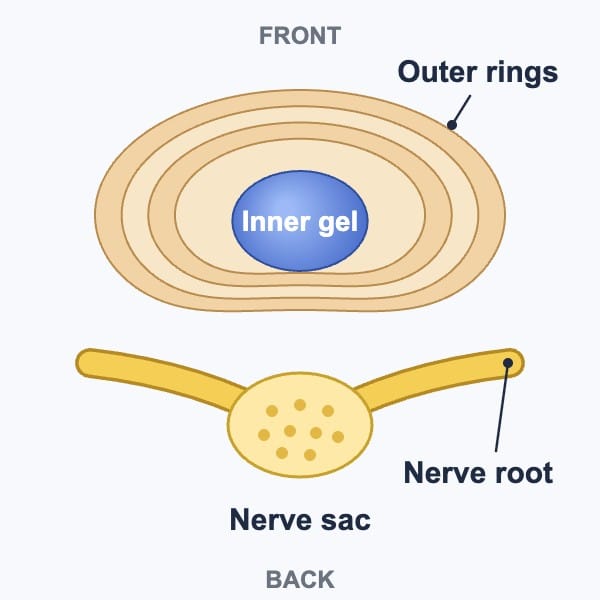
- Spinal disc changes: A disc may show degeneration, bulging, protrusion, herniation, prolapse, or extrusion. The MRI term alone does not prove that the disc is the source of pain.
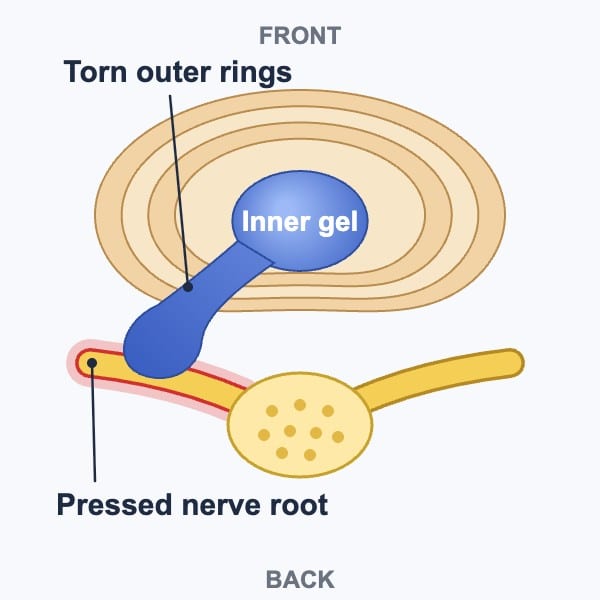
- Nerve irritation: A lumbar nerve root may be irritated by a disc, narrowing, joint change, inflammation, or another factor, producing leg symptoms as well as back pain.
- Spinal stenosis or foraminal narrowing: Reduced space around the spinal canal or nerve openings may occur with disc-height loss, facet enlargement, ligament thickening, or spondylolisthesis.
- Spondylolisthesis: One vertebra sits forward relative to another. Its relevance depends on the grade, stability, nerve effects, symptoms, and function.
- Prolonged sitting, work and driving demands: Long periods in one position, limited movement variety, repeated bending, poor equipment fit, and commuting may contribute to symptom patterns without proving one “bad posture” caused the problem.
- Hip, knee, gait, and activity factors: Changes elsewhere in the movement system can alter how the back handles load. This does not mean every back problem starts outside the spine.
Detailed pages explain facet hypertrophy, ligamentum flavum hypertrophy, spinal stenosis, spondylolisthesis, degenerative disc disease, and sacroiliac joint concerns.
What Does “Slipped Disc” Mean?
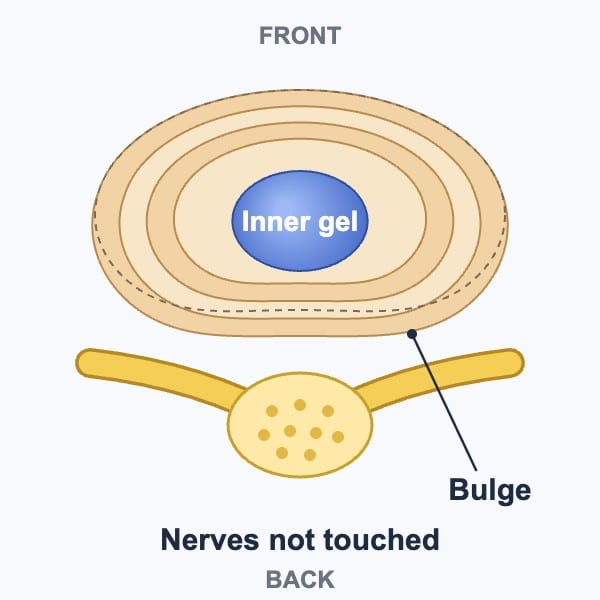
“Slipped disc” or “slip disc” is a common public phrase, not one precise imaging diagnosis. Modern lumbar-disc terminology distinguishes a broad disc bulge from a localized herniation and describes protrusion and extrusion as patterns of herniation.
| MRI Term | Plain-Language Meaning |
| Disc bulge | Disc tissue extends broadly beyond the usual disc margin. A bulge is not automatically a herniation and may be present without symptoms. |
| Disc herniation | Disc material extends beyond the normal disc space in a more localized area. |
| Disc protrusion | A herniation in which the outward extension remains broader at its base than at its furthest point. |
| Disc extrusion | A herniation that extends farther beyond its base; a separated fragment may be described as sequestration. |
| Disc prolapse | A term used variably in reports and everyday speech. The radiology wording and images should be reviewed rather than assuming one universal meaning. |
| Degenerative disc change | Age- or load-related changes may include reduced hydration, height loss, fissures, bulging, endplate change, or osteophytes. These findings do not automatically equal pain. |
The terminology above follows the consensus framework described in Lumbar Disc Nomenclature: Version 2.0. Imaging findings are common in people without symptoms, which is why the MRI should be read with the history and examination rather than in isolation. See the MyChiro pages on slipped-disc care and spinal discs.
| What This Does Not Mean A disc is not described here as “out of alignment,” and no claim is made that chiropractic, decompression, or another method can put a disc back, restore it to new, guarantee healing, or remove the need for medical or surgical review. Suitability depends on the individual presentation. |
Is Back Pain With Leg Pain Always Sciatica?
No. Sciatica is a symptom pattern involving pain and sometimes numbness, tingling, or weakness along a lumbar or sacral nerve pathway, but leg symptoms may also be referred from joints or muscles, arise from the hip or circulation, or have another neurological or medical explanation.
- Sciatica or lumbar radicular symptoms: pain or altered sensation that follows a nerve-root pattern into the buttock, thigh, calf, or foot.
- Referred pain: pain felt away from the source without clear nerve-root sensory or motor changes.
- Pinched nerve or nerve impingement: everyday descriptions for nerve irritation or compression; the location and cause need assessment.
- Piriformis or buttock-region irritation: symptoms may resemble sciatica, but the source cannot be confirmed from symptom location alone.
- Hip, vascular, systemic, or other neurological conditions: these may require a different professional pathway.
Read the dedicated guides to sciatica, sciatic nerve pain, and pinched-nerve symptoms.
When Does Back Pain Need Urgent Medical Review?
Routine chiropractic or physiotherapy assessment is not the right first step when symptoms suggest a medical emergency, serious neurological change, fracture, infection, or another condition requiring urgent evaluation.
- New difficulty starting or controlling urination, loss of bladder or bowel control, or a major change in urinary or bowel function.
- New numbness around the groin, genitals, inner thighs, buttocks, or saddle region.
- Rapidly worsening leg weakness, foot drop, inability to stand or walk normally, or major loss of coordination.
- Severe back pain after a significant fall, collision, impact, or other trauma, particularly with osteoporosis or fracture risk.
- Fever, chills, feeling seriously unwell, or a recent infection together with severe or worsening back pain.
- Unexplained weight loss, a known history of cancer, immune suppression, or another major medical concern with new persistent pain.
- Chest pain, breathing difficulty, abdominal pain, fainting, or symptoms that do not behave like a routine musculoskeletal problem.
- Pregnancy-related warning signs such as bleeding, fluid loss, severe abdominal or pelvic pain, reduced fetal movement, severe headache, visual disturbance, or symptoms your obstetric provider has told you require urgent review.
The NICE guideline on low back pain and sciatica emphasizes appropriate assessment and referral rather than assuming every presentation is routine mechanical back pain.
How Is Back Pain Assessed at CSC Bukit Damansara?
The first visit begins with history and examination. The purpose is to understand the symptom pattern, daily limitations, relevant health factors, and whether the presentation is suitable for chiropractic, physiotherapy, coordinated care, imaging review, or referral.
- History and goals: When symptoms began; what worsens or eases them; previous episodes, injuries, care, medication, work demands, sleep, driving, sport, and activities that matter to you.
- Movement and functional review: How the back responds to sitting, standing, walking, bending, lifting, changing position, and task-specific movement.
- Joint and muscle assessment: Relevant spinal, pelvic, hip, and soft-tissue findings within professional scope.
- Neurological screening where indicated: Strength, reflexes, sensation, balance, gait, and nerve-related signs when leg symptoms, numbness, tingling, or weakness are reported.
- Imaging and report review: Existing MRI, X-ray, CT, and medical reports are considered alongside symptoms and examination. Imaging is not ordered automatically.
- Explanation and options: Findings, uncertainties, limitations, care choices, referral options, and fees are discussed before care proceeds.
The CSC Bukit Damansara page explains what happens at the first visit and provides the current location and appointment details.
Do You Need an MRI or X-Ray for Back Pain?
Not everyone with back pain needs imaging. Imaging is most useful when the result is likely to change decisions, when warning signs are present, when symptoms are persistent or progressive, or when the history and examination raise a specific concern.
A systematic review by Brinjikji and colleagues found that several degenerative imaging features are common in people without symptoms and become more frequent with age. This does not make an MRI unimportant; it means the finding should be interpreted in context.
- Bring the original images or image-access link when available, not only the written report.
- Bring previous X-rays, MRI, CT, surgical reports, injection records, and relevant laboratory or specialist reports.
- Do not assume that the most dramatic sentence in a report is necessarily the only cause of the symptoms.
What Care Options May Be Considered?
Care is selected after assessment and may involve chiropractic, registered physiotherapy, guided exercise, rehabilitation, education, or referral. A person may receive one service or a coordinated plan; no method or device is automatic.
Chiropractic for Back Pain
Chiropractic care at CSC focuses on spinal and joint motion and mechanical function within chiropractic scope. Methods are selected according to the person’s findings, comfort, age, health history, disc or nerve considerations, and response.
Options may include lower-force instrument-assisted methods, drop-table care, mobilization, or flexion-distraction where suitable. A broader explanation of chiropractic techniques is available on the CSC-related educational site.
Registered Physiotherapy for Back Pain
Registered physiotherapy may address muscle response, mobility, strength, endurance, balance, movement confidence, graded activity, work demands, and exercise progression. Physiotherapy may be provided on its own or coordinated with chiropractic.
Residents who specifically want physiotherapy can read the Sri Petaling and Bukit Jalil physiotherapy page or the back-physiotherapy guide.
Coordinated Chiropractic and Physiotherapy
When both joint and soft-tissue or rehabilitation needs are relevant, the services may be coordinated. Read how chiropractic and physiotherapy are combined. The plan is based on assessment rather than a standard package, and one discipline is not presented as universally better than the other.
Spinal Decompression, NSD Therapy® and Rehabilitation
Selected people with disc- or nerve-related presentations may be considered for table-assisted decompression or other rehabilitation methods. These services are not suitable for everyone and are not described as repairing, rehydrating, or restoring a disc.
Further information is available on spinal decompression, the NSD Therapy® website, the MyChiro NSD Therapy® page, the CSC physiotherapy and rehabilitation gym, and PhysioWorld.
Depending on the assessment and actual availability, physiotherapy may also use hands-on care, guided exercise, therapeutic ultrasound, electrotherapy, laser, shockwave, heat or cold applications, or other modalities. The presence of equipment does not determine whether it is appropriate.
Comprehensive Support for Back Discomfort During Pregnancy in Sri Petaling
Pregnancy brings various changes to the body, including shifts in posture and increased pressure on the spine. Many expecting mothers experience back discomfort, particularly between the fourth and seventh months of pregnancy. This discomfort can arise due to muscular imbalances, spinal misalignments, or increased strain on the lower back.
At Chiropractic Specialty Center®, we provide non-surgical spinal support for pregnancy-related back concerns. Our team integrates chiropractic care and physiotherapy to help individuals maintain spinal mobility and reduce postural strain. We focus on movement-based rehabilitation to encourage better posture and flexibility during pregnancy and postpartum recovery.
For more information about prenatal and postpartum spinal care, contact our main center near Sri Petaling at +603 2093 1000
Non-Surgical Spinal Support for Back Discomfort in Sri Petaling & Bukit Jalil
At Chiropractic Specialty Center®, we provide customized Chiropractic back care programs designed to improve movement and posture. Our approach combines chiropractic back care techniques with physiotherapy to enhance flexibility and support spinal health.
Many individuals experience stiffness, postural imbalances, or movement limitations due to prolonged sitting, repetitive movements, or age-related spinal changes. Our care programs focus on addressing:
- Spinal joint stiffness– Limited movement in spinal joints can contribute to discomfort.
- Slipped discs– Disc-related issues may lead to restricted mobility.
- Sciatic-nerve-related concerns– Nerve compression may cause sensations in the lower back and legs.
- Pinched nerve care: Our integrative pinched nerve care address all types of nerve impingement be it in the neck, upper back or lower back.
- Postural misalignments– Poor posture can contribute to muscular tension.
- Age-related or Degenerative spinal changes– Over time, spinal flexibility may decrease, affecting movement efficiency.
By addressing these concerns with a structured approach, we help individuals regain mobility and improve overall spinal stability.
For further details, contact our our main center near Sri Petaling at +603 2093 1000
What Can You Do While Waiting for an Assessment?
General self-management should be cautious, comfortable, and responsive to symptoms. It is usually preferable to avoid prolonged bed rest and remain gently active within tolerance, while stopping activities that produce progressive weakness, loss of control, or other warning signs.
- Change position regularly rather than trying to hold one “perfect” posture all day.
- Use short, comfortable walks or light movement if they do not cause worsening neurological symptoms.
- Break longer sitting or driving periods when practical and adjust the seat, back support, screen, keyboard, or work surface to fit the task.
- Avoid repeatedly testing painful movements, heavy lifting, forceful stretching, aggressive self-manipulation, or online traction routines when the cause is uncertain.
- Use heat or cold only for comfort and protect the skin; stop if symptoms worsen.
- Discuss medication questions with a pharmacist or medical practitioner, particularly during pregnancy, with other health conditions, or when taking multiple medicines.
- Seek urgent assessment rather than self-managing when red flags are present.
Guidelines from the World Health Organization, NICE, and the 2021 APTA/JOSPT clinical practice guideline support an individualized, active and multimodal approach rather than reliance on one passive procedure.
How Can Desk Work and Driving Affect Back Pain?
Desk work and driving can influence symptoms through sustained positions, limited movement variety, repeated reaching, vibration, fatigue, equipment fit, and the total amount of sitting. These factors may contribute, but they do not prove that one posture caused a disc or joint condition.
- Adjust the chair so the back and thighs are supported without pressure behind the knees.
- Keep frequently used items close enough to avoid repeated reaching and twisting.
- Position the main screen in front and at a height and distance that reduce repeated bending.
- For longer laptop use, consider an external keyboard and mouse so the screen can be elevated.
- Vary the task and position; sitting, standing, and walking all become uncomfortable when held too long.
For detailed desk, computer and workstation information, see the dedicated Office Syndrome in Kuala Lumpur page.
What Should You Bring to Your First Visit?
- Identification and the contact details needed for registration.
- Any recent MRI, X-ray, CT, radiology report, medical report, surgical report, or injection record relevant to the concern.
- A current list of medication and important medical conditions.
- Details of how the symptoms began, previous episodes, treatments tried, and what changed afterward.
- Comfortable clothing that allows the relevant area and movement to be assessed.
- Your questions and the daily activities you most want to understand or return to.
The first visit is not an automatic adjustment or pre-set treatment package. Findings, options, limitations, referral needs, and fees are explained before care proceeds.
How Do Sri Petaling and Bukit Jalil Residents Reach CSC?
CSC Bukit Damansara is in Plaza Damansara beside CIMB Bank and Caring Pharmacy. On-site and street parking are available. Travel time changes substantially with traffic, so a fixed number of minutes cannot be stated for journeys from Sri Petaling or Bukit Jalil.
Get directions from Sri Petaling | Get directions from Bukit Jalil | Get directions from OUG
For broader chiropractic information for these communities, see Chiropractor for Sri Petaling and Bukit Jalil residents and Chiropractic care for Sri Petaling and Bukit Jalil residents. This guide focuses specifically on back pain, slipped-disc terminology, sciatica, and related back and leg symptoms.
Frequently Asked Questions
These answers are educational and do not diagnose an individual. They address local access, back pain, slipped-disc terminology, sciatica, imaging, care options, and what to expect when attending CSC Bukit Damansara from Sri Petaling or nearby areas.
Is Chiropractic Specialty Center Sri Petaling still open?
Where can Sri Petaling residents receive CSC back pain care?
Can I get back pain treatment if I live in Sri Petaling?
Which CSC center serves Bukit Jalil, OUG, Kuchai Lama and Taman Desa?
What causes lower back pain after prolonged sitting?
Why does my back hurt when I stand up after sitting?
Can lifting cause sudden lower back pain?
How to Change my Photo from Admin Dashboard?
What does slipped disc mean?
How to Change my Photo from Admin Dashboard?
Can a slipped disc cause leg pain, numbness or tingling?
Is every leg symptom sciatica?
What is a pinched nerve or nerve impingement?
What does facet hypertrophy mean on an MRI?
What does ligamentum flavum hypertrophy mean?
What is spinal stenosis?
Do I need an MRI or X-ray for back pain?
Can a chiropractor assess lower back pain?
Can I receive physiotherapy for back pain without chiropractic?
What chiropractic methods may be considered for back pain?
What happens during the first appointment?
How many sessions will I need?
Can pregnant people be assessed for back pain?
Is care available for older adults with degenerative back changes?
When should I seek emergency care instead of booking a routine visit?
How do I make an appointment from Sri Petaling or Bukit Jalil?
Where can I park at CSC Bukit Damansara?
References
These sources provide general background on assessment, activity, exercise, manual care, imaging, disc terminology, and back-related leg symptoms. More detailed references are available on the linked condition pages.
- World Health Organization. WHO guideline for non-surgical management of chronic primary low back pain in adults in primary and community care settings. Geneva: World Health Organization; 2023. ISBN 978-92-4-008178-9.
- National Institute for Health and Care Excellence. Low back pain and sciatica in over 16s: assessment and management. NICE guideline NG59. Published November 30, 2016; current online guidance.
- George SZ, Fritz JM, Silfies SP, Schneider MJ, Beneciuk JM, Lentz TA, Gilliam JR, Hendren S, Norman KS. Interventions for the Management of Acute and Chronic Low Back Pain: Revision 2021. J Orthop Sports Phys Ther. 2021;51(11):CPG1-CPG60. doi:10.2519/jospt.2021.0304.
- Qaseem A, Wilt TJ, McLean RM, Forciea MA. Noninvasive Treatments for Acute, Subacute, and Chronic Low Back Pain: A Clinical Practice Guideline From the American College of Physicians. Ann Intern Med. 2017;166(7):514-530. doi:10.7326/M16-2367.
- Chou R, Deyo R, Friedly J, Skelly A, Hashimoto R, Weimer M, Fu R, Dana T, Kraegel P, Griffin J, Grusing S, Brodt ED. Nonpharmacologic Therapies for Low Back Pain: A Systematic Review for an American College of Physicians Clinical Practice Guideline. Ann Intern Med. 2017;166(7):493-505. doi:10.7326/M16-2459.
- Fardon DF, Williams AL, Dohring EJ, Murtagh FR, Rothman SLG, Sze GK. Lumbar Disc Nomenclature: Version 2.0. Spine J. 2014;14(11):2525-2545. doi:10.1016/j.spinee.2014.04.022.
- Brinjikji W, Luetmer PH, Comstock B, Bresnahan BW, Chen LE, Deyo RA, Halabi S, Turner JA, Avins AL, James K, Wald JT, Kallmes DF, Jarvik JG. Systematic Literature Review of Imaging Features of Spinal Degeneration in Asymptomatic Populations. AJNR Am J Neuroradiol. 2015;36(4):811-816. doi:10.3174/ajnr.A4173.
- Bronfort G, Hondras MA, Schulz CA, Evans RL, Long CR, Grimm R. Spinal Manipulation and Home Exercise With Advice for Subacute and Chronic Back-Related Leg Pain: A Trial With Adaptive Allocation. Ann Intern Med. 2014;161(6):381-391. doi:10.7326/M14-0006.
- Hayden JA, Ellis J, Ogilvie R, Malmivaara A, van Tulder MW. Exercise Therapy for Chronic Low Back Pain. Cochrane Database Syst Rev. 2021;9(9):CD009790. doi:10.1002/14651858.CD009790.pub2.
- Coulter ID, Crawford C, Hurwitz EL, Vernon H, Khorsan R, Suttorp Booth M, Herman PM. Manipulation and Mobilization for Treating Chronic Low Back Pain: A Systematic Review and Meta-Analysis. Spine J. 2018;18(5):866-879. doi:10.1016/j.spinee.2018.01.013.
Contact CSC Kuala Lumpur (Bukit Damansara)
Arrange an Assessment Call +603 2093 1000 or WhatsApp +60 17 269 1873. Full address, current hours, parking, and map details are on the Bukit Damansara contact page. You may also email [email protected]. |
The former Sri Petaling clinic is not an appointment location. New patients are seen by appointment at the active center, and fees are explained before care proceeds.
Visited CSC Bukit Damansara? You are welcome to share an honest Google review. Reviews are optional, unincentivized, and may reflect any genuine experience.
Author Information
“Back Pain Treatment Sri Petaling & Bukit Jalil | CSC” was written and reviewed by Yama Zafer, D.C., a Doctor of Chiropractic (Cleveland University–Kansas City, United States) trained in both chiropractic and physiotherapy, a registered T&CM (Chiropractic) practitioner in Malaysia, and the founder and director of Chiropractic Specialty Center® with over 30 years of clinical experience, and readers may review his professional background, registration information, experience, and editorial profile on the official same-domain biography page.
Last Updated
This page was last updated on August 2, 2026, after a substantive review of factual accuracy, clarity, references, internal links, comments, local business details, and current information under the H1 title “Back Pain Care for Sri Petaling and Bukit Jalil Residents.”