


C4-C5: What Symptoms at This Neck Level Mean
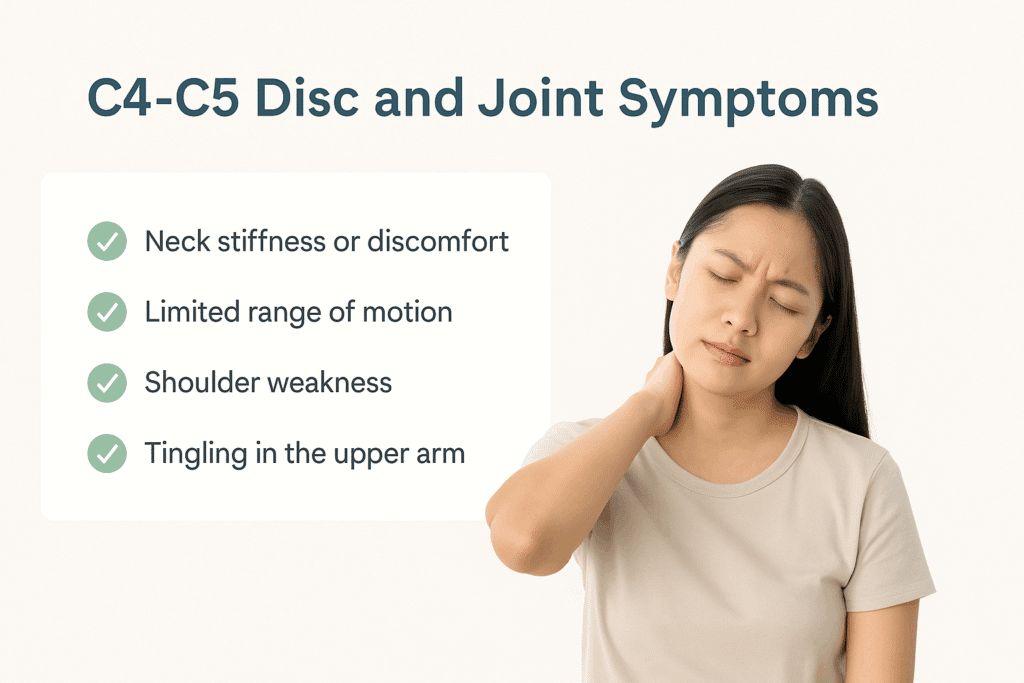
C4-C5 symptoms center on the shoulder and the outer upper arm when the C5 nerve root is involved. Typical are pain over the top of the shoulder, an ache down the outer arm and weakness lifting the arm sideways. C4-C5 is the joint between the fourth and fifth neck vertebrae, between the upper and lower neck, and it takes load from both.
Numbness, where present, sits on the outer shoulder rather than in the hand. That is why a C4-C5 problem can pass for a shoulder complaint for months. Resting the hand of the painful side on top of the head often lessens the pain, a sign that points to the nerve. Disc change at this level is common on scans of people with no symptoms.
My approach at this level is gentle and non-rotatory, combined with physiotherapy and kept within what you can comfortably tolerate. Below are the C5 nerve root and spinal cord symptoms, the disc bulge stages and the hospital warning signs. Then come the conditions found at C4-C5, the whole neck as one chain and how a plan is built.
For more information about the C4-C5 level, contact the Bukit Damansara (KL) main center: WhatsApp+60 17 269 1873 Call+603 2093 1000
Takeaway: Key Points on C4-C5 Spine Care in Kuala Lumpur
| Question | Short answer |
|---|---|
| What does C4-C5 do? | It is a key motion segment for head and shoulder movement, and it protects the C5 nerve root, which drives shoulder and upper arm strength. Trouble here often reaches both the upper neck balance and the lower neck load. |
| Are disc problems common at C4-C5? | Yes. C4-C5 is among the top two or three neck levels for disc herniations and wear changes. Wear is also common on scans of people with no symptoms at all (Matsumoto and colleagues, 1998). |
| What does C5 nerve root compression feel like? | Pain over the shoulder and down the outer upper arm, sometimes with numbness there, and weakness lifting the arm or bending the elbow. The biceps reflex may be weaker on testing (Margetis and colleagues, 2025). |
| Does a disc bulge at C4-C5 press on the nerve? | In my view, a true bulge as the MRI pictures it does not press on the nerve. When there are nerve symptoms, the disc is likely in transition, bulging further out once the body is upright. |
| What are the signs of spinal cord compression here? | Clumsy hands, numbness in both hands, an unsteady walk or heavy legs suggest pressure on the cord rather than one nerve. These need a prompt medical assessment, and conservative care continues only while any weakness improves. |
| Why do I call C4-C5 a workhorse? | Apart from the top joints, C0-C1 and C1-C2, C4-C5 and C5-C6 do most of the neck's work. A head held forward over a laptop or phone loads them as much as the upper neck, if not more. |
| Which neck methods do I avoid? | The Ring Dinger®, the Y-Strap, towel pulls and high-force twisting. They can overstretch ligaments, aggravate disc injuries and endanger the vertebral arteries, so I never use them at C4-C5. |
| Is yoga safe with a C4-C5 disc problem? | No. Yoga must be avoided with a C4-C5 disc problem, because poses that load or twist the neck press on one of its largest discs. My Back Pain to Leg Pain talk rules out yoga with any disc problem. |
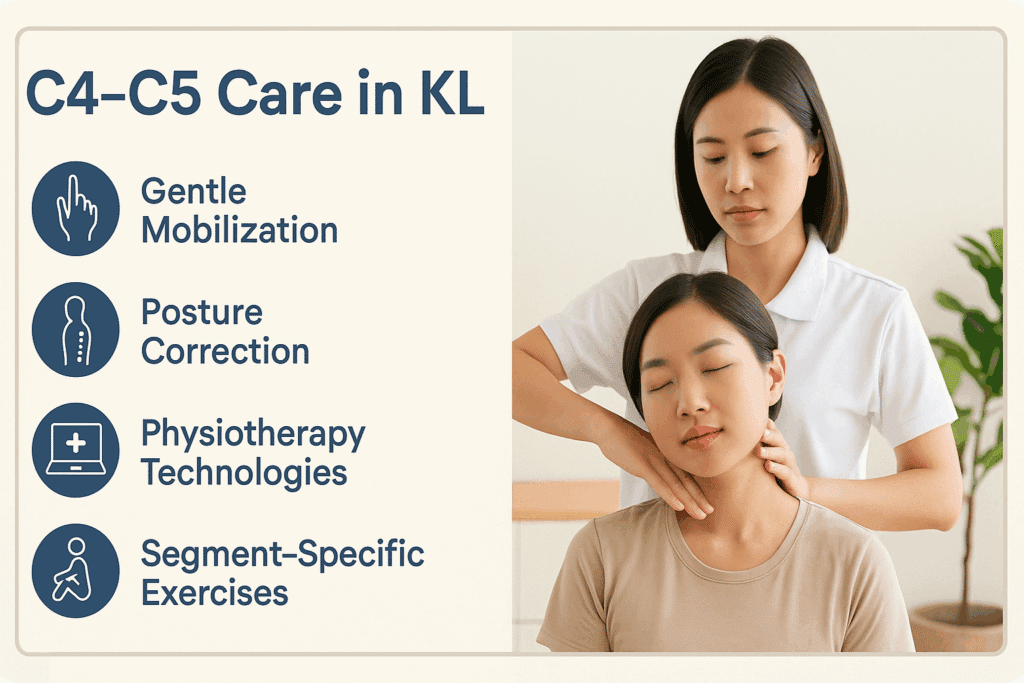
| What can treatment include? | Gentle, non-rotatory chiropractic with physiotherapy. Where the assessment supports it, spinal decompression, NSD Therapy®, high-intensity laser, ultrasound or shockwave may join them. Every step is explained beforehand and kept within what you can comfortably tolerate. |
C4-C5 Guide: What Each Section Covers
- C4-C5 Nerve Root Compression Symptoms
- Disc Bulge and Herniation at C4-C5
- Spinal Cord Compression Symptoms at C4-C5
- Emergency Signs: When to Call 999
- Book Gentle C4-C5 Care in Kuala Lumpur
- Understanding the C4-C5 Segment
- Cervical Spondylosis at C4-C5
- Spondylolisthesis: One Vertebra Slipping
- Whiplash and Neck Injuries
- C4-C5 Spine: Key Statistics
- Upper Cervical Health and C4-C5
- The Whole Neck as One Chain
- Unsafe Neck Techniques to Avoid
- Patient-, Condition- and Age-Specific Care
- Integrated, Non-Invasive C4-C5 Treatment at CSC
- Summary Table: C4-C5 Spine
- FAQ: C4-C5 Spinal Joint, Disc and Nerve Care
C4-C5 Nerve Root Compression Symptoms
The C5 nerve root leaves the spine through the opening between C4 and C5. On examination, its strength is tested in the deltoid, which lifts the arm out to the side, and in the biceps (Margetis and colleagues, 2025).
- Pain over the top of the shoulder that can spread down the outer upper arm.
- Numbness or tingling over the outer shoulder and upper arm, rarely in the hand.
- Weakness lifting the arm out to the side or bending the elbow.
- A weaker biceps reflex on the painful side when it is tested.
- Neck pain that worsens when the head tips back or turns toward the painful side.
Shoulder Joint or Nerve Root?
A rotator cuff tear or shoulder impingement can also bring outer shoulder pain and weakness lifting the arm. Tenderness over the shoulder and pain when someone else moves the arm point to the shoulder itself (Margetis and colleagues, 2025).
The examination separates the two, and both can be present at once. It often makes sense to read about C4-C5 alongside the shoulder pain guide, since the two are so easily confused.
The C5 root is affected less often than the roots below it. More than half of all cases involve the C7 root and roughly a quarter the C6 root. C1 to C5 and C8 are involved less often (Margetis and colleagues, 2025).
Nerve root pain usually improves with time. More than 85 percent of acute cases clear within 8 to 12 weeks without any specific treatment (Margetis and colleagues, 2025).
Weakness, Both Arms or Several Levels
Weakness that keeps getting worse needs a prompt medical assessment. Where weakness is present, conservative care can continue only while the weakness itself is improving.
Symptoms in both arms, or at several root levels, especially after an injury, call for urgent imaging. They can mean a central disc extrusion pressing on the spinal cord (Margetis and colleagues, 2025).
Disc Bulge and Herniation at C4-C5
C4-C5 disc problems are common on MRI reports, which usually describe one of these:
- Bulging disc: the outer ring weakens and the disc spreads past its normal edge.
- Herniated disc: the soft center pushes through a tear in the outer ring and can press on the C5 nerve root or the spinal cord.
- Extrusion, fragmentation and sequestration: advanced stages in which disc material moves further out, raising the risk of cord compression. A partly torn-away piece is a fragmented disc; once it breaks off completely, the disc is fully fragmented, also called sequestered.
I describe the path in Why Spinal Discs Get Damaged. “A bulge becomes a protrusion, then a prolapse, then a herniation, a rupture, fragmentation, and sequestration.”
My position is that a true disc bulge, in the form an MRI captures, does not press on a nerve. Plenty of people carry one without any symptoms.
The scan catches the disc at rest, lying flat and often early in the day, when it is full of fluid. Hours of sitting with the head forward, driving or lifting load it from above, and the weakened fibers can push further out.
I call this stage a disc bulge in transition. It no longer acts like a simple bulge but like a protrusion, herniation or extrusion, and only then can it explain arm symptoms. By that stage the condition is serious.
Why it matters: the C4-C5 disc can wear over time from poor posture, repetitive strain or injury. Once weakened, it tears more easily, which can bring nerve irritation, shoulder weakness, tingling in the arm or reduced reflexes.
Related guides cover disc degeneration, the spinal disc itself and canal stenosis. The slipped disc guide explains how they are cared for.
Spinal Cord Compression Symptoms at C4-C5
When the spinal cord itself is squeezed, the condition is called myelopathy, and its signs differ from a pinched nerve root. Its features include numb or clumsy hands, tingling in more than one limb, weakness and an unsteady gait. Heavy legs are often noticed early (Margetis and colleagues, 2025).
A disc can also touch the cord without symptoms. Teresi and colleagues (1987) scanned 100 people with no neck symptoms, and the cord was compressed in seven, each time by a disc protrusion.
In a larger study, a disc protrusion compressed the cord in 7.6 percent of 497 people without symptoms, mostly over 50 (Matsumoto and colleagues, 1998). A report alone does not decide; the examination does.
Cervical Canal Stenosis and C4-C5 Measurements
A healthy cervical spinal canal is generally 14-18 mm in diameter, though individual anatomy varies. In one study, a canal under 13 mm counted as congenitally narrow (Morishita and colleagues, 2009).
A narrow canal went with more disc wear and cord compression, and in those canals C4-C5 moved more than usual (Morishita and colleagues, 2009). Stenosis at C4-C5 means narrowing that may press on the spinal cord or the nerve roots.
Radiologists can grade the narrowing from 0 to 3 (Kang and colleagues, 2011). Grade 1 means more than half the fluid space around the cord is lost. Grade 2 is a deformed cord, and grade 3 a signal change inside it.
Signs of stenosis may include:
- Neck stiffness or neck pain.
- Arm weakness or tingling.
- Balance problems or changes in walking.
- In severe cases, the signs of spinal cord compression (myelopathy) described above.
Emergency Signs: When to Call 999
Some signs need emergency care, not a clinic visit. Call 999 at once, without driving yourself, for any sudden stroke sign on the list of the US Centers for Disease Control and Prevention:
- Face, arm or leg numbness or weakness that starts suddenly, often on one side.
- Confusion, difficulty speaking or trouble following what others say, starting suddenly.
- Sight that suddenly dims or blurs in one eye or both.
- Sudden dizziness, unsteady walking, a loss of balance or poor coordination.
- A sudden, severe headache without a known cause.
Mayo Clinic's first-aid guidance treats the following as signs of a possible spinal injury. If any applies, phone 999 and do not move the person; hold the head and neck in line:
- An injury that put strong force on the back or the head.
- Severe pain in the neck or back.
- A head injury with a lasting change in consciousness.
- Paralysis, weakness or numbness anywhere, or trouble controlling the arms, legs, bladder or bowel.
- An odd, twisted position of the neck or back.
Book Gentle C4-C5 Care in Kuala Lumpur
C4-C5 care at Chiropractic Specialty Center (CSC) brings non-rotatory chiropractic and physiotherapy into one plan. The aim is freer joint movement, protected nerves and a working shoulder, without high-force methods. Each part is described under non-rotatory chiropractic adjustment and physiotherapy in Kuala Lumpur.
A second location shortens the trip for many readers, and both centers give the same care. The Bandar Sri Damansara center offers chiropractic with physiotherapy. Its address, telephone number and opening hours are on the Bandar Sri Damansara contact page. Directions to the main center are on the Bukit Damansara contact page.
- Bukit Damansara (KL, main center): Call +603 2093 1000 or WhatsApp +60 17 269 1873 to see the Bukit Damansara / KL center.
- Bandar Sri Damansara (KL): Call +603 6262 5777 or WhatsApp +60 12 455 6939 to see the Bandar Sri Damansara center.
Understanding the C4-C5 Segment
The C4-C5 segment is a key motion and stability zone in the middle of the neck. It links upper neck movement with the lower cervical spine and allows bending forward, tipping back and smooth side bending.
It holds one of the larger discs of the neck, a common place for the bulges, herniations and wear seen on MRI or X-ray reports. Like the other levels from C3 to C7, the subaxial spine, C4 and C5 have a similar build (Kaiser and colleagues, 2023).
- Disc: one of the thicker cervical discs, made to absorb shock and spread load.
- Facet joints: guide smooth movement, limit excess rotation and add stability.
- Nerve pathway: the C5 nerve root exits between C4 and C5. It powers the deltoid and carries feeling from the outer upper arm.
- Load sharing: C4-C5 works with C5-C6 below, the most mobile level, and C3-C4 above to hold posture and range of motion.
Because C4-C5 governs the C5 nerve root, changes here can affect shoulder strength, arm function and nerve health as well as neck motion. Problems can also cascade, stressing the upper neck above and the levels below, and in severe cases even changing balance and walking.
How far each level moves varies from one person to another (Bogduk and Mercer, 2000).
Cervical Spondylosis at C4-C5
Cervical spondylosis is the general term for wear in the discs, vertebrae and joints. At C4-C5 it can mean:
- Disc drying and loss of height.
- Bone spurs along the vertebral edges and facet joints.
- Thickened ligaments that narrow the canal or the nerve openings.
These changes can reduce flexibility and add stiffness, with symptoms ranging from a mild loss of motion to nerve compression. On neck X-rays of 200 people without symptoms, at least one wear change appeared by age 60 to 65 in 95 percent of men. The figure for women was 70 percent (Gore and colleagues, 1986).
Spondylolisthesis: One Vertebra Slipping
Spondylolisthesis is the forward or backward slip of one vertebra over the next. At C4-C5 it can:
- Narrow the nerve pathways.
- Strain the supporting ligaments.
- Speed up wear in nearby discs and joints.
Older adults, people with a past injury and those with a defect in the bony arch (spondylolysis) are more at risk. The terms are easily mixed up, and this explanation of the difference between spondylolisthesis, spondylolysis and spondylosis sets them apart.
Whiplash and Neck Injuries
C4-C5 is the second most mobile neck level after C5-C6, which leaves it exposed in whiplash from car accidents, sports collisions or falls. Hyperflexion and hyperextension forces can:
- Injure the discs and ligaments.
- Strain the facet joints.
- Cause tiny tears that may lead to wear years later.
Some symptoms appear at once; others stay hidden for months before they surface.
C4-C5 Spine: Key Statistics
What studies of the neck report, with what each one measured:
- High prevalence of degeneration: imaging studies show that over 35-40% of adults above 40 years have measurable C4-C5 disc degeneration, even without symptoms. By age 60, that number rises to more than 65%.
- Wear without symptoms: in an MRI study of 497 people without symptoms, from C2-C3 to C6-C7, disc degeneration rose with age. It went from 12 to 17 percent of discs in the twenties to 86 to 89 percent over 60 (Matsumoto and colleagues, 1998).
- Disc protrusion without symptoms: seen in 20 percent of people aged 45 to 54 and 57 percent of those over 64 (Teresi and colleagues, 1987).
- Common herniation site: C4-C5 ranks among the top three cervical segments for disc herniations, with 14-18% of all cervical herniations occurring at this level.
- Disc height and size: the average C4-C5 disc height is 4.0-4.5 mm in adults, with the front slightly taller than the back. This disc is typically the second-thickest in the neck after C5-C6, making it a primary load-bearing structure.
- Nerve involvement: C5 nerve root compression from C4-C5 changes is found in up to 25% of cervical radiculopathy cases reported in clinical series.
- Canal stenosis rates: narrowing at C4-C5 is seen in about 15% of adults over 50 without symptoms, and in over 35% of patients with myelopathy.
- Cord impingement without symptoms: the cord was impinged in 16 percent of people under 64 and 26 percent over 64 (Teresi and colleagues, 1987). None of them had neck symptoms.
- Facet joint hypertrophy: C4-C5 facet enlargement or osteoarthritis appears in more than 30% of cervical spondylosis patients, often contributing to nerve compression. Facet arthritis is also a common source of mechanical neck pain (Kaiser and colleagues, 2023).
Upper Cervical Health and C4-C5
C4-C5 is influenced by the mechanics of the upper cervical spine (C0-C3). Poor alignment in the upper neck can:
- Add strain to the middle of the neck.
- Change how the shoulders move.
- Affect balance and head posture.
CSC addresses upper cervical tension with gentle suboccipital muscle release, occipital glides and posture correction. The four suboccipital muscles, and the myodural bridges linking them to the membrane around the spinal cord, belong to the top of the neck. They are explained in the C2-C3 guide.
The Whole Neck as One Chain
I see the cervical spine as one connected chain, and C4-C5 sits near its middle. Trouble low in the neck reaches the middle levels. From there it climbs to the upper neck, the skull base and, in time, the brainstem and the brain.
After C0-C1 and C1-C2, the workhorses of the neck are C4-C5 and C5-C6. Looking down at a laptop, a phone or another handheld device shifts the head's weight forward. In my view, that load falls on these lower levels as heavily as on the upper neck, if not more.
The muscles show the same link. Between the skull and C7, two muscle groups, the multifidus and the erector spinae, span the segments and bind them together. As I see it, they strain one level at a time; over time, together, they drive degenerative and spondylotic change.
When that process worsens, it can end in compression of a spinal nerve or of the spinal cord. At times, the cord then swells (edema) or degenerates.
Seven vertebrae make up the cervical spine. Its joints run from C0-C1 (skull and atlas) down to C7-T1, where the neck meets the upper back. Each level has its own part in movement, stability and nerve protection:
- C0-C1 and C1-C2: most of the head's nodding and turning, closely tied to balance and coordination.
- C2-C3: neck turning and side bending, often linked to tension headaches.
- C3-C4: stability, and protection of the nerves to the upper chest and shoulders.
- C4-C5: a high-motion level for head, neck and shoulder movement. Disc herniation or joint wear here may weaken the shoulder or change feeling in the upper arm.
- C5-C6: a common site of wear, affecting arm strength and wrist extension.
- C6-C7: grip strength and hand coordination.
- C7-T1: the link to the upper back, passing load between the neck and the thoracic spine.
Care for every neck level at Chiropractic Specialty Center is matched to the person's condition, age and build. It combines gentle chiropractic, physiotherapy and rehab, without high-force twisting or risky methods.
Unsafe Neck Techniques to Avoid
Forceful methods such as the Ring Dinger®, the Y-Strap, towel pulls and high-force twisting create uncontrolled traction or rotation. They can:
- Overstretch ligaments and strain muscles.
- Aggravate disc injuries and load the facet joints suddenly.
- Endanger the vertebral arteries.
The risk is higher with disc herniations, canal stenosis, blood vessel problems or wear that comes with age. Even when a pull feels good in the moment, it may speed up wear, cause instability or trigger new symptoms months or years later.
CSC never uses these methods. Care relies instead on controlled, non-rotatory chiropractic and evidence-based physiotherapy.
In Neck Cracks Are Dangerous, I put it plainly: “Aggressive neck care is never good and should always be avoided.” My advice: refuse any forceful pull or crack of the neck.
Yoga with a Disc Problem
Yoga is ruled out too. With a C4-C5 disc problem it must be avoided, because poses that load or twist the neck press on one of its largest discs.
Patient-, Condition- and Age-Specific Care
C4-C5 care at CSC is adjusted to the person:
- Children: no rotatory adjustments. Care centers on gentle mobilization, posture correction and soft tissue work. For teenagers, I may use chiropractic manipulation that is non-rotatory using the Activator instrument.
- Older adults: gentle positioning that spares arthritic joints and fragile tissues.
- Women: force and positioning adapted to smaller neck structures.
- Athletes: sport-specific rehab that rebuilds strength and motion without overloading tissue that is still recovering.
Before a child's neck is treated, the guide to neck manipulation in children gives the international guidance for each age.
Integrated, Non-Invasive C4-C5 Treatment at CSC
Depending on the assessment, a program may include:
- Spinal decompression: a gentle, controlled pull on the neck, without rotation or force.
- NSD Therapy®: a focused, non-surgical protocol for spinal joint and spinal disc problems.
- High-intensity laser therapy (HILT): a higher-power laser aimed at the deep tissues around the level.
- Therapeutic ultrasound: applied to the back and sides of the neck, reaching the sternocleidomastoid and the muscles that support it.
- Shockwave therapy: for tension in the trapezius and rhomboids.
- Electrotherapy: to settle muscle guarding before hands-on care. Heat is rarely part of the plan, and it stays off any neck with a disc or facet joint problem, or inflamed tissue.
- Gentle chiropractic: the Activator®, Thompson drop or flexion-distraction, all non-rotatory.
- Soft tissue and fascia therapy: gentle release of trigger points, the suboccipitals and the upper back stabilizers.
Most laser research on neck pain uses low-level laser, a gentler type. Across 16 trials, it reduced pain more than placebo (Chow and colleagues, 2009).
Chiropractors and physiotherapists at CSC work in one plan. In Is Chiropractic Safe? 13 Questions Answered, my answer to which one to choose is “Don't choose between one or the other. Choose both.”
Care is kept within what you can comfortably tolerate. Discomfort during care means it is being done too aggressively, so tell the clinician at once. “No pain, more gain.” is my motto.
Progress is reviewed as care continues. In Is Chiropractic Safe? 13 Questions Answered, I say a plan needs another look if there is no improvement by session five. At session ten, we decide together.
For disc problems, my words in Sciatica vs Slipped Disc: Video Explanation are: “Surgery should be the last option. Exhaust conservative route.”
When I recommend conservative care, I mean focused care. It is built on your imaging and examination findings and directed at the causes they document. It treats the neck as a connected whole and must never cause harm. Routine neck treatment is not what I mean, and many forms of conservative care achieve nothing. If focused care like this fails, surgery can become an option.
The possible effects and risks are explained before care begins. The fee for a plan is explained and agreed before care begins.
Summary
C4-C5 is a high-importance motion segment for both the neck and the shoulder. When it is injured or worn, pain, weakness and a lower quality of life can follow. CSC's approach combines a precise assessment, gentle chiropractic and targeted physiotherapy.
Healthy movement at C4-C5 matters for comfortable neck and shoulder use. CSC's integrated, non-invasive approach aims to protect the discs, joints and nerves while mobility is rebuilt.
Planning a visit? The current chiropractic price in Kuala Lumpur and the physiotherapy fees in Kuala Lumpur are listed before you come in.
Summary Table: C4-C5 Spine
| Feature | Details |
|---|---|
| Segment | C4-C5: the central mobility zone of the neck |
| Key functions | Neck flexibility, shoulder movement, nerve protection |
| Nerve | C5 root: deltoid and biceps strength, feeling over the outer upper arm |
| Common issues | Disc herniation, facet wear, narrowed nerve openings |
| CSC approach | Non-rotatory chiropractic with physiotherapy and posture rehab |
FAQ: C4-C5 Spinal Joint, Disc and Nerve Care
What does the C4-C5 segment do?
C4-C5 gives the neck much of its flexibility, positions the head and adds to the shoulder's range of motion. It also protects the C5 nerve root, which powers shoulder muscles such as the deltoid and carries feeling from the outer upper arm. Because it moves a lot and carries load, it is one of the busiest levels of the neck.
Is C4-C5 part of the upper cervical spine?
No. The upper cervical spine runs from the skull down to C3, so C4-C5 belongs to the middle of the neck. The two still work as one chain: problems at C4-C5 can change movement above and below, and upper neck tension can add strain here. The upper cervical guide explains the top joints.
What symptoms can problems at this level cause?
Reduced neck movement, neck pain and stiffness are common. When the C5 root is involved, pain covers the top of the shoulder and the outer upper arm. Numbness or tingling there and weakness lifting the arm can join it. Posture can change as muscles guard. Symptoms in both hands, or an unsteady walk, point to the spinal cord and need prompt assessment.
How is a C5 nerve problem told apart from shoulder trouble?
Both can cause outer shoulder pain and weakness lifting the arm. Tenderness over the shoulder and pain when someone else moves the arm point to the shoulder joint. Pain that worsens as the head tips back or turns toward the sore side points to the nerve. So does pain that lessens with the hand resting on the head. Both can exist together, so the examination checks each.
How important is this disc, and what causes a herniation?
It is one of the larger discs in the neck and sits at a high-motion level. That makes it prone to herniation, wear and nerve compression. Common causes are disc degeneration, repetitive strain, whiplash, poor posture and sudden high-impact forces. In my video Why Spinal Discs Get Damaged, I trace this damage to poor habits kept up over time.
Can whiplash damage this segment?
Yes. Whiplash can overstretch the ligaments, injure the disc and strain the facet joints at C4-C5. Small tears may lead to wear months or years later, and some symptoms appear only after a delay. After any car accident or fall with neck pain, an examination is worthwhile even if the pain seems minor at first.
What are the symptoms of spinal cord compression at C4-C5?
Pressure on the cord tends to affect both hands or several limbs. Typical are numb or clumsy hands, tingling in more than one limb, weakness and an unsteady walk. Heavy legs are often an early sign. These signs need a prompt medical assessment. Sudden weakness, or a loss of control of the bladder or bowels after an injury, needs 999.
How does CSC care for these problems?
We combine gentle, non-rotatory chiropractic adjustments with targeted physiotherapy, posture correction and rehabilitation exercises. Where the assessment supports it, spinal decompression, NSD Therapy®, high-intensity laser, ultrasound or shockwave may be added. Care is kept within what you can comfortably tolerate, and the possible effects and risks are explained before care begins.
Why avoid methods like the Y-Strap or Ring Dinger®?
They apply uncontrolled force that can overstretch ligaments, injure discs and stress the vertebral arteries. The danger is greater for older adults and for anyone with disc wear, stenosis or blood vessel problems. My video Neck Cracks Are Dangerous warns against aggressive neck care of any kind, and CSC does not use these methods.
How can I protect this level of my neck long term?
Keep good posture, especially at screens, and break up long spells with the head forward. Strengthen the neck and upper back muscles with exercises your provider has checked. Avoid aggressive neck manipulation, and avoid yoga if you have a disc problem. Have early stiffness or reduced motion looked at rather than waiting.
How to Read This Guide
Where I write in the first person, the position is mine, from my videos, talks and written answers. Each quote names its video. Studies appear by author and year, with full details in the list below. This guide covers C4-C5 in general, and only an examination can show what lies behind your own symptoms.
References and Citations
- Adams MA, Dolan P. Spine biomechanics. J Biomech. 2005;38(10):1972-1983.
- Bogduk N, Mercer S. Biomechanics of the cervical spine. I: Normal kinematics. Clin Biomech (Bristol). 2000;15(9):633-648.
- Centers for Disease Control and Prevention. Signs and symptoms of stroke. CDC; 2026.
- Chiu TT, Lam TH, Hedley AJ. A randomized controlled trial on the efficacy of exercise for patients with chronic neck pain. Spine (Phila Pa 1976). 2005;30(1):E1-E7.
- Chow RT, Johnson MI, Lopes-Martins RA, Bjordal JM. Efficacy of low-level laser therapy in the management of neck pain: a systematic review and meta-analysis of randomised placebo or active-treatment controlled trials. Lancet. 2009;374(9705):1897-1908.
- Ghiselli G, Wang JC, Bhatia NN, Hsu WK, Dawson EG. Adjacent segment degeneration in the lumbar spine. J Bone Joint Surg Am. 2004;86(7):1497-1503.
- Gore DR, Sepic SB, Gardner GM. Roentgenographic findings of the cervical spine in asymptomatic people. Spine (Phila Pa 1976). 1986;11(6):521-524.
- Iatridis JC, Setton LA, Foster RJ, Rawlins BA, Weidenbaum M, Mow VC. Degeneration affects the anisotropic and nonlinear behaviors of human anulus fibrosus in compression. J Biomech. 1998;31(6):535-544.
- Kaiser JT, Reddy V, Launico MV, Lugo-Pico JG. Anatomy, head and neck: cervical vertebrae. StatPearls. Treasure Island (FL): StatPearls Publishing; 2023.
- Kang Y, Lee JW, Koh YH, et al. New MRI grading system for the cervical canal stenosis. AJR Am J Roentgenol. 2011;197(1):W134-W140.
- Margetis K, Magnus W, Mesfin FB. Cervical radiculopathy. StatPearls. Treasure Island (FL): StatPearls Publishing; 2025.
- Matsumoto M, Fujimura Y, Suzuki N, et al. MRI of cervical intervertebral discs in asymptomatic subjects. J Bone Joint Surg Br. 1998;80(1):19-24.
- Mayo Clinic Staff. Spinal injury: first aid. Mayo Clinic; 2023.
- Morishita Y, Falakassa J, Naito M, Hymanson HJ, Taghavi C, Wang JC. The kinematic relationships of the upper cervical spine. Spine (Phila Pa 1976). 2009;34(24):2642-2645.
- Morishita Y, Naito M, Hymanson H, Miyazaki M, Wu G, Wang JC. The relationship between the cervical spinal canal diameter and the pathological changes in the cervical spine. Eur Spine J. 2009;18(6):877-883.
- Radhakrishnan K, Litchy WJ, O'Fallon WM, Kurland LT. Epidemiology of cervical radiculopathy: a population-based study from Rochester, Minnesota, 1976 through 1990. Brain. 1994;117(Pt 2):325-335.
- Teresi LM, Lufkin RB, Reicher MA, et al. Asymptomatic degenerative disk disease and spondylosis of the cervical spine: MR imaging. Radiology. 1987;164(1):83-88.
- Suri P, Hunter DJ, Rainville J, Guermazi A, Katz JN. Cervical spine stenosis: anatomy, pathophysiology, and clinical implications. PM R. 2010;2(7):640-653.
- Notarnicola A, Maccagnano G, Gallone MF, et al. Extracorporeal shockwave therapy in the treatment of chronic neck pain. Muscles Ligaments Tendons J. 2016;6(1):81-86.
The studies above concern neck anatomy and movement, disc and canal findings on scans and nerve root problems. Others deal with first aid for stroke and spinal injury, and with research on exercise and laser. No study here examined care at Chiropractic Specialty Center.
The Author of C4-C5 Nerve Root Compression Symptoms & Disc Bulge Treatment
C4-C5 Nerve Root Compression Symptoms & Disc Bulge Treatment was written by Yama Zafer, D.C., who has 30+ years in chiropractic and physiotherapy and founded Chiropractic Specialty Center in Kuala Lumpur in 2006.
Last Updated: C4-C5: What Symptoms at This Neck Level Mean
C4-C5: What Symptoms at This Neck Level Mean was last reviewed and updated on October 16, 2026.
Baca halaman ini dalam Bahasa Malaysia: Slip Disc C4-C5: Apa Maksud Gejala pada Paras Leher Ini