

Avoid Ring Dinger®, Towel Jerks & Y-Strap
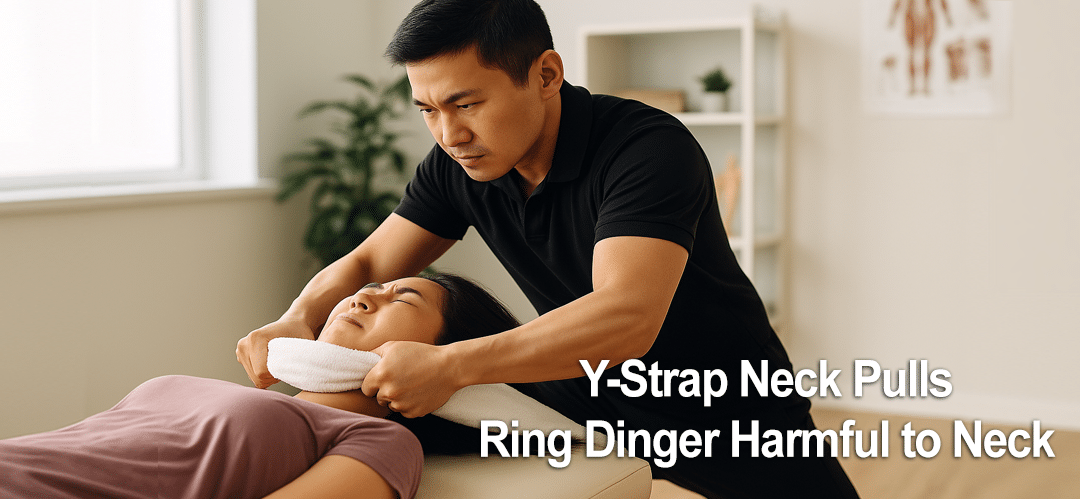
Ring Dinger® is a trademarked term for a rapid axial pull applied along the spine, usually through the neck. Similar high-force traction maneuvers are also seen online under names such as Y-strap pulls or towel jerks. Their visibility comes largely from dramatic videos, but a video does not show whether a person was screened beforehand, how much force was applied, or whether neurological and vascular risk factors were considered.
Published research on these specific high-force maneuvers is scarce: a search of PubMed, the main index of medical research, found no study of the Ring Dinger® or the Y-strap. Serious complications after neck manipulation are rare, but they are documented, so careful screening, informed consent and the choice of technique matter whenever the neck is treated.
These pulls apply a fast, forceful stretch to the neck, close to its nerves, discs and blood vessels and to the brainstem. In a neck with disc problems, early arthritis (spondylosis or bone spurs) or a spine problem that has not yet been found, such a pull can bring on dizziness or headaches, and in rare cases stroke-like symptoms. At Chiropractic Specialty Center, neck care is non-rotatory and built on gentle joint mobilization, soft tissue work, spinal decompression and corrective exercise, chosen after a thorough assessment.
This guide to the Ring Dinger® neck pull, towel jerks and the Y-strap, and the risks they carry, is published by Chiropractic Specialty Center, Bukit Damansara (KL) main center: WhatsApp+60 17 269 1873 Call+603 2093 1000
Ring Dinger®, Y-Strap and Towel Jerks: Key Takeaways
| Point | What to know |
|---|---|
| What they are | Fast, forceful pulls along the neck, sold as the Ring Dinger®, Y-strap pulls or towel jerks and often filmed for social media. |
| The research | A PubMed search found no study of the Ring Dinger® or the Y-strap, so their use rests on videos rather than evidence. |
| Where the force goes | Into the discs, joints and ligaments of the neck, close to the vertebral arteries; with the lower body held in place, the pull runs the length of the spine. |
| Hidden risk | Neck arthritis (cervical spondylosis) is common and often silent, and its bone spurs can narrow the space around the vertebral artery. |
| The crack | A crack is the sound of a gas cavity forming in the joint fluid (Kawchuk et al., 2015); it does not show that anything was put back in place. |
| Stroke risk | Very rare; a large Canadian study found no excess risk of this kind of stroke with chiropractic care compared with family doctor visits (Cassidy et al., 2008). |
| Care at CSC | Non-rotatory and gentle: joint mobilization, soft tissue work, spinal decompression and exercise, planned after an assessment. |
Ring Dinger®: Page Guide & Key Sections
- Why Ring Dinger®, Towel Jerks and Y-Strap Pulls Raise Concern
- Arranging a Neck Assessment in KL
- Mild Issues Like Neck Stiffness Are Often Overcorrected
- Serious Neck Conditions Make Forceful Pulls Dangerous
- Cervical Spine Anatomy: A Delicate Balance
- What Is Spondylosis in the Neck?
- Sudden Neck Pulls: What Actually Happens
- Why the Brainstem Is at Risk
- Why These Techniques Should Be Avoided
- What Gentle Neck Care Looks Like at CSC
- Watch the Full Video Explanation
- Ring Dinger® and Y-Strap Compared With Upper Cervical Chiropractic
- How a Forceful Neck Pull Loads the Spine From Neck to Tailbone
- Final Thoughts: Education Prevents Injury
- Related Neck and Spine Guides
- Frequently Asked Questions About Neck Pull Techniques Like Ring Dinger® & Y-Strap
- References
Why Ring Dinger®, Towel Jerks and Y-Strap Pulls Raise Concern
Forceful neck pull methods such as the Ring Dinger®, the Y-strap and towel jerks (towel-based forced traction) apply a rapid, high-velocity pull along the cervical spine. They are often presented online as a way to put the spine back in place or to decompress it, but no published study of either the Ring Dinger® or the Y-strap could be found in PubMed. Spinal decompression as used at CSC is a different method: slow, controlled and measured.
Tears in the arteries of the neck, called dissections, cause nearly 1 in 5 strokes in people under 45, and trauma is one of the factors considered important in how they start (Thanvi et al., 2005). In people with neck arthritis, turning the head lowered blood flow in the basilar artery, which the two vertebral arteries join to form, and the drop was linked with age, vertigo and the grade of arthritis on X-ray (Olszewski et al., 2006). Among stroke patients, those with cervical spondylosis more often had their stroke in the back of the brain, the area these arteries supply: 34.2% compared with 17.5% (Chen et al., 2015).
Stroke after neck treatment is very rare. A Canadian study covering more than 100 million person-years found that people under 45 who had this kind of stroke were about three times more likely than others to have seen either a chiropractor or a family doctor beforehand. The authors concluded that the neck pain and headache of an artery tear already under way bring people in for care before the stroke, and they found no excess risk with chiropractic care compared with primary care (Cassidy et al., 2008). The concern is a fast, forceful pull on a neck that may already hold an unrecognized tear or bone spurs.
That is why the assessment before neck care, and the choice of technique, matter more than the sound a neck makes. At Chiropractic Specialty Center, care is planned around each person's spine: gentle joint mobilization, soft tissue therapy, spinal decompression and guided rehabilitation.
In the Neck Cracks Are Dangerous Explained video, Yama Zafer, D.C., uses a spine model to show why towel pulls and Y-Strap pulls put sudden load on the small joints, discs, nerves and vertebral arteries of the neck.
Children's necks call for gentle care: the guide to neck manipulation in children sets out the age guidance and the research, the guide to neck cracking in children explains what a neck crack shows, and the guide to chiropractic care for children explains keeping a child safe during any hands-on treatment.
Arranging a Neck Assessment in KL
A first visit at either Kuala Lumpur center checks how the neck moves, the nerves to the arms, the history for anything that calls for caution before neck treatment, and any X-ray or MRI, before care options are discussed. Neck care at both centers is non-rotatory and combines gentle chiropractic, clinical physiotherapy and targeted rehabilitation:
- Bukit Damansara (KL, main center): Call +603 2093 1000 or WhatsApp +60 17 269 1873 to see the Bukit Damansara / KL center.
- Bandar Sri Damansara (KL): Call +603 6262 5777 or WhatsApp +60 12 455 6939 to see the Bandar Sri Damansara center.
Mild Issues Like Neck Stiffness Are Often Overcorrected
Neck stiffness is one of the most common reasons people look for fast relief, especially after long hours at a desk or after waking up with a locked feeling. This is where forceful neck pulls and towel jerks often come in: viral videos present dramatic cracks as the answer to simple tightness or restriction, yet these forceful techniques are rarely needed.
Mild stiffness usually comes from postural fatigue, a joint that is not moving freely, or tight soft tissues, and these respond to gentler methods such as joint mobilization, soft tissue work and guided movement. A sudden pull along the neck, as in the Ring Dinger® or the Y-strap, may produce a popping sound, but the reason for the stiffness stays in place, and in a neck that has not been assessed the pull can add new risk.
Choosing the method starts with an assessment rather than a show.
Serious Neck Conditions Make Forceful Pulls Dangerous
In moderate to severe neck problems, such as disc damage or early arthritis (spondylosis), forceful traction techniques are not only unnecessary but potentially harmful. These conditions change how load passes through the neck and leave areas such as the uncovertebral joints, the vertebral arteries and the spinal cord more exposed.
A person with early disc degeneration may feel little yet already have spinal narrowing (stenosis) or bone spurs near the arteries. A high-velocity pull applied to an area like this can stretch delicate tissues, and in an artery it can contribute to a tear in the inner lining.
This matters most when traction is done without imaging, assessment or clinical screening: what looks like a simple crack can be followed by dizziness, changes in vision or, in rare cases, a problem with the blood supply to the brain. For serious neck conditions, care at CSC is segment by segment and measured, with no yanking and no surprise maneuvers.
Before Saying Yes to a Neck Pull
Videos of neck pulls, some with machines and some with towels, show dramatic cracks and quick relief. The Ring Dinger® combines a sudden manual pull on the neck with the lower body held in place; other methods use a towel or a Y-shaped strap around the head.
They may look impressive, but they carry anatomical risks, especially in people whose spinal degeneration or blood vessel problems have not been diagnosed.
Cervical Spine Anatomy: A Delicate Balance
The neck, or cervical spine, is made up of seven vertebrae (C1 to C7) connected by joints, discs and ligaments, with blood vessels, spinal nerves and the spinal cord running through and beside them.
One set of small joints in the neck, the uncovertebral joints, also called the joints of von Luschka, develop in childhood and act as guardrails that limit sideways movement between the vertebrae.
Beside these joints run the two vertebral arteries, which pass through small bony openings (the foramina transversaria) in the cervical vertebrae and supply blood to the brainstem, the cerebellum and the back of the brain.
What Is Spondylosis in the Neck?
Cervical spondylosis is the common term for age-related wear in the neck: changes in the discs, joints and ligaments that can bring stiffness, less movement and bony outgrowths called osteophytes, or bone spurs.
Many people with spondylosis feel nothing at first, but in some it can affect nerve function or blood flow, especially during forceful movements or extreme neck positions.
How Spondylosis Near the Uncinate Process Affects the Vertebral Artery
The uncinate processes are small, curved ridges on each side of the vertebrae in the neck. They form the uncovertebral joints, the guardrails described above.
With age, these joints can develop bone spurs that grow close to the vertebral arteries. In a neck with spondylosis in this area, a sudden pull such as a Y-strap or Ring Dinger® could irritate or stretch the artery, which is why a neck with even mild wear calls for gentle methods rather than aggressive traction.
Bone Spurs and Vertebral Artery Risks
Over time, posture, degeneration or injury can lead to bone spurs (osteophytes) on the uncovertebral joints. These spurs can narrow the space around the vertebral artery or press on it, especially when the neck turns or tips back. In 80 people with cervical spondylosis, turning the head lowered blood flow in the basilar artery, and the drop was linked with vertigo and with the grade of arthritis (Olszewski et al., 2006).
When a sudden traction force, such as a Ring Dinger® or a towel yank, is applied, the vertebral artery may:
- be compressed or stretched
- tear in its inner lining (an intimal tear)
- develop a vertebral artery dissection, which can lead to a stroke in the brainstem or the back of the brain
Sudden Neck Pulls: What Actually Happens
Techniques such as the Ring Dinger®, the Y-strap and the towel pull use:
- a sudden, high-velocity pull (a distraction force)
- often with the neck tipped back or slightly turned
- sometimes with the lower body held in place, by hand or with a device
This combination can:
- increase tension on the discs of the neck
- stress the facet joints and their capsules
- tug on the brainstem and spinal cord through their covering, the dura
Why the Brainstem Is at Risk
The brainstem leaves the skull and becomes the spinal cord at the foramen magnum, the large opening at the base of the skull. Both are wrapped in a continuous sheath, the dura mater, a tough membrane that runs from the brain down to the base of the spine.
A forceful pull can:
- jolt the dura and the brainstem
- put shear stress on the junction between the skull and the top of the neck
- bring on dizziness, changes in vision, headache or nausea
A related pattern, beauty parlor stroke syndrome, was described in five people who developed stroke-like symptoms after having their hair washed with the neck tipped back over a salon sink (Weintraub, 1993).
Why These Techniques Should Be Avoided
Aggressive neck pulls carry risk whatever the technique or system, and more so in people with:
- arthritis or spondylosis
- disc bulges or herniations
- fragile blood vessels, for example with high blood pressure or a clotting disorder
- unstable posture or a previous whiplash injury
Because these pulls have no clear clinical indication, their use rests more on show than on evidence. An everyday comparison is pulling hard on a plugged-in cable while the device is running: sooner or later, something can short.
What Gentle Neck Care Looks Like at CSC
Neck care at Chiropractic Specialty Center relies on assessment rather than force. It can include:
- gentle mobilization of the neck joints
- soft tissue work
- segmental traction or spinal decompression, applied slowly
- corrective exercises
Where it is clinically indicated in younger people without spondylosis, minimal, low-amplitude mobilization of the neck may be considered, always after a thorough assessment. The guide to the neck chiropractor in KL explains how neck care is assessed and planned at CSC.
Watch the Full Video Explanation
In this 14-minute video, Yama Zafer, D.C., explains the risks a forceful pull carries for the discs, the vertebral artery and the brainstem, using spine models and real examples. The video page carries the full walkthrough.
Ring Dinger® and Y-Strap Compared With Upper Cervical Chiropractic
In the clinical position of Yama Zafer, D.C., the Ring Dinger®, the Y-strap and similar forceful neck pulls do not belong in chiropractic care: no study of them could be found in PubMed, and they are often performed for dramatic effect rather than for a clinical reason.
Upper cervical chiropractic techniques work on the top of the neck, the occiput (C0) and the atlas (C1), with precise, low-force methods planned from an examination and often from X-rays. Anyone considering upper cervical chiropractic care can ask which method will be used, and why.
Recognized Upper Cervical Techniques
- Atlas Orthogonal (AO): an instrument-assisted method in which measurements from X-rays set the angle of a light impulse delivered to the atlas by a percussion instrument.
- Palmer upper cervical (HIO, "hole-in-one") method: B.J. Palmer's precise, low-force hand adjustment of the atlas, guided by X-ray analysis.
- NUCCA and toggle recoil: other upper cervical approaches that use precise, low-force adjustments.
Summary Comparison Table
| Technique | Description |
|---|---|
| Atlas Orthogonal (AO) | Instrument-assisted, X-ray guided, gentle upper cervical adjustment. |
| Palmer Upper Cervical (HIO) | X-ray analysis and a precise hand adjustment of the atlas. |
| NUCCA and toggle recoil | Low-force methods within upper cervical chiropractic. |
| Ring Dinger®, Y-strap, towel jerks | High-force pulls with no published study behind them; not used at CSC. |
How a Forceful Neck Pull Loads the Spine From Neck to Tailbone
A forceful neck pull reaches beyond the neck. When the lower body is held in place, as in the Ring Dinger®, the pull runs the length of the spine, so the discs, ligaments and joints from the top of the neck to the lower back take part of the load.
Occiput-C1 (Upper Neck and Skull Base)
A forceful pull puts a sudden lengthwise load on the craniovertebral junction, where the skull meets the spine. The occiput (C0) and atlas (C1) are held by small ligaments, such as the transverse and alar ligaments, which are smaller here than elsewhere in the spine and can be overstretched. The vertebral arteries pass close by on their way through the foramen magnum to the brain, and a sudden pull can stretch or irritate them. Read more about Occiput-C1 anatomy and gentle care.
C1-C2 (Atlas-Axis Joint)
The atlas (C1) and axis (C2) provide most of the neck's turning movement and rely on a precise balance of ligaments, including the transverse ligament that holds the dens, the peg of C2, in place. A sudden pull can strain this joint and its capsule, and because the vertebral arteries curve sharply here, a rapid stretch adds strain to them. Explore C1-C2 structure and function.
C2-C3 Spinal Segment
This segment hands movement over from the upper neck to the lower neck. Its facet joints are small, with thin capsules that a sudden force can strain, and a rapid pull also loads the disc. Learn more about C2-C3 health.
C3-C4 Spinal Motion Segment
C3-C4 is a common site for early spondylosis and thickened facet joints, and a forceful pull adds load to joints and ligaments that are already worn. The nerve that leaves the spine here helps supply the shoulder and the diaphragm, so irritation here can be felt there. Read C3-C4 care insights.
C4-C5 Spinal Segment
The C4-C5 disc and facet joints help control bending the neck forward and back. A sudden pull can strain the disc or the facet capsules, more so after a previous whiplash or with early wear. Read about C4-C5 anatomy and risks.
C5-C6
C5-C6 is one of the most mobile levels of the neck and one of the most often injured. A high-force pull can aggravate an existing disc bulge or strain a joint capsule, and the C6 nerve root that leaves here serves the arm and wrist. Discover more on C5-C6 health.
C6-C7 Motion Segment in the Neck
Posture and daily load already stress the C6-C7 disc, and a sudden pull adds shear force to it. Irritation of the nerve here can send pain into the forearm or hand. Understand the C6-C7 segment details.
C7-T1, the Last Motion Segment in the Neck
This junction joins the neck to the upper back, and a forceful pull loads both. The C8 nerve root that leaves here helps control grip strength. Learn about C7-T1 stability and care.
The Lower Back and Tailbone
With the lower body held in place, part of the pull reaches the lower back:
- L1-L2, the uppermost motion segment of the lower back, helps steady trunk movement, and a sudden load can strain its disc or facet joints. Learn more about L1-L2 mechanics.
- L2-L3, in the upper part of the lower back, can be strained the same way, and a sudden load can aggravate early wear. Read the L2-L3 spine care information.
- L3-L4, in the middle of the lower back, is a common level for age-related disc changes, and a sudden force from above raises disc pressure and facet joint compression. Understand L3-L4 anatomy and function.
- L4-L5, near the pelvis, carries the highest mechanical load in the lower back, and an existing disc problem here can be irritated by the pull. See the details on L4-L5 risks and care.
- L5-S1, the last motion segment, is key for bending and lifting, and existing disc herniations or facet joint irritation here can be aggravated. Explore L5-S1 care.
- The tailbone can feel the pull too, especially when the pelvis is held in place, which can strain the pelvic ligaments around it. Understand CSC's tailbone and coccyx care.
Final Thoughts: Education Prevents Injury
Online videos of loud spinal cracks and dramatic neck pulls can be impressive, but they do not show what can go wrong, sometimes without warning.
Before agreeing to any high-force technique, especially the Ring Dinger® or a towel yank, it is worth getting informed, having the neck assessed, and asking: "Is this safe for my neck, given my spine and history?"
The chiropractic price in Kuala Lumpur and physiotherapy fees in Kuala Lumpur pages list the current fees.
Frequently Asked Questions About Neck Pull Techniques Like Ring Dinger® & Y-Strap
Are neck pull methods like Ring Dinger® and Y-Strap safe?
Neck pulls can look dramatic in videos, but they put a fast, strong pull on the neck close to its blood vessels, nerves and discs, and no study of the Ring Dinger® or the Y-strap could be found in PubMed. In a neck with hidden problems, such as arthritis, disc wear or weak posture, a pull like this can bring on dizziness or, rarely, damage to an artery. A full assessment of the neck comes before any neck treatment at CSC, and the methods used there are gentle and non-rotatory.
Can aggressive neck pulls fix my stiff neck?
A stiff neck usually comes from posture, tight muscles or mild joint tension, and none of these needs a strong pull. Gentle joint movement, stretching and hands-on care work on these causes directly. A strong pull may give a loud pop, but the pop is the sound of a gas cavity forming in the joint fluid (Kawchuk et al., 2015), and the reason for the stiffness stays in place. In a neck with hidden wear, the pull can also add new strain.
What happens if I have bone spurs or disc wear in my neck?
Bone spurs and disc wear, together called spondylosis, change how the neck handles force. Spurs can sit close to the vertebral artery, and in people with cervical spondylosis, turning the head lowered blood flow in the basilar artery, more so in those with vertigo or more advanced arthritis (Olszewski et al., 2006). A forceful pull can stretch or irritate nerves, blood vessels or joints in a neck like this, sometimes without symptoms at first. That is why a full assessment comes before any neck care.
I saw a video where someone got a big crack from a Y-Strap, should I try it too?
The crack may look satisfying, but it is the sound of a gas cavity forming in the joint fluid as the joint surfaces separate (Kawchuk et al., 2015), not a sign that anything was put back in place. Videos also leave out the person's health history and whether their spine could handle that kind of pull. A dramatic sound says nothing about whether a method suits a particular neck, which is what an assessment decides.
Could a neck pull cause a stroke?
Rarely, yes. Tears in the neck arteries, called dissections, cause nearly 1 in 5 strokes in people under 45, and trauma is one of the factors linked with them (Thanvi et al., 2005). Stroke after neck treatment is very rare, and a large Canadian study found no excess risk with chiropractic care compared with family doctor visits (Cassidy et al., 2008). The concern is a fast, forceful pull on a neck that may already have a fragile artery. Stroke-like symptoms, such as sudden dizziness with slurred speech, double vision or weakness on one side, need urgent medical attention.
Should anyone ever try neck pulls like the Ring Dinger® or Y-Strap?
In the clinical position of Yama Zafer, D.C., no. High-force neck pulls have no clear clinical indication, no study of them could be found in PubMed, and their risks outweigh any short-term effect. Even people who seem healthy can have early disc wear, bone spurs or blood vessel changes that make a sudden pull riskier. Forceful traction on the neck has no place in neck care at CSC, which relies on gentle, controlled methods chosen after an assessment.
What's a safer option than Ring Dinger® or Y-Strap neck pulls?
At Chiropractic Specialty Center, neck care uses gentle, controlled methods: light joint mobilization, muscle work, posture correction and slow spinal decompression, with no yanking, twisting or sudden force. Each plan is based on how the person's neck moves, what the assessment finds and their history, and it is reviewed as care goes on. For children, the methods are gentler still, as the guide to neck manipulation in children explains.
This article is for education. It cannot assess an individual reader's neck, and neck care decisions are made after an assessment by a qualified practitioner. Ring Dinger® is a registered trademark and is referred to here only for discussion and commentary; Chiropractic Specialty Center and Yama Zafer, D.C., are not affiliated with or endorsed by the trademark owner or any party associated with it.
References
- Kawchuk GN, Fryer J, Jaremko JL, Zeng H, Rowe L, Thompson R. Real-time visualization of joint cavitation. PLoS One. 2015;10(4):e0119470.
- Cassidy JD, Boyle E, Côté P, et al. Risk of vertebrobasilar stroke and chiropractic care: results of a population-based case-control and case-crossover study. Spine (Phila Pa 1976). 2008;33(4 Suppl):S176-S183.
- Thanvi B, Munshi SK, Dawson SL, Robinson TG. Carotid and vertebral artery dissection syndromes. Postgrad Med J. 2005;81(956):383-388.
- Olszewski J, Majak J, Pietkiewicz P, Luszcz C, Repetowski M. The association between positional vertebral and basilar artery flow lesion and prevalence of vertigo in patients with cervical spondylosis. Otolaryngol Head Neck Surg. 2006;134(4):680-684.
- Chen CC, Chung CY, Lee TH, Chang WH, Tang SF, Pei YC. Increased risk of posterior circulation infarcts among ischemic stroke patients with cervical spondylosis. Neuropsychiatr Dis Treat. 2015;11:273-278.
- Weintraub MI. Beauty parlor stroke syndrome: report of five cases. JAMA. 1993;269(16):2085-2086.
These references describe neck arteries, neck arthritis, joint sounds and stroke risk in general. None of them evaluates care at Chiropractic Specialty Center.
The Author of Ring Dinger®, Y-Strap and Towel Jerks: The Risks
Ring Dinger®, Y-Strap and Towel Jerks: The Risks was written by Yama Zafer, D.C., who has 30+ years in chiropractic and physiotherapy and founded Chiropractic Specialty Center in Kuala Lumpur in 2006.
Last Updated: Avoid Ring Dinger®, Towel Jerks & Y-Strap
Avoid Ring Dinger®, Towel Jerks & Y-Strap was last reviewed and updated on October 2, 2026.