
A therapist pressing with both hands on the upper back of a man lying face down on a treatment table

Back Pain Treatment for Residents of Sri Petaling, Kuala Lumpur

Back pain treatment for residents of Sri Petaling, Kuala Lumpur, begins with an assessment of how the pain behaves and where it spreads. Sri Petaling residents with back pain may feel an ache across the belt line, sharp pain on bending, morning stiffness or pain in the buttock. Burning, tingling or numbness below the knee points to an irritated nerve root, often called sciatica.

Common causes are muscle strain, irritated spinal joints, a damaged or herniated disc and narrowing around the nerves. Most wear-related changes in the discs and joints follow an injury, sudden or repeated, or repeated harmful strain from posture and daily habits. Conservative care combines gentle, non-rotatory chiropractic care, physiotherapy, hands-on soft tissue work and condition-specific exercise, kept within what the patient can comfortably tolerate. Reviews of trials found less pain with exercise, and with spinal manipulation, in people with chronic low back pain.

The former Sri Petaling clinic of Chiropractic Specialty Center (CSC) has closed. Sri Petaling and Bukit Jalil residents are now seen at its two Kuala Lumpur centers, the Bukit Damansara main center and Bandar Sri Damansara. The sections below cover the research, appointments, warning signs, symptoms, causes, disc damage, sciatica, scans, care options, costs and home care.

This guide, Back Pain Treatment for Residents of Sri Petaling, KL, is published by Chiropractic Specialty Center, Bukit Damansara (KL) main center: WhatsApp+60 17 269 1873 Call+603 2093 1000

Back Pain Treatment for Residents of Sri Petaling: Key Takeaways

PointWhat to know
Sciatica and slipped discSciatica is a nerve problem, and in my practice it has always come with some disc involvement. A neurological examination checks both, and an MRI is used when a disc problem is suspected.
PhysiotherapyRegistered physiotherapists work at both Kuala Lumpur centers. My advice is to combine physiotherapy with chiropractic instead of choosing between them.
First visitA first visit takes 30 minutes to two hours from arrival to leaving. It tests movement, strength, reflexes and sensation, and reviews any scans brought along.
FeesAn examination is RM100, and a chiropractic adjustment is RM150, or RM110 when physiotherapy is part of the same visit. The fees are the same at both Kuala Lumpur centers and are explained before care begins.
Opening hoursBoth Kuala Lumpur centers open Monday to Friday, 8:00 AM to 8:00 PM, and Saturday to Sunday, 8:00 AM to 6:00 PM. Public-holiday hours can differ.
Nearby areasPeople from Bukit Jalil, OUG, Kuchai Lama, Taman Desa, Happy Garden, Old Klang Road and Salak South book at the same centers as Sri Petaling residents.
Signs that need a hospitalNew numbness around the genitals or anus, new difficulty passing urine, or loss of bladder or bowel control needs urgent medical attention at a hospital emergency department straight away, within hours.
What scans showDisc damage is often silent, so a scan finding alone does not show where the pain comes from.
Disc damageIn my experience, disc damage is progressive: a bulge can move on to a protrusion, a prolapse, a herniation, an extrusion and a fragment.
Page Guide: Back Pain Treatment From Sri Petaling

What Studies Show About Non-Surgical Back Pain Treatment

Two research reviews help Sri Petaling residents weigh back pain treatment without surgery:

  • Exercise: a Cochrane review of 249 trials compared exercise with no treatment, usual care or a placebo. Exercise probably reduced chronic low back pain, on moderate-certainty evidence, by enough to matter to patients. Its effect on daily function was small [1].
  • Manipulation and mobilization: a review of 51 trials on chronic low back pain found both likely to reduce pain and improve function, on moderate-quality evidence. Manipulation, a quick and precise adjustment, showed a larger effect than mobilization, which moves a joint slowly. Against other active care, the pooled differences were small, and both appeared safe [2]. In my view, the method must also suit the condition, as I explain in my video Is Chiropractic Safe? 13 Questions Answered.

These findings describe back pain care in general, not care at CSC. My order of care is a full assessment first, then gentle conservative care.

Back Pain Assessment Appointments for Sri Petaling Residents

Sri Petaling residents can ask either Kuala Lumpur center about appointment times for an assessment. The first visit examines how the back moves and how the leg nerves respond, and goes through any MRI or X-ray images. Please call or WhatsApp before visiting; maps and opening hours for both centers are on the CSC contact and directions page:

Bukit Damansara is the main center, and Bandar Sri Damansara is in the northwest of the city. Both offer chiropractic and physiotherapy, and the fees are the same at both.

Routes From Sri Petaling to the Two Kuala Lumpur Centers

From Sri Petaling, the Bukit Damansara main center is the nearer of the two by road. Google Maps, checked on Sunday, October 11, 2026, at about 10:40 AM, gave 22 minutes and 17.5 km by car. That route uses Kerinchi Link and the SPRINT expressway, which has tolls.

The Sungai Besi and New Pantai expressways took a minute or two longer. Bandar Sri Damansara took 29 minutes and 27 km, also by the SPRINT expressway. By public transport, each trip took close to 1.5 hours with changes. Weekday traffic can add a lot of time, so check the route before leaving.

Item Bukit Damansara (main center)

Center

Chiropractic Specialty Center: KL (Bukit Damansara)

Address

Plaza Damansara, No. 71, Jalan Medan Setia 1, Bukit Damansara, 50490 Kuala Lumpur

Hours

Monday to Friday, 8:00 AM to 8:00 PM; Saturday to Sunday, 8:00 AM to 6:00 PM. Public-holiday hours may differ.

Landmark and parking

Beside CIMB Bank and Caring Pharmacy, with on-site and street parking at Plaza Damansara.

Directions

From Sri Petaling | From Bukit Jalil | From OUG

Item Bandar Sri Damansara

Center

Chiropractic Specialty Center: Bandar Sri Damansara

Address

8-G, Jalan Damar SD 15/1, Bandar Sri Damansara, 52200 Kuala Lumpur

Hours

Monday to Friday, 8:00 AM to 8:00 PM; Saturday to Sunday, 8:00 AM to 6:00 PM. Public-holiday hours may differ.

Landmark

Across from the Central Spine Sri Damansara Community Park, in the same row of shops as the Mazda dealership.

Directions

From Sri Petaling | From Bukit Jalil | From OUG

Directions to each center are also on the Bukit Damansara Google Maps listing and the Bandar Sri Damansara Google Maps listing. Parking and maps are on the Bukit Damansara contact page and the Bandar Sri Damansara contact page. Two related pages cover chiropractic for these residents: Chiropractor for Sri Petaling and Bukit Jalil residents and Chiropractic care for Sri Petaling and Bukit Jalil residents. Every service offered is listed in the CSC Services guide.

When Back Pain Needs a Doctor or Hospital First

With lower back pain, check for new changes in feeling around your genitals, between your genitals and anus, or around your anus. New or worsening numbness in these areas needs urgent medical attention, with a thorough assessment at a hospital emergency department straight away, within hours. The same applies to new difficulty passing urine, even while you still have bladder and bowel control, and to any loss of that control. There are several possible causes, and assessment helps clarify what is happening. Some may call for an invasive procedure, but assessment does not automatically mean surgery is needed.

Leg weakness that keeps getting worse should not be ignored. It calls for a careful assessment by a competent provider, and conservative care can continue only while the weakness itself is improving.

A medical doctor comes first when back pain comes with any of these:

  • Severe pain after a significant fall, collision or other injury, especially with osteoporosis.
  • Fever, chills or feeling seriously unwell, or a recent infection, with severe or worsening pain.
  • Unexplained weight loss, a history of cancer or a weakened immune system, with new pain that persists.
  • Chest pain, breathing difficulty, abdominal pain or fainting.
  • Pregnancy warning signs such as bleeding, fluid loss, severe abdominal or pelvic pain, reduced fetal movement, severe headache or changes in vision.

The assessment at CSC checks for these first, and a referral is arranged when the findings call for one. Without these signs, back and leg symptoms are usually assessed calmly at a first visit, and conservative care is considered first.

Lower Back Pain Symptoms and What They May Mean

Back pain is a symptom, and its pattern points to the likely source. The common symptoms of lower back pain are:

  • An ache or tightness across the lower back or belt line.
  • Sharp pain when bending, lifting, twisting or rising from a chair.
  • Stiffness after sitting, driving or sleeping that eases with gentle movement.
  • Muscle spasm on one or both sides of the spine.
  • Pain on one side, near the dimple at the back of the pelvis.
  • Pain that spreads into the buttock, hip, groin or thigh.
  • Burning, tingling or numbness below the knee, into the calf or foot.
  • A weak leg, or a foot that drags or catches on steps.
  • Pain that flares with coughing, sneezing or straining.
  • Heavy, aching legs when standing or walking that settle with sitting.

The table below matches common back pain patterns, including the middle and upper back, with what they may point to.

Pattern What It May Mean

Lower back pain

Pain or stiffness around the lower spine, waistline, sacrum (the bone at the base of the spine) or upper buttock. It may sit on one side or in the middle, change with movement or keep returning.

Mid-back pain

Symptoms around the mid-back (the thoracic spine) or the ribs. They may come from posture, lifting, long sitting, muscle strain or another cause that needs assessment.

Upper-back and shoulder-blade pain

Tightness, aching, burning or tiredness between the shoulder blades, sometimes linked with the neck, desk work or the way a person breathes.

Sudden back pain

Pain that starts after lifting, bending, a quick movement, a fall, sport, or an unfamiliar activity. A sudden start does not by itself identify the injured structure.

Back pain after sitting or driving

Symptoms that build during long desk work, commuting, gaming, or travel and change when the person stands, walks, or changes position.

Back pain when bending, standing, or walking

Pain that changes with position can come from a disc, a joint, a muscle, the hip or a nerve. One movement alone does not tell them apart.

Back pain with buttock or leg symptoms

Pain, tingling, numbness, burning, heaviness, or weakness extending below the back often means an irritated nerve root, usually from a damaged disc. The hip, circulation and other causes are checked as well.

Recurrent or persistent back pain

Pain that keeps coming back, or lasts longer than expected, calls for a fresh look at movement, daily load, health, work and earlier care.

For broader education, read the back pain treatment guide for Kuala Lumpur, the dedicated lower-back page, the upper-back page, and the back-physiotherapy page.

What Can Cause Lower Back Pain?

Several causes often act together, and finding the root cause of one person’s pain takes a thorough assessment by a qualified provider. In my experience, age is a factor, but not the only one: genetics, daily habits, earlier injuries and posture all add to the wear. I have seen a dried-out, or desiccated, disc in a girl of seven and healthy discs in people in their 80s. Common sources of injury and strain are a fall, years of heavy lifting and long hours of slouched sitting. The common causes are:

  • Muscle or ligament strain: Repeated lifting, an unfamiliar load, sudden movement, sport, coughing, or holding the back stiffly for long periods can strain muscles and connective tissue.
  • Spinal joint irritation: The small joints that guide spinal movement may become sensitive or stiff. Enlargement of these joints under years of extra load is described as facet hypertrophy.
  • Sacroiliac joint and pelvic factors: One-sided lower-back or upper-buttock pain may involve the sacroiliac joint, where the base of the spine meets the pelvis. Hip, lumbar, nerve and other causes can feel similar.
  • Spinal disc damage: A damaged disc can bulge, then protrude, prolapse or herniate toward the nerves; the slipped disc section below explains the stages. A disc can be damaged without pain, so the MRI term alone does not show that the disc is the source of pain.
  • Nerve irritation: A lumbar nerve root may be irritated by a disc, narrowing, joint change, inflammation, or another factor, producing leg symptoms as well as back pain.
  • Spinal stenosis or foraminal narrowing: Less space around the spinal canal or the nerve openings, from a narrowed disc, enlarged joints, a thickened ligament or a slipped vertebra.
  • Spondylolisthesis: One vertebra sits forward relative to another. Its relevance depends on the grade, stability, nerve effects, symptoms, and function.
  • Prolonged sitting, work and driving demands: Long periods in one position, repeated bending, poor equipment fit and commuting all add load. Sitting presses the weight of the body down on the lower-back joints and discs, and leaning forward adds to it. Over time, poor posture strains the muscles, then the ligaments and joints, and eventually the disc. I explain this in my video on how posture affects the spine.
  • Hip, knee, gait, and activity factors: Changes elsewhere in the movement system can alter how the back handles load.

Detailed pages explain facet hypertrophy, ligamentum flavum hypertrophy, spinal stenosis, spondylolisthesis, degenerative disc disease, and sacroiliac joint concerns.

What Does “Slipped Disc” Mean?

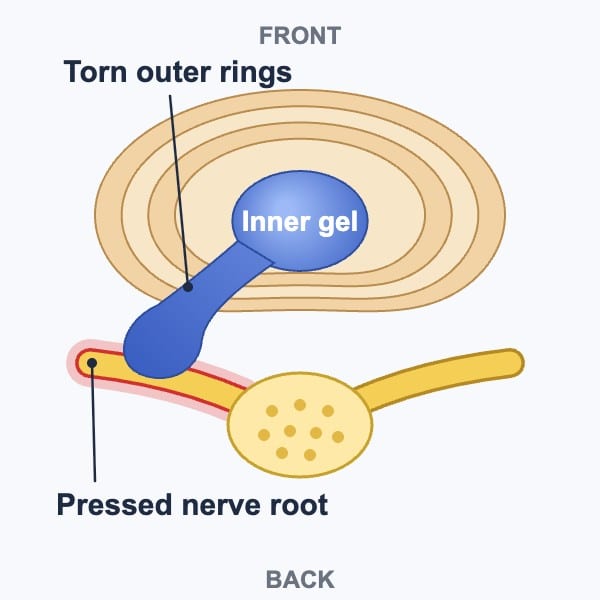
“Slipped disc” or “slip disc” is the layman’s term for a damaged disc at any stage from a bulge to a fragment. Each disc has a gel-like center, the nucleus, held in place by a ring of tough fibers, the annulus. Load and poor habits wear the disc down until fibers of the ring tear, and the center then moves toward the weakest point. A tear at the back of the disc matters more, because the spinal cord and nerves lie there.

I describe disc damage as progressive, in this order:

Stage What It Means
Disc degeneration The disc dries out and loses height under the load of each day, and its fibers weaken and begin to tear.
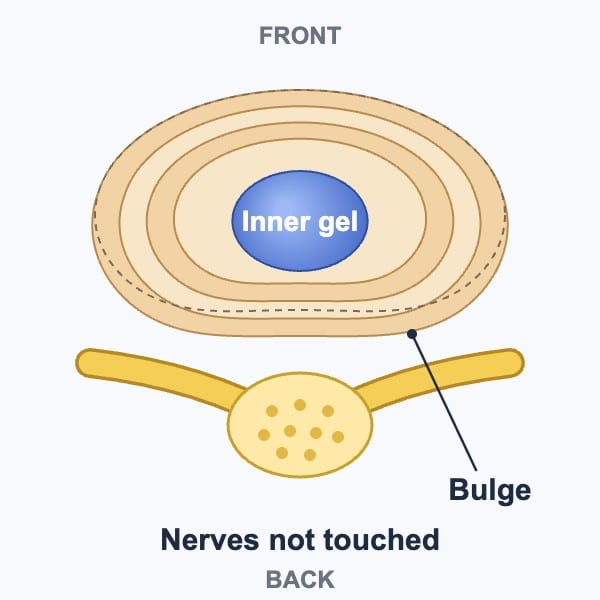
Disc bulge The disc fibers are swollen more than usual. A true bulge is still contained and leaves the spinal cord and nerves untouched.
Disc protrusion The soft center moves out toward the spinal canal or a nerve opening, but it does not break through the outer fibers.
Disc prolapse The protrusion has gone further. Only a few remaining outer fibers keep the center from breaking into the spinal canal.
Disc herniation or rupture The last intact fibers tear, and the center comes into contact with the contents of the spinal canal or a nerve opening.
Disc extrusion Material from the soft center has been forced out to the outer edge of the disc. It needs to be assessed promptly; that does not automatically mean surgery, and it can include conservative care.
Fragmentation and sequestration In this last and most dangerous stage, a piece of the soft center tears away and lies loose in the spinal canal. It also needs prompt assessment.

In my experience, once a disc is damaged, it can move through these stages rapidly or over years. Small tears can also be missed on an MRI. I explain the stages in my videos Why Spinal Discs Get Damaged and Bulging Disc vs Herniated Disc. See also the MyChiro pages on slipped-disc care and spinal discs.

The three drawings look down on a lower-back disc, stomach side at the top. They compare a healthy disc with a bulge and a herniation.

.csc-disc-trio{display:grid;grid-template-columns:repeat(3,minmax(0,1fr));gap:10px;margin:12px 0 22px;max-width:720px}@media (max-width:767px){.csc-disc-trio{grid-template-columns:1fr;max-width:340px;margin-left:auto;margin-right:auto}}
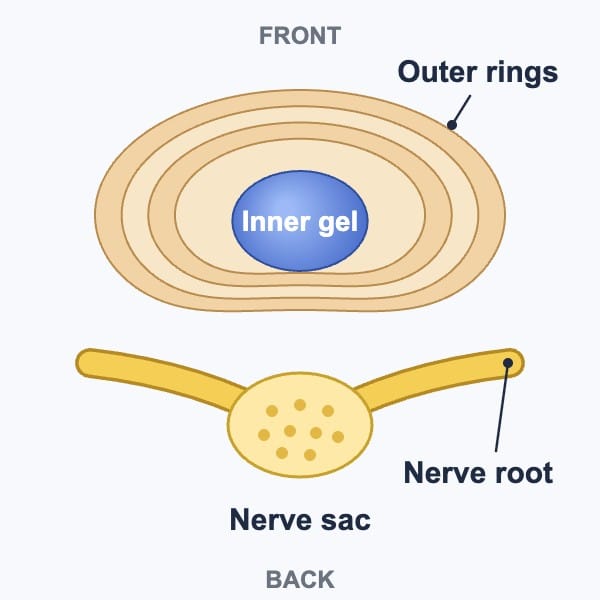
Top view of a healthy lower-back disc: the outer rings hold the inner gel in the middle, with space for the nerve sac and nerve roots behind Healthy disc
Top view of a lower-back disc bulge: the swollen outer rings still hold the inner gel, and the nerves behind the disc are not touched Disc bulge
Top view of a lower-back disc herniation: the inner gel has pushed through torn outer rings and presses on a nerve root behind the disc Disc herniation

Is Leg Pain Always Sciatica?

No. Leg pain can also come from the hip, the circulation or another medical cause. To me, sciatica is a loose term: it describes a symptom and means the sciatic nerve is inflamed. The nerve is formed from several nerve roots of the lower back and the base of the spine, and in some people the roots vary.

Sciatica is a nerve issue, not a muscle issue. I have not seen sciatica without some disc involvement; the degree ranges from mild to moderate.

  • Sciatica: pain along the sciatic nerve into the buttock, thigh, calf or foot, usually in one leg. It can turn into numbness and tingling, then weakness.
  • Pinched nerve: an everyday name for a nerve root that is pressed on; the assessment finds where and why.
  • Muscles and fascia: the muscles of the back, buttock, hamstring, outer thigh and calf share the nerve's supply. They can tighten and develop trigger points too, so care looks at the nerve and the muscles together.
  • Hip, circulation or other medical causes: these may need a different specialist.

I explain the difference in my video Sciatica vs Slipped Disc.

Read the dedicated guides to sciatica, sciatic nerve pain, and pinched-nerve symptoms.

How the First Assessment at CSC Works

The first visit begins with history and examination. It looks for the likely source of the pain, checks for anything that needs a doctor first, and sets a plan that fits the person.

  1. History and goals: When symptoms began; what worsens or eases them; previous episodes, injuries, care, medication, work demands, sleep, driving, sport, and activities that matter to the person.
  2. Movement and functional review: How the back responds to sitting, standing, walking, bending, lifting, changing position, and task-specific movement.
  3. Joint and muscle assessment: the joints of the spine, pelvis and hips are examined, with the muscles and soft tissues around them.
  4. Neurological screening where indicated: Strength, reflexes, sensation, balance, gait, and nerve-related signs when leg symptoms, numbness, tingling, or weakness are reported.
  5. Imaging and report review: existing MRI, X-ray, CT and medical reports are read with the symptoms and the examination. A new scan is ordered only when the examination shows a need, as the next section explains.
  6. Explanation and options: Findings, uncertainties, limitations, care choices, referral options, and fees are discussed before care proceeds.
  7. Progress checks: the tests from the first visit are repeated at review visits, with pain scores and the patient’s own report.

The CSC Bukit Damansara page explains what happens at the first visit and provides the current location and appointment details.

When an MRI or X-Ray Is Needed

Not every patient needs a scan. In my view, an X-ray should only be ordered after a thorough assessment, and only when it is indicated. When a scan is needed, it is usually one of these:

  • An X-ray, when the joints or the alignment of the spine are the concern. An X-ray shows only the bones.
  • An MRI, when a disc problem is suspected, so the diagnosis is confirmed rather than guessed. An MRI uses no radiation and shows the bones, joints, muscles, ligaments and the space the nerves occupy.
  • X-rays taken bending forward and back, plus an MRI, when a vertebra may have slipped.

A scan comes sooner after major trauma, or when a fracture, an infection or worsening nerve changes are suspected.

In my Back Pain to Leg Pain talk, I put it simply: “the most common symptom of spinal disc damage is zero.” An MRI study of 98 adults without back pain found a disc bulge in 52 percent and a protrusion in 27 percent [3]. So a report is read together with the symptoms and the examination. The most alarming line in a report is not always the cause of the symptoms.

Back Pain Treatment Options for Sri Petaling Residents

Care is chosen after the assessment and combines several methods. I frame recovery in two halves: increase what is beneficial for the back, and decrease what is harmful to it. A good plan also needs an accurate diagnosis, careful execution, and changes to posture, habits and daily activity. In my Sciatica vs Slipped Disc video, I point out that a visit lasts from 30 minutes to two hours: “What about the other 22 hours? You have to mind your posture, your habits.”

Chiropractic Care Without Forceful Twisting

For the lower back, forceful, high-speed twisting and cracking are avoided at CSC. In my view, twisting and cracking are wrong for a spine with a damaged disc, no matter how experienced the chiropractor. I keep rotary manipulation for spines where I am 100 percent certain no disc is damaged.

Joints are adjusted by hand or with a low-force instrument. Flexion-distraction, a slow bending motion on a special table, may be used for some disc and joint problems.

Care is kept within what the patient can comfortably tolerate. To me, discomfort during care means it is being done too aggressively, so the patient tells the clinician at once. My motto has always been “No pain, more gain.”

Back pain treatment for residents of Sri Petaling: a clinician's gloved hands on the lower back of a person lying face down on a flexion-distraction tableFlexion-distraction: the person lies face down on a table that allows a slow bending motion at the lower back.

Physiotherapy and Hands-On Soft Tissue Work

Registered physiotherapists work on how the muscles respond, how the back moves, strength, balance and a step-by-step return to daily tasks. Hands-on soft tissue work includes trigger point therapy, which presses on tight knots in a muscle. Myofascial therapy works on the muscles and their wrapping tissue. Residents who want physiotherapy can read the Sri Petaling and Bukit Jalil physiotherapy page or the back-physiotherapy guide.

Exercise and When It Starts

In my view, exercise and stretching must be condition specific and age appropriate, and start only when the body is ready. With a disc problem, exercise waits until the back is stable, usually from the fifth to seventh session and for some people from the third. Early exercises include Kegel exercises when the pelvic floor is weak, wall-assisted squats, and cat and camel. Cat and camel slowly rounds and arches the back on the hands and knees. Core work and strengthening for the glutes, hamstrings, calves and thighs follow by severity, then balance work.

Coordinated Chiropractic and Physiotherapy

At CSC the chiropractor and the physiotherapist work from one plan, each with a distinct job. Read how chiropractic and physiotherapy are combined.

Spinal Decompression and NSD Therapy®

Some people with disc or nerve problems may be offered decompression on a special table, as one part of a wider plan. Care may also use ultrasound, electrotherapy (mild currents through pads on the skin), laser, shockwave (sound-wave pulses through the skin), or cold therapy. Heat is not applied to a back with a disc or facet joint problem, or to any inflamed area. Read more on spinal decompression, the NSD Therapy® website, the MyChiro NSD Therapy® page, the CSC physiotherapy and rehabilitation gym and PhysioWorld.

Injections and Surgery

Injections and surgery are a distant last resort, considered only after conservative care has had a fair trial and is not working. In my Sciatica vs Slipped Disc video, I also say that surgery “should be the last option. Exhaust conservative route.”

Some severe cases need specialist care sooner, such as an infection or a disc fragment that has broken loose. New numbness around the genitals or anus, new difficulty passing urine, or loss of bladder or bowel control needs urgent medical attention at a hospital emergency department straight away, within hours. Leg weakness that is getting steadily worse also needs a prompt assessment. Medicines are a matter for a doctor or pharmacist, and a specialist is involved when needed.

Back Pain During Pregnancy for Sri Petaling Residents

Back pain is common during pregnancy. As the baby grows, posture changes and more load falls on the lower back and pelvis.

At CSC, pregnancy back pain is first checked for warning signs that belong with the obstetric team. When a muscle and joint check is suitable, care may use low-force chiropractic, registered physiotherapy and gentle exercise. It is planned around the pregnancy and the months after birth. The prenatal and postnatal care page explains this care in detail.

Back Pain Treatment for Older Adults and Children

Older adults, especially those with spinal stenosis or arthritis, follow a gentler plan at CSC. It relies more on changes to daily habits and delays stretching. Balance and stability work is added, such as a rocker board, a wobble board, gym ball balance and Kegel exercises. Decompression sessions are lighter and shorter, and hands-on care is softer.

The assessment also weighs osteoporosis, blood thinners, steroid use, falls and past spinal surgery. Some people need a scan or a medical opinion first.

In a child or teenager, back pain is assessed with growth in mind. A doctor comes first after a significant injury, or when the pain comes with fever, night pain, weight loss, weakness or numbness. New numbness around the genitals or anus, new difficulty passing urine, or loss of bladder or bowel control needs urgent medical attention at a hospital emergency department straight away, within hours.

Very young children receive non-force care, and teenagers may receive care with a low-force instrument. A parent or guardian gives consent and can stay throughout every visit.

The guide to chiropractic care for children explains the first visit.

To jump to a part of this video or read along, see the Spine and Joint Care in Kuala Lumpur video page.

Caring for Lower Back Pain at Home Before the First Visit

Until the first visit, I advise the home care below for lower back pain, unless an urgent sign appears. New numbness around the genitals or anus, new difficulty passing urine, or loss of bladder or bowel control needs urgent medical attention at a hospital emergency department straight away, within hours.

What to do:

  • Ice the sore area 2 to 3 times a day for 10 to 15 minutes, at least 2 hours apart. Wrap the pack in a cloth and set a timer.
  • Stand up every 15 minutes of sitting and walk for 10 to 20 seconds.
  • Sleep at least six hours, with seven to eight hours of unbroken sleep where possible, and longer when sleep is broken. Sleep on the right side first, the left side second, or on the back with a bolster under the knees. On the side, use a pillow that keeps the spine straight and a bolster between the knees.
  • Check with a pharmacist or doctor before taking any medicine for the pain.

What to avoid:

  • Bending and twisting at the waist.
  • Lifting while the back is sore; when a lift cannot wait, keep it under 2 kg.
  • Stretching and exercise in the early stage, until the assessment shows the back is ready.
  • Yoga, which must be avoided with a disc problem, because its deep bends and twists load the discs.
  • Any activity that hurts at the time or raises pain within 72 hours, since inflammation can take up to 72 hours to show.
  • Hot packs on a sore, inflamed back, since heat can add to the inflammation.
  • Long road trips. When one cannot wait, ride in the front passenger seat, reclined. A driver with acute, intense back pain stops after about 15 minutes, where it is safe, to walk and stretch the calves. No drive should go past 20 to 30 minutes without a break.
  • Forcing the back to crack, long spells in bed, and slouching on a sofa.
  • Deadlifts, and gym work that combines bending, twisting and free weights.
  • Hard or aggressive hamstring stretches.
  • A forceful massage, or anyone walking on the back.

I show the sitting, sleeping and standing positions in my neck and back self-help video.

Arrange an assessment sooner when the pain keeps returning or getting worse. The same goes for pain that spreads down a leg with numbness or weakness, or disturbs sleep, walking or work.

Desk Work, Driving and Long Sitting

Desk work and driving load the back through long fixed positions, little movement, repeated reaching, vibration, tiredness and many hours of sitting.

  • Sit back so the buttocks touch the chair's back support and the top of the belt line rests against it.
  • Keep the knees level with the hips or slightly lower, and the feet flat under the knees. Leave a small gap between the back of the knees and the seat.
  • Place the main screen straight ahead, with the eyes slightly below its top edge, and raise a laptop or connect it to a monitor.
  • Keep the elbows at about 90 degrees.
  • Keep frequently used items close to avoid reaching and twisting. Keep the phone on the side of the hand that does not write, or use a headset.

I explain the desk setup in my desk posture video. The Office Syndrome in Kuala Lumpur page covers desk work in more detail.

What to Bring for the First Visit

  • Identification and the contact details needed for registration.
  • Any recent MRI, X-ray or CT, with the original images or an image-access link where available, not only the written report.
  • Radiology, medical and surgical reports and injection records relevant to the concern.
  • A current list of medication and important medical conditions.
  • Details of how the symptoms began, previous episodes, treatments tried, and what changed afterward.
  • Comfortable clothing that allows the relevant area and movement to be assessed.
  • A list of questions, and the daily activities that matter most to get back to.

The first visit is an assessment, and any care that follows is planned from its findings.

How Much Does Back Pain Treatment Cost at CSC?

Under the CSC quotation dated June 25, 2026, the examination is RM100 and a chiropractic adjustment RM150, or RM110 with physiotherapy in the same visit. Physiotherapy runs from RM57 to RM180 a standard unit, by type of service, or RM27 to RM150 a unit alongside chiropractic. The same fees apply at both Kuala Lumpur centers, and the chiropractic price and physiotherapy price pages for Kuala Lumpur list every item. The total depends on the findings, the methods and the number of visits; flexion-distraction or a reading of earlier scans is charged separately. The fee for a plan is explained and agreed before care begins.

Frequently Asked Questions

Is the CSC Sri Petaling clinic still open?

No. The former CSC Sri Petaling clinic is closed for good and takes no appointments. Back pain treatment for Sri Petaling residents now takes place at CSC Bandar Sri Damansara or the Bukit Damansara main center, both in Kuala Lumpur. People from Bukit Jalil, OUG, Kuchai Lama, Taman Desa, Old Klang Road and nearby areas use the same centers. Both have the same hours and fees, so the choice comes down to the route and the appointment time.

How many visits does back pain treatment take?

The number of visits is set after the assessment. It depends on the cause, how long the pain has been present, the person’s goals and how the back responds. In my view, the chiropractor should reassess if there is no improvement by the fifth session. If there is none by the tenth, the patient and the chiropractor decide together whether to continue.

Can lifting cause sudden lower back pain?

Yes. A heavy or awkward lift, especially with a twist, can strain a muscle, irritate a spinal joint or worsen a disc problem. While the back is sore, avoid lifting; a lift that cannot wait stays under 2 kg. New numbness around the genitals or anus, new difficulty passing urine, or loss of bladder or bowel control needs urgent medical attention at a hospital emergency department straight away, within hours.

How long does lower back pain take to settle?

How long lower back pain lasts depends on its cause, how long it has been present and how the back responds to care. In my experience, the pace depends on the severity of the problem, other health conditions, following the advice and consistency. Pain that was neglected for a long time may leave lingering symptoms or flare-ups even after recovery. Progress is judged at review visits rather than guessed in advance.

Is chiropractic safe for back pain?

In my video Is Chiropractic Safe? 13 Questions Answered, my answer is that “chiropractic care is safe. It is safe when it's performed by a competent chiropractor who is also registered,” and it must be condition based. In my view, how safe it is comes down to the chiropractor, their experience and the technique chosen. Before care begins, its possible effects and risks are explained. With a damaged disc or a compressed nerve, I use only gentle methods that do not twist the spine. At CSC, care is kept within what the patient can comfortably tolerate.

Should I see a chiropractor or physiotherapist?

I recommend both, as I say in my video Is Chiropractic Safe? 13 Questions Answered: “Don't choose between one or the other. Choose both.” To me, holistic care means comprehensive care, and no single approach can be comprehensive on its own. For back pain, the chiropractor adjusts the spinal and pelvic joints without forceful twisting and also treats the muscles and ligaments. An adjustment alone cannot reach every tissue at depth. That is where the physiotherapist adds exercise, hands-on soft tissue care and a step-by-step return to everyday activities. The two are separately registered professions, and at CSC they treat side by side.

Why does my back hurt when I stand up after sitting?

Standing up after a long sit loads the lower back at the moment its muscles, joints and discs are stiffest from holding one position. A sore disc or an irritated spinal joint often reacts most in that first movement. How the pain changes after a few steps, with bending or with longer standing gives useful clues at the assessment. Standing up every 15 minutes of sitting and rising without a twist both reduce the strain.

This page is general information for Sri Petaling residents about back pain and its care, and it cannot assess any one reader’s situation. The cause of a symptom, the meaning of a scan and the right next step are decided at an individual assessment.

References

  1. Hayden JA, Ellis J, Ogilvie R, et al. Exercise therapy for chronic low back pain. Cochrane Database Syst Rev. 2021;9(9):CD009790.
  2. Coulter ID, Crawford C, Hurwitz EL, et al. Manipulation and mobilization for treating chronic low back pain: a systematic review and meta-analysis. Spine J. 2018;18(5):866-879.
  3. Jensen MC, Brant-Zawadzki MN, Obuchowski N, et al. Magnetic resonance imaging of the lumbar spine in people without back pain. N Engl J Med. 1994;331(2):69-73.

These studies describe back pain and its care in general and do not evaluate care at Chiropractic Specialty Center.

The Author of Back Pain Treatment for Residents of Sri Petaling, KL

Back Pain Treatment for Residents of Sri Petaling, KL was written by Yama Zafer, D.C., who has 30+ years in chiropractic and physiotherapy and founded Chiropractic Specialty Center in Kuala Lumpur in 2006.

Last Updated: Back Pain Treatment for Residents of Sri Petaling, Kuala Lumpur

Back Pain Treatment for Residents of Sri Petaling, Kuala Lumpur was last reviewed and updated on October 11, 2026.