

Slipped Disc Care Through Gentle Methods
A slipped disc does not slip. The disc remains attached to the vertebrae above and below it. What changes is the tough outer wall, built from layered fibers, which weakens over years and allows the softer inner material to push outward, and sometimes through. That distinction matters, because a weakened wall behaves very differently from something that has fallen out of place.
Many improve over time. The useful marker during recovery is not the pain score but the distance symptoms travel: pulling back toward the spine indicates improvement, even when the back itself aches more for a few days, while spreading further down the limb does not.
This guide to a slipped disc, its signs, its diagnosis and its course over time, is published by Chiropractic Specialty Center, Bukit Damansara (KL) main center: WhatsApp+60 17 269 1873 Call+603 2093 1000
Key Takeaways: What to Know About a Slipped Disc
- “Slipped disc” is a common name for a disc bulge, protrusion, herniation, extrusion or sequestration.
- Disc changes usually build up gradually from everyday loading and age-related change rather than one single movement.
- Symptoms arise when a disc irritates or presses on a nerve, which can send pain, tingling or weakness into an arm or leg.
- Many disc herniations shrink on their own, and larger ones are more likely to do so.
- Conservative care is the usual first step; surgery is a distant last resort for most people, with specific exceptions described below.
What Is a Slipped Disc?
Each spinal disc has a fibrous outer wall (the annulus) and a softer, water-rich center (the nucleus). With age and repeated loading, the outer wall can develop small tears. A bulging disc extends beyond its normal border around much of its edge. In a herniated disc, inner material pushes through a weakened part of the wall; an extruded disc is a larger herniation, and a fragmented or sequestrated disc means a piece has separated. More on how a disc gets damaged is available separately.
For the chapter list and the transcript, open the Bulging Disc vs Herniated Disc video guide.
The video above explains how a disc bulge differs from a herniation and how disc changes can progress.
Slipped Disc Assessment at Two KL Centers
A first visit works out which level is involved, whether a nerve root is irritated, and whether anything needs medical attention first. The examination tests movement, strength, sensation and reflexes, and any MRI you bring is read alongside those findings. Directions and hours are on the Bukit Damansara contact page and the Bandar Sri Damansara contact page, or you can call or message either center:
- Bukit Damansara (KL, main center): Call +603 2093 1000 or WhatsApp +60 17 269 1873 to see the Bukit Damansara / KL center.
- Bandar Sri Damansara (KL): Call +603 6262 5777 or WhatsApp +60 12 455 6939 to see the Bandar Sri Damansara center.
Signs and Symptoms of a Slipped Disc
- Local pain: In the neck or lower back, often with stiffness.
- Spreading pain: Into the arm from the neck, or into the buttock and leg from the lower back, often called sciatica.
- Numbness or tingling: In the area supplied by the irritated nerve root.
- Weakness: For example, difficulty lifting the foot or pushing up onto the toes, or weakness in the grip or arm.
Which Spinal Levels Are Most Often Involved?
There is no disc between the skull and C1 or between C1 and C2; the first disc is at C2-C3. In the neck, disc problems are most common at C5-C6 and C6-C7, with C4-C5, C3-C4, C2-C3 and C7-T1 involved less often. In the lower back, L4-L5 and L5-S1 account for most herniations, with L3-L4, L2-L3 and L1-L2 less common.
How a Slipped Disc Is Diagnosed
Diagnosis starts with the history and a physical examination, including a check of strength, sensation and reflexes. Many people with back or neck pain do not need a scan at first. MRI is the most useful test when it is needed, because it shows discs and nerves, whereas X-rays mainly show bone. MRI is usually considered when symptoms are severe, when there is weakness or other neurological change, when symptoms have not improved after about six weeks, or when surgery or an injection is being considered. Because disc changes are common in people with no symptoms, the scan is always read together with the examination.
What Happens to a Herniated Disc Over Time
A systematic review of studies that imaged lumbar disc herniations twice found that the herniated material shrinks on its own in many cases, and that larger herniations are more likely to regress: regression was reported in about 96 percent of sequestrations, 70 percent of extrusions, 41 percent of protrusions and 13 percent of bulges, with complete resolution in about 43 percent overall.
That runs against intuition: the frightening scan is often the one most likely to improve. It is not a reason to ignore symptoms or skip assessment, but it is a reason not to rush into a decision while the picture is still changing. It is also worth knowing that disc bulges, protrusions and degeneration appear on scans in many people who have no pain at all, and the proportion rises with age.
A Realistic Timeline
- The first two weeks: Settling and staying moving. Bed rest tends to slow recovery; short, frequent walks are better than long periods of sitting or lying.
- Weeks two to six: Leg or arm symptoms often start to centralize. Pain moving back toward the spine is a good sign, even if the back itself feels no better.
- Weeks six to twelve: Strength and loading are rebuilt. This is the part that helps prevent a recurrence, and the part most often skipped once pain eases.
- Review at four to six weeks: If nothing measurable has changed, the plan or the diagnosis needs revisiting rather than repeating.
Everyday Steps That Help
- Keep moving with walking or swimming, and break up long periods of sitting.
- Lift with the load close to the body and avoid repeated bending and twisting while symptoms are active.
- Leave out yoga altogether, as it must be avoided with a slipped disc even when symptoms are quiet.
- Set up your desk and screen so you are not holding your head or trunk bent forward for long periods.
- Maintain a healthy weight and stay generally active once symptoms allow.
Non-Surgical Care Options
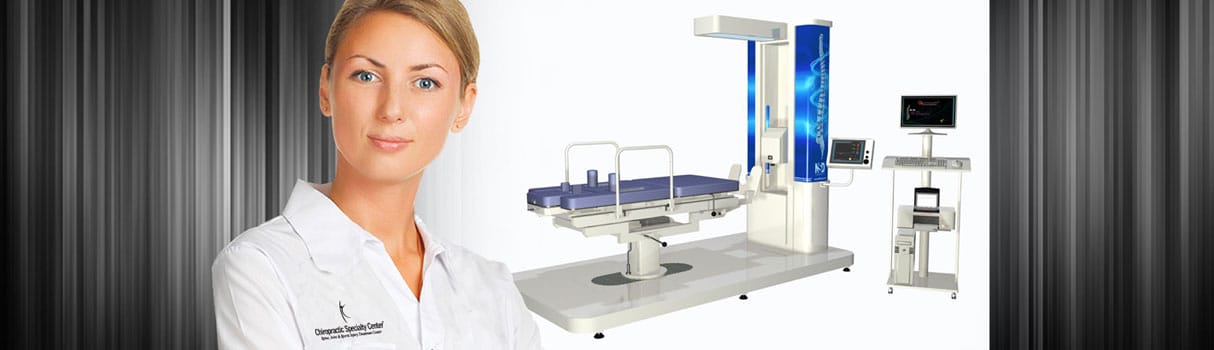
Conservative care is guided by the examination. At CSC it follows a sequence: assessment first, then non-rotatory chiropractic care, registered physiotherapy and guided exercise, with the exercise progressed as symptoms settle. For selected disc problems, controlled spinal decompression, for example with the RxDecom® table, may be added as part of NSD Therapy®. Decompression changes load on the disc for a period; it is not shown to rebuild a damaged disc, and it is used alongside exercise rather than on its own. Care for neck stiffness and sciatica and leg pain follows the same principles.
Medication, Injections and Surgery
Anti-inflammatory medication can ease pain for a short period but does not change the disc. Epidural steroid injections may give short-term relief of leg pain for some people; the decision is made with a doctor and depends on the findings. In a large randomized trial of sciatica, early surgery gave faster relief of leg pain than prolonged conservative care, but results at one year were similar in both groups. That is why surgery is usually reserved for specific situations: a change in bladder or bowel control, weakness that keeps getting worse, or severe pain that has not improved with a proper course of conservative care where the scan clearly matches the symptoms.
What the Assessment Checks
- While a slipped disc in the lower back is being helped with care for back or leg pain, get urgent medical attention, a thorough assessment by a competent clinician the same day, if numbness develops or worsens around your genitals, between your genitals and anus, or around your anus. New difficulty passing urine needs the same urgent assessment; loss of bladder or bowel control does not have to occur first, and if it does occur, it is urgent too. These symptoms have several possible causes. Some may call for an invasive procedure, but the assessment determines what care is appropriate, rather than assuming surgery is necessary.
- Weakness that keeps getting worse, or a foot that drags when you walk, should not be ignored; have it assessed by a competent provider. Conservative care may still be a reasonable route depending on what that assessment shows.
- Symptoms in both legs, or unsteadiness on your feet, are checked during the examination.
- Fever with back pain, back pain after a recent infection or procedure, or severe pain after significant trauma or in anyone with osteoporosis or a history of cancer should be checked by a doctor first.
Planning a visit? You can review the current chiropractic price in Kuala Lumpur and physiotherapy fees in Kuala Lumpur before you come in.
Slipped Disc: Common Questions Answered
Is surgery always needed for a slipped disc?
No. Most people improve with conservative care, and many herniations shrink on their own. Surgery is considered in the specific situations described above.
How long does a slipped disc take to improve?
It varies. Many people notice improvement within six to twelve weeks, and some take longer. The direction of change in leg or arm symptoms is a useful guide.
Can exercise help?
Yes. Guided exercise is a central part of recovery and helps reduce the chance of a recurrence.
Is MRI better than X-ray for a slipped disc?
MRI shows discs and nerves, while X-rays mainly show bone. Not everyone needs a scan, but when one is needed, MRI is usually the right test.
What daily habits can make it worse?
Long periods of sitting, repeated bending and twisting, and lifting with the load held away from the body.
References
- Chiu CC, Chuang TY, Chang KH, Wu CH, Lin PW, Hsu WY. The probability of spontaneous regression of lumbar herniated disc: a systematic review. Clin Rehabil. 2015;29(2):184-195.
- Brinjikji W, Luetmer PH, Comstock B, et al. Systematic literature review of imaging features of spinal degeneration in asymptomatic populations. AJNR Am J Neuroradiol. 2015;36(4):811-816.
- Peul WC, van Houwelingen HC, van den Hout WB, et al. Surgery versus prolonged conservative treatment for sciatica. N Engl J Med. 2007;356(22):2245-2256.
- Foster NE, Anema JR, Cherkin D, et al. Prevention and treatment of low back pain: evidence, challenges, and promising directions. Lancet. 2018;391(10137):2368-2383.
These references describe lumbar disc herniation and its conservative and surgical management in general. None of them evaluates care at Chiropractic Specialty Center.
The Author of Can a Slipped Disc Be Helped? What the Evidence Says
Can a Slipped Disc Be Helped? What the Evidence Says was written by Yama Zafer, D.C., who has 30+ years in chiropractic and physiotherapy and founded Chiropractic Specialty Center in Kuala Lumpur in 2006.
Last Updated: Slipped Disc Care Through Gentle Methods
Slipped Disc Care Through Gentle Methods was last reviewed and updated on October 3, 2026.
Slipped Disc L5 S1 compressed
Compressed at L5-S1 describes loss of disc height at the lowest level of the lumbar spine. It helps to separate what that finding means from what it actually does, because the two are often confused.
Loss of height means the disc has lost water content and no longer holds the two vertebrae as far apart. On its own that is a common finding, present in many people with no back pain at all. Symptoms come from the consequences. As the disc narrows, the two small facet joints behind it are pressed together and take load they were not built to carry, and the opening the S1 nerve root passes through becomes smaller. That is why the same wording on a report is silent in one person and disabling in another.
The pattern that identifies root involvement at this level is S1: pain into the buttock and down the back of the thigh and calf toward the outer foot, a weak push-off when rising onto the toes, and a reduced ankle reflex. If those are present the nerve is involved, not only the joint.
What has to be established before anything is decided. Is there weakness, and is it stable or worsening. If your symptoms steadily get worse, or the care you are receiving is not helping, please arrange a medical review. New numbness around the genitals or anus, new difficulty passing urine, or loss of bladder or bowel control needs urgent medical attention: a thorough assessment by a competent clinician the same day. In the absence of those, this level is usually managed conservatively.
Conservative care at L5-S1 has to do two things that general treatment often does not. It has to reduce the compressive load on a segment that carries most of the body weight in sitting and bending. And it has to restore hip mobility, because a stiff hip transfers its work straight into this level and is one of the most common reasons L5-S1 keeps flaring after it settles. Strengthening of the gluteal and deep trunk muscles follows once symptoms allow. Some have found spinal decompression therapy by devices like the RxDecom or similar to be helpful for spinal disc related issues, including those that at times cause nerve issues.
Bring the MRI images to any assessment rather than only the report. Height loss, nerve root contact, and facet change are all visible on the images and only summarized in the text.
I have a cervical herniated disc and having pain due to nerve impingement. The pain runs down to my shoulder and left arm. It's been constant for the past 3 weeks. It was about to go off, but it came back 2 days ago. I wonder what kind of treatment would be suitable for me as it affects my daily activities and work. Please, contact me through my mail address below.
The pattern you describe, constant pain running from the neck into the shoulder and down one arm, is cervical radiculopathy: a nerve root being irritated where it exits the spine. In the left arm it is most often the C6 or C7 root. Which root is involved is worked out from where the symptoms land, which reflex is affected, and which specific muscles test weak, not from the MRI report alone.
The first thing that should decide your treatment is not how severe the pain is but whether there is measurable weakness. Grip strength, straightening the elbow, lifting the wrist, and holding the arm out to the side each map to a different root. Weakness that is stable can be managed conservatively. Weakness that keeps getting worse should be assessed promptly by a competent provider, and conservative care may still be part of the plan. Symptoms in both arms, clumsy hands, or unsteady walking point to the spinal cord rather than a root, which the examination checks. Any loss of bladder or bowel control needs urgent medical attention: a thorough assessment by a competent clinician the same day.
Where it is a single irritated root with no progressive weakness, most cases settle over weeks to a few months without surgery. Suitable care has three parts and they run in order. Reduce the irritation at the root and restore the movement the segment has lost. Remove the loading that keeps reproducing it, which for most working adults is sustained neck flexion at a desk or phone and a sleeping position that holds the neck rotated. Then rebuild the deep neck flexors and the scapular muscles, which are almost always weak by the time a disc at this level becomes symptomatic, and which is the part most often skipped.
While a root is acutely irritated, forceful end-range rotation of the neck is not appropriate. Lower-force and traction-based approaches are the safer starting point. Some have found spinal decompression therapy by devices like the RxDecom or similar to be helpful for spinal disc related issues, including those that at times cause nerve issues.
An in-person examination that tests reflexes, strength, and sensation is what turns this from a general answer into a specific plan.
One detail in your message is worth answering on its own: the pain had nearly settled and then returned two days ago. That pattern is common and it is usually misread.
Early relief in cervical radiculopathy generally reflects inflammation around the nerve root subsiding. It does not mean the mechanical cause has resolved. The segment that allowed the root to be compressed still moves the way it did, and the muscles that should be protecting it are still deconditioned. So when normal activity resumes at full volume, which is exactly what people do the moment pain eases, the root is loaded again and symptoms return. The relapse is not a sign that treatment failed. It is a sign that the pain settled faster than the tissue and the muscle control did.
Two practical consequences. First, return to activity in steps rather than all at once, and treat the first few pain-free days as the most fragile part of the recovery, not the end of it. Second, stop using pain intensity as your only measure of progress.
The more reliable measure is how far the symptoms travel. Symptoms retreating up the arm toward the neck indicate the root is less irritated, even when neck pain temporarily increases. Symptoms traveling further down toward the hand and fingers indicate the opposite, and that direction of change matters more than whether today hurt more or less than yesterday. Keep a simple daily note of where the furthest point is.
Escalate rather than continue if weakness appears or worsens, if the hand becomes clumsy, or if numbness becomes constant rather than intermittent.
I have slip discs L4/L5 L5/S1. What would you advise that should I do; operation, or do you have another alternative?
Whether you need an operation is decided by your neurological examination, not by the wording of the MRI report. L4-L5 and L5-S1 are the two most commonly affected levels in the lumbar spine, and disc changes at those levels are common even in people with no symptoms at all. The finding alone does not justify surgery.
If your symptoms steadily get worse, or the care you are receiving is not helping, please arrange a medical review. New numbness around the genitals or anus, new difficulty passing urine, or loss of bladder or bowel control needs urgent medical attention: a thorough assessment by a competent clinician the same day.
Outside those situations a structured conservative trial is the usual first step, and it is worth being specific about what that means. Painkillers, rest, and general massage are not a trial of conservative care. A proper attempt addresses the load on the involved segment, restores the movement lost above and below it, and rebuilds the muscles that stabilize the lower back, which weaken quickly once pain limits movement. Some have found spinal decompression therapy by devices like the RxDecom or similar to be helpful for spinal disc related issues, including those that at times cause nerve issues.
Two questions to put to whoever proposes an operation. Which level are you operating on, and how does that level explain my symptoms. And is a fusion planned or a decompression alone. Fusion increases mechanical load on the segments beside it over time, which matters when two adjacent levels are already involved.
If you have not yet had a hands-on assessment that tested your reflexes, strength, and sensation level by level, that is the missing step, and it belongs before a decision either way.
Please provide the location of your centers. I'm contactable at 0122352672.
Suffering from prolapsed disc C5-C6 since 2013.
Chiropractic Specialty Center has two centers in Kuala Lumpur: Bukit Damansara, the main center, and Bandar Sri Damansara. Addresses, hours, and direct numbers for each are on the contact pages of this site.
On the clinical side, a C5-C6 prolapse present since 2013 needs a different starting point than a recent one. Two things matter more than the age of the finding.
The first is what the disc is doing now, not what it did on the scan that named it. A prolapse from years ago may have shrunk, stayed the same, or been joined by degenerative narrowing at the same level. If your most recent imaging is several years old, it no longer describes your spine.
The second is whether the problem involves the nerve root or the spinal cord. C5-C6 is a level where both are possible. Nerve root involvement gives pain, numbness, or weakness down one arm in a defined pattern, and it is usually appropriate for conservative care. Cord involvement is different: clumsy hands, dropping objects, buttons and keys becoming difficult, unsteady walking, or a change in bladder control. Those signs call for prompt medical assessment and current imaging, not manual treatment.
Where the picture is nerve root or mechanical neck pain, a structured course of care is reasonable to attempt. It should be specific to the segment: identifying which movements load C5-C6, physiotherapy-led treatment, and progressive strengthening of the deep neck flexors and scapular support, which are consistently weak in long-standing cervical disc problems. Some have found spinal decompression therapy by devices like the RxDecom or similar to be helpful for spinal disc related issues, including those that at times cause nerve issues.
Bring your original 2013 imaging as well as anything more recent. The comparison between the two is often the most informative item in the file.
Have you tried this treatment? Mine got the same problem
Since the problem is described as the same one without the detail, what follows is what determines whether an approach is likely to suit you, which is more useful than another person's experience of it.
Two people with identical MRI wording can need different things, and the examination is what separates them. Is a nerve root involved, or is the pain coming from the joints and muscles around a degenerated disc. Is there measurable weakness or a lost reflex. Do symptoms travel below the knee or below the elbow, and does that distance change with position. Those answers decide what is appropriate, not the wording of the report.
Before comparing treatments, rule out what does not belong in conservative care at all. If your symptoms steadily get worse, or the care you are receiving is not helping, please arrange a medical review. New numbness around the genitals or anus, new difficulty passing urine, or loss of bladder or bowel control needs urgent medical attention: a thorough assessment by a competent clinician the same day.
Where those are absent, judge any approach by three things. Does it begin with an examination rather than a package of sessions. Does it address the mechanical loading that keeps reproducing the problem, not only the pain. And does it include progressive strengthening, which is the part most often left out and a common reason symptoms return after they settle. Some have found spinal decompression therapy by devices like the RxDecom or similar to be helpful for spinal disc related issues, including those that at times cause nerve issues.
If you post which level is involved and what the symptoms do across a day, a far more specific answer is possible.
Dear Manual,
Thank you for the kind words. I am pleased to hear you like it. We have spent lots of time developing our site and blog. Please share our posts and pages with friends and family. Far too many go on suffering needlessly when we can help.
Kind regards,
Yama Zafer, D.C.
Doctor of Chiropractic; registered with the Malaysian Traditional and Complementary Medicine Division as a chiropractic practitioner
I'm a slip disc patient. Currently, I'm on medication and have been referred to Assunta hospital for treatment. I want to seek 2nd opinion. Can I know how/ where I can refer to? Kindly please contact me.
A second opinion is most useful when the person giving it can see what your first clinician saw. Bring the actual MRI images on disc or through the hospital portal, not only the typed report. Reports summarize; the images show which level is involved, which direction the disc has moved, and whether it is contacting a nerve root or only narrowing the space.
Three questions separate an operation that is necessary from one that is merely available. First, what is your neurological status: is there measurable weakness, a lost reflex, or numbness in a defined nerve pattern, and is it stable or worsening. Second, do the imaging findings match your symptoms anatomically. A disc at one level does not explain pain that follows a different nerve. Third, what conservative care has actually been tried, at what intensity, and for how long. Painkillers and rest are not a trial of conservative care.
Progressive motor weakness or a foot that drags should be assessed promptly by a competent provider, and conservative care can still be a reasonable route for as long as it keeps producing results. New numbness around the genitals or anus, new difficulty passing urine, or loss of bladder or bowel control needs urgent medical attention: a thorough assessment by a competent clinician the same day.
Where none of that is present, most disc presentations are given a structured conservative trial first. That means care aimed at the involved segment rather than general massage or heat: manual and physiotherapy-led treatment, load management, and progressive rehabilitation of the muscles that control the segment. Some have found spinal decompression therapy by devices like the RxDecom or similar to be helpful for spinal disc related issues, including those that at times cause nerve issues. It is not a cure and it does not suit every presentation, which is why assessment comes first.
For a hands-on assessment, Chiropractic Specialty Center has two centers in Kuala Lumpur, Bukit Damansara and Bandar Sri Damansara. Bring the images and any specialist letters with you.