

Professional Physiotherapist in Kuala Lumpur
A physiotherapist in Kuala Lumpur should open by measuring what has been lost: range of movement in each direction, strength compared with the uninjured side, and the specific movement that reproduces the symptoms. Those figures form the baseline against which every later session is judged, and they are what turns progress into something demonstrable.
Sessions usually combine hands-on work with exercise, and the balance shifts toward exercise as an area improves. Clothing that allows movement is worth wearing. Work between visits is where most of the change occurs, which is why a program should be progressed as tolerance rises rather than repeated unchanged for months.
For more information about seeing a physiotherapist in Kuala Lumpur, contact the Bukit Damansara (KL) main center: WhatsApp+60 17 269 1873 Call+603 2093 1000
Key Takeaways
- Registered physiotherapists alongside chiropractors: Both work from one set of examination findings at Chiropractic Specialty Center.
- Measured and progressed: Each plan starts from baseline measurements and is reviewed against them.
- Home program: You leave with specific exercises to do between visits, because that is where most of the change happens.
How We Provide Personalized Care
At Chiropractic Specialty Center in Kuala Lumpur, registered physiotherapists and chiropractors combine hands-on care and exercise with therapy devices such as laser, shockwave, ultrasound and spinal decompression when they suit the problem. Plans cover neck and back pain, slipped discs, scoliosis and joint or sports injuries, and they are adjusted as the measurements change. More on how the two professions work together is on the page for chiropractic care in Kuala Lumpur.
Physiotherapy Assessment at Our Two KL Centers
Physiotherapy assessments are available at both centers of Chiropractic Specialty Center, in Bukit Damansara and Bandar Sri Damansara. Wear clothing that lets the area be moved and examined, and bring any recent scan reports.
- Bukit Damansara (KL, main center): Call +603 2093 1000 or WhatsApp +60 17 269 1873 to see the Bukit Damansara / KL center.
- Bandar Sri Damansara (KL): Call +603 6262 5777 or WhatsApp +60 12 455 6939 to see the Bandar Sri Damansara center.
Customized Physiotherapy for Neck & Back Pain in KL
Neck and back pain are among the most common reasons people see a physiotherapist, whether the cause is posture strain, restricted movement, a slipped disc, nerve irritation or joint stiffness. A plan may include:
- Hands-on soft tissue release to ease tightness
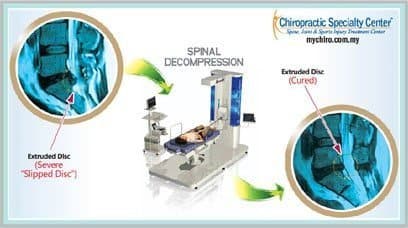
- Non-surgical spinal decompression where a disc problem suits it
- High-intensity laser or ultrasound therapy to settle symptoms enough for exercise
- Electrotherapy for short-term symptom relief
- Strength and mobility exercises progressed over time
More on the full range of services is on the Physiotherapy in KL & Malaysia page.
Sciatica & Slipped Disc Physiotherapy in KL
Sciatica pain that runs from the lower back into the buttock and leg often involves a disc at L4-L5 or L5-S1 irritating a nerve root. Physiotherapy aims to settle the irritated sciatic nerve and restore spinal movement, using gentle mobilization, nerve glide movements and progressive spinal exercises.
Physiotherapy for Neck Pain & Slipped Discs
In the neck, slipped discs are most common at C4-C5, C5-C6 and C6-C7, where they can cause stiffness, restricted movement and arm symptoms. Alongside exercise and hands-on care, a plan may use:
- spinal decompression for selected disc problems
- high-intensity laser therapy
- shockwave therapy for soft tissue problems
- cryo-thermal therapy for symptom relief
Scoliosis Physiotherapy in KL for Adults & Teens
Scoliosis is a sideways curve of the spine that can appear in the teenage years or in adulthood. Physiotherapy for scoliosis is built around the shape and flexibility of each curve and focuses on posture, flexibility and strength. More detail is on the page about scoliosis care in KL.
Prenatal & Postnatal Physiotherapy
Pregnancy-related changes often contribute to pain in the back, hips and pelvis. Physiotherapy can help with these strains during pregnancy and after delivery. At Chiropractic Specialty Center, prenatal and postnatal care may include:
- the Webster technique, a gentle pelvic assessment and adjustment method used in pregnancy
- gentle, instrument-assisted (Activator) chiropractic adjustments
- physiotherapy exercise for pregnancy and postpartum recovery
Physiotherapy for Joint & Sports Injuries in Kuala Lumpur
Knee, shoulder, elbow and wrist problems, including carpal tunnel syndrome, are assessed and managed with hands-on techniques and exercise, with clinical therapy equipment used where it helps symptoms settle enough for loading to progress.
What Is IPKL (Integrative Physiotherapy Kuala Lumpur)?
IPKL is the name Chiropractic Specialty Center uses for combining chiropractic and physiotherapy in one structured plan. The chiropractor and the physiotherapist work from the same examination, so joint movement, muscle control and exercise are addressed together rather than in separate courses of care, with injections or surgery discussed only when conservative care is not enough.
Why Device Settings and Technique Matter
Physiotherapy involves judgment about which hands-on techniques and which equipment suit the case in front of you, and when to stop using them. Devices such as ultrasound, electrotherapy, shockwave therapy and laser therapy need correct settings and application to be useful.
Every chiropractor and physiotherapist at CSC is trained in the use of these devices and in manual therapy before treating patients.
Conditions We Address with Integrated Chiropractic & Physiotherapy
Chiropractic and physiotherapy at CSC offer non-surgical options for conditions including:
- neck and upper back pain
- acute and chronic back concerns
- Upper extremity rehabilitation (shoulders, arms, elbows, wrists and hands)
- Lower extremity rehabilitation (hips, knees, ankles and feet)
- Scoliosis-specific exercise using non-rotatory methods
- Non-invasive care for slipped discs and spondylosis
- Rehabilitation for sciatica and spondylolisthesis
- Assessment of neck-related factors in tinnitus
- Care for jaw pain, jaw clicking and TMD
Physiotherapy vs. Physical Therapy: Is There a Difference?
The two terms describe the same profession. “Physiotherapy” is the usual term in Malaysia, the United Kingdom and Australia, and “physical therapy” is the usual term in the United States.
At Chiropractic Specialty Center, physiotherapists combine manual therapy and exercise with therapy devices where appropriate. Manual therapy may include:
- soft tissue mobilization
- joint mobilization
- trigger point therapy
- customized exercise therapy
How Physiotherapy Is Planned at CSC
Rather than a standard protocol, each plan is built around what the assessment shows is driving the problem. The focus is on:
- a clear assessment before treatment starts
- a plan matched to your condition and goals
- chiropractors and physiotherapists working from the same findings
- therapy devices used only where they help exercise progress
Every physiotherapist completes in-house training before treating patients, and the team takes part in regular research reviews. More on customized chiropractic and physiotherapy is available on a separate page.
Conditions Commonly Seen by Our Physiotherapists
Chiropractors and physiotherapists at CSC work together, so the assessment covers both disciplines and the plan is not split between them. Conditions commonly seen include:
- Slipped discs
- Scoliosis
- Jaw pain (TMD)
- Knee, hip and shoulder problems
- Headaches and migraines with a neck component
- Tinnitus and dizziness with a neck component
- Pinched nerves
- Trigger finger or thumb
The approach starts by working out what is driving the problem, so the plan targets that rather than the sore area alone, and it is reviewed against the first-visit measurements.
What Physiotherapy Has Good Evidence For, and Where It Is Thinner
The research is stronger for some problems than for others, and it is more useful to say where than to imply it is strong everywhere.
- Chronic low back pain: strong. Exercise therapy reduces pain and improves function compared with no treatment or usual care (Hayden JA, Ellis J, Ogilvie R, Malmivaara A, van Tulder MW. Exercise therapy for chronic low back pain. Cochrane Database Syst Rev. 2021;(9):CD009790).
- Chronic neck pain: specific. Strengthening of the neck, shoulder girdle and upper limb gave moderate to large improvement; stretching alone showed no beneficial effect (Gross A, Kay TM, Paquin JP, et al. Cochrane Database Syst Rev. 2015;(1):CD004250). A neck program built on stretches is built on the part that did not work.
- Shoulder impingement: encouraging. Exercise eased pain more than non-exercise care, and manual therapy, laser and shockwave each did better than sham treatment, in a meta-analysis of randomized trials (Steuri R, Sattelmayer M, Elsig S, et al. Br J Sports Med. 2017;51(18):1340-1347).
- Carpal tunnel splinting: limited. The evidence overall is of low certainty, but splinting may bring some short-term improvement, and it is inexpensive with little risk of harm (Karjalainen TV, et al. Cochrane Database Syst Rev. 2023;CD010003).
- Passive modalities alone: weak. Ultrasound, heat, current and traction can make a region comfortable enough to move. None of them is a treatment course on its own, and a plan that never progresses past them is not a plan.
How to Tell a Thorough Physiotherapy Plan From a Thin One
Wherever physiotherapy is provided, these questions are worth asking, and a good center will not mind them.
- Was anything measured at the first visit? Range, strength, and what the person can and cannot do. Without a baseline there is nothing to judge progress against.
- Is there something to do between visits? If every session is done to the patient and nothing is asked of them between visits, the part with the strongest evidence is missing.
- Does the load go up? The same three exercises at the same weight in week ten as in week one means nothing is adapting.
- Is there a review point? A plan should be reassessed at four to six weeks and changed if the measurements have not moved.
- Was it explained what would make this the wrong treatment? Honest care includes the boundary.
When Physiotherapy Is Not the Right First Step
A doctor should be seen first, or the physiotherapist told at once, if any of these apply:
- A loss of bladder or bowel control. This needs urgent medical attention.
- Progressive weakness, a dropping foot, or visible muscle wasting.
- Fever, unexplained weight loss, night pain that wakes the person from sleep, or a history of cancer.
- Pain that began with a significant fall or collision, or in anyone with osteoporosis.
- A hot, red, swollen joint, or calf swelling and redness after a period of immobility.
Physiotherapy Services Overview at CSC Kuala Lumpur
Service Focus | What You Can Expect |
Spine, Joint & Muscle Care | Personalized care combining physiotherapy with chiropractic methods under one roof |
Neck & Back Pain | Hands-on therapy, spinal decompression, and advanced devices for mobility and comfort |
Slipped Discs (Neck & Back) | Non-surgical methods like decompression, laser, ultrasound, and cryo-thermal therapy |
Scoliosis for Teens & Adults | Care plans built around posture, flexibility and strength |
Sports & Joint Support | Targeted techniques for shoulders, knees, elbows, and more using shockwave & rehab tools |
Pregnancy & Postnatal Support | Gentle physiotherapy and chiropractic methods for mobility and comfort |
Integrated Technology Use | Laser therapy, shockwave, electrotherapy, and more , used alongside exercise |
Personalized Exercise Plans | At-home guidance and strengthening routines progressed over time |
Frequently Asked Questions About Physiotherapy in KL
What conditions can a physiotherapist in KL help with at CSC?
Physiotherapists at CSC see neck and back pain, slipped discs, scoliosis, sports injuries and joint problems, using non-invasive care planned around your assessment.
Is physiotherapy at CSC in Kuala Lumpur combined with chiropractic care?
Yes. Physiotherapy and chiropractic are provided in the same center and planned from the same examination findings, so the two parts of care work together.
Do you offer specialized physiotherapy for scoliosis?
Yes. Scoliosis physiotherapy is planned around each person’s curve and flexibility, for both teenagers and adults, and focuses on posture, flexibility and strength.
What technologies do your physiotherapists in KL use?
Laser therapy, shockwave, ultrasound, spinal decompression and cryo-thermal therapy may be used where they suit the problem, always alongside hands-on care and exercise.
Can I get physiotherapy if I’m pregnant or recently gave birth?
Yes. Prenatal and postnatal physiotherapy uses gentle methods adapted to the stage of pregnancy or recovery, and your obstetrician or midwife should be kept informed.
Peer-Reviewed Medical References
- Hayden JA, Ellis J, Ogilvie R, et al. Exercise therapy for chronic low back pain. Cochrane Database Syst Rev. 2021;9(9):CD009790.
- Gross A, Kay TM, Paquin JP, et al. Exercises for mechanical neck disorders. Cochrane Database Syst Rev. 2015;1(1):CD004250.
- Steuri R, Sattelmayer M, Elsig S, et al. Effectiveness of conservative interventions including exercise, manual therapy and medical management in adults with shoulder impingement: a systematic review and meta-analysis of RCTs. Br J Sports Med. 2017;51(18):1340-1347.
- Karjalainen TV, Lusa V, Page MJ, et al. Splinting for carpal tunnel syndrome. Cochrane Database Syst Rev. 2023;2(2):CD010003.
- Childs JD, Cleland JA, Elliott JM, et al. Neck pain: clinical practice guidelines linked to the International Classification of Functioning, Disability, and Health. J Orthop Sports Phys Ther. 2008;38(9):A1-A34.
- Hayden JA, van Tulder MW, Malmivaara AV, et al. Meta-analysis: exercise therapy for nonspecific low back pain. Ann Intern Med. 2005;142(9):765-775.
- Flynn T, Fritz J, Whitman J, et al. A clinical prediction rule for classifying patients with low back pain who demonstrate short-term improvement with spinal manipulation. Spine (Phila Pa 1976). 2002;27(24):2835-2843.
- Kisner C, Colby LA. Therapeutic Exercise: Foundations and Techniques. 7th ed. Philadelphia: F.A. Davis; 2017.
- Kendall FP, McCreary EK, Provance PG, et al. Muscles: Testing and Function with Posture and Pain. 5th ed. Baltimore: Lippincott Williams & Wilkins; 2005.
- O’Sullivan SB, Schmitz TJ, Fulk GD. Physical Rehabilitation. 6th ed. Philadelphia: F.A. Davis; 2014.
None of these references evaluates a care program at Chiropractic Specialty Center. The journal articles can be checked through their free PubMed records; the last three are standard textbooks.
The Author of Physiotherapist in Kuala Lumpur: What to Expect
Physiotherapist in Kuala Lumpur: What to Expect was written by Yama Zafer, D.C., who has 30+ years in chiropractic and physiotherapy and founded Chiropractic Specialty Center in Kuala Lumpur in 2006.
Costs are explained before any care begins, and the current chiropractic prices and physiotherapy prices are published on our website.
Last Updated: Professional Physiotherapist in Kuala Lumpur
Professional Physiotherapist in Kuala Lumpur was last reviewed and updated on October 3, 2026.