

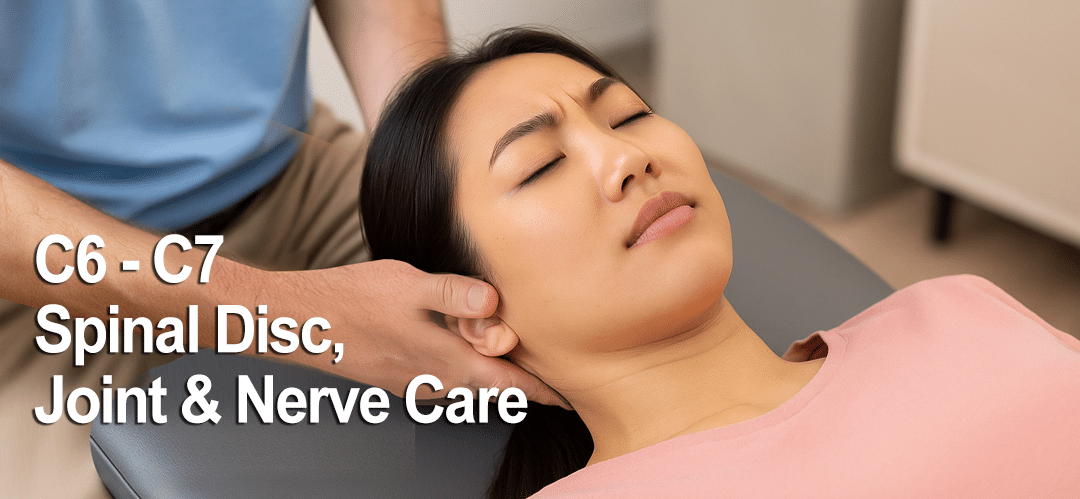
C6-C7: What Symptoms at This Neck Level Mean
C6-C7 is the joint between the sixth and seventh cervical vertebrae, the lowest freely moving level of the neck and one of the two most commonly involved. The C7 nerve root leaving here has a recognizable territory: the back of the arm, the triceps muscle, and the middle finger.
Weakness at this level shows as difficulty straightening the elbow against resistance or pushing a door closed, and the triceps reflex may be reduced. Resting the affected arm on top of the head often eases the symptoms, which can support a nerve-related explanation rather than the shoulder.
For more information about C6-C7, contact the Bukit Damansara (KL) main center: WhatsApp+60 17 269 1873 Call+603 2093 1000
Key Takeaways About the C6-C7 Level
- Location: C6-C7 sits at the base of the neck, where the flexible cervical spine meets the stiffer upper back.
- Nerve supply: The C7 nerve root exits here and serves the triceps, wrist and finger extensors, and sensation around the middle finger.
- Common findings: Disc herniation, age-related disc and joint changes, and narrowing of the nerve openings are all seen at this level.
- Imaging needs context: Disc and joint changes are common in people with no symptoms, so a scan finding matters only when it matches the examination.
- Care at CSC: Assessment first, then non-rotatory chiropractic care, registered physiotherapy and exercise. Injections or surgery are a distant last resort.
Where C6-C7 Sits and What the C7 Nerve Supplies
The C6-C7 level includes the intervertebral disc between the two vertebrae and the small facet joints at the back of the spine. Because it is the last freely moving level before the thoracic spine, it carries a large share of the load when you look down, lift or hold the head forward for long periods.
The C7 nerve root leaves the spine through an opening at this level. When it is irritated, typical signs include pain spreading down the back of the arm, tingling or numbness toward the middle finger, weakness when straightening the elbow, and a reduced triceps reflex. Grip can feel weaker too, although grip strength depends on several nerve roots, not C7 alone. Related pages explain a pinched nerve and nerve pain in more detail.
Assessment for C6-C7 Symptoms at Two KL Centers
If you have neck pain with arm symptoms, or a scan report that mentions C6-C7, a first visit starts with your history and an examination of movement, strength, sensation and reflexes, and any imaging you bring is read alongside those findings. Directions and hours are on the Bukit Damansara contact page and the Bandar Sri Damansara contact page, or you can call or message either center:
- Bukit Damansara (KL, main center): Call +603 2093 1000 or WhatsApp +60 17 269 1873 to see the Bukit Damansara / KL center.
- Bandar Sri Damansara (KL): Call +603 6262 5777 or WhatsApp +60 12 455 6939 to see the Bandar Sri Damansara center.
Common Problems at C6-C7
- Disc bulge and herniation: A disc bulge is a broad extension of the disc beyond its normal margin; a herniated disc is a more localized displacement that may press on the C7 nerve root.
- Cervical spondylosis: Age-related changes in the discs and joints, including bone spurs. See the cervical spondylosis guide.
- Facet joint changes: Thickening of the small joints at the back of the spine, described on the facet hypertrophy page.
- Narrowing of the canal or nerve openings: Covered on the spinal stenosis page. Narrowing of the central canal can affect the spinal cord, which changes how the problem is managed.
- Slippage: Forward or backward slippage of one vertebra on another is less common in the lower neck; see spondylolisthesis.
- Injury: A collision or fall can strain the discs, ligaments and joints at this level. The whiplash guide covers this.
How Often Is C6-C7 Involved?
In a population-based study of cervical radiculopathy in Rochester, Minnesota, the C7 nerve root was the root most often affected, followed by C6. Among disc herniations in the neck, C5-C6 and C6-C7 are the levels most often reported. These figures describe groups of people; they do not predict what any one person’s neck is doing.
What Imaging Can and Cannot Tell You
MRI studies of people with no neck symptoms have found disc bulges, disc degeneration and narrowing in a substantial share of them, and the proportion rises with age. That is why a report mentioning C6-C7 is only one piece of information. It matters when it matches your symptoms and examination findings, and it may be incidental when it does not.
How C6-C7 Problems Are Assessed
Assessment looks at the whole neck, not one level in isolation. It includes your history, neck and upper back movement, shoulder movement to rule the shoulder in or out, strength in the arm and hand, sensation, reflexes, and whether certain positions ease or reproduce arm symptoms. The upper neck is checked too, because stiffness in one part of the neck can change the load on another; see the upper neck guide.
Conservative Care for C6-C7 at CSC
Care at CSC follows a conservative sequence: assessment first, then non-rotatory chiropractic care, registered physiotherapy and guided exercise. Depending on the findings, a plan may include:
- Gentle joint mobilization without twisting thrusts, or instrument-assisted Activator adjustments
- Flexion-distraction or spinal decompression where a disc-related pattern makes it appropriate
- Soft tissue work such as trigger point therapy for the surrounding muscles
- High intensity laser therapy or therapeutic ultrasound as a short-term aid to make exercise more tolerable
- Exercise for the neck, shoulder blade and arm, and changes to how you sit and work, delivered through physiotherapy
Progress is measured against specific things you have difficulty doing, and the plan is reviewed if there is no measurable change. Medical review, imaging or referral is discussed openly when it may be appropriate, and injections or surgery remain a distant last resort, considered only when conservative care has been given a fair trial.
Why CSC Does Not Use Y-Strap or Ring Dinger Neck Pulls
Techniques such as Y-Strap or Ring Dinger pulls apply a sudden, strong pull through the neck. CSC does not use them, as a precaution: gentler options exist for the lower neck, and a quick pull loads the discs and ligaments at levels such as C6-C7 without a detailed assessment first. The neck-pull risks article explains this further.
When to See a Doctor First
- A change in bladder or bowel control needs medical attention the same day.
- Weakness in the arm or hand that keeps getting worse, clumsiness of the hands, or a change in walking or balance should be assessed promptly by a competent provider; conservative care may still be a reasonable route depending on what that assessment shows.
- Neck pain with fever, unexplained weight loss, or after a serious fall or accident should be checked by a doctor first.
Other Neck Levels
The neighboring levels behave differently. See the guides to C2-C3, C3-C4, C4-C5, C5-C6 and C7-T1, and the degenerative disc disease page for age-related disc changes.
Planning a visit? You can review the current chiropractic price in Kuala Lumpur and physiotherapy fees in Kuala Lumpur before you come in.
Frequently Asked Questions About C6-C7
What does the C6-C7 level do?
It allows movement at the base of the neck, transfers load between the neck and upper back, and protects the C7 nerve root, which serves the triceps, wrist and finger extensors and sensation around the middle finger.
What symptoms can come from C6-C7?
Neck pain and stiffness, pain down the back of the arm, tingling toward the middle finger, and weakness when straightening the elbow. Similar symptoms can come from the shoulder or a nerve in the arm, which is why an examination matters.
Does a C6-C7 disc finding on MRI mean I need surgery?
Not by itself. Many people with disc findings at C6-C7 manage with conservative care. Surgery is usually discussed when there are signs of spinal cord involvement, when weakness keeps getting worse, or when a fair trial of conservative care has not helped.
References
- Radhakrishnan K, Litchy WJ, O’Fallon WM, Kurland LT. Epidemiology of cervical radiculopathy: a population-based study from Rochester, Minnesota, 1976 through 1990. Brain. 1994;117(Pt 2):325-335.
- Boden SD, McCowin PR, Davis DO, Dina TS, Mark AS, Wiesel S. Abnormal magnetic-resonance scans of the cervical spine in asymptomatic subjects: a prospective investigation. J Bone Joint Surg Am. 1990;72(8):1178-1184.
- Teresi LM, Lufkin RB, Reicher MA, et al. Asymptomatic degenerative disk disease and spondylosis of the cervical spine: MR imaging. Radiology. 1987;164(1):83-88.
- Bogduk N, Mercer S. Biomechanics of the cervical spine. I: Normal kinematics. Clin Biomech (Bristol). 2000;15(9):633-648.
- Falla D, Farina D. Neural and muscular factors associated with motor impairment in neck pain. Curr Rheumatol Rep. 2007;9(6):497-502.
- Rao RD, Gourab K, David KS. Operative treatment of cervical spondylotic myelopathy. J Bone Joint Surg Am. 2006;88(7):1619-1640.
These references describe neck anatomy, imaging findings and nerve root problems in general. None of them evaluates care at Chiropractic Specialty Center.
The Author of C6-C7 Neck Segment: Symptoms and What They Mean
C6-C7 Neck Segment: Symptoms and What They Mean was written by Yama Zafer, D.C., a graduate of Cleveland University - Kansas City with 30+ years in chiropractic and physiotherapy.
Last Updated: C6-C7: What Symptoms at This Neck Level Mean
C6-C7: What Symptoms at This Neck Level Mean was last reviewed and updated on September 25, 2026.