

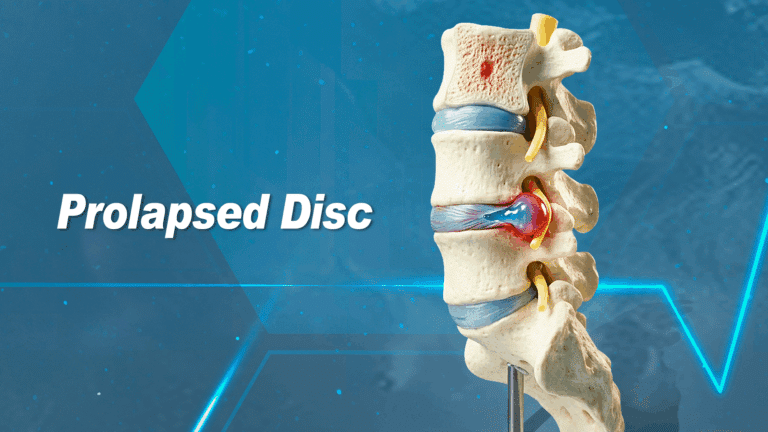
Prolapsed Disc: What Is Really Happening Inside the Spine?
A prolapsed disc means inner disc material has pushed through the outer wall rather than merely into it. The term describes a real structural change, and it sounds worse than the outlook usually is: material that has passed through the wall is exposed to the blood supply, and it is the kind the body clears most readily.
Larger prolapses therefore tend to reduce more over time rather than less, and limb symptoms commonly ease before the back or neck does. Most are managed without surgery.
This guide to a prolapsed disc, where it fits in disc changes and how it affects everyday movement, is published by Chiropractic Specialty Center, Bukit Damansara (KL) main center: WhatsApp+60 17 269 1873 Call+603 2093 1000
Key Takeaways
- A prolapsed disc means disc material has moved beyond its outer boundary
- Location matters more than size when it comes to symptoms
- Nerve-related symptoms depend on irritation, not just structure
- Movement and spinal load play a major role in how symptoms appear
- Pain may appear in the back, neck, arms, or legs depending on location.
- MRI findings must always be interpreted together with symptoms and movement assessment.
On This Page: Prolapsed Disc Explained
Video: What Does a Prolapsed Disc Look Like Inside the Spine?
This short clip shows visually where a prolapsed disc sits among the different kinds of disc change, and how disc material moves in relation to the outer fibers.
Key Moments from the video:
- 0:00 What a prolapsed disc means
- 0:05 How the disc is still partially contained
- 0:10 Why is it considered an early structural change
A simple way to understand how a prolapsed disc sits between early disc changes and more advanced stages.
Arranging an Assessment for a Prolapsed Disc
To arrange an assessment for a prolapsed disc, see the Bukit Damansara contact page and the Bandar Sri Damansara contact page, or call either center directly:
- Bukit Damansara (KL, main center): Call +603 2093 1000 or WhatsApp +60 17 269 1873 to see the Bukit Damansara / KL center.
- Bandar Sri Damansara (KL): Call +603 6262 5777 or WhatsApp +60 12 455 6939 to see the Bandar Sri Damansara center.
How a Prolapsed Disc Changes Everyday Movement
A prolapsed disc is not just a structural issue. It changes how the body moves, stabilizes, and distributes load throughout the day.
Simple activities can start to feel different:
- Sitting may increase pressure in the lower spine
- Bending forward may shift load toward the disc
- Standing for long periods may create fatigue in surrounding muscles
- Turning or reaching may feel restricted or uneven
These changes are not random. They reflect how the spine adapts when one segment is no longer handling pressure evenly.
Over time, the body may compensate. Muscles tighten. Movement becomes guarded. Patterns shift. Understanding these changes helps explain why symptoms can come and go, and why they are not always tied to the size of the disc prolapse.
What Is a Prolapsed Disc and Where Does It Fit in Disc Changes
A prolapsed disc refers to inner disc material moving through the weakened outer fibers of the disc. The terms used for disc changes vary between reports and clinicians, and "prolapse", "herniation" and "slipped disc" are often used loosely for the same thing. A common way to describe the range of disc changes is:
- Disc bulge: the disc extends evenly beyond its normal margin, without a focal breach of the outer ring.
- Protrusion: a focal displacement of disc material that remains largely contained, with a broad base.
- Extrusion (prolapse through the wall): disc material has passed through the outer fibers, often with a narrower neck than the displaced portion.
- Sequestration or fragmentation: a piece of disc material has separated from the disc and may move away from it.
Where a change sits on this range does not by itself determine how noticeable the symptoms will be, and material that has passed through the outer wall is often the kind that regresses most over time.
How Disc Changes Progress Over Time
Spinal discs are designed to handle pressure, movement, and load throughout daily activity. But they rely on balance.
Over time, repeated stress can affect how the disc distributes pressure:
- Long periods of sitting
- Repeated bending or lifting
- Uneven posture
- Reduced movement variability
As pressure builds, the outer fibers may weaken.
When the inner material begins to move through these weakened areas, a prolapse occurs. If loading patterns continue to stress the disc, the condition may progress further into protrusion, herniation, extrusion, or fragmentation.
This process usually develops gradually rather than from a single event.
How Sitting Habits Can Influence Spinal Disc Changes
Daily posture and sitting habits play a major role in how pressure builds within the spine. Small positioning changes repeated over time can influence how discs handle load throughout the day. This video breaks down common desk habits and how they affect spinal balance.
Key Moments
- 00:00 Why sitting posture matters
- 00:36 Armrest and chair positioning
- 01:21 How posture affects spine loading
- 01:46 Step-by-step sitting setup
- 02:57 Keyboard and wrist positioning
- 04:36 Monitor and screen height
- 05:02 Why long sitting adds stress
- 07:46 Final posture guidance
Better sitting habits can help reduce repeated stress that contributes to disc changes over time.
Why Location Matters More Than Size
Not all disc prolapses behave the same.
The impact depends heavily on where the disc material moves.
Common locations include:
- Central: toward the center of the spinal canal
- Subarticular: along the nerve root pathway
- Foraminal, where nerves exit the spine
- Extraforaminal: outside the nerve exit region
A small prolapse near a nerve root may produce noticeable symptoms, while a larger prolapse elsewhere may produce little or no symptoms.
Why Nerve Symptoms Can Travel Away From the Spine
When a prolapsed disc affects a nearby nerve, symptoms often appear along the path of that nerve rather than only in the spine..
This is why symptoms may be felt in the:
- Arm or hand (from the neck and upper back)
- Leg or foot (Sciatica from the lower back)
Nerve-related symptoms may include:
- Radiating pain
- Tingling or altered sensation
- Muscle weakness in specific areas
These patterns follow known nerve pathways, which is why the exact location of the disc change is important.
How Symptoms May Appear in Different Areas of the Body
Symptoms vary depending on which part of the spine is affected and how nearby nerves respond.
Lower spine involvement may include:
- Lower back pain
- Symptoms into the buttock or leg
- Tingling or altered sensation in the leg
- Difficulty with prolonged sitting
Neck involvement may include:
- Neck stiffness or pain
- Symptoms into the shoulder or arm
- Tingling or altered sensation in the hand
- Changes in grip or arm strength
Because spinal nerves travel into the limbs, symptoms are often felt away from the spine itself.
Why MRI Alone Does Not Tell the Full Story
MRI scans are helpful for identifying structural changes in the spine.
However, imaging alone does not show:
- How the spine moves
- How muscles support the spine
- How the body distributes load during daily activities
Many people have disc changes visible on MRI without experiencing pain.
For this reason, imaging findings must always be interpreted together with:
- Clinical examination
- Movement assessment
- Symptom history
How Care Is Structured for a Prolapsed Disc
Care for a prolapsed disc focuses on how the spine functions during movement rather than only the structural change itself.
A structured approach often looks at three key areas:
- Mechanical function: How the spine handles load during movement
- Neuromuscular control: How muscles coordinate to stabilize the spine
- Tissue adaptation: How surrounding structures respond over time
Care may include:
- Movement-based strategies
- Muscle-focused work
- Joint-specific techniques
- Rehabilitation exercises
Each component helps the spine move more evenly and reduces unnecessary stress on affected areas.
Related reading: slipped disc care in Kuala Lumpur, neck pain care and back pain care.
When You Should Pay Closer Attention
Some symptoms need prompt attention:
- If you have back or leg pain associated with a prolapsed lumbar disc, get urgent medical attention, a thorough assessment by a competent clinician the same day, if numbness develops or worsens around your genitals, between your genitals and anus, or around your anus. New difficulty passing urine needs the same urgent assessment; loss of bladder or bowel control does not have to occur first, and if it does occur, it is urgent too. These symptoms have several possible causes. Some may call for an invasive procedure, but the assessment determines what care is appropriate, rather than assuming surgery is necessary.
- Progressive muscle weakness, difficulty walking or rapidly worsening neurological symptoms should not be ignored and should be assessed promptly by a competent provider; conservative care may still be a reasonable route once that assessment is done.
These signs are not common, but they are important.
It often helps to read about prolapsed discs alongside slipped discs, extruded discs, fragmented (sequestered) discs, slip disc symptoms, and herniated discs.
Recap: What You Need to Know
A prolapsed disc means inner disc material has moved through the weakened outer fibers of the disc. What matters most is not just the structure, but where the disc material has moved, whether nearby nerves are involved and how the spine behaves during movement. Many prolapses reduce over time, and most are managed without surgery.
Every fee, from the first examination to package options, is listed on the chiropractic price in Kuala Lumpur and physiotherapy price list in Kuala Lumpur pages.
Frequently Asked Question
Is disc prolapse the same as a slipped disc?
Can a disc prolapse heal naturally?
Is disc prolapse always painful?
Can exercise help a prolapsed disc?
Peer-Reviewed Medical References
- Chiu CC, Chuang TY, Chang KH, Wu CH, Lin PW, Hsu WY. The probability of spontaneous regression of lumbar herniated disc: a systematic review. Clin Rehabil. 2015;29(2):184-195.
- Brinjikji W, Luetmer PH, Comstock B, et al. Systematic literature review of imaging features of spinal degeneration in asymptomatic populations. AJNR Am J Neuroradiol. 2015;36(4):811-816.
The Author of Prolapsed Disc: Causes, Symptoms and What It Means
Prolapsed Disc: Causes, Symptoms and What It Means was written by Yama Zafer, D.C., who has 30+ years in chiropractic and physiotherapy and founded Chiropractic Specialty Center in Kuala Lumpur in 2006.
Last Updated: Prolapsed Disc: What Is Really Happening Inside the Spine?
Prolapsed Disc: What Is Really Happening Inside the Spine? was last reviewed and updated on September 30, 2026.