


C3-C4: What Symptoms at This Neck Level Mean
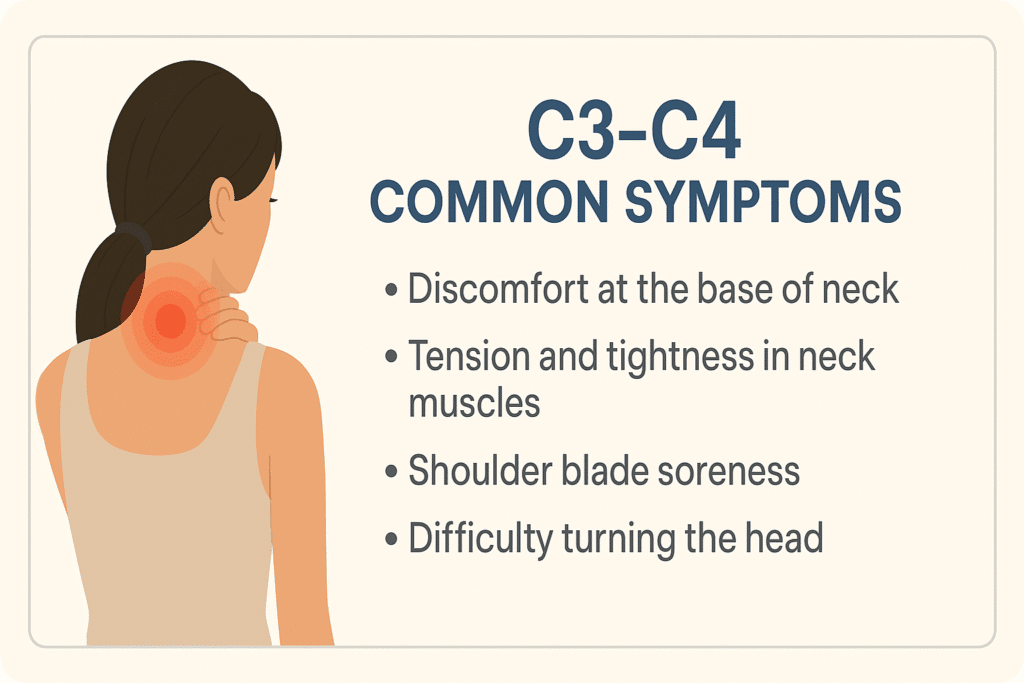
C3-C4 symptoms usually stay in the neck and the top of the shoulder rather than the hand. The common pattern is neck stiffness and pain at the base of the neck, with an ache over the top of the shoulder. C3-C4 is the joint between the third and fourth neck vertebrae, in the middle of the neck.
That referral pattern is why a C3-C4 problem is sometimes treated as a shoulder problem. When turning or tipping the head changes the shoulder symptom, the neck is contributing. Findings at this level are common on scans of people without symptoms, so the examination outweighs the report.
I care for this level with gentle, non-rotatory methods, kept within what you can comfortably tolerate, and with physiotherapy in the same plan. Below are the disc bulge and nerve root symptoms, the hospital warning signs and how C3-C4 works. Then come the common problems, my approach and care for children, older adults and pregnancy.
For more information about the C3-C4 level, contact the Bukit Damansara (KL) main center: WhatsApp+60 17 269 1873 Call+603 2093 1000
Takeaway: What to Remember About C3-C4 Care in Kuala Lumpur
| Question | Short answer |
|---|---|
| What does C3-C4 do? | This mid-neck segment supports head turning and side bending and steadies posture. The C4 nerve leaving here serves the base of the neck, the shoulders and the upper chest. It also joins the nerve to the diaphragm. |
| Which problems are common here? | Disc bulges and herniations, disc wear, joint narrowing and posture strain. They can bring stiffness, less movement and nerve-related pain, and the examination shows which of them matters for you. |
| Does a disc bulge here press on the nerves? | In my view, a true disc bulge does not compress nerves on an MRI. With nerve symptoms and a bulge on the report, the disc may be in transition, pushing out further when upright. |
| What does C4 nerve root pressure feel like? | Pain at the base of the neck and across the top of the shoulder, at times with tingling or numbness. Weakness that keeps getting worse needs a prompt assessment (Margetis and colleagues, 2025). |
| Can C3-C4 affect breathing? | The C3, C4 and C5 roots form the phrenic nerve, the only motor nerve of the diaphragm (Oliver and Ashurst, 2023). Breathing changes from a neck problem happen only in some cases; sudden breathlessness needs 999. |
| Which neck methods do I avoid? | Aggressive methods such as towel jerks, high-force twists and the Ring Dinger®. They can strain joints, discs and blood vessels, and I never use them at C3-C4 or anywhere else in the neck. |
| Is yoga safe with a C3-C4 disc problem? | No. With a C3-C4 disc problem, yoga must be avoided, inverted poses and neck rolls included. The Back Pain to Leg Pain talk gives my rule: people with a disc problem should not do yoga at all. |
| What can care include? | Gentle chiropractic with physiotherapy, and where the assessment supports it, spinal decompression, high-intensity laser, ultrasound or shockwave. The plan is explained first, and care at every stage is kept within what you can comfortably tolerate. |
| Is care different in pregnancy, childhood or later life? | Yes. Methods are adapted for pregnancy, for children and for older adults, to protect delicate tissues while restoring neck function. The section on special groups below explains how, including what I avoid for each group. |
C3-C4 Guide: Sections at a Glance
- C3-C4 Disc Bulge and Nerve Root Compression Symptoms
- Book Gentle, Integrated C3-C4 Care in Kuala Lumpur
- Understanding the C3-C4 Segment: Function and Importance
- C3-C4 Disc and Joint Conditions: Causes and Linked Resources
- Upper Cervical Health and Its Link Below
- Mid-Neck Link in the Stability Chain
- Why Gentle Neck Care Matters
- Evidence-Based Care for C3-C4: Kids, Elderly and Pregnancy
- Neck Pain and Stiffness: What You Need to Know
- Non-Invasive Care in KL for C3-C4 Neck and Spinal Disc Issues
- Comprehensive, Step-by-Step C3-C4 Care: From Assessment to Recovery
- Exercises for the Neck and Upper Back: My Rules
- Summary Table: C3-C4 Spine
- FAQ: C3-C4 Spinal Joint, Disc and Nerve Care
C3-C4 Disc Bulge and Nerve Root Compression Symptoms
Problems at C3-C4 rarely send symptoms down into the hand. Most people notice the neck and the top of the shoulder first, and the pattern depends on which structure is irritated.
C4 Nerve Root Compression Symptoms
The C4 nerve root leaves the spine through the opening between C3 and C4. It contributes to sensation in the lower neck, the shoulders and the upper chest. When a nerve root is pressed, pain spreads beyond the neck and can come with tingling, numbness or muscle weakness (Margetis and colleagues, 2025).
- Pain at the base of the neck, often on one side.
- An ache across the top of the shoulder, sometimes toward the shoulder blade.
- Tingling or numbness over the lower neck, shoulder or upper chest.
- Neck stiffness and less turning or side bending toward the painful side.
C4 problems are uncommon compared with the levels below. In a population study of 561 people with cervical radiculopathy, the C7 root was affected most often, then C6 (Radhakrishnan and colleagues, 1994).
People often ask about the C3 nerve root here. The C3 root leaves one level higher, between C2 and C3. Its symptoms sit around the upper neck and the back of the head, and the C2-C3 guide covers it.
Disc Bulge at C3-C4: What It Means for Symptoms
A bulging disc extends beyond its normal boundary, often from repetitive strain or wear. In my view, the true disc bulge pictured on an MRI is not what compresses a nerve. Many people have a bulge and no symptoms at all.
How, then, can a bulge bring numbness or tingling? The scan is usually done lying flat, often after a night's rest, when the disc has soaked up fluid. In that unloaded position, its fibers may not push out far enough to touch the nerve, so the report reads bulge.
Upright, after hours of sitting hunched at a screen or driving, the weight of the head and upper body can push the fibers further out. I call this a disc bulge in transition: in reality it behaves as a protrusion, a herniation or even an extrusion. That is when it can explain nerve symptoms, and it is then a serious condition.
A slipped or herniated disc, where the inner material pushes through the outer layer, can press on the C4 nerve root or the spinal cord. The disc bulge guide explains the stages in more detail.
Facet Joint Pain at C3-C4
Each small facet joint of the neck sends pain to its own area, which helps place the level on examination (Dwyer and colleagues, 1990). Arthritis in these joints is a frequent source of mechanical neck pain (Kaiser and colleagues, 2023). Thickening of the joints behind the disc can also narrow the nerve pathways.
When the Spinal Cord Is Involved
Pressure on the spinal cord itself is called myelopathy, and it looks different from a pinched nerve. Clumsy or numb hands, tingling in several limbs, weakness and an unsteady walk are among its features. A heavy feeling in the legs is often an early sign (Margetis and colleagues, 2025).
Any of these needs a prompt medical assessment. Where weakness is present, conservative care can continue only while the weakness itself is improving.
Acute nerve root pain mostly settles: over 85 percent of cases resolve in 8 to 12 weeks with no specific treatment (Margetis and colleagues, 2025). Scans and symptoms do not always match, which is why the examination leads.
Warning Signs That Need a Hospital
Call 999 straight away, and do not drive yourself, for any sudden sign of stroke on the US Centers for Disease Control and Prevention list:
- Numbness or weakness in the face, arm or leg, mostly on one side.
- Confusion, difficulty speaking or trouble understanding speech.
- Loss of sight or blurred vision in one or both eyes.
- Difficulty walking, dizziness, loss of balance or poor coordination.
- A severe headache that comes on with no known cause.
Mayo Clinic's first-aid page lists the situations that point to a possible spine injury. If any applies, call 999 and keep the person still, with the head and neck unmoved:
- Heavy force on the back or the head during the injury.
- Severe neck or back pain.
- A head injury, followed by a change in alertness that does not pass.
- Weakness, numbness or paralysis, or lost control of the limbs, the bladder or the bowels.
- A neck or body that is twisted or sitting at an odd angle.
Book Gentle, Integrated C3-C4 Care in Kuala Lumpur
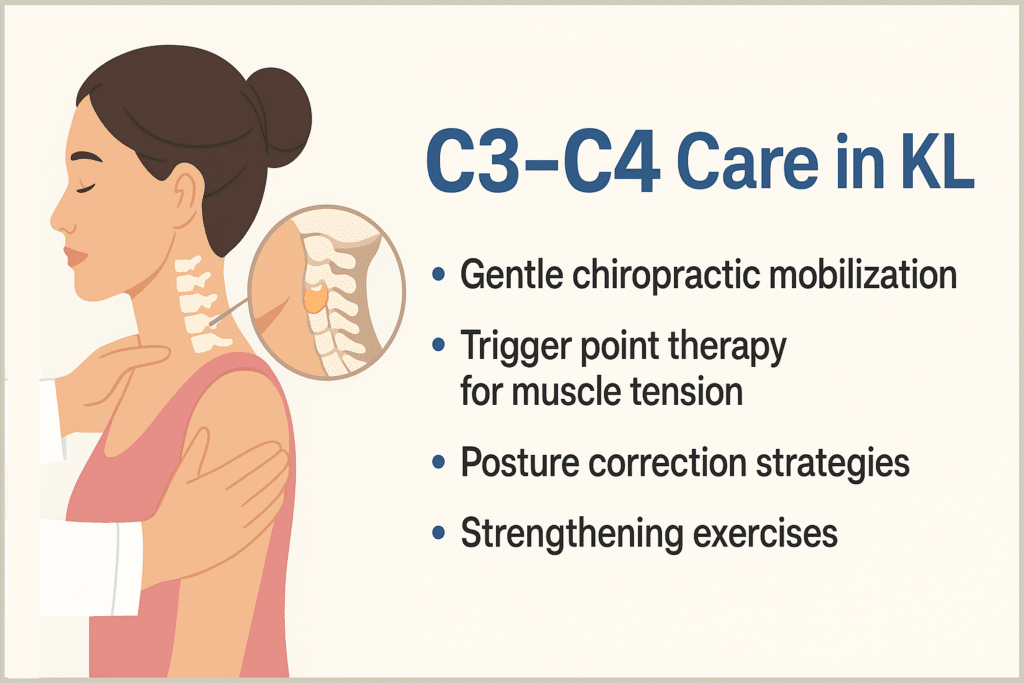
At Chiropractic Specialty Center (CSC) in Kuala Lumpur, care for C3-C4 is gentle, non-rotatory chiropractic adjustment combined with physiotherapy. Its aims are to restore joint glide, protect the nerves and improve neck function without unnecessary risk. It rests on the non-rotatory chiropractic adjustment with evidence-based physiotherapy.
Travel across Kuala Lumpur is not always simple, so both centers offer the same care. Each center has a page with its address, telephone number and opening hours. They are Bandar Sri Damansara location and opening hours and, for the main center, how to reach the Bukit Damansara center. The Bandar Sri Damansara center in northwest Kuala Lumpur provides chiropractic together with physiotherapy.
- Bukit Damansara (KL, main center): Call +603 2093 1000 or WhatsApp +60 17 269 1873 to see the Bukit Damansara / KL center.
- Bandar Sri Damansara (KL): Call +603 6262 5777 or WhatsApp +60 12 455 6939 to see the Bandar Sri Damansara center.
Understanding the C3-C4 Segment: Function and Importance
C3-C4 sits in the mid-cervical region, linking upper and lower neck mechanics. C3 and C4 belong to the subaxial spine, C3 to C7, whose vertebrae share nearly the same shape (Kaiser and colleagues, 2023). The disc cushions the load between them, while the two facet joints behind it guide movement and add stability.
Small bony lips on the sides of the vertebral bodies, the uncinate processes, form uncovertebral joints. These serve to stop one vertebra slipping on the next. The vertebral arteries pass up through openings in the side processes on their way to the brain.
The segment acts as the mid-cervical anchor. It fine-tunes side bending, controls mid-range turning and steadies head posture during reading, driving and screen use. How far each level moves differs from person to person (Bogduk and Mercer, 2000).
C3-C4 shares load with the shoulders and upper back, so a problem here may feel like neck and shoulder tightness or band-like stiffness. Healthy movement at C3-C4 spreads forces evenly through the cervical spine. That reduces postural fatigue and protects the lower cervical discs from extra stress.
The C4 nerve root, which exits between C3 and C4, also joins C3 and C5 in forming the phrenic nerve. That nerve is the motor supply of the diaphragm, the main breathing muscle, and its irritation is behind the hiccup reflex (Oliver and Ashurst, 2023).
The C3-C4 level plays a key role in neck stability, head movement and protecting the nerves to the shoulders. When this segment has disc stress, joint narrowing or alignment changes, stiffness, reduced range or muscle imbalance can follow. Identifying these changes early gives a clearer picture of the level involved and lowers the chance of strain spreading to nearby levels.
C3-C4 Disc and Joint Conditions: Causes and Linked Resources
C3-C4 can be affected by several spinal conditions that influence joint motion, disc health and nerve protection. Common findings at this level include:
- Slipped or herniated disc: the inner disc material pushes through its outer layer and can press on the C4 nerve root or the spinal cord.
- Bulging disc: the disc extends beyond its normal boundary, often after repetitive strain or with wear.
- Degenerative disc changes: the disc loses water and elasticity, and its cushioning falls. In laboratory tests, degeneration changed how the disc's outer ring resists compression (Iatridis and colleagues, 1998).
- Facet joint hypertrophy: thickening of the small joints behind the disc, which can narrow the nerve pathways.
- Cervical spondylosis: wear of the discs, joints and ligaments that can change stability and motion.
- Spinal canal stenosis: narrowing of the central canal, which may compress the spinal cord or nerve roots.
- Foraminal narrowing: a tighter nerve opening that can press on the C4 nerve root.
- Early spondylotic changes that alter the alignment of the neck.
Cervical disc degeneration is seen in over 25% of adults by age 40. In an MRI study of 497 people without symptoms, disc degeneration rose steadily with age (Matsumoto and colleagues, 1998). It was seen in 17 percent of men's discs and 12 percent of women's in their twenties, and 86 and 89 percent over 60.
C3-C4 is involved less often than C5-C6, but it is still clinically significant, especially with postural strain and the changes that come with age. In one large study of nerve root pain, 68.4 percent of cases involved spondylosis, a disc or both. A confirmed disc protrusion explained 21.9 percent (Radhakrishnan and colleagues, 1994).
Why These Conditions Develop
These changes may come from repetitive postural strain, poor ergonomics, past injuries or wear over time. Weak surrounding muscles, reduced blood flow to the discs and accumulated mechanical stress can all contribute. Now and then, a sudden force or a heavy lift causes a disc herniation.
In my experience, age plays a part, but it is never the only factor; posture, habits, injuries and genetics count too. Neck pain is common worldwide, and women report it more often than men (Fejer and colleagues, 2006).
Each condition has its own page with symptoms, risks and care: Slipped Disc, Bulging Disc, Herniated Disc and Degenerative Disc. There are also pages on Facet Joint Issues, Cervical Spondylosis and Canal Stenosis.
Upper Cervical Health and Its Link Below
The upper cervical spine covers the skull base down to C3, and C3-C4 is where it hands over to the lower neck. The level acts as the bridge between the head's movement control and the rest of the neck.
Proper alignment here supports balanced posture, protects the spinal nerves and allows smooth head turning without extra strain on nearby discs or joints. When C3-C4 mechanics are disrupted, the muscles, ligaments and nerves of the upper neck and shoulders can all be affected.
The four small suboccipital muscles under the skull, and the myodural bridges that tie them to the spinal cord's covering, belong to the levels above. The C2-C3 guide describes them, with the symptoms linked to them.
Mid-Neck Link in the Stability Chain
The C3-C4 segment is the central transition point of the neck. Above it lies the upper cervical spine, the skull down to C2-C3; below it, the lower cervical spine, C4-C5 down to C7-T1. It works with:
- Upper cervical segments (C0-C1, C1-C2 and C2-C3), which provide head movement, protect the brainstem and influence balance.
- Lower cervical segments (C4-C5, C5-C6, C6-C7 and C7-T1), which bear load, control arm movement and steady the shoulder girdle.
- The upper thoracic transition: the C7-T1 junction stabilizes neck posture against upper back motion.
When C3-C4 is restricted or unstable, both the upper and lower neck may compensate, leading to stiffness, imbalance or nerve irritation. Keeping C3-C4 balanced lets the whole neck work smoothly.
In my view, the neck behaves like a kinematic chain: when one part goes, the others follow. A stable middle and lower neck is what the top of the neck relies on. So when C3-C4 or the levels below are unstable, or a nerve or the cord is compressed there, trouble can travel upward.
The whole cervical spine is connected, so the domino effect runs all the way up. What happens in the lower neck affects the middle of the neck, where C3-C4 sits. Both then affect the upper neck, the base of the skull and, in the end, the brainstem and the brain.
Apart from C0-C1 and C1-C2, I regard C4-C5 and C5-C6, just below this level, as the workhorses of the neck. A head held forward over a laptop, phone or other handheld device loads the upper neck. It loads the lower neck just as much, if not more, so the strain spreads widely.
Along the back of the neck, from the base of the skull down to C7, the multifidus and erector spinae muscles tie the segments together. In my view, they affect each segment one at a time and, together, bring degenerative and spondylotic changes. If that worsens, a spinal nerve or the spinal cord can be compressed, at times leading to swelling (edema) or degeneration in the cord.
Why Gentle Neck Care Matters
Aggressive neck methods, such as towel jerks, high-force twisting or devices like the Y-Strap, put sudden, uneven force on the neck joints and blood vessels. These techniques carry added risks, especially with hidden disc problems, vascular concerns or degenerative changes. The Ring Dinger guide sets out those risks.
Sudden traction or rotation raises the chance of joint injury, disc damage or vascular compromise, and it can overload C3-C4 and its neighbors. At Chiropractic Specialty Center, we avoid such methods entirely. Care for the upper cervical and C3-C4 segments uses precise, gentle, non-rotatory approaches combined with physiotherapy, which protect joint health while restoring movement.
My video Neck Cracks Are Dangerous is direct about it: “Aggressive neck care is never good and should always be avoided.” If anyone offers to yank or pull your neck, my advice there is to “ask them to stop.”
Evidence-Based Care for C3-C4: Kids, Elderly and Pregnancy
At Chiropractic Specialty Center, C3-C4 care is adapted to each person, from children to older adults and pregnant patients. The commitment is to safe methods grounded in evidence.
- Children under 12: in my practice, rotatory chiropractic techniques are avoided entirely, and direct mid-neck adjustments too, as the uncovertebral joints are still developing. Gentle mobilization, posture correction and physiotherapy protect growing structures. For teenagers, I may use chiropractic manipulation that is non-rotatory using the Activator instrument.
- Older adults: ligament laxity and disc thinning with age call for controlled, non-rotatory adjustments and physiotherapy. These build stability without stressing arthritic joints or weakened soft tissues.
- Pregnancy: hormonal changes increase joint laxity, so gentle positioning, tailored mobilization and safe physiotherapy options come first.
For a child, care at C3-C4 follows the age guidance in the guide to neck manipulation in children. How gentle, low-force methods are chosen is set out in the guide to chiropractic care for children.
Pregnancy, Neck Health and Headaches
Pregnancy changes posture, ligament flexibility and muscle balance, which can strain the neck, C3-C4 included. Hormonal laxity lets joints move more freely but also leaves them more open to misalignment or instability.
When C3-C4 mechanics change in pregnancy, muscle tension and nerve irritation can add to neck stiffness and certain headache patterns. This segment also works with the upper neck (C0 to C2), which plays a key part in head posture and in tension-type headaches during pregnancy.
At Chiropractic Specialty Center, care for pregnant patients is always gentle, non-rotatory and tailored for comfort. It aims at balanced motion at C3-C4, better posture and less muscle strain, without forceful manipulation. Ultrasound, high-intensity laser and gentle muscle work may be used on the trapezius, the suboccipital muscles and the sternocleidomastoid. Safety for mother and baby comes first.
Neck Pain and Stiffness: What You Need to Know
Neck stiffness and pain often develop when segments like C3-C4 lose their natural mobility or alignment. Pain here can feel local or spread toward the shoulders, while stiffness may limit turning, side bending, or looking up and down.
At CSC, care for neck stiffness and neck pain begins by finding which segments are involved, upper, middle or lower. It then addresses joint motion and the soft tissues around it, with physiotherapy and gentle, non-rotatory chiropractic techniques together.
Non-Invasive Care in KL for C3-C4 Neck and Spinal Disc Issues
At Chiropractic Specialty Center, care for C3-C4 avoids high-force or rotational adjustments, which can stress the discs and the vertebral arteries. Our integrated program includes:
- Gentle chiropractic cervical mobilization for joint glide and flexibility.
- Physiotherapy, such as high-intensity laser therapy (HILT) and therapeutic ultrasound, directed at the affected tissues.
- Postural retraining for forward head carriage and strain.
- Targeted muscle therapy for neck and shoulder stability.
- Segment-specific rehab, as take-home exercises or at our physiotherapy gym in Bukit Damansara.
Our registered physiotherapists and chiropractors in KL work side by side, addressing joint mechanics and the soft tissues around them in one plan. My advice in Is Chiropractic Safe? 13 Questions Answered is simple: “Don't choose between one or the other. Choose both.”
Comprehensive, Step-by-Step C3-C4 Care: From Assessment to Recovery
1. Precise, Full-Segment Assessment Comes First
C3-C4 problems rarely occur in isolation. The first step is a detailed evaluation of the whole neck, upper, middle and lower, along with the upper back and shoulder girdle. It includes posture analysis, joint motion testing, soft tissue palpation and, where appropriate, imaging. The aim is to see how C3-C4 interacts with the rest of the neck before any plan is made.
2. Integrative, Non-Invasive Therapies and Why They Matter
CSC combines manual skills with therapeutic devices, each chosen after the assessment:
- Spinal decompression: for confirmed disc bulges or herniations at C3-C4, a gentle, controlled pull without forceful manipulation.
- High-intensity laser therapy (HILT): a laser that reaches deep tissues, kept only mildly warm. A review of 16 trials found that low-level laser, a gentler type, lowered neck pain against placebo (Chow and colleagues, 2009).
- Ultrasound therapy: applied to the back of the neck and also its sides, to reach the sternocleidomastoid and other side neck muscles.
- Shockwave therapy: for trapezius tension and its attachment points.
- Electrotherapy: used to calm muscle guarding and prepare tissues for mobilization. Heat plays little part, and none at all where a disc or facet joint in the neck is damaged.
3. Treating Beyond the Neck for Lasting Stability
C3-C4 depends on a stable base. Manual therapy at CSC often targets the upper back, where the trapezius and rhomboids meet, to release tension in the foundation of the neck. In Neck Trigger Points and Exercises, I call the upper back that foundation, and treating the neck alone can leave its stress in place.
4. Gentle Chiropractic: Tailored for Every Patient
Chiropractic adjustments for C3-C4 are always gentle and non-rotatory. Older adults are spared stress on arthritic joints and weakened soft tissues. In pregnancy, positions and techniques allow for ligament laxity, and children under 12 receive no direct mid-neck adjustment.
Care is kept within what you can comfortably tolerate. Discomfort during care means it is being done too aggressively, so tell the clinician at once. My motto is “No pain, more gain.”
5. Protecting Critical Structures
Care is designed to protect delicate anatomy, including the vertebral arteries, the spinal cord and the flow of spinal fluid. Methods are chosen to avoid aggravating disc bulges or herniations. The suboccipital muscles, the upper cervical tissues and their myodural junctions are included, for balanced muscle activation and coordination.
6. Why Overly Aggressive Neck Methods Are Risky
Towel jerks, high-force twisting and the Ring Dinger® can overload C3-C4 and its neighbors. CSC replaces them with gentle mobilization guided by the examination, supported by therapeutic devices.
7. The CSC Difference
By combining manual skills with therapeutic devices, each C3-C4 program is built to address:
- The segment itself: disc, joints and ligaments.
- The muscles and posture that support it.
- The balance between the upper and lower neck.
- Long-term stability through rehab and posture retraining.
Progress is reviewed as care goes on. In Is Chiropractic Safe? 13 Questions Answered, I say the plan should be looked at again if nothing has improved by the fifth session. The tenth session is the point for a decision together. Surgery has its place, but for disc problems, as I put it in Sciatica vs Slipped Disc: Video Explanation: “Surgery should be the last option. Exhaust conservative route.”
On this site, conservative care always means focused care. It is specific to what your scans and examination reveal, looks at the whole neck and aims at the causes behind those findings. It must not cause harm. I do not mean routine neck treatment, and many forms of conservative care are useless. Surgery becomes an option only when focused care of this kind has been given properly and has not worked.
The possible effects and risks are explained before care begins. The fee for a plan is explained and agreed before care begins.
Exercises for the Neck and Upper Back: My Rules
Before trying any exercise, check it with your doctor or another healthcare provider. That is the first rule I give in Neck Trigger Points and Exercises. These are the ones I show for the neck and upper back once the neck is ready:
- Neck isometrics: press the head gently into your own hand, to the front, back and each side, with the neck kept still. Hold about five seconds, or three if five is too long.
- W, T and L arm positions for the upper back, with the shoulders kept down and never shrugged.
- Light fingertip pressure on tender points in the trapezius and between the shoulder blades, never deep.
My rule in that video is clear: “Do not get someone else to push on you.” If an exercise brings numbness, tingling or discomfort, stop at once; the neck is not ready for it yet.
In a trial of 145 people with chronic neck pain, six weeks of deep neck muscle activation and strengthening improved pain and disability. By six months, only pain and satisfaction still differed (Chiu and colleagues, 2005).
Summary
C3-C4 health matters for smooth neck movement, balanced posture and the nerve supply to the shoulders and upper chest. Assessed and cared for correctly, the segment puts less strain on the joints, discs and muscles around it. Chiropractic Specialty Center combines gentle, non-rotatory chiropractic with physiotherapy and therapeutic devices, without high-force or risky methods.
If stiffness, reduced motion or posture-related neck problems are troubling you, our team in Kuala Lumpur can guide you through a plan suited to you. Contact the Bukit Damansara main center or the Bandar Sri Damansara center to start.
Summary Table: C3-C4 Spine
| Feature | Details |
|---|---|
| Segment | C3-C4: the mid-cervical stability zone |
| Key functions | Neck stability, head turning, nerve protection |
| Nerve | C4 root: base of the neck, shoulders, upper chest; part of the phrenic nerve |
| Common issues | Disc bulge, facet arthropathy, foraminal narrowing |
| CSC approach | Gentle chiropractic, physiotherapy, posture rehab |
If you would like to keep reading, shoulder blade pain is a closely related topic.
The current fees are on the chiropractic prices page and the physiotherapy fee list.
FAQ: C3-C4 Spinal Joint, Disc and Nerve Care
What does the C3-C4 segment do, and where is it?
C3-C4 sits in the middle of the cervical spine, between the third and fourth neck vertebrae, connecting the upper and lower neck. It maintains mid-neck stability, controls head turning and side bending, and supports posture. It also protects the C4 nerve root, which serves the shoulders and plays a part in breathing through the phrenic nerve.
What symptoms can occur with C3-C4 problems?
Symptoms may include neck stiffness, pain at the base of the neck, shoulder pain and reduced head turning. A pinched C4 root can add tingling or numbness over the shoulder or upper chest. In some cases, diaphragm involvement brings breathing changes. Sudden breathlessness, or stroke signs such as face or arm weakness, need 999 at once.
What does the C4 nerve root do?
The C4 nerve root provides sensation to the lower neck, the shoulders and the upper chest. Together with C3 and C5, it forms the phrenic nerve, the motor nerve of the diaphragm (Oliver and Ashurst, 2023). That is why a high neck injury can affect breathing, and why such injuries are treated as emergencies.
Why is C3-C4 important for posture?
C3-C4 works with the surrounding cervical segments to keep the head balanced over the shoulders. That reduces strain on the muscles and discs of the neck and upper back. When it stiffens, the levels above and below often take extra load. That is why long hours looking down at a phone or screen can bring neck and shoulder tightness.
Which C3-C4 issues are most common, and what makes a disc bulge or herniate?
Common problems include disc bulges, herniated discs, facet joint hypertrophy, disc wear, cervical spondylosis and spinal canal stenosis. Causes include repetitive posture strain, poor ergonomics, past injuries and wear over time. A sudden force or a heavy lift can also trigger a herniation. In my view, a true bulge does not compress a nerve.
Can C3-C4 problems cause headaches?
They can contribute. When C3-C4 mechanics are disrupted, they can affect muscles and nerves linked to the upper cervical spine, which may add to tension-type headaches. The upper neck itself, C0 to C3, is the more frequent source of headache from the neck. The headache and migraine guide covers the other causes as well.
How is C3-C4 treated without surgery, and what makes CSC's approach different?
CSC combines gentle, non-rotatory chiropractic adjustments with physiotherapy, posture correction and segment-specific rehab. Where the assessment supports it, spinal decompression, high-intensity laser, ultrasound or shockwave may be added. We look at the whole neck and its supporting structures, not only C3-C4, and the possible effects and risks are explained before care begins.
Why avoid aggressive neck adjustments?
High-force twisting, towel jerks and Y-Strap pulls can overload joints, discs and blood vessels, raising the risk of injury. A worn or bulging disc can be pushed further by such force. In Neck Cracks Are Dangerous, I say aggressive neck care should always be avoided. Anyone offered a neck yank should ask the person to stop.
How is C3-C4 care adapted for pregnancy, older adults and children under 12?
In pregnancy, care uses gentle, non-rotatory adjustments and therapies for posture and muscle strain, without stressing lax joints or ligaments. For older adults, methods avoid stressing arthritic joints and focus on stability and gentle mobilization. For children under 12, direct mid-neck adjustments are avoided, as the uncovertebral joints are still developing.
How long does recovery take, can problems be prevented, and are there home exercises?
Recovery time varies with the severity of the condition, age and overall health, and early care tends to go better over time. Good posture, stronger supporting muscles, balance between the upper and lower neck, and sound ergonomics at work can reduce recurrence. We design segment-specific programs for home or for our physiotherapy gym.
How to Read This Guide
Statements in the first person are my own clinical positions, from my videos, talks and written answers. Each quoted video is named beside the quote. Studies are cited by author and year and listed below. The page describes the C3-C4 level in general; only an examination can tell what is behind your own symptoms.
References and Citations
- Adams MA, Dolan P. Spine biomechanics. J Biomech. 2005;38(10):1972-1983.
- Bogduk N, Mercer S. Biomechanics of the cervical spine. I: Normal kinematics. Clin Biomech (Bristol). 2000;15(9):633-648.
- Bogduk N. Functional anatomy of the cervical spine. In: Grieve GP, ed. Modern Manual Therapy of the Vertebral Column. 3rd ed. Edinburgh: Churchill Livingstone; 2005:25-39.
- Centers for Disease Control and Prevention. Signs and symptoms of stroke. CDC; 2026.
- Chiu TT, Lam TH, Hedley AJ. A randomized controlled trial on the efficacy of exercise for patients with chronic neck pain. Spine (Phila Pa 1976). 2005;30(1):E1-E7.
- Chow RT, Johnson MI, Lopes-Martins RA, Bjordal JM. Efficacy of low-level laser therapy in the management of neck pain: a systematic review and meta-analysis of randomised placebo or active-treatment controlled trials. Lancet. 2009;374(9705):1897-1908.
- Dwyer A, Aprill C, Bogduk N. Cervical zygapophyseal joint pain patterns. I: A study in normal volunteers. Spine (Phila Pa 1976). 1990;15(6):453-457.
- Fejer R, Kyvik KO, Hartvigsen J. The prevalence of neck pain in the world population: a systematic critical review of the literature. Eur Spine J. 2006;15(6):834-848.
- Haldeman S, Carroll L, Cassidy JD, et al. The Bone and Joint Decade 2000-2010 Task Force on Neck Pain and Its Associated Disorders: executive summary. Spine (Phila Pa 1976). 2008;33(4 Suppl):S5-S7.
- Iatridis JC, Setton LA, Foster RJ, Rawlins BA, Weidenbaum M, Mow VC. Degeneration affects the anisotropic and nonlinear behaviors of human anulus fibrosus in compression. J Biomech. 1998;31(6):535-544.
- Kaiser JT, Reddy V, Launico MV, Lugo-Pico JG. Anatomy, head and neck: cervical vertebrae. StatPearls. Treasure Island (FL): StatPearls Publishing; 2023.
- Margetis K, Magnus W, Mesfin FB. Cervical radiculopathy. StatPearls. Treasure Island (FL): StatPearls Publishing; 2025.
- Matsumoto M, Fujimura Y, Suzuki N, et al. MRI of cervical intervertebral discs in asymptomatic subjects. J Bone Joint Surg Br. 1998;80(1):19-24.
- Mayo Clinic Staff. Spinal injury: first aid. Mayo Clinic; 2023.
- Oliver KA, Ashurst JV. Anatomy, thorax, phrenic nerves. StatPearls. Treasure Island (FL): StatPearls Publishing; 2023.
- Radhakrishnan K, Litchy WJ, O'Fallon WM, Kurland LT. Epidemiology of cervical radiculopathy: a population-based study from Rochester, Minnesota, 1976 through 1990. Brain. 1994;117(Pt 2):325-335.
- Ghiselli G, Wang JC, Bhatia NN, Hsu WK, Dawson EG. Adjacent segment degeneration in the lumbar spine. J Bone Joint Surg Am. 2004;86(7):1497-1503.
- Suri P, Hunter DJ, Rainville J, Guermazi A, Katz JN. Cervical spine stenosis: anatomy, pathophysiology, and clinical implications. PM R. 2010;2(7):640-653.
- Horne R, Taylor R, Butters M, et al. High-intensity laser therapy for musculoskeletal conditions: a systematic review. Phys Ther Rev. 2016;21(3-6):233-243.
- Notarnicola A, Maccagnano G, Gallone MF, et al. Extracorporeal shockwave therapy in the treatment of chronic neck pain. Muscles Ligaments Tendons J. 2016;6(1):81-86.
These references cover neck anatomy and movement, nerve root and disc problems and neck pain in the population. They also cover stroke and spine-injury first aid, and exercise and laser research. None of them assessed care at Chiropractic Specialty Center.
The Author of C3-C4 Disc Bulge & Nerve Root Compression Symptoms in KL
C3-C4 Disc Bulge & Nerve Root Compression Symptoms in KL was written by Yama Zafer, D.C., who has 30+ years in chiropractic and physiotherapy and founded Chiropractic Specialty Center in Kuala Lumpur in 2006.
Last Updated: C3-C4: What Symptoms at This Neck Level Mean
C3-C4: What Symptoms at This Neck Level Mean was last reviewed and updated on October 16, 2026.
Baca halaman ini dalam Bahasa Malaysia: Slip Disc C3-C4: Apa Maksud Gejala di Tengah Leher