
Chiropractic Care: What It Involves, Step by Step
Chiropractic care at Chiropractic Specialty Center starts with an examination, not an adjustment, and every step after that depends on what the examination finds. Good chiropractic care looks after the spine, the joints, the muscles and the nerves together, uses gentle non-rotatory methods where a disc, a nerve or a worn joint is involved, and runs alongside registered physiotherapy and exercise.
It does not use medicine, injections or surgery, and it has a purpose and a goal set by your findings, with a point where progress is reviewed. New patients can usually be seen the same day at either Kuala Lumpur center, but call or send a WhatsApp message first so a chiropractor is free when you arrive.
This page, Chiropractic Care: 7 Clear Steps From Exam to Review, is published by Chiropractic Specialty Center, Bukit Damansara (KL) main center: WhatsApp +60 17 269 1873 Call +603 2093 1000
The sections below cover the seven steps of chiropractic care, what it is and is not, the methods used, chiropractic care with physiotherapy, how long it takes, the research, fees and common questions.
Chiropractic Care: Key Takeaways
- Assessment first: chiropractic care begins with your history and an examination; imaging only when the examination shows a reason for it.
- Personalized, not routine: each case is planned on its own, usually with two or three options and their benefits and shortfalls; you decide.
- Gentle methods: non-rotatory adjustments such as the Activator, flexion-distraction and drop-table work, with no twisting of a damaged disc or a compressed nerve.
- With physiotherapy: in my view you should not choose between a chiropractor and a physiotherapist; choose both.
- A plan with an end: progress is reviewed at set points, and care with no improvement is reassessed rather than continued by habit.
The Seven Steps of Chiropractic Care at CSC
- History: when the problem started, what makes it better or worse, where it spreads, and any numbness, tingling or weakness.
- Examination: posture, movement, orthopedic and neurological tests, muscle strength and reflexes, and how each joint moves.
- Imaging, only when indicated: bring any X-ray or MRI films, CDs and reports you already have, but please do not have a scan taken just for the visit.
- Findings and options: what is involved, a muscle, a joint, a disc or a nerve, explained in plain words, with the options and their trade-offs.
- Care begins: gentle chiropractic adjustments, soft-tissue work and, where it fits, physiotherapy in the same visit or the next.
- Your part of the plan: sitting, sleeping, lifting and screen habits, and exercises once the body is ready for them.
- Review: the findings of the first examination are retested at set points, and the plan changes if they do not.
The first visit has no fixed length. It takes as long as your problem needs, from about 20 minutes to an hour or more, because chiropractic care that skips the examination skips the part that decides everything else.
What Chiropractic Care Is, and What It Is Not
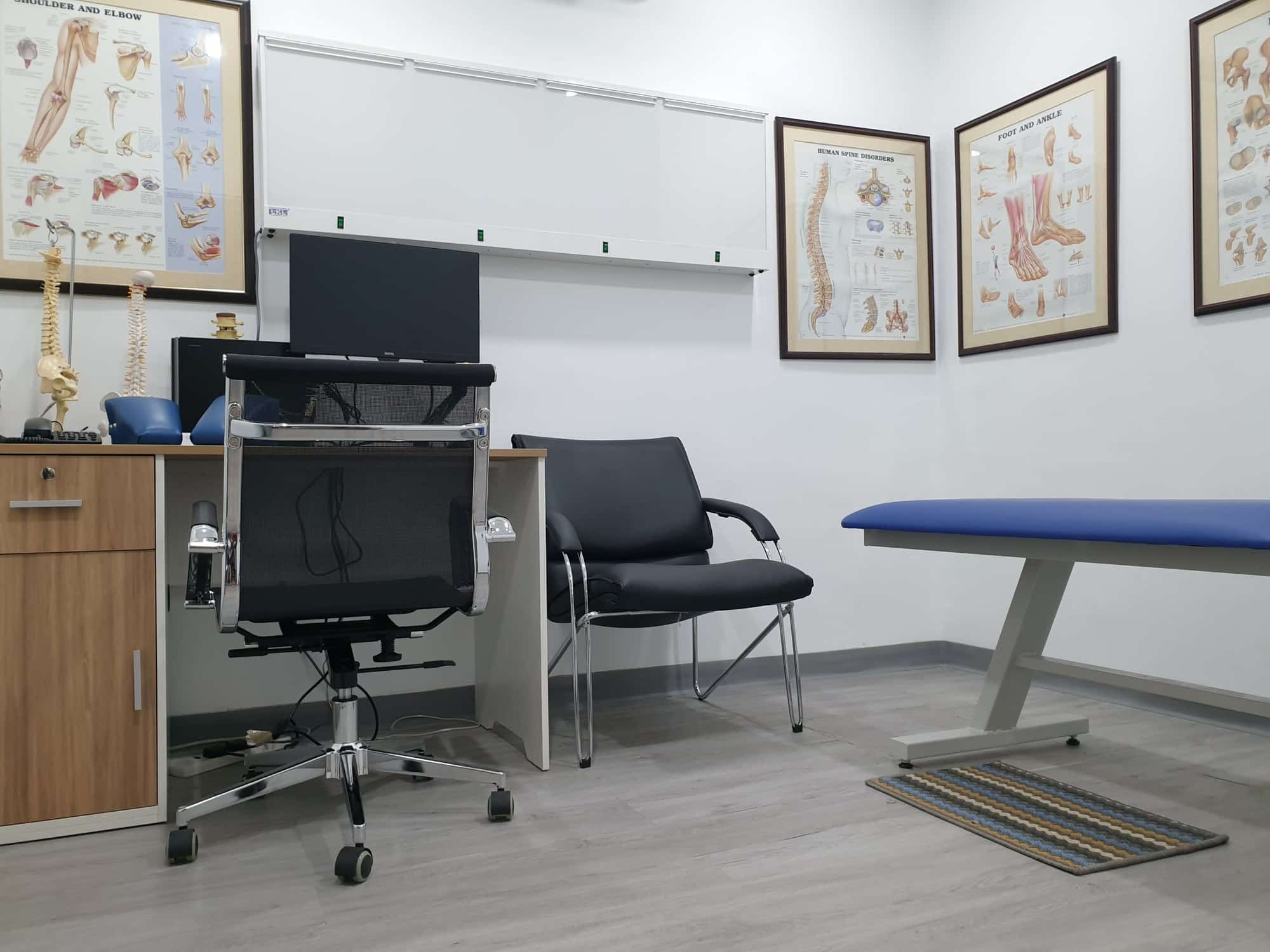
Chiropractic care is a hands-on way to care for the spine, joints, muscles, ligaments and nerves. Chiropractors like me look after every joint in the body, not only the spine: the pelvis, shoulder, elbow, wrist, hip, knee, ankle, foot and jaw. The main treatment is an adjustment, a set amount of force applied to a joint that is not moving well, by hand or with an instrument.
- Reasonable to try: low back pain, neck pain, headaches that start in the neck, and many joint and limb problems where movement and load are the issue.
- Not a treatment for illness outside the muscles, joints and nerves: claims that spinal care treats organ disease, immune problems or other illness are not supported, and CSC does not make them.
- Not a replacement for a medical check when the history or examination points somewhere else; part of the chiropractor's job is to spot that and say so.
- Not a lifelong need: a plan should have a review point and an end. If nobody has told you yours, ask.
Personalized Chiropractic Care, Not a Routine
Every case is assessed on its own, with no cookie-cutter plans. After the examination I usually give two or three options, with what each offers and where each falls short. I recommend one, but the patient decides. The only request I refuse is one I believe would cause harm, such as a rotatory manipulation of a spine with a disc problem.
That is the opposite of the routine some people expect from chiropractic care: lie on your side, have your back twisted, repeat for every patient. A plan that is the same for everyone cannot be specific to anyone. Two people with the same MRI report can need different care, because the report shows the structure, not how that person moves, sleeps, works and heals.
Gentle, Non-Rotatory Methods
There are hundreds of chiropractic techniques. Gonstead and Diversified are well established and good for mobilizing joints, and in a young person with no degeneration and no disc damage they can be appropriate. For moderate or severe degeneration, disc problems or a compressed nerve, I use chiropractic care that does not twist the spine at all:
- The Activator technique: a hand-held, spring-loaded instrument that gives one light, quick impulse to a precise point. More on the Activator technique page.
- Flexion-distraction: gentle, rhythmic motion of the lower back on a special table, often used for disc problems.
- Thompson drop-table work: a small section of the table drops a short distance as the adjustment is given, so less force is needed.
- A non-force upper cervical method: for the top of the neck, from the skull to C2.
- Soft-tissue work: muscles, ligaments and trigger points, by hand or with the instrument.
We do not use fast twisting moves on the neck, the kind most linked to the rare but serious blood vessel problems people read about, and never the ring dinger, Y-strap or towel pulls. Low-force chiropractic care sometimes takes more sessions; I think it is worth it, especially for older patients, people with weaker bones and people on blood thinners. Before we do anything, we tell you what we plan to do and why, and if you ask us not to use a certain method, we respect that.
In that two-minute video I show a non-rotatory Activator adjustment next to the side-posture twist I do not use for joint or disc problems. The transcript is on the Rotatory vs Non-Rotatory Adjustment video page.
Chiropractic Care With Physiotherapy and Rehabilitation
An adjustment restores movement a joint has lost; it cannot, on its own, reach every tissue at depth or build the strength to hold that movement. That is why chiropractic care at CSC runs with registered physiotherapy: manual work, graded exercise and, when the examination calls for them, therapeutic ultrasound, electrotherapy, shockwave or high-intensity laser.
Exercise is chosen for the condition and the age, and it starts only when the body is ready. At the Bukit Damansara main center there is a supervised gym for that stage, and the exercises are planned by the chiropractor and physiotherapist together. As I say in my video Is Chiropractic Safe? 13 Questions Answered: do not choose between one or the other; choose both.
Problems Commonly Addressed
Chiropractic care is mainly for problems of the spine, joints and nerves. The ones I see most often include:
- neck pain and stiffness, upper neck problems and headaches that start in the neck
- lower back pain, a slipped disc in the neck or lower back (bulging, herniated or prolapsed), and sciatica
- spondylosis, spondylolisthesis, facet joint and ligamentum flavum thickening
- shoulder, elbow, wrist and hand problems, and sports injuries
- hip, knee, ankle and foot problems, often linked to how weight is transferred through the legs
- jaw problems, together with the upper neck, and posture strain from desk and phone work
Most of the neck patients I see are in their 20s and 30s, the first generation to use phones and tablets since childhood, or in their 30s to 50s and at a laptop all day.
Chiropractic care is the same at both CSC centers in Kuala Lumpur: the same examination, the same methods and the same fees. Directions and hours are on the Bukit Damansara contact page and the Bandar Sri Damansara contact page, or call or message either center:
- Bukit Damansara (KL, main center): Call +603 2093 1000 or WhatsApp +60 17 269 1873 to see the Bukit Damansara / KL center
- Bandar Sri Damansara (KL): Call +603 6262 5777 or WhatsApp +60 12 455 6939 to see the Bandar Sri Damansara center
How Long It Takes
No number of visits can be set before the examination. How long chiropractic care takes depends on what is involved, how long it has been there, how badly a nerve is pinched, your general health, how closely the advice is followed and, above all, how well your body repairs itself. I have seen young patients heal slowly and patients in their golden years respond well.
If there is no improvement by about the fifth session, the plan is reassessed; if there is none by the tenth, we discuss whether to continue. Be honest about what you did between visits, too: a long run or a weekend of lifting can explain a setback better than anything done on the table.
Maintenance Care: When It Makes Sense
Chiropractic care should have a purpose and a goal, set by what the examination finds. I do not recommend regular adjustments for people with no symptoms to "boost" the body or its immunity, just as a daily aspirin makes sense only for someone with an underlying vascular problem. If it is not broken, do not fix it.
Once it has been fixed, a maintenance or preventive visit now and then, for someone who has had episodes of neck, back or joint trouble before, helps keep the repair from going bad. That is the only kind of wellness plan I recommend.
What the Research Says
A 2019 review of 47 trials found that spinal manipulation eased chronic low back pain about as well as other recommended treatments in the short term, with a small short-term gain in daily function. For neck pain, a 2015 Cochrane review found that manipulation and gentler mobilization gave similar results for pain and function, and the Bone and Joint Decade Task Force found manual therapy, exercise and education among the reasonable options for neck pain.
These gains are modest, which is why CSC joins chiropractic care with physiotherapy and exercise rather than relying on adjustments alone. To recover, increase everything that helps your condition and decrease everything that harms it; for any care to have a good chance of a positive outcome, the problem must be accurately diagnosed, the plan properly made, the care carried out without flaws, and the whole thing topped with changes to posture, habits and daily activity.
In Is Chiropractic Safe? 13 Questions Answered I explain registration, techniques, imaging, the cracking sound and how progress is reviewed.
Choosing a Chiropractor in Malaysia
Chiropractors in Malaysia register under the Traditional and Complementary Medicine Act 2016, after a university degree program, and it is fair to ask about registration before a first visit. Chiropractic care is safe when it is performed by a competent chiropractor who is registered; it is the chiropractor who makes mistakes, not chiropractic. A good chiropractor checks you first, explains the plan in plain words, uses exercise as part of care, and sets a point to review progress. More on the signs of a good chiropractor.
Preparing for Your First Chiropractic Care Visit
A little preparation makes the first visit more useful. Wear comfortable clothing you can move in. Bring every past medical record that relates to the problem, the imaging itself on film or CD as well as the reports, and a list of the medicines you take.
- Write down when the problem started, how it has changed and everything you have already tried, including exercises, massage and other chiropractic care.
- Note what makes it better or worse: sitting, standing, walking, bending, lying down, coughing or sneezing.
- Write down the questions you want answered, because they are easily forgotten in the room.
- During the examination, mention even slight discomfort, so the tests and the first care can be adjusted.
If you are coming for someone else, a parent or a partner, the same list helps them. Very young children are cared for with non-force methods only, and a low-force method such as the Activator may be used for teenagers.
Fees for Chiropractic Care at CSC
Fees for chiropractic care are the same at every CSC center: RM100 for the examination, RM150 for an adjustment, or from RM110 for the adjustment when the visit also includes physiotherapy. Packages of 15 and 20 sessions are available; the full list is on the chiropractic price in Kuala Lumpur page and the physiotherapy fees in Kuala Lumpur page.
Chiropractic Care: Common Questions
Does chiropractic care hurt?
It should not. My motto has always been no pain, more gain: care should never be uncomfortable, and if it is, tell your chiropractor so the force or the method can be changed.
Does chiropractic care always involve cracking?
No. The cracking sound is gas released from the joint fluid, and it is not what restores movement. The non-rotatory methods used at CSC, such as the Activator, make no cracking sound.
Do I need an X-ray before chiropractic care?
Not usually. Not every patient needs imaging, and ordering an X-ray before an examination is the wrong order. If the examination shows a reason for imaging, you are told why and referred.
Is chiropractic care suitable for older adults?
Often, yes, with the right method. For people in their 40s and older with degenerative changes, bone spurs or nerve impingement I use low-force, non-rotatory methods rather than anything that produces an audible crack.
Can chiropractic care be combined with physiotherapy?
Yes, and in my view it should be. At CSC the chiropractor and the physiotherapist work on one plan, often in the same visit.
Can I see a chiropractor for chiropractic care the same day?
Usually, yes. Call or send a WhatsApp message to either Kuala Lumpur center first so a chiropractor is free when you arrive.
Related Reading
- Chiropractic treatment: how the method is chosen: the techniques compared, and when each is used.
- Chiropractic adjustment for all ages and joints: what an adjustment is at each age.
- Chiropractic therapy combined with physiotherapy: how the two professions share one plan.
- Chiropractor in Malaysia: registration, training and the first visit.
Peer-Reviewed References
- Rubinstein SM, de Zoete A, van Middelkoop M, et al. Benefits and harms of spinal manipulative therapy for the treatment of chronic low back pain: systematic review and meta-analysis of randomised controlled trials. BMJ. 2019;364:l689.
- Gross A, Langevin P, Burnie SJ, et al. Manipulation and mobilisation for neck pain contrasted against an inactive control or another active treatment. Cochrane Database Syst Rev. 2015;(9):CD004249.
- Hurwitz EL, Carragee EJ, van der Velde G, et al. Treatment of neck pain: noninvasive interventions: results of the Bone and Joint Decade 2000-2010 Task Force on Neck Pain and Its Associated Disorders. Spine (Phila Pa 1976). 2008;33(4 Suppl):S123-S152.
These references describe spinal manipulation and manual therapy for spine and neck problems in general. None of them tests a care program at Chiropractic Specialty Center.
The Author of Chiropractic Care: 7 Clear Steps From Exam to Review
Chiropractic Care: 7 Clear Steps From Exam to Review was written by Yama Zafer, D.C., Chiropractor in Kuala Lumpur Since 1996, who founded Chiropractic Specialty Center in Kuala Lumpur in 2006.
Last Updated: Chiropractic Care: What It Involves, Step by Step
Chiropractic Care: What It Involves, Step by Step was last reviewed and updated on October 28, 2026.
Share with others: