High Intensity Laser Therapy (HILT) in KL: What to Expect

High intensity laser therapy is an option in Kuala Lumpur for neck, back and joint pain that stays after an injury or strain. HILT uses a Class IV laser to deliver light energy through the skin into muscles, tendons, ligaments, joints and nerves. It suits people whose examination finds irritated soft tissue or a joint or disc problem. It is one part of a plan with exercise.

A high intensity laser therapy session takes a few minutes for each area. The clinician keeps a handheld applicator moving over the skin while the area warms. Everyone in the room wears protective glasses, and nothing breaks the skin. Mild redness or warmth afterward usually settles within a few hours. The laser is never aimed at the eyes, a pregnant abdomen or an area of known or suspected cancer.

A 2023 review pooled 48 randomized trials in people with muscle and joint pain. Against sham or no laser, HILT lowered pain scores by a further 1.9 cm on a 10 cm scale. The authors call that difference clinically relevant. The sections below cover what studies measured in cells, nerves and muscles, HILT versus low-level laser, session numbers and fees.

For more information about high intensity laser therapy, contact the Bukit Damansara (KL) main center: WhatsApp+60 17 269 1873 Call+603 2093 1000

High Intensity Laser Therapy: Key Takeaways

PointWhat to know
How it differs from low-level laserA Class IV therapy laser can be up to 30 times stronger than a Class IIIb laser. It reaches deeper tissue in less time (Lu et al., 2021).
Side effects in trialsAmong the trials that recorded side effects, one person had an allergic reaction to HILT. Warmth and brief redness are what people usually notice.
Back and neck painIn a review of 10 trials, HILT added to exercise improved pain and function more than placebo laser with exercise. The evidence was rated low (Alayat et al., 2019).
Given with exerciseIn 28 of the 48 trials in the 2023 review, high intensity laser therapy was given together with exercise.
Measured in cellsLight absorbed in the mitochondria raised ATP, the molecule cells use for energy, and nitric oxide. Most of these were laboratory studies of lower-power lasers (Hamblin, 2017).
Measured in nervesIn 20 people with carpal tunnel syndrome, HILT improved pain, tingling and nerve conduction at the wrist. TENS did not change nerve conduction (Casale et al., 2013).
Typical course in trialsMost trials gave 5 to 20 sessions. At CSC, the number is set after the assessment.
Fee per unit at CSCRM130, or RM100 when chiropractic is part of the same visit, from the CSC quotation dated June 25, 2026.
How progress is checkedThe first visit's measures are repeated. If they have not improved by the fifth session, the plan is reviewed. By the tenth, the next step is decided together.

High Intensity Laser Therapy: Page Guide

Does High Intensity Laser Therapy Work? What the Trials Found

The largest review so far pooled 48 randomized trials of high intensity laser therapy in muscle, tendon and joint problems (Arroyo-Fernández et al., 2023). Compared with sham or no laser, the extra fall in pain was 1.9 cm on a 10 cm scale. Compared with other conservative methods, it was 0.7 cm. High intensity laser therapy lowered pain more than therapeutic ultrasound, TENS and low-level laser, and more than shockwave therapy in one trial.

Function, range of motion and quality of life improved as well, while muscle strength did not change. The authors conclude that high intensity laser therapy is effective for pain, function, range of motion and quality of life in these problems. They add that the findings must be treated with caution, because many trials had a high risk of bias.

Back and Neck Pain Trials

A 2019 review covered 10 trials, 6 in low back pain and 4 in neck pain. HILT with exercise reduced pain and improved function more than placebo laser with exercise. HILT on its own, or with conventional physiotherapy, also did better than conventional physiotherapy alone. The authors rated the evidence very low to low and call HILT a complementary method (Alayat et al., 2019).

In one of those trials, 72 men with chronic low back pain had four weeks of care in one of three groups. The groups were HILT with exercise, placebo laser with exercise, and HILT alone. HILT with exercise gave the greatest gains in pain, disability and lumbar movement. At 12 weeks, lumbar movement in both exercise groups was still better than at the start (Alayat et al., 2014).

For neck pain, a 2024 review included 20 trials of high intensity laser therapy added to other physiotherapy, especially exercise. Pain scores were 14.1 mm lower on a 100 mm scale, and neck extension improved. Only the change in pain was large enough to matter clinically.

The authors rated the certainty of the evidence as low. The clearest results came in myofascial neck pain, long-standing neck pain and cervical radiculopathy (de la Barra Ortiz et al., 2024). Cervical radiculopathy means a pinched nerve in the neck.

Combined With Spinal Decompression for a Disc Protrusion

A trial included 63 people with a lumbar disc protrusion. One group had high intensity laser therapy with spinal decompression, and the other had decompression alone. After two weeks, the laser group scored better on the Oswestry disability index, bent forward further and raised the straight leg higher. Back and leg pain scores did not differ significantly between the groups (Chen et al., 2018). How decompression is done is explained in the guide to spinal decompression therapy.

Shoulder and Other Joint Trials

In 70 people with shoulder impingement, 10 sessions of high intensity laser therapy over two weeks reduced pain more than 10 sessions of therapeutic ultrasound. Only the pain difference reached a clinically important size, and the trial had no placebo group (Santamato et al., 2009). The 2023 review also included trials in tennis elbow, carpal tunnel syndrome, knee osteoarthritis, plantar fasciitis and jaw disorders. It found the largest gains in function at the knee and shoulder.

Arranging an Assessment in KL

The first visit finds where the problem comes from before laser is considered. It tests movement, strength and nerve signs, and it examines the joints above and below the sore area. Any X-ray or MRI is reviewed too. Either Kuala Lumpur center can arrange it:

Opening hours and directions for both centers are on the CSC locations page.

Tissue Effects of HILT: What Studies Measured

Yama Zafer, D.C., describes the effects below as the potential impact of HILT on the body's own tissue. The studies show how far each one has been measured. Much of this research used lower-power lasers in cells and animals, so each finding names its setting: cells, animals or people.

Cells and Energy

Inside cells, an enzyme in the mitochondria called cytochrome c oxidase absorbs red and near-infrared light. Laboratory studies then found more ATP, the molecule cells use for energy. They also found a brief rise in nitric oxide and the making of new proteins (Hamblin, 2017).

In cell studies, lower-dose laser light increased the growth of fibroblasts, the cells that make collagen (Cotler et al., 2015). This research also shows a dose effect: low doses stimulate cells, and high doses can hold them back (Hamblin, 2017). So the dose is set for each area.

Blood Flow and Swelling

Nitric oxide widens blood vessels. A review of laser studies describes new small blood vessels and more collagen forming in wounds. It also describes less swelling within hours to days (Cotler et al., 2015). In a trial of 60 people with chronic wounds, high intensity laser therapy was added to standard wound care. Wound scores improved more after three weeks, and no burns occurred (Lu et al., 2021).

Inflammation

Lower inflammation is one of the most consistent findings in this research. In animal studies, laser light reduced inflammatory cells in joints (Cotler et al., 2015). It also reduced inflammation in wounds, the lungs and the spinal cord. In activated immune cells, it lowered the markers of the inflammatory type (Hamblin, 2017).

Nerves and Pain Signals

Pain signals travel along thin nerve fibers called C and A-delta fibers. A review explains that a focused, higher-intensity laser spot on a nerve can block conduction in these fibers. It also notes that serotonin and endorphin levels rose in animal studies and after laser treatment of myofascial pain in patients (Cotler et al., 2015).

In 20 people with carpal tunnel syndrome, 15 sessions of high intensity laser therapy improved pain and tingling. Conduction in the median nerve at the wrist improved too, while TENS, the comparison, did not change it (Casale et al., 2013). In rats with a crushed sciatic nerve, a pulsed high-intensity laser was given daily for nine days. Leg function scores were better from the first week, and more nerve fibers were found at four weeks (Ko et al., 2024).

Muscles and Trigger Points

A trial included women with long-standing myofascial pain of the trapezius, the muscle between the neck and shoulder. Both groups did the same exercises, one with high intensity laser therapy and one with placebo laser. The laser group improved more in pain and neck disability at 4 and 12 weeks (Dundar et al., 2015). A review of laser practice also describes laser over trigger points to reduce their tenderness and relax tight muscle fibers (Cotler et al., 2015).

HILT vs Low-Level Laser: How They Compare

Low-level laser therapy, also called LLLT or cold laser, uses Class 3R or 3B lasers of about 10 to 500 milliwatts (Cotler et al., 2015). High intensity laser therapy uses Class IV lasers, which can be up to 30 times stronger than a Class IIIb laser. Their depth of penetration rises with their power, so they reach deep tissue in a short time (Lu et al., 2021).

The authors of that 2021 trial write that, with more power, HILT can reach 8 to 10 cm deeper into the body.

PointHILTLow-level laser (LLLT, cold laser)
Laser classClass IVClass 3R or 3B
PowerUp to 30 times a Class IIIb laserAbout 10 to 500 milliwatts
Time to deliver a doseShorter, at higher powerLonger, at lower power
Head-to-head trialsPain 1.2 cm lower on a 10 cm scale; function betterThe comparison group in those trials

Some trials compared the two directly. In those trials, pain fell a further 1.2 cm on a 10 cm scale with HILT than with low-level laser. Function also improved more (Arroyo-Fernández et al., 2023).

Problems Tested in Randomized Trials

High intensity laser therapy is considered after an assessment, as one part of care. Each problem below has been tested in randomized trials, and each has its own guide on this site:

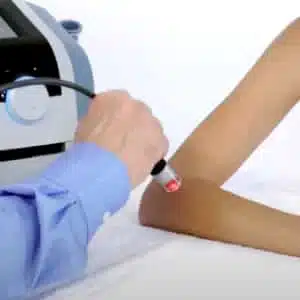
A clinician guides a laser therapy applicator over the forearm, just below the elbow

Does HILT Hurt? What a Session Feels Like

Most people feel a gradual warmth under the skin while the applicator moves. The area is uncovered, and everyone in the room wears protective glasses. The clinician keeps the handheld applicator moving for a few minutes over each area. If the warmth builds too much, say so at once. The output is lowered or the applicator moves faster, because care is kept within what the patient can comfortably tolerate.

The laser warms the tissue, so a skin burn is possible if the heat is not managed. That is why the applicator never rests in one spot. Normal activity can resume the same day.
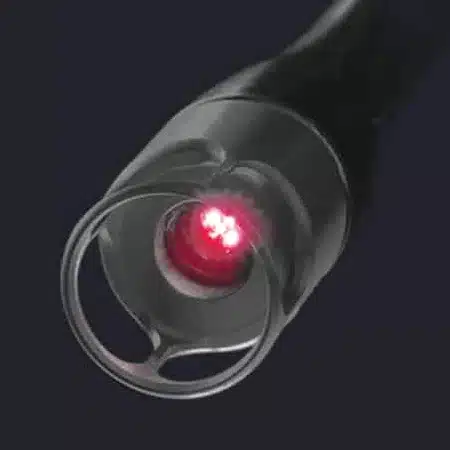
Close-up of a handheld laser therapy applicator with its tip lit red

HILT Side Effects and Safety Checks

In the trials, side effects were seldom reported. Of the 48 trials in the 2023 review, 18 recorded side effects, and one participant had an allergic reaction to HILT. High intensity laser therapy uses more power than low-level laser. So the authors call for future trials to check for side effects systematically (Arroyo-Fernández et al., 2023).

Laser light can damage the eyes, so protective glasses are worn throughout. Before the first session, tell the clinician about any of these:

  • pregnancy;
  • a history of cancer;
  • medication that makes the skin sensitive to light;
  • reduced feeling in the area;
  • a tattoo over the area, since dark ink absorbs more heat.

During laser therapy or any other physiotherapy for back or leg pain, any new or worsening numbness around your genitals, between your genitals and anus, or around your anus needs urgent medical attention: a thorough assessment at a hospital emergency department straight away, within hours. New difficulty passing urine needs the same, even before any loss of bladder or bowel control, and a loss of that control is urgent too. These symptoms can have different causes, and assessment helps identify the appropriate next step. Some may call for an invasive procedure, but being assessed does not mean that you necessarily need surgery.

How Many Sessions Are Planned?

The number is set after the assessment. In the 2023 review, 18 trials gave 5 to 10 sessions and 28 gave 11 to 20 (Arroyo-Fernández et al., 2023). At CSC, the plan names the measures that will be repeated, such as range of movement, strength or how long sitting is comfortable. If they have not improved by the fifth session, the plan is reviewed. By the tenth session, the next step is decided together.

Where It Fits With Chiropractic and Physiotherapy

Yama Zafer, D.C., recommends chiropractic and physiotherapy together rather than one or the other; in his words, "Choose both." High intensity laser therapy is one of the physiotherapy methods in that plan:

  • Chiropractic: gentle care matched to the condition, such as chiropractic manipulation that is non-rotatory using the Activator instrument. There is no twisting where a disc is damaged.
  • Physiotherapy: manual therapy, with HILT, shockwave therapy, therapeutic ultrasound or spinal decompression where the findings call for them.
  • Exercise: exercise rehabilitation once the area is ready, since most HILT trials paired the laser with exercise.
  • Daily habits: posture, sleep and sitting breaks. Breaks come every 15 to 20 minutes while the back hurts, with half a minute to a minute on the feet; people without back problems can sit 30 to 40 minutes between breaks.

Medical review, imaging or referral is discussed whenever the findings call for it. Injections and surgery remain a distant last resort, weighed only when a focused, properly delivered conservative plan has not helped.

How Much Does High Intensity Laser Therapy Cost in KL?

At CSC, one unit of high intensity laser therapy is RM130, or RM100 when chiropractic is part of the same visit. The price page also lists "HILT, 50 cm" at RM180, or RM150 when chiropractic is part of the same visit. A chiropractic adjustment is RM150 on its own, or from RM110 when physiotherapy such as HILT is part of the same visit, so an adjustment with HILT comes to RM210 (RM110 plus RM100). The examination at the first visit is RM100.

These fees come from the CSC quotation dated June 25, 2026, and are the same at the Bukit Damansara and Bandar Sri Damansara centers. The total depends on what the assessment finds, the methods used and how many visits the plan needs. The fee for a plan is explained and agreed before care begins.

The full fees are on the chiropractic price page and the physiotherapy price page.

High Intensity Laser Therapy: Frequently Asked Questions

How Long Will Laser Therapy Last?

A session lasts a few minutes per area, and most courses in the trials ran from 5 to 20 sessions. How long the changes last is less certain. In the 2023 review, trials measured results from the end of treatment up to 24 weeks later. Compared with sham or no laser, the extra fall in pain tended to shrink at longer follow-up. The gain in function tended to grow (Arroyo-Fernández et al., 2023). Yama Zafer, D.C., sees lifestyle change as the most important part of care, because the habits that continue after care shape what lasts.

Is Laser Physiotherapy the Same as HILT?

Not always. Laser physiotherapy is a general name for laser used in physiotherapy. It can mean low-level laser, at about 10 to 500 milliwatts, or HILT, a stronger Class IV laser (Cotler et al., 2015). The two are dosed differently and were tested in different trials. So it is worth asking which type a clinic uses, at what power and for how long. The laser listed on the CSC physiotherapy price page is HILT.

Which Laser Is Best for Physiotherapy?

No single laser is best for every person or problem. The choice depends on what the assessment finds and how deep the irritated tissue lies. It also depends on the dose tested for that problem and on whether exercise is part of the plan. In trials that compared the two directly, HILT lowered pain scores more than low-level laser (Arroyo-Fernández et al., 2023). Before a laser session, it is fair to ask who assessed the problem, what the laser should change and how progress is measured.

Is HILT the Same as a Surgical Laser?

No. Both belong to the highest power class of lasers. A review of laser therapy lists Class 4 together with surgical lasers (Cotler et al., 2015). A surgical laser is used to cut tissue during an operation. HILT is applied over the skin with a moving applicator, nothing is cut and the skin stays intact. The warmth people feel is the reason the applicator keeps moving and the reason the dose is set for each area.

Can HILT Be Given on the Same Day as a Chiropractic Adjustment?

Yes. HILT can be given in the same visit as a chiropractic adjustment, and its fee is then lower, as the cost section above shows. The clinician decides the order and whether both suit that visit, after checking how the area responded since the last session. Yama Zafer, D.C., recommends chiropractic and physiotherapy together, so a visit can combine an adjustment with physiotherapy such as HILT, manual therapy or exercise.

Can I Go Back to Work or Exercise the Same Day?

Yes. Nothing breaks the skin, so most people return to work the same day. Exercise follows the plan set at the assessment: most HILT trials paired the laser with exercise, and the exercises are progressed as the area allows. If the area feels warm or looks a little red, that usually settles within a few hours. Hot packs on an inflamed area are avoided, as Yama Zafer, D.C., advises. Any new or worse symptom is reported at the next visit.

How to Read This High Intensity Laser Therapy Guide

This guide is educational. It explains HILT in general and cannot assess your own situation, so an examination is the way to know whether laser suits you. Where it reports a study, it gives what that study found, in whom and with what limits.

References

  • Arroyo-Fernández R, Aceituno-Gómez J, Serrano-Muñoz D, Avendaño-Coy J. High-Intensity Laser Therapy for Musculoskeletal Disorders: A Systematic Review and Meta-Analysis of Randomized Clinical Trials. J Clin Med. 2023;12(4):1479.
  • Lu Q, Yin Z, Shen X, et al. Clinical effects of high-intensity laser therapy on patients with chronic refractory wounds: a randomised controlled trial. BMJ Open. 2021;11(7):e045866.
  • Alayat MSM, Alshehri MA, Shousha TM, et al. The effectiveness of high intensity laser therapy in the management of spinal disorders: A systematic review and meta-analysis. J Back Musculoskelet Rehabil. 2019;32(6):869-884.
  • Hamblin MR. Mechanisms and applications of the anti-inflammatory effects of photobiomodulation. AIMS Biophys. 2017;4(3):337-361.
  • Casale R, Damiani C, Maestri R, Wells CD. Pain and electrophysiological parameters are improved by combined 830-1064 high-intensity LASER in symptomatic carpal tunnel syndrome versus Transcutaneous Electrical Nerve Stimulation. A randomized controlled study. Eur J Phys Rehabil Med. 2013;49(2):205-211.
  • Alayat MS, Atya AM, Ali MM, Shosha TM. Long-term effect of high-intensity laser therapy in the treatment of patients with chronic low back pain: a randomized blinded placebo-controlled trial. Lasers Med Sci. 2014;29(3):1065-1073.
  • de la Barra Ortiz HA, Arias M, Liebano RE. A systematic review and meta-analysis of randomized controlled trials on the effectiveness of high-intensity laser therapy in the management of neck pain. Lasers Med Sci. 2024;39(1):124.
  • Chen L, Liu D, Zou L, et al. Efficacy of high intensity laser therapy in treatment of patients with lumbar disc protrusion: A randomized controlled trial. J Back Musculoskelet Rehabil. 2018;31(1):191-196.
  • Santamato A, Solfrizzi V, Panza F, et al. Short-term effects of high-intensity laser therapy versus ultrasound therapy in the treatment of people with subacromial impingement syndrome: a randomized clinical trial. Phys Ther. 2009;89(7):643-652.
  • Cotler HB, Chow RT, Hamblin MR, Carroll J. The Use of Low Level Laser Therapy (LLLT) For Musculoskeletal Pain. MOJ Orthop Rheumatol. 2015;2(5):00068.
  • Ko PY, Hsu CC, Chen SY, Li CL, Jou IM, Wu PT. The Pulsed Nd:YAG Laser Therapy Enhanced Nerve Regeneration via Apoptosis Inhibition in a Rat Crushed Sciatic Nerve Model. Neurochem Res. 2024;49(4):949-958.
  • Dundar U, Turkmen U, Toktas H, Solak O, Ulasli AM. Effect of high-intensity laser therapy in the management of myofascial pain syndrome of the trapezius: a double-blind, placebo-controlled study. Lasers Med Sci. 2015;30(1):325-332.

These references describe laser therapy research in general. None of them evaluates care at Chiropractic Specialty Center.

The Author of High Intensity Laser Therapy: Uses, Research & Side Effects

High Intensity Laser Therapy: Uses, Research & Side Effects was written by Yama Zafer, D.C., who has 30+ years in chiropractic and physiotherapy and founded Chiropractic Specialty Center in Kuala Lumpur in 2006.

Last Updated: High Intensity Laser Therapy (HILT) in KL: What to Expect

High Intensity Laser Therapy (HILT) in KL: What to Expect was last reviewed and updated on October 16, 2026.

Share with others: