


TMJ Disorders: Jaw Clicking, Stiffness and Assessment
TMJ disorders affect the temporomandibular joint, the muscles that move the jaw, or both. Clicking can occur when the small cartilage disc inside the joint moves out of step with the jaw, while locking or restricted opening can point to a different mechanical problem that deserves assessment.
A click on its own, with full opening and no pain, is extremely common and frequently needs nothing. What carries more significance is a jaw that no longer opens fully, or one that deviates to one side on the way. Normal opening is roughly three stacked fingers between the front teeth. The upper neck is examined at the same time, because neck and jaw problems occur together more often than people expect.
This guide to TMJ disorders, from jaw clicking and stiffness to how they are assessed, is published by Chiropractic Specialty Center, Bukit Damansara (KL) main center: WhatsApp+60 17 269 1873 Call+603 2093 1000
Key Takeaways for TMJ Disorders
Top 3 points for people with TMJ symptoms:
- TMJ disorders have several causes: muscle tension, changes in the joint disc, clenching or grinding habits and neck posture can all contribute.
- Conservative care comes first: jaw exercise, manual therapy, posture work and habit changes have the strongest support in current guidelines.
- A plan built on your findings: care is more likely to help when it addresses what is actually loading the jaw.
Table of Contents: TMJ Disorders & Jaw Clicking Alignment Care
Temporomandibular Joint Disorder (TMJ Disorder or TMD) in Malaysia
Temporomandibular disorder (TMD) is an umbrella term for problems affecting the jaw joint, the chewing muscles or both. Because several different problems sit under that label, the aim of an assessment is to work out which one is present rather than stopping at a general diagnosis.
At CSC, the chiropractors and physiotherapists examine jaw movement, the chewing muscles, the joint and the neck before deciding on care.
A note on terms: TMJ stands for temporomandibular joint, which is the jaw joint itself. TMD stands for temporomandibular disorder, which describes a problem with that joint or its muscles. Many people say “TMJ” when they mean the disorder, so both terms appear on this page.
Jaw and Neck Assessment for TMJ in KL
Jaw opening, jaw muscles and the upper neck are examined together at both centers of Chiropractic Specialty Center, and care is coordinated with your dentist when a night guard or dental review is needed. Directions are on the Bukit Damansara contact page and the Bandar Sri Damansara contact page.
- Bukit Damansara (KL, main center): Call +603 2093 1000 or WhatsApp +60 17 269 1873 to see the Bukit Damansara / KL center.
- Bandar Sri Damansara (KL): Call +603 6262 5777 or WhatsApp +60 12 455 6939 to see the Bandar Sri Damansara center.
Physiotherapy or Chiropractic Care for Jaw and TMJ Pain?
Dentists, physiotherapists and chiropractors all care for people with TMJ disorders, and each profession brings something different:
- Dentists assess the teeth and bite, provide night guards or splints, and refer to oral and maxillofacial surgeons when surgery is being considered.
- Physiotherapists use jaw exercise, manual therapy and posture work, sometimes with devices such as ultrasound, TENS or laser.
- Chiropractors use manual therapy for the jaw muscles and joint, and chiropractic care for the neck when it contributes.
At CSC, chiropractic and physiotherapy are combined in one plan, and patients are referred to a dentist when a night guard or dental assessment is needed.
Working With Your Dentist on a TMJ Disorder
Dentists are central to the care of many TMJ disorders, particularly when the teeth, bite or night-time grinding are involved. Chiropractors and physiotherapists add assessment and care of the jaw muscles, joint movement and the neck.
CSC works with local dentists when a night guard or dental review is needed, so that each part of the problem is handled by the right professional.
Self-Help Tips for Jaw Pain
A few simple measures help many people while the jaw settles:
Heat or cold for comfort. A warm compress can relax tight jaw muscles, and a cold pack wrapped in a cloth can ease pain after a flare. Use either for up to 15 minutes, and choose whichever feels better.
Rest the jaw. Eat softer foods for a while, cut food into small pieces, and avoid chewing gum, hard sweets and very wide bites. Avoid resting your jaw on your hand, which loads the joint for long periods.
Muscle Relaxants for TMJ Pain: What to Know
Muscle relaxants are sometimes prescribed for jaw pain. The evidence for them in TMJ disorders is limited, and they affect the whole body rather than the jaw muscles alone, often causing drowsiness. Any medication decision belongs with your doctor or dentist.
Current guidelines give the strongest support to active, non-drug care: jaw exercise, manual therapy, posture work and addressing clenching and stress.
At CSC, chiropractors and physiotherapists combine hands-on care and exercise, with clinical therapy devices used where they help the jaw settle enough for exercise to progress.
Surgery for Temporomandibular Joint Dysfunction
Most TMJ disorders are managed without surgery. A 2023 international clinical practice guideline made strong recommendations in favor of jaw mobilization, jaw exercise with stretching, manual trigger point therapy, postural exercise and cognitive behavioral therapy, and strong recommendations against discectomy and irreversible oral splint therapy (Busse JW, Casassus R, Carrasco-Labra A, et al. BMJ. 2023;383:e076227).
At CSC, chiropractors and physiotherapists provide the non-surgical parts of that approach. Jaw pain often comes with headaches or neck stiffness or disc problems, so the neck is assessed alongside the jaw. Where an earlier course of care has not helped, the first step is to ask what was tried and for how long.
Surgery is a last resort, considered by an oral and maxillofacial surgeon for specific joint problems that do not respond to conservative care.
Neck Pain and TMJ Dysfunction
Neck pain and neck stiffness often occur alongside TMJ disorders. The upper neck is the most closely linked, including upper cervical problems involving the occiput and atlas, C1-C2, C2-C3 and C3-C4. Lower neck levels such as C4-C5, C5-C6, C6-C7 and C7-T1 can also affect posture and jaw function.
Neck conditions such as spinal canal stenosis, degenerated discs, bulging discs and herniated discs are sometimes seen in people with TMJ symptoms, and many people with TMJ disorders also have neck complaints. Assessing both helps the plan address everything that is contributing.
A slipped disc in the neck can cause pain in the upper back, shoulder, arm and hand; see slip disc symptoms for more. When neck and jaw problems occur together, both are assessed at the same visit.
How to Recover From TMJ Headaches
TMJ disorders are a common cause of headaches, usually from tense chewing muscles and sometimes from the jaw joint or disc. These headaches are often felt at the temples and are more common in people who grind or clench their teeth at night.
Grinding and clenching are called bruxism, and stress is a common contributor. People with TMJ headaches often notice facial pain or headache in the morning, usually around the temples and sometimes toward the forehead or the back of the head.
Recovery usually involves addressing bruxism, for example with a night guard from your dentist, together with jaw exercise, manual therapy and posture work from a physiotherapist or chiropractor.
Understanding the Jaw Joint (TMJ)
The jaw joint is unusual in how it moves and in the small disc it contains, which is one reason TMJ problems can be confusing. Before discussing care options, it helps to understand the joint itself.
The Jaw Joint: A Hinge and Gliding Joint
The jaw joint both hinges and glides, which allows the complex movements needed for eating, swallowing, talking and yawning. Understanding how it works helps you describe your symptoms and take part in decisions about care.
How to Choose Care for TMJ Pain in Malaysia
A sound awareness of the anatomy of the jaw joint and related structures is essential to the establishment of a correct diagnosis and appropriate care.
A clear understanding of the jaw joint and its related structures is essential for a correct diagnosis and appropriate care.
When choosing a clinician, ask how they will assess the jaw and neck, what the plan involves, how progress will be measured, and when they would refer you to a dentist or surgeon. Clear answers to those questions are a good sign.
Definition of Terms Used for TMJ Dysfunction
We are pleased to bring you our list of TMJ terms used by our clinical teams and this website. Please review them, and should you have any questions or need further clarification, please contact one of our centers today.
TMD: The term TMD refers to a problematic jaw joint. Many refer to their jaw pain as a TMJ, which is incorrect, as the term TMJ is ONLY reflective of the joint itself. TMD stands for Temporomandibular Disorder; in other words, jaw pain.
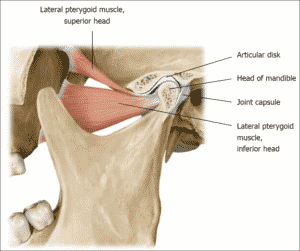
Articular Disc: The articular disc is a fibrous extension of the capsule that runs between the two articular surfaces of the Temporomandibular Joint. The disc articulates with the mandibular fossa of the temporal bone above and the mandible condyle below. An articular disc divides the joint into two sections, each with its synovial membrane. In addition to attachments to both temporal and superior aspects of the mandibular condyle, the collateral ligaments also attach the disc to the condyle medially and laterally. The anterior disc attaches to the joint capsule and the superior head of the lateral pterygoid. The posterior portion connecting to the mandibular fossa is better known as the retrodiscal tissue.
What Is Bruxism?
Involuntary habitual grinding of the teeth, typically during sleep. Individuals that have bruxism may also unconsciously clench their teeth during the day.
Grinding and Jaw Clicking in Children
Grinding is common in children. A click in a child's jaw without pain or locking may only need watching, while clicking that comes with pain, headaches, a stiff neck or heavy grinding at night deserves an assessment. Care for a child's jaw is very gentle and non-force, and the guide to chiropractic care for children explains grinding and jaw problems in children.
The Capsule of the Jaw Joint
The capsule is a fibrous membrane that surrounds the joint and attaches to the articular eminence, articular disc, and mandibular condyle’s neck.
Retrodiscal Tissue of the Jaw Joint
Unlike the disc itself, the retro-discal tissue is vascular and highly innervated. As a result, the retro-discal tissue is often a major contributor to the pain of temporomandibular disorder (TMD), particularly when there is inflammation or compression of the joint.
Synovium of the Jaw Joint
The synovium is a thin layer of tissue serving as the protective lining of joints and tendon sheaths. The synovium acts to control the environment within the joint and tendon sheath. It does this in two ways: first, it serves as a membrane to determine what can pass into the joint space and what stays outside; second, the cells within the synovium produce substances that lubricate the joint.
We hope you found this section of our website helpful. We aim to provide our patients and visitors with pertinent health-related information. Visit or call one of our centers if you have additional questions about jaw pain, TMD, or other health-related issues today.
The chiropractic price list in Kuala Lumpur and physiotherapy fees in Kuala Lumpur pages list every fee before care begins.
What a Click Actually Means
Clicking is the symptom people worry about most and the one that usually matters least. It is worth understanding why.
Inside the jaw joint sits a small disc that normally travels with the condyle as you open. If the disc sits slightly forward at rest and then snaps back into place during opening, you get a click. That is disc displacement with reduction, and it is common, often painless, and frequently lifelong without causing trouble.
The situation that matters is when the disc no longer snaps back. Then the click disappears and the opening becomes limited instead, because the disc is blocking the movement. A click that stops and is replaced by restricted opening is a change worth reporting, whereas a click on its own usually is not. That is the opposite of what most people assume, and it is the single most useful thing on this page.
We do not treat noise. We treat pain, restricted opening, and difficulty eating, and we say so plainly when someone arrives asking us to make a click go away.
The Load Audit Worth Doing Before Any Treatment
Spend a week noticing these. For a good number of people, this alone changes the picture:
- Daytime clenching. Teeth should be apart at rest, with the tongue on the palate. Set a reminder and check where your teeth are each time it goes off.
- Chewing habits. Gum, ice, hard bread crusts, tough meat, nail biting, chewing on one side only.
- Sustained opening. Long dental appointments, yawning wide, singing, playing a wind instrument. Tell your dentist in advance and ask for breaks.
- Sleep position. Sleeping with the hand or arm pressed under the jaw loads the joint for hours at a time.
- Stress and the neck. Jaw tension and neck tension travel together, which is why we assess the neck in every jaw case.
Jaw Symptoms That Need a Doctor or Dentist First
- A jaw that locks closed and will not open, or locks open and will not close.
- Facial swelling, fever, or pain centered on a tooth.
- Jaw pain brought on by exertion, or with chest pain, breathlessness or sweating. Treat that as a cardiac emergency.
- Scalp tenderness with jaw pain on chewing in an older adult, which needs same-day medical review.
- Numbness of the lip or chin, or a bite that has changed suddenly.
Peer-Reviewed Medical References
- Busse JW, Casassus R, Carrasco-Labra A, et al. Management of chronic pain associated with temporomandibular disorders: a clinical practice guideline. BMJ. 2023;383:e076227.
- Armijo-Olivo S, Pitance L, Singh V, et al. Effectiveness of manual therapy and therapeutic exercise for temporomandibular disorders: systematic review and meta-analysis. Phys Ther. 2016;96(1):9-25.
- Alowaimer HA, Al Shutwi SS, Alsaegh MK, et al. Comparative efficacy of non-invasive therapies in temporomandibular joint dysfunction: a systematic review. Cureus. 2024;16(3):e56713.
- Mauro G, Verdecchia A, Suárez-Fernández C, et al. Temporomandibular disorders management: what’s new? A scoping review. Dent J (Basel). 2024;12(6):157.
- Abouelhuda AM, Khalifa AK, Kim YK, et al. Non-invasive different modalities of treatment for temporomandibular disorders: review of literature. J Korean Assoc Oral Maxillofac Surg. 2018;44(2):43-51.
- Chu EC, Lee WT, Chau C, et al. Temporomandibular disorder treated with chiropractic therapy. Cureus. 2023;15(3):e36377.
These references cover guidelines and reviews of non-invasive TMJ care and one chiropractic case report. None of them evaluates a care program at Chiropractic Specialty Center. Each one can be checked through its free PubMed record.
The Author of TMJ Disorders: Jaw Clicking, Stiffness and Care
TMJ Disorders: Jaw Clicking, Stiffness and Care was written by Yama Zafer, D.C., who has 30+ years in chiropractic and physiotherapy and founded Chiropractic Specialty Center in Kuala Lumpur in 2006.
Last Updated: TMJ Disorders: Jaw Clicking, Stiffness and Assessment
TMJ Disorders: Jaw Clicking, Stiffness and Assessment was last reviewed and updated on October 2, 2026.