
TMJ Disorders: Jaw Clicking, Stiffness and Assessment
A TMJ problem often starts as a jaw that clicks, aches when chewing, or feels stiff on waking. TMJ disorders affect the temporomandibular joint, the muscles that move the jaw, or both. Common causes are clenching or grinding, chin resting and a disc that has slipped. Care combines gentle jaw joint and upper neck work, TMJ physiotherapy, ice and habit changes.
For more information about TMJ disorders, contact either Kuala Lumpur center:
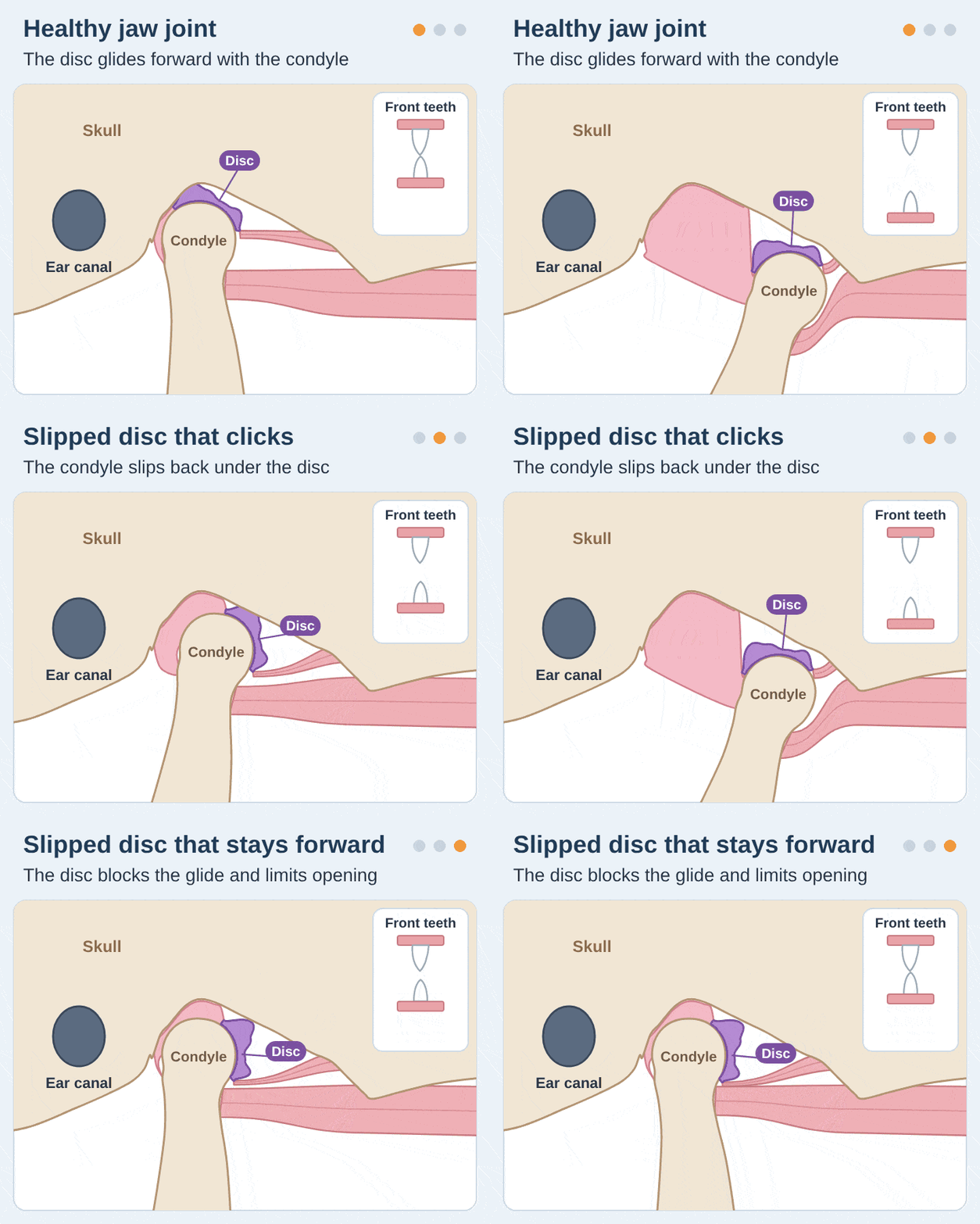
Clicking can occur when the small cartilage disc inside the joint slips forward and snaps back as the jaw opens. A click on its own, with full opening and no pain, is extremely common. It still deserves a check, since jaw joint problems are often silent in their early stages. What carries more significance is a jaw that no longer opens fully, or one that deviates to one side on the way. In a five-year trial of 106 people whose slipped disc locked the jaw, nonsurgical care did as well as surgery (Schiffman and colleagues, 2007). The sections below cover each symptom, clicking, alignment, self-care and warning signs.
Key Takeaways for TMJ Disorders
| Topic | What to know |
|---|---|
| In Malay | The jaw is rahang and the jaw joint is sendi rahang; many people in Malaysia simply say TMJ. |
| Jaw alignment | A bite that feels off center often means the two joints move out of step, so both joints and C1 are checked. |
| Several causes | Muscle tension, changes in the joint disc, clenching or grinding habits and neck posture can all contribute. |
| Upper neck (upper cervical) care | Our founder, Yama Zafer, D.C., sees care at C1, the top neck bone, as the most important part of his plan for the jaw. He often finds a C1 problem on the same side as the jaw problem. |
| Conservative care first | Care starts with gentle hands-on methods, ice, posture work and habit changes, and jaw exercises are added once the joint settles. Botox and steroid injections are not part of it. |
| A plan built on your findings | Care is more likely to help when it addresses what is actually loading the jaw. |
| Neck research | In a small study with no comparison group, jaw pain fell and pain-free opening widened after ten neck-only sessions (La Touche and colleagues, 2009). |
| Ice, not heat | Ice is the first choice for a sore jaw, and heat is used only rarely. |
| Night guards | A custom night guard lessens the load on the disc in people who clench or grind. A dentist makes it, and it is only one part of the plan. |
Table of Contents: TMJ Symptoms, Clicking and Care
TMJ Research: Clicking, Locking and Conservative Care
The studies below look at clicking, locking and the neck in TMJ care. Researchers call these problems TMD, short for temporomandibular disorder. None of them evaluates the care given at Chiropractic Specialty Center (CSC).
- Schiffman and colleagues (2007) followed 106 people with a closed lock, a disc that no longer returns, for five years. Nonsurgical care did as well as arthroscopy or open joint surgery. The authors advised starting without surgery, to avoid operations that are not needed.
- Kalaykova and colleagues (2010) followed 55 people with clicking jaws for two years. In those with short episodes of locking, the click came later in opening. In seven it disappeared, usually without a lasting lock. MRI showed their discs still out of place, returning only partly or not at all.
- In a small study by La Touche and colleagues (2009), 19 adults with painful jaw muscles received manual therapy and exercise for the neck alone. After five weeks their jaw pain was lower and they could open wider without pain, and the gains held at the 12-week check. There was no comparison group.
- Grondin and colleagues (2015) measured how far the top of the neck could turn. Every one of 37 people with TMD pain was limited, against none of 20 people without jaw pain, and those with headaches were limited most.
- A 2016 review by Armijo-Olivo and colleagues analyzed 48 trials and rated the evidence low. Even so, manual therapy, alone or with exercises for the jaw or the neck, showed promising effects.
Jaw and Neck Assessment for TMJ in KL
Call or WhatsApp one of our centers if you have additional questions about a clicking or stiff jaw, TMD, or other health-related issues. At the first visit, jaw opening is measured, and the joints, the chewing muscles and the upper neck are examined. A normal opening is about three stacked fingers between the front teeth.
- Bukit Damansara (KL, main center): Call +603 2093 1000 or WhatsApp +60 17 269 1873 to see the Bukit Damansara / KL center.
- Bandar Sri Damansara (KL): Call +603 6262 5777 or WhatsApp +60 12 455 6939 to see the Bandar Sri Damansara center.
Directions are on the Bukit Damansara contact page and the Bandar Sri Damansara contact page. Please bring any jaw or neck scans you have, with the images themselves and not only the reports. It also helps to know whether a partner or family member has heard you grind at night.
Temporomandibular Joint Disorder (TMD) in Malaysia: What TMJ Means
TMJ stands for temporomandibular joint, which is the jaw joint itself. The name joins the two bones it links: the temporal bone of the skull and the mandible, the lower jaw. Each person has two, one on the right and the other on the left, directly in front of each ear.
TMD stands for temporomandibular disorder, which describes a problem with that joint or its muscles. Many people say “TMJ” when they mean the disorder, so both terms appear on this page. At our centers, your jaw problem may be called TMD. In Malay, the jaw is rahang and the jaw joint is sendi rahang.
Temporomandibular disorder is an umbrella term for problems affecting the jaw joint, the chewing muscles or both. Several different problems sit under that label. The aim of an assessment is to work out which one is present rather than stopping at a general diagnosis. At CSC, the chiropractors and physiotherapists examine jaw movement, the chewing muscles, the joint and the neck before deciding on care.
The international diagnostic criteria, known as DC/TMD, sort the common forms into groups such as these (Schiffman and colleagues, 2014):
- Muscle pain: sore or tight chewing muscles, often after clenching or grinding.
- Joint pain: an irritated joint, felt in front of the ear when chewing or opening.
- Headache from TMD: a headache at the temple that a jaw problem brings on.
- Disc displacement: a disc that has moved out of place, with or without a click or locking.
- Degenerative change: wear of the joint surfaces, often with a grating sound.
The jaw rarely acts alone in these problems. The guide to how the jaw, the upper neck and the muscles work together in TMD explains this further.
Understanding the Jaw Joint (TMJ)
The jaw joint works every time you eat, swallow, talk or yawn. It is unusual in how it moves and in the small disc it contains, which is one reason TMJ problems can be confusing. Understanding how it works helps you describe your symptoms and take part in decisions about care.
We are pleased to bring you our list of TMJ terms used by our clinical teams and this website. Please review them below.
A Hinge and Gliding Joint
In the first part of opening, the head of the jaw bone, called the condyle, turns like a hinge. As the mouth opens wider, the condyle slides forward and down onto a ridge of the skull called the articular eminence. The jaw joint both hinges and glides, which allows the complex movements needed for eating, swallowing, talking and yawning. Anatomists call it a ginglymoarthrodial joint, from the Greek words for hinge and gliding.
The Articular Disc
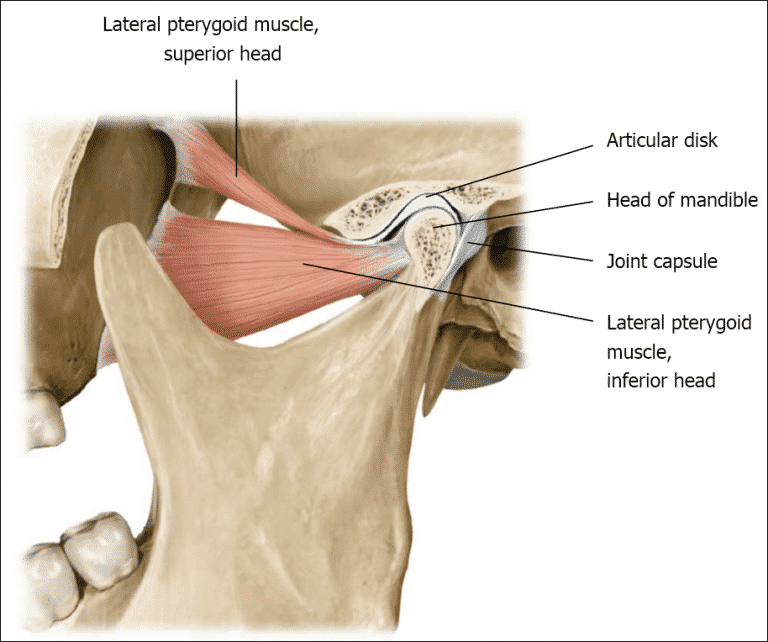
The articular disc is a fibrous extension of the capsule that runs between the two articular surfaces. It is a firm, oval pad of fibrocartilage. Above it is the mandibular fossa, a shallow hollow in the skull. Below it is the condyle of the mandible. The disc divides the joint into two sections, each with its own synovial lining.
Its center is thin and its front and back edges are thicker, a shape that keeps it centered over the condyle as the jaw moves. Collateral ligaments attach the disc to the inner and outer sides of the condyle. At the front, the disc joins the joint capsule and the upper head of the lateral pterygoid, the muscle that pulls the jaw forward. The posterior portion, connecting to the mandibular fossa, is better known as the retrodiscal tissue.
The Capsule and Its Ligaments
The capsule is a fibrous membrane that surrounds the joint. It attaches to the articular eminence, the articular disc and the neck of the mandibular condyle. Ligaments reinforce it. In our founder's experience, when the disc slips out of place, the ligaments that hold it are weak as well. That is one reason putting a slipped disc back in place is complex.
Retrodiscal Tissue: Where Much of the Pain Starts
Unlike the center of the disc, the retrodiscal tissue is vascular and highly innervated, which means rich in blood vessels and nerves. As a result, it is often a major contributor to the pain of TMD, particularly when the joint is inflamed or compressed. When the disc slides forward, the condyle can press on this tissue, which is one reason a displaced disc can start to hurt.
Jaw Joint Nerves: Why a Slipped Disc Can Be Silent
Feeling in the jaw joint comes mainly from the auriculotemporal nerve, a branch of the lower division of the trigeminal nerve. The masseteric and deep temporal nerves send smaller branches to the front of the joint.
Nerve endings are densest at the edges of the disc and fade toward its center, which has almost none (Wink and colleagues, 1992). The center has no blood vessels either. A disc can therefore shift without causing any pain. Pain usually starts when the tissue behind the disc, the capsule or the ligaments are stretched, pinched or inflamed.
Two kinds of nerve fibers carry that pain. Thin, lightly insulated A-delta fibers carry the quick, sharp pain of a sudden catch, at about 5 to 30 meters per second. C fibers, with no insulation, carry the slower, dull ache of inflammation, at about 0.5 to 2 meters per second.
A finger joint has no disc that can slip quietly, so even a slight strain there is often felt at once. In the jaw, the disc can shift well out of place before it presses on tissue that hurts. In our founder's experience, such a problem is often missed or misdiagnosed. He sees this as part of the design, not a fault. If every small change in the joint hurt, we could not talk, eat or drink in comfort. It is also why clicking, slight discomfort and stiffness should not be ignored, since they may be the only signs of a hidden disc problem.
The Synovium
The synovium is a thin layer of tissue that serves as the protective lining of joints and tendon sheaths. It controls the environment inside the joint in two ways. First, it acts as a membrane that decides what can pass into the joint space and what stays outside. Second, its cells produce substances that lubricate the joint.
Why the Jaw Is Not Built to Carry Weight
The jaw joint is not a weight-bearing joint. Resting the chin on a closed fist or the palm of the hand forces it to bear weight for as long as the pose lasts. Our founder asks about this habit at every first visit, because he sees it as critical.
TMJ Symptoms: What Each Sign Can Point To
TMJ symptoms rarely come one at a time. The table pairs common signs with what they often point to, though only an examination can say which applies to you. The guide to how temporomandibular joint dysfunction is assessed describes each test.
| Sign | What it often points to |
|---|---|
| A click when opening or closing | A disc that sits forward, snaps back on opening and slips forward again on closing, often painless at first |
| A grating or sandy sound | Wear of the joint surfaces, often after years of clenching, grinding or an old injury |
| Stiffness on waking | Clenching or grinding in sleep, which tires the chewing muscles overnight |
| The mouth opens less than three finger widths | A disc that blocks the glide, or chewing muscles too tight to let the jaw open fully |
| The chin swings to one side as the mouth opens | The two joints moving out of step, from a disc or muscle problem on one side |
| Pain in front of the ear when chewing | An irritated joint, or pressure on the sensitive tissue behind the disc |
| Aching temples or morning headaches | A tight temporalis muscle at the side of the head, often linked to grinding |
| Ear fullness or ringing | The jaw joint sits right in front of the ear canal, and ear symptoms often travel with TMD |
| Neck stiffness on the same side | The upper neck and the jaw are often affected together |
Jaw Clicking and Stiffness: When to Have a Click Checked
Clicking is the symptom people worry about most. It is worth understanding what a click can and cannot tell you.
Inside the jaw joint sits a small disc that normally travels with the condyle as you open. If the disc sits slightly forward at rest and then snaps back into place during opening, you get a click. That is disc displacement with reduction. Reduction here means the disc slips back into place. It is common and often painless, and many people live with it for years. In our founder's experience, though, clicking, deviation and alignment problems are often silent until a later stage. That is why a clicking jaw is examined rather than dismissed.
A clicking jaw that is not uncomfortable may need no care at all. Still, a clicking jaw often goes with a slipped disc in the jaw, which may be painless at the beginning. In our founder's experience, clicking is especially common in people who clench or grind their teeth, during sleep or during the day.
Locking or limited opening can mean the disc no longer snaps back, a later stage that deserves assessment. That is the situation that matters most: the click then disappears, and opening can become limited because the disc blocks the movement. Sometimes the click fades with no lock, yet the disc stays out of place (Kalaykova and colleagues, 2010). A click that stops and is replaced by restricted opening is the change most worth reporting. A click that has been there for years deserves one examination too. A silent problem in the joint can move on to a later stage.
Our founder sees a clicking jaw as often progressive, moving from mild to moderate to severe. Locking can arrive without warning, like the straw that breaks the camel's back. It can also follow a spell of stiffness, neck pain, headaches or soreness when chewing. Noticing these signs early leaves time to change the habits that load the joint. Care is aimed at the joint, its disc, the chewing muscles and the upper neck rather than at the noise itself. Progress is measured by pain, opening and eating.
Morning stiffness tells a different story. A jaw that is stiff and tired on waking, then loosens over the morning, often points to clenching or grinding during sleep. Most people learn that they grind from a partner or family member who hears it at night.
What Is Bruxism? Grinding and Clenching
Bruxism is clenching or grinding of the teeth that a person does without meaning to, in sleep or while awake. Daytime clenching often comes when concentrating or under stress. A 2023 review of 20 studies linked bruxism with about 2.25 times the odds of TMD (Mortazavi and colleagues, 2023). Grinding and clenching are among the common causes of TMJ pain, alongside habits such as chin resting.
Grinding and Jaw Clicking in Children
Grinding is common in children, and exam stress can make it worse. A click in a child's jaw without pain or locking is worth one gentle examination, because jaw problems are often silent at first. Clicking that comes with pain, headaches, a stiff neck or heavy grinding at night deserves an assessment soon.
Heavy grinding can wear and misshape a developing jaw joint. For a child who grinds heavily, our founder considers a custom night guard, made by a dentist, critical. Care for a child's jaw is very gentle and non-force, with no machine-based therapy. The guide to chiropractic care for children explains grinding and jaw problems in children.
Jaw Alignment: When One Side Moves Differently
People often look up jaw alignment when the jaw feels off center or the bite feels different from one side to the other. Others notice the chin swinging sideways as the mouth opens. Often the two joints are not moving in step.
Common reasons include a disc that has slipped on one side and tight or uneven chewing muscles. Habits that load one joint more, such as chewing on one side or resting the chin on one hand, add to it. Our founder also checks the upper neck, since C1 is often involved on the same side.
Alignment care at CSC is gentle, using very specific manual methods for the jaw joint and non-force care for the upper neck.
Self-Help Tips for Jaw Pain and TMD: Ice, Soft Food, Rest
Try the steps below for a week while the cause is being worked out, and notice which habits load your jaw:
- Ice first: our founder recommends ice for a sore jaw and uses heat only rarely. When in doubt, ice.
- A frozen balloon: fill a small party balloon with water, a little bigger than a golf ball, and freeze it. Someone at home then massages each jaw joint with it in small circles for 5 to 7 minutes. The balloon is used two or three times a day, and each jaw rests for two hours or more before the next round.
- Soft food, small bites: choose softer food for a while and cut it small. Avoid gum, candy, chocolate, almonds and other hard nuts, hard bread crusts, tough meat and big bites out of a sandwich.
- Chewing habits: crunching ice, nail biting and chewing on one side only all load the joint.
- Daytime clenching: teeth should be apart at rest, with the tongue on the palate. Set a reminder and check where your teeth are each time it goes off.
- No chin resting: keep your hand away from your chin at a desk or a table.
- Wide opening: keep yawns small, and take breaks from singing or playing a wind instrument.
- Long spells with the mouth open: ask for short breaks to close and rest the jaw.
- Sleep position: sleeping with a hand or an arm pressed under the jaw loads the joint for hours at a time.
- Stress and the neck: jaw and neck tension travel together, so check your neck posture whenever you catch yourself clenching.
These steps support care for the joint; they do not replace an examination of it.
Physiotherapy or Chiropractic Care for Jaw and TMJ Pain?
Physiotherapists and chiropractors both care for people with TMJ disorders, and each profession brings something different. At CSC, chiropractic and physiotherapy are combined in a single plan. It is built on what the examination finds in the jaw, the chewing muscles and the upper neck. The page on chiropractic combined with physiotherapy in Kuala Lumpur describes how the two roles fit together.
Upper Cervical Care: The Most Important Part
The most important part of that plan, in the view of our founder, Yama Zafer, D.C., is upper cervical care. He often finds the jaw problem at its most intense alongside a C1 problem on the same side. C1 and the joints around it are cared for alongside the jaw, using non-force methods. The guide to an upper cervical chiropractor in KL explains them.
Care for the Jaw Itself
- Very gentle, very specific manual work on the jaw joint, which our founder sees as the core of jaw care.
- Trigger point and myofascial work on the temporalis and masseter (chewing muscles), and the trapezius and sternocleidomastoid (neck muscles).
- Therapeutic ultrasound over the joint and the chewing muscles.
- TENS, a mild electrical current through skin pads, only when the jaw is markedly tender, and stopped if it is not helping.
- Self-massage and icing, taught for use at home.
- Jaw exercises after the joint has settled, typically from the third to fifth session onward.
Progress is reviewed after three to five sessions, because how the jaw responds is often the clearest guide to what comes next. The guide to how TMJ treatment options are decided sets out the order of care in full.
TMJ Physiotherapy
TMJ physiotherapy covers the muscle and soft tissue side of the plan. It uses therapeutic ultrasound, laser for the upper neck, hands-on release, posture work and home exercises, with TENS only when the jaw is markedly tender. Our physiotherapists also work on the neck, because neck and jaw problems so often occur together.
Chiropractic for the Jaw
Chiropractors use manual therapy for the jaw muscles and joint, and chiropractic care for the neck when it contributes.
A 2023 case report described one woman whose TMD symptoms settled after four weeks of chiropractic care (Chu and colleagues, 2023). Her care combined spinal adjustments, soft tissue work and exercise. One case cannot show what care will do for anyone else. The guide to what a jaw chiropractor in KL does covers that role on its own page.
Night Guards for Clenching and Grinding
CSC does not make night guards. When one is needed for clenching or grinding, our founder refers the patient to a dentist to have it made. It usually takes five to seven days to make. Ready-made guards bought online are not recommended.
A guard is worn mostly at night, and by day as well in stressful periods, and it is replaced every six months or sooner. It lessens the impact on the disc and the joint capsule, but it never solves the joint problem on its own. It is always one part of the plan.
How to Choose Care for TMJ Pain in Malaysia
A sound awareness of the anatomy of the jaw joint and related structures is essential to the establishment of a correct diagnosis and appropriate care.
When choosing a clinician, ask how they will assess the jaw and neck and what the plan involves. Ask, too, how progress will be measured and when they would refer you elsewhere. Clear answers to those questions are a good sign.
Muscle Relaxants, Injections and Surgery
Muscle relaxants are sometimes prescribed for jaw pain. The evidence for them in TMJ disorders is limited. They affect the whole body rather than the jaw muscles alone, and they often cause drowsiness. In our founder's view, they give minimal help to an injured jaw, temporary help at most. CSC does not prescribe medicine, so questions about a prescription belong with a general practitioner. Care at CSC is active and drug-free: jaw exercise, manual therapy, posture work and addressing clenching and stress.
Our founder does not recommend Botox or steroid injections for the jaw joint. He finds them of little help, and in more than 30 years he has never had to send a jaw patient for one.
Surgery for Temporomandibular Joint Dysfunction
Most TMJ disorders are managed without surgery. Surgery is kept for a fractured jaw, which belongs in a hospital emergency department, and for the rare case where conservative care has not helped. Where an earlier course of care has not helped, the first step is to ask what was tried and for how long. In 30+ years, our founder has never sent a patient for jaw joint surgery, and in his view its long-term results are not very good.
The closed lock trial in the research above found surgery no better than nonsurgical care over five years.
Neck Pain and TMJ Dysfunction
Neck pain and neck stiffness often occur alongside TMJ disorders. In one study of 40 women, the worse the jaw disability, the worse the neck disability tended to be (Silveira and colleagues, 2015).
Our founder sees the jaw, the upper neck and the muscles between them as one chain. A long-standing upper neck problem can bring jaw trouble with it, and a jaw problem can work back down to the neck. The upper neck is the most closely linked: the base of the skull (occiput) with C1 (atlas), then C1-C2, C2-C3 and C3-C4. Lower neck levels such as C4-C5, C5-C6, C6-C7 and C7-T1 can also affect posture and jaw function. The whole neck is therefore examined, as it is for neck pain treatment in Kuala Lumpur.
Some people with TMJ symptoms also have neck conditions, such as worn, bulging or herniated discs, or a narrowed spinal canal (stenosis). Assessing both lets the plan address everything that contributes.
The neck has discs of its own, built differently from the disc in the jaw. A slipped disc in the neck can cause pain in the upper back, shoulder, arm and hand, as the page on slip disc symptoms explains.
How to Recover From TMJ Headaches
TMJ disorders are a common cause of headaches, usually from tense chewing muscles and sometimes from the jaw joint or disc. These headaches are more common in people who grind or clench their teeth at night. People with TMJ headaches often notice facial pain or headache in the morning, usually around the temples. The temporalis muscle fans out over the side of the head, so when grinding tightens it, the pain is felt as a headache. Sometimes it spreads toward the forehead or the back of the head.
Jaw exercise, manual therapy and posture work from a physiotherapist or chiropractor are part of the plan. So are care for the upper neck and, when grinding is involved, a night guard. The page on headache and migraine in KL covers other causes.
Jaw Symptoms That Need a Doctor First
Some of these signs point away from the jaw joint, and others need emergency care for the jaw itself. All of them need medical care before anything else:
- Jaw pain with chest pain or pressure, breathlessness, sweating or nausea, or jaw pain brought on by exertion: call 999 right away. A heart attack can be felt in the jaw, sometimes with no chest pain at all (Kreiner and colleagues, 2020).
- In an adult over 50, jaw pain with chewing, a new temple headache, scalp tenderness or any change in vision can signal giant cell arteritis. See a doctor immediately.
- A jaw injury after a fall or a blow: go to a hospital emergency department.
- A jaw stuck open that will not close: see a doctor promptly.
- Facial swelling with fever, or pain centered on one tooth: these can point to an infection or a tooth problem rather than the joint. See a doctor promptly. Swelling with trouble swallowing or breathing needs a hospital emergency department right away.
- New numbness of the chin or lower lip, or a bite that feels different all of a sudden: see a doctor promptly.
The jaw pain guide lists every heart attack sign that the UK's NHS gives, and when to call 999.
The chiropractic price list in Kuala Lumpur and physiotherapy fees in Kuala Lumpur pages list every fee before care begins.
Further Reading: Upper Neck Levels, Eagle Syndrome and Tinnitus
We hope you found this section of our website helpful. We aim to provide our patients and visitors with pertinent health-related information. These pages carry on from the jaw joint:
- Occiput and Atlas (C0-C1): What This Joint Does: the joint where the skull meets the top of the neck.
- C1-C2 (Atlas & Axis): Symptoms, Nerves and Adjustment: the turning joint just below it, and the nerves nearby.
- C2-C3 Segment Dysfunction: Spine, Nerves and Neck Pain: the next level down, and how it feeds neck pain.
- C3-C4: What Symptoms at This Neck Level Mean: the last of the levels most closely linked with the jaw.
- Eagle Syndrome: Structured Non-Invasive Care Options: an overlong styloid process, the slender spike of bone under the ear, that can mimic jaw and throat pain.
- Tinnitus Treatment in KL: Care Options From Ear to Neck: ringing in the ears, and its links with the jaw and the neck.
TMD Questions People Ask
Where is the TMJ, and how can I feel it move?
Can a TMJ problem affect one side only?
Do I need an X-ray or MRI for a TMJ problem?
Can stress cause TMJ problems?
What is TMJ called in Malay?
Can a chiropractor realign the jaw?
This TMJ guide is general information and does not replace an examination of your own jaw by a qualified practitioner.
Peer-Reviewed Medical References
- Schiffman EL, Look JO, Hodges JS, et al. Randomized effectiveness study of four therapeutic strategies for TMJ closed lock. J Dent Res. 2007;86(1):58-63.
- La Touche R, Fernández-de-las-Peñas C, Fernández-Carnero J, et al. The effects of manual therapy and exercise directed at the cervical spine on pain and pressure pain sensitivity in patients with myofascial temporomandibular disorders. J Oral Rehabil. 2009;36(9):644-652.
- Kalaykova S, Lobbezoo F, Naeije M. Two-year natural course of anterior disc displacement with reduction. J Orofac Pain. 2010;24(4):373-378.
- Grondin F, Hall T, Laurentjoye M, Ella B. Upper cervical range of motion is impaired in patients with temporomandibular disorders. Cranio. 2015;33(2):91-99.
- Armijo-Olivo S, Pitance L, Singh V, et al. Effectiveness of manual therapy and therapeutic exercise for temporomandibular disorders: systematic review and meta-analysis. Phys Ther. 2016;96(1):9-25.
- Schiffman E, Ohrbach R, Truelove E, et al. Diagnostic Criteria for Temporomandibular Disorders (DC/TMD) for clinical and research applications: recommendations of the International RDC/TMD Consortium Network and Orofacial Pain Special Interest Group. J Oral Facial Pain Headache. 2014;28(1):6-27.
- Wink CS, St Onge M, Zimny ML. Neural elements in the human temporomandibular articular disc. J Oral Maxillofac Surg. 1992;50(4):334-337.
- Mortazavi N, Tabatabaei AH, Mohammadi M, Rajabi A. Is bruxism associated with temporomandibular joint disorders? A systematic review and meta-analysis. Evid Based Dent. 2023;24(3):144.
- Chu EC, Lee WT, Chau C, Wong E, Cheng HY. Temporomandibular disorder treated with chiropractic therapy. Cureus. 2023;15(3):e36377.
- Silveira A, Gadotti IC, Armijo-Olivo S, Biasotto-Gonzalez DA, Magee D. Jaw dysfunction is associated with neck disability and muscle tenderness in subjects with and without chronic temporomandibular disorders. Biomed Res Int. 2015;2015:512792.
- Kreiner M, Okeson J, Tanco V, Waldenström A, Isberg A. Orofacial pain and toothache as the sole symptom of an acute myocardial infarction entails a major risk of misdiagnosis and death. J Oral Facial Pain Headache. 2020;34(1):53-60.
- Schiffman E, Ohrbach R. Executive summary of the Diagnostic Criteria for Temporomandibular Disorders for clinical and research applications. J Am Dent Assoc. 2016;147(6):438-445.
These references cover one trial, other clinical studies, reviews, the international diagnostic criteria, an anatomy study and one case report. None of them evaluates a care program at Chiropractic Specialty Center. Each one can be checked through its free PubMed record.
The Author of TMJ Disorders: Jaw Clicking, Stiffness and Care
TMJ Disorders: Jaw Clicking, Stiffness and Care was written by Yama Zafer, D.C., who has 30+ years in chiropractic and physiotherapy and founded Chiropractic Specialty Center in Kuala Lumpur in 2006.
Last Updated: TMJ Disorders: Jaw Clicking, Stiffness and Assessment
TMJ Disorders: Jaw Clicking, Stiffness and Assessment was last reviewed and updated on October 23, 2026.