

Spinal Decompression Therapy in Kuala Lumpur
Spinal decompression therapy applies controlled, cyclical traction to one targeted segment of the spine, with the aim of reducing pressure across the disc and opening the space through which the nerve root passes. It is delivered on a motorized table, clothed, with harnesses at the pelvis and trunk, and the pull builds and releases in cycles rather than holding steady.
It suits some disc presentations considerably better than others, which is why examination precedes the table. It is given as a course over several weeks and works alongside exercise rather than in place of it. The spinal level being targeted, and the measure that will be repeated to show whether the course achieved anything, should both be stated at the start.
This guide to spinal decompression therapy in Kuala Lumpur, and how decompression differs from traction and inversion, is published by Chiropractic Specialty Center, Bukit Damansara (KL) main center: WhatsApp+60 17 269 1873 Call+603 2093 1000
What to understand about decompression therapy
- It is a course. Sessions are repeated over weeks, and progress is reviewed against the starting measurements.
- It targets a level. Setup angle and pull direction are chosen for the segment involved, which is why the assessment comes first.
- It is rarely used alone. Manual therapy, soft-tissue work and rehabilitation address what traction on its own cannot.
- Some conditions rule it out. Fracture, infection, tumor, advanced osteoporosis, certain implants and pregnancy are among the reasons it may be inappropriate.
- Some changes alter the plan. Leg weakness that keeps getting worse is reassessed before the next session. If you are considering or receiving spinal decompression for back or leg pain, get urgent medical attention, a thorough assessment by a competent clinician the same day, if numbness develops or worsens around your genitals, between your genitals and anus, or around your anus. New difficulty passing urine needs the same urgent assessment, even while bladder and bowel control remain intact, and so does any loss of that control. These symptoms have several possible causes. Some may call for an invasive procedure, but assessment helps determine suitable care and does not automatically mean surgery is necessary.
Decompression, traction and inversion are not the same thing
These get used interchangeably in conversation. They differ in how the force is applied and how much of it reaches one segment.
| Method | How force is applied | Level targeting | Supervision |
|---|---|---|---|
| Mechanised spinal decompression | Cyclical pull and release on a computer-controlled cycle | Set for a specific segment and angle | Clinical, each session monitored |
| Flexion-distraction | Rhythmic movement of a hinged table under the practitioner hands | Practitioner controls the level directly | Hands-on throughout |
| Static traction | A steady, unchanging pull | General to a region | Usually set and left |
| Inversion table | Body weight while tilted head-down | None; the whole spine is loaded | Home use, unsupervised |
| Manual traction | Applied by the practitioner using body weight and grip | Reasonable, within hands-on limits | Hands-on throughout |
Inversion raises blood pressure and eye pressure, which is why it is unsuitable for some people who tolerate clinical decompression perfectly well.
Spinal Decompression Therapy in Kuala Lumpur is a structured, non-surgical approach often explored for spinal disc concerns such as disc bulges, herniated discs, or early degenerative disc changes in the neck or lower back. When spinal discs experience excessive pressure or reduced hydration, nearby joints, muscles, and nerves may become sensitive, influencing posture, movement, and everyday activity.
At Chiropractic Specialty Center (CSC) in Kuala Lumpur, spinal decompression is incorporated into an integrated care model that combines gentle chiropractic methods of care, physiotherapy rehabilitation, and guided exercise & movement programs. This coordinated approach aims to reduce disc pressure gently and improve spinal movement while avoiding aggressive pulling or twisting techniques.
If you would like to see costs before a visit, CSC publishes its chiropractic fees and physiotherapy fees in full.
What You Need to Know About Spinal Decompression Therapy
Spinal decompression therapy is a non-surgical method used to gently reduce pressure within spinal discs affected by disc bulges, herniation, or early degenerative changes. Controlled decompression creates space between spinal segments, which may support disc hydration and reduce mechanical stress on nearby nerves and joints.
- Spinal decompression therapy is a non-surgical method designed to gently reduce pressure within spinal discs.
- Controlled decompression may help improve disc hydration and reduce mechanical stress on nearby joints, muscles, and nerves.
- The approach is commonly explored for spinal disc concerns such as disc bulges, herniated discs, and early degenerative disc changes.
- At Chiropractic Specialty Center in Kuala Lumpur, decompression is integrated with chiropractic methods, physiotherapy rehabilitation, and guided exercise programs.
- Structured programs aim to improve spinal movement, muscular balance, and joint mechanics without aggressive traction, twisting, injections, or surgery.
Decompression Assessment at Our Two KL Centers
Whether spinal decompression suits a particular set of disc findings is decided at an assessment at either center of Chiropractic Specialty Center, where the examination and any MRI or X-ray reports are reviewed together. Directions are on the Bukit Damansara contact page and the Bandar Sri Damansara contact page.
- Bukit Damansara (KL, main center): Call +603 2093 1000 or WhatsApp +60 17 269 1873 to see the Bukit Damansara / KL center.
- Bandar Sri Damansara (KL): Call +603 6262 5777 or WhatsApp +60 12 455 6939 to see the Bandar Sri Damansara center.
Top 5 Takeaways - Spinal Decompression Therapy at CSC
- Controlled equipment: Decompression at CSC uses the NSD Therapy® system with RxDecom® equipment, which applies a computer-controlled pull and release rather than manual traction or high-force methods.
- Assessment first: Every care plan starts with a physical examination and a review of any imaging, such as MRI, to identify the level involved and decide whether decompression suits it.
- Non-invasive: No surgery, injections or twisting; the pull is gradual and monitored throughout the session.
- Rehabilitation alongside: Care includes one-on-one physiotherapy and exercise in our physiotherapy gym to build strength and control, and decompression is given together with that rehabilitation rather than on its own. In a randomized trial of 60 adults with lumbar radiculopathy, adding non-surgical decompression to routine physical therapy improved pain, back movement and disability more than physical therapy alone after four weeks of treatment (Amjad et al., 2022).
- Suited to some disc presentations: It is most often considered for disc bulges, herniations and early degenerative changes, and it is not suitable for everyone.
- No yoga: Yoga must be avoided by anyone with a disc problem, before, during and after a course of decompression.
Who May Explore Spinal Decompression Therapy
Spinal decompression therapy is often explored by individuals experiencing spinal disc or nerve-related concerns that influence posture, movement, or everyday activity. Because spinal discs help distribute pressure between the vertebrae, structural changes within the disc can affect nearby joints, muscles, and nerves.
People sometimes consider decompression care when dealing with conditions commonly associated with disc stress, including disc bulges, herniated discs, degenerative disc changes, or sciatica-type leg symptoms. In these situations, decompression sessions may be combined with physiotherapy rehabilitation, chiropractic mobilization, and structured strengthening exercises.
For individuals seeking slip disc care in KL, decompression may be part of a broader conservative spine care program designed to improve spinal movement and reduce excessive disc loading.
A careful clinical evaluation helps determine whether symptoms may be related to spinal discs, joint mechanics, muscular imbalance, or nerve irritation.
Ring Dinger® Is Not Spinal Decompression Here’s Why That Matters
The Ring Dinger® and similar viral neck or back pull techniques often market themselves as “spinal decompression therapy,” but they’re not.
These methods involve rapid manual traction usually performed without sufficient spinal screening or long-term rehabilitative planning. Unlike true spinal decompression therapy, which uses calibrated mechanical forces to slowly offload disc pressure in a controlled setting, the Ring Dinger® applies fast, full-body yanks that may endanger patients with disc degeneration, vascular issues, or joint instability.
Spinal decompression therapy at CSC is the opposite: it's slow, monitored, and deeply personalized. At CSC, RxDecom® decompression is combined with physiotherapy and chiropractic care and progressed gradually for each person, rather than applied as a one-size-fits-all pull.
Learn more about the risks of aggressive neck and back pulls by visiting our full Ring Dinger® Warning Page.
Video Explanation: Risks of Ring Dinger® and High-Force Neck Pulls
High-force traction methods such as the Ring Dinger®, Y-strap pulls, or towel-based neck traction are often promoted online as forms of spinal decompression. However, these techniques apply sudden traction forces to the cervical spine rather than the slow, controlled decompression used in structured spinal care programs.
In this educational video, Yama Zafer, D.C. explains how the neck’s joints, discs, ligaments, nerves, and vertebral arteries respond to rapid traction forces. Using spine models and clear demonstrations, the discussion highlights why careful evaluation and controlled spinal methods are important before any traction-based procedure involving the neck.
Key moments and an edited transcript of this video are on our Neck Cracks Are Dangerous video page.
Where to Find Non-Surgical Spinal Decompression in KL
Chiropractic Specialty Center offers spinal decompression, using the NSD Therapy® approach and RxDecom® equipment, at both of its Kuala Lumpur centers. The main center in Bukit Damansara is usually closer for readers in Bangsar, TTDI and Mont Kiara, while the Bandar Sri Damansara center is closer for Kepong, Desa ParkCity and northern Petaling Jaya.
Both centers follow the same approach: care plans are based on the examination, imaging when relevant and a functional assessment.
Non-Surgical Spinal Decompression in Kuala Lumpur
Non-surgical decompression of the neck and back uses a computer-controlled pull and release to reduce pressure on a targeted disc segment. It is most often considered for disc bulges, herniations and early degenerative changes.
At Chiropractic Specialty Center, RxDecom® and NSD Therapy® decompression are combined with chiropractic methods, physiotherapy and rehabilitation exercise in one plan built around your spinal findings, without surgery or medication.
How Spinal Decompression, Chiropractic Adjustment, and Physiotherapy Work Together
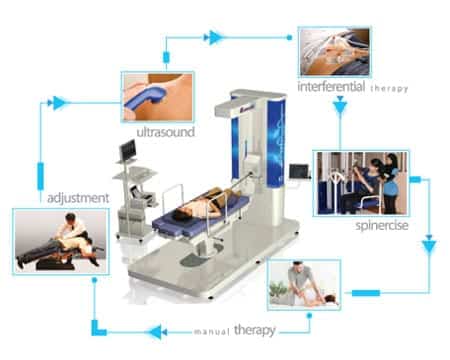
At CSC in Kuala Lumpur, decompression is commonly combined with chiropractic adjustment or chiropractic joint mobilization, physiotherapy, and guided rehabilitation exercises. Each part of care focuses on a different area of the spine and surrounding tissues.
Spinal decompression aims to gently reduce pressure within the affected disc segment. Chiropractic adjustment or joint mobilization focuses on how nearby spinal joints are moving and whether stiffness in those joints may be adding extra stress to the disc and surrounding nerves.
Physiotherapy and rehabilitation exercises are then used to improve muscle balance, posture habits, and spinal stability. This helps the spine handle daily positions such as sitting, bending, standing, and walking with less repeated mechanical stress.
By structuring care in this way, the focus stays on both the affected disc and the surrounding joints, muscles, and posture patterns that may be contributing to ongoing spinal strain.
Spinal Disc Hydration and the Role of Spinal Decompression
Healthy spinal discs rely on a steady exchange of fluids and nutrients to maintain flexibility and shock-absorbing function. Unlike many tissues in the body, spinal discs do not have a direct blood supply. Instead, they depend on movement and pressure changes within the spine to absorb nutrients and release waste products.
When discs experience excessive loading or degenerative changes, this natural exchange process may become less efficient, influencing spinal movement and nearby nerve structures.
Spinal decompression aims to gently reduce pressure within specific spinal segments. Controlled traction creates temporary changes in disc pressure that may allow fluids and nutrients to move back into the disc through a physiological process known as imbibition, which may support disc hydration.
At Chiropractic Specialty Center in Kuala Lumpur, decompression is incorporated into NSD Therapy®, an integrative care model that combines spinal decompression with physiotherapy-based rehabilitation, gentle chiropractic mobilization, and guided strengthening exercises. This coordinated approach focuses on multiple factors that influence spinal health, including disc loading patterns, muscular balance, posture habits, and joint mechanics.
By combining decompression with physiotherapy and structured rehabilitation, care programs aim to improve spinal mobility, support muscular stability, and encourage healthier movement patterns as part of a conservative, non-surgical spine care strategy.
What the Different Types of Slipped Disc Changes Mean
A slipped disc is a general term often used to describe several different types of spinal disc changes.
These changes may begin with early disc wear or a degenerative disc change, then progress into a disc bulge, disc protrusion, prolapsed disc, or a herniated disc, depending on how far the inner disc material shifts beyond its normal boundary.
In some cases, the disc may progress further and rupture (ruptured disc) or progress to an extruded disc or fragmented disc, where disc material moves more significantly and may affect nearby nerve pathways.
Understanding the exact stage matters because each type of disc change may influence the spine, joints, and nerves differently.
For a more detailed explanation of each stage, explore our related pages on degenerative disc disease, disc bulge, disc protrusion, prolapsed disc, herniated disc, extruded disc, and fragmented disc.
How Disc Changes May Affect the Sciatic Nerve and Leg Symptoms
Spinal disc changes in the lower back may sometimes affect the nearby nerve roots that come together to form the sciatic nerve.
When this happens, symptoms may not stay limited to the lower back. Changes may also be felt through the buttock, thigh, calf, or foot, depending on which nerve pathway is involved and how the surrounding joints and soft tissues respond.
This is why leg symptoms, tingling, numbness, or changes in walking and standing tolerance are often discussed together with sciatica and leg pain, pinched nerve patterns, or lower lumbar disc changes.
In some situations, these symptoms may overlap with spondylolisthesis-related nerve changes or other lower spine conditions that affect stability and nerve spacing.
For more detailed reading, explore our related pages on the sciatic nerve, sciatica care in Kuala Lumpur, pinched nerve patterns, and disc-related leg symptoms.
Video: How Spinal Discs Absorb Nutrients (Imbibition Explained)
Spinal discs do not have a direct blood supply. Instead, they rely on a process called imbibition, where movement and pressure changes allow discs to absorb fluid and nutrients. This short video explains how that process works and why spinal movement and decompression may influence disc hydration.
What Spinal Decompression Is, When It May Help, and When It May Not
Spinal decompression is a structured non-surgical method used to gently reduce pressure within a specific spinal disc segment.
The goal is to create carefully controlled changes in pressure inside the disc space. In certain cases, this may help reduce mechanical stress on nearby joints and nerves while allowing the disc to absorb fluid more efficiently.
Spinal decompression is often considered when disc-related changes such as a disc bulge, disc protrusion, herniated disc, or early disc wear are contributing to neck, back, or leg symptoms. It may also be included as part of a broader care plan when posture habits, prolonged sitting, or repeated loading are placing extra stress on the spine.
At CSC in Kuala Lumpur, spinal decompression is commonly combined with chiropractic adjustment, chiropractic joint mobilization, physiotherapy, and rehabilitation exercises so the focus is not only on the disc itself, but also on the joints, muscles, and posture patterns around it.
A careful clinical assessment is important because spinal decompression is not suitable for every situation. Factors such as severe instability, certain fractures, advanced bone weakness, or progressive neurological changes may require a different care pathway.
When a Structured Spine Assessment May Be Helpful
A structured spine assessment may be helpful when neck, back, leg, or nerve-related symptoms continue to affect daily activities, sitting tolerance, walking, posture, or sleep.
Because spinal disc changes, joint stiffness, muscle imbalance, and nerve-related symptoms can sometimes overlap, it is important to first understand which structures may be contributing to the problem.
At CSC in Kuala Lumpur, assessments commonly look at spinal joints, disc-related findings, posture habits, muscle balance, walking tolerance, and when appropriate, imaging such as MRI or X-ray findings.
This helps determine whether spinal decompression, chiropractic adjustment, chiropractic joint mobilization, physiotherapy, rehabilitation exercises, or another conservative care approach may be more suitable for the individual findings.
The aim of the assessment is to understand how the spine, surrounding joints, muscles, and nerve pathways are working together before any structured care plan is considered.
For a child or teenager with back pain, the guide to chiropractic care for children explains how care is chosen for a growing spine, from gentle hands-on methods to exercise and posture advice.
It often helps to read about spinal decompression alongside how the RxDecom device works, what a DTS traction session involves and intersegmental traction.
Video: Chiropractic, Physiotherapy & Imaging, Common Questions Answered
People exploring spinal decompression or other conservative spine care options often have questions about chiropractic methods, physiotherapy, and when imaging such as MRI may be appropriate. In this video, Yama Zafer, D.C. discusses commonly asked questions about spinal care approaches, how different methods may be combined, and why careful evaluation is important before beginning any structured spine care program.
For the chapter list and the transcript, open the Is Chiropractic Safe video page.
Spinal Decompression Therapy FAQs
What is spinal decompression therapy and how does it work?
Spinal decompression therapy is a non-surgical method that uses controlled, cyclical mechanical traction to reduce pressure on a targeted spinal disc segment. At Chiropractic Specialty Center, the RxDecom® system is used as part of the NSD Therapy® approach. The pull builds and releases gradually, without twisting or sudden force.
Is spinal decompression the same as the Ring Dinger® or Y-Strap?
No. The Ring Dinger® and Y-Strap are rapid manual traction techniques that apply a sudden pull, often without imaging or a care plan. Spinal decompression at CSC uses a computer-controlled table that applies a slow, targeted pull and release, and it is used only after assessment, especially for people with disc problems or spinal instability.
Who may be suited to spinal decompression therapy at CSC?
Decompression is most often considered for disc bulges, herniations and early degenerative changes, particularly when leg or arm symptoms fit the disc findings. Each case begins with an assessment, including posture and movement checks and a review of any MRI, and decompression is combined with chiropractic care, physiotherapy and rehabilitation when it suits the findings.
What makes CSC’s decompression therapy different from standard traction?
Standard static traction applies a steady, general pull to a region. The RxDecom® system used at CSC applies a computer-controlled pull and release set for a specific segment and angle, and each session is monitored. At CSC, decompression is always combined with exercise-based rehabilitation.
How long does a course of spinal decompression take?
Decompression is given as a course over several weeks, and progress is reviewed against the measurements taken at the start, such as walking or sitting tolerance. How much changes, and how quickly, depends on the disc presentation and its severity.
What should I expect during a spinal decompression session?
Each session begins with a review of the findings. The person lies clothed on the RxDecom® table with harnesses at the pelvis and trunk, or with head support for the neck, and the pull builds and releases in cycles. There are no sudden pulls, and rehabilitation exercises are usually part of the plan.
Where can I find spinal decompression therapy in Kuala Lumpur?
Spinal decompression is available at both Chiropractic Specialty Center locations in Kuala Lumpur: Bukit Damansara and Bandar Sri Damansara. Phone and WhatsApp numbers for both are listed in the assessment section earlier on this page.
What does spinal decompression do?
Can spinal decompression help a slipped disc or herniated disc?
Is spinal decompression safe for the neck and lower back?
Peer-Reviewed Medical References
- Singh V, Malik M, Kaur J, et al. A systematic review and meta-analysis on the efficacy of physiotherapy intervention in management of lumbar prolapsed intervertebral disc. Int J Health Sci (Qassim). 2021;15(2):49-57.
- Amjad F, Mohseni-Bandpei MA, Gilani SA, Ahmad A, Hanif A. Effects of non-surgical decompression therapy in addition to routine physical therapy on pain, range of motion, endurance, functional disability and quality of life versus routine physical therapy alone in patients with lumbar radiculopathy; a randomized controlled trial. BMC Musculoskelet Disord. 2022;23(1):255.
These references describe research on physiotherapy and non-surgical decompression for lumbar disc problems in general. None of them evaluates a care program at Chiropractic Specialty Center. Each one can be checked through its free PubMed or publisher record.
The Author of Spinal Decompression Therapy in KL - Non-Surgical Care
Spinal Decompression Therapy in KL - Non-Surgical Care was written by Yama Zafer, D.C., who has 30+ years in chiropractic and physiotherapy and founded Chiropractic Specialty Center in Kuala Lumpur in 2006.
Last Updated: Spinal Decompression Therapy in Kuala Lumpur
Spinal Decompression Therapy in Kuala Lumpur was last reviewed and updated on October 3, 2026.
Share with others: