
You are currently viewing Chiropractic Care First for Spine & Joint Health

Chiropractic Care First: Trying Gentle Care Before Surgery

Chiropractic care first means starting with gentle, hands-on care and exercise for back, neck and joint pain, before moving on to injections or surgery. This order makes sense because most back pain improves with time and the right care, and the first steps carry the least risk.

At Chiropractic Specialty Center (CSC), the first step is a careful examination of the spine and joints, and what it finds decides the plan. Chiropractic, physiotherapy or both may be used, and stronger options stay open if gentle care does not help after a fair trial. New patients can usually be seen the same day at either Kuala Lumpur center, but call or send a WhatsApp message first.

This page, Chiropractic Care First: 5 Clear Reasons Before Surgery, is published by Chiropractic Specialty Center, Bukit Damansara (KL) main center: WhatsApp +60 17 269 1873 Call +603 2093 1000

Chiropractic Care First: Five Reasons in Brief

  1. Spine surgeons recommend it: a World Federation of Neurosurgical Societies committee concluded that, without serious nerve loss, conservative treatment should be the first line for a lumbar disc herniation.
  2. The results often catch up: in a Dutch trial of 283 people with sciatica, prolonged conservative care did as well at one year as early surgery, although surgery eased leg pain sooner.
  3. The risks are lower: mild soreness for a day or two is common after spinal care, and serious problems are rare.
  4. Nothing is lost by starting gently: injections and surgery remain available if a fair trial of care does not help.
  5. It treats the whole problem: gentle care is combined with exercise and changes to the habits that load the spine.

Why Chiropractic Care First Makes Sense

Research on spine care points to this order. A committee of the World Federation of Neurosurgical Societies, reviewing the evidence on lumbar disc herniation, concluded that in the absence of cauda equina syndrome or other serious neurological deficits, conservative treatment should be the first line of treatment. A companion statement recommends surgery when conservative treatment has failed or when nerve function is being lost.

In a Dutch trial of 283 people with sciatica from a herniated disc, those who started with prolonged conservative care did as well after one year as those who had early surgery, although early surgery eased leg pain sooner. Surgery still has a place. In my words, it should be the last option: exhaust the conservative route first. And there are times I cannot help; when that happens, I tell the person to go and talk to the surgeon.
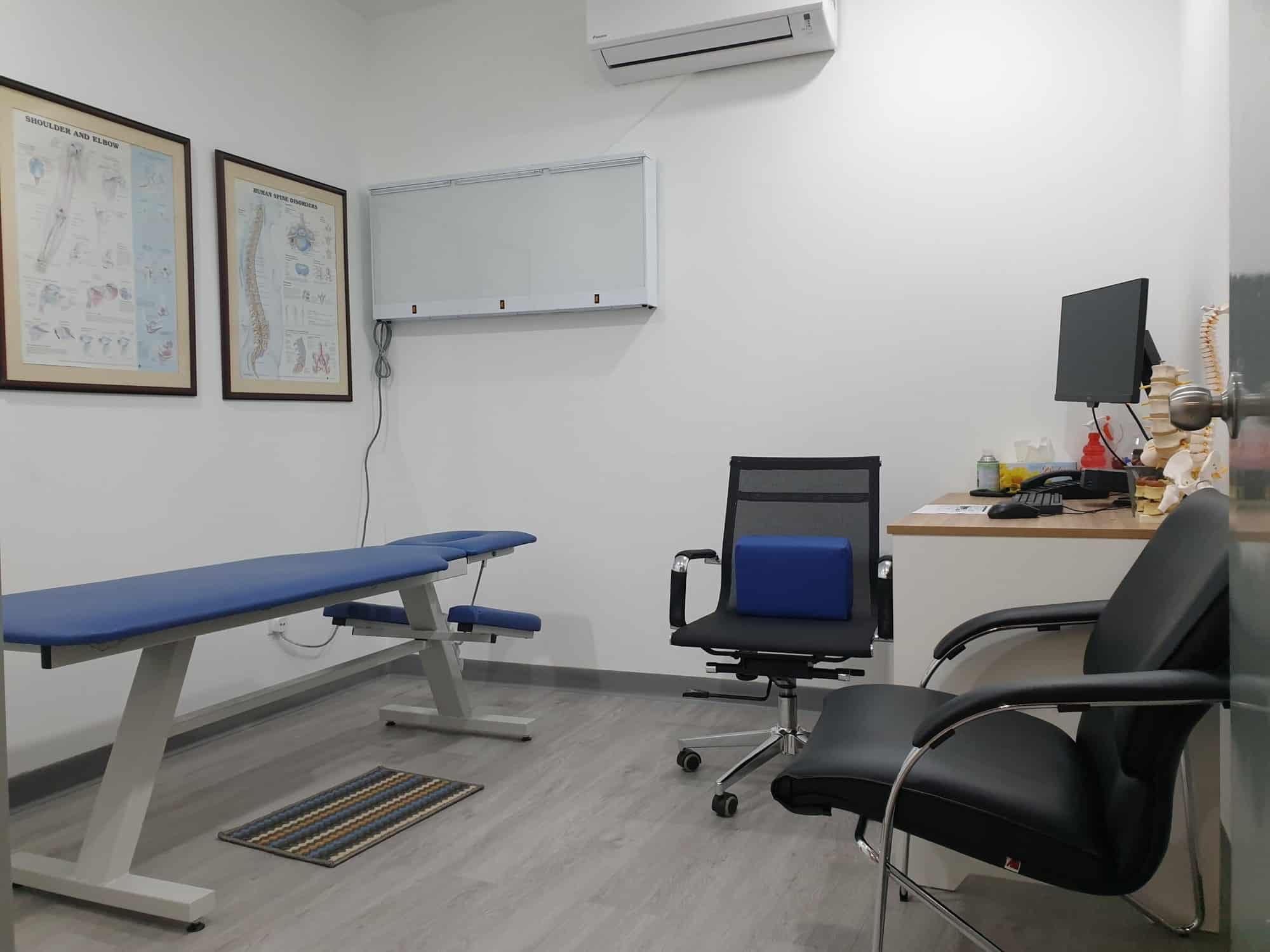
Examination room at the Bukit Damansara center where chiropractic care first begins

What Conservative Care Is, and What It Is Not

Choosing chiropractic care first does not mean choosing anything that is not surgery. Conservative care is not neck cracking, Thai massage or someone walking on your back. It is condition-based care that does not harm: an accurate examination, gentle methods chosen for the problem, exercise introduced when the body is ready, and advice on the daily habits that load the spine.

I see a patient for 30 minutes or two hours. What about the other 22 hours? That is why habits matter as much as the treatment table. Getting better from a spine or joint problem comes down to two things done together: doing more of what helps, such as the right movement, exercise and care, and doing less of what hurts, such as long hours of sitting, lifting the wrong way or poor sleep.

What a First Chiropractic Check Looks At

At the first visit, the chiropractor asks how the problem started and what makes it better or worse. Then comes a look at posture and movement, with tests of the nerves, reflexes and muscle strength, and any scans you bring are read too. Imaging is requested only if the examination shows a reason for it. Together, this shows whether the problem comes from the joints, the muscles, the nerves or a mix.

People most often choose chiropractic care first for low back pain, neck pain, sciatica, a slipped disc and headaches that start in the neck. At CSC, the check also decides whether physiotherapy, rehabilitation exercise or spinal decompression should be part of the plan. CSC is equipped to assess, and where an intervention is needed that CSC is not equipped for, a referral to an appropriate healthcare provider is made.

Chiropractic Care First for a Slipped Disc and Sciatica

For a slipped disc, chiropractic care first means no cracking, twisting or yanking on a damaged disc. I am not a fan of rotary manipulation, and I use it only when I am certain there is no disc damage. Care uses non-rotatory methods such as the Activator, with physiotherapy, and spinal decompression when it is indicated. Walking on level ground is encouraged from the first day, because every step moves the joints.

Spine problems such as a slipped disc, sciatica or spondylosis may be assessed for NSD Therapy®, CSC's own spine program, which brings together spinal decompression, non-rotatory chiropractic, focused physiotherapy and rehabilitation exercise. More is on the NSD Therapy, slipped disc and sciatica treatment pages.

Entrance to the spinal decompression room at the Bukit Damansara center

Chiropractic Care First for Joint Problems

Joint problems follow the same path, with an examination first and a plan second. For a painful knee, hip or shoulder, chiropractic care first means gentle joint mobilization or adjustment, soft-tissue work and graded strengthening, so the joint can move and carry load again before anything more invasive is considered. For the knee I use my own alignment method, developed with the Activator instrument, with no twisting, yanking or pulling.

The pages on knee osteoarthritis, hip bursitis and frozen shoulder explain more.

Chiropractic Care First for Neck Pain and Headaches

For neck pain, and for headaches that start in the neck, chiropractic care first means low-force care for the small joints of the neck, never forceful twisting, Y-strap pulls or towel yanks. The top of the neck in particular is always adjusted gently, whatever the age or health of the person. Care is combined with exercises for the muscles that hold the head up and with changes to screen height, sitting and sleep.

Most neck problems seen at CSC are mechanical: stiff joints, tight muscles, a worn or bulging disc, or a nerve irritated as it leaves the spine. These are exactly the problems for which choosing chiropractic care first is sensible. More is on the neck pain treatment page.

What You Do Between Visits

  • Walk on level ground from the first day: short and often, because walking depressurizes the joints.
  • Break up sitting: with acute pain, move for 30 seconds to a minute every 15 to 20 minutes; as it settles, every 30 to 40 minutes.
  • Use cold, not heat, on a disc or an inflamed area: cloth-wrapped, for 10 to 15 minutes, two or three times a day, at least two hours apart.
  • Sleep on your side, with a pillow that keeps the spine straight and a bolster between the knees.
  • Start the first exercises early: pelvic floor squeezes and buttock squeezes can begin from day one; others are added when retesting shows the problem has settled.

The best time to change a habit is while it still hurts. Feeling better is not the same as being finished, and pain alone is not a yardstick of recovery.

Questions to Ask Before Injections or Surgery

If you have been told you need an injection or an operation for back or neck pain, these questions help you decide whether chiropractic care first has had a fair chance:

  • Is there serious or progressive nerve loss? That changes the order; pain alone usually does not.
  • What conservative care has been tried, for how long and how consistently? A few sessions of massage is not a fair trial.
  • What is likely to happen if I wait and try conservative care properly? In the Dutch sciatica trial, results at one year were similar.
  • What are the risks and the recovery time of the procedure? You should hear both, in plain words.

How Long a Fair Trial of Gentle Care Lasts

Choosing chiropractic care first does not mean staying with it no matter what. If there is no improvement by about the fifth session, the plan is reassessed; if there is none by the tenth, we discuss whether to continue, change course or see a specialist. How quickly someone improves depends on the severity of the problem, how long it has been there, their general health and how closely the advice is followed.

Where a nerve is weak, strength is tested again at each review. Do not ignore progressive weakness; seek care from a competent provider, conservative or surgical. Conservative care can continue only while the weakness itself is improving, and for as long as it produces results it may still be a reasonable route.

When the Order Changes

Chiropractic care first is the right order for most back, neck and joint problems, but not for all of them. The only genuinely urgent spinal situation is loss of bowel and bladder control. A fracture, an infection, a tumor or a condition outside the musculoskeletal system belongs with a medical doctor, and the examination is designed to find these before any treatment begins.

Is Chiropractic Care First Safe?

Mild soreness or stiffness for a day or two is common after spinal care, much like after unfamiliar exercise. Serious problems are rare: one large review put them between 1 in 2 million treatments and 13 in 10,000 patients. CSC uses gentle methods that do not twist or jerk the neck, and chiropractic is safe when it is performed by a competent chiropractor who is registered.

In Is Chiropractic Safe? 13 Questions Answered I explain when a manual technique is appropriate and when a method that does not twist the spine is the better choice.

Where Chiropractic Came From

The first chiropractic treatment was given in 1895 by Daniel David Palmer in Davenport, Iowa, in the United States. His first patient was a man named Harvey Lillard. Palmer believed that a spinal bone out of place could press on a nerve and upset health. He called this a "subluxation", and he called the hands-on correction an "adjustment".

Many of Palmer's early ideas have not held up in modern research. What has held up is the value of hands-on care and movement for back and neck pain. Today's chiropractors look at the joints, muscles and nerves together, not at one bone alone. The modern view is explained on the page about what subluxation means today.

Staying Active as the Years Go By

How a person moves at 70 often depends on how they moved at 40. The World Health Organization advises adults to get 150 to 300 minutes of moderate activity each week, plus muscle-strengthening work on two or more days. For older adults, it adds balance and strength training on three or more days a week to help prevent falls.

Pain often makes people move less, and moving less makes muscles and joints weaker. The aim of choosing chiropractic care first is to help a person start moving again, so that cycle can be broken. More on this is in the article on staying well into retirement.

A staff member guiding a man through a lat pulldown in the gym at the Bukit Damansara main center

How Care Works at CSC

CSC has cared for spine and joint problems in Malaysia since 2006. Every plan starts with the examination described above, and a person can choose chiropractic only, physiotherapy only, or both together. For any care to help, the problem first has to be accurately diagnosed, then properly planned, then carried out with as few flaws as possible, and finally topped with changes to posture, habits and daily activities.

To ask whether chiropractic care first is the right step for a back, neck or joint problem, contact either Kuala Lumpur center. Fees are the same at both. Directions and hours are on the Bukit Damansara contact page and the Bandar Sri Damansara contact page:

Fees are the same at every CSC center: RM100 for the examination and RM150 for an adjustment, or from RM110 when the visit also includes physiotherapy, as listed on the chiropractic price in Kuala Lumpur page, with physiotherapy fees listed separately.

Chiropractic Care First: Common Questions

Should I try chiropractic care first before surgery?

For most back, neck and joint problems without serious nerve loss, yes. Spine surgeons recommend conservative treatment as the first line, and surgery remains available if a fair trial does not help.

How long should I try chiropractic care first?

If there is no improvement by about the fifth session the plan is reassessed; if there is none by the tenth, we discuss whether to continue or change course.

Is chiropractic care first safe for a slipped disc?

When it uses non-rotatory methods such as the Activator, with no twisting or cracking of the spine, and is combined with physiotherapy, it is a gentle way to start.

What if chiropractic care first does not help?

The plan is changed, or you are referred to an appropriate specialist. Nothing is lost by starting with the least invasive option.

Is chiropractic care first suitable for neck pain?

For most mechanical neck pain, yes, provided the care is low-force with no forceful twisting, and is combined with exercise and changes to daily habits.

Do I need a scan before chiropractic care first?

Not always. Imaging is requested only if the examination shows a reason for it. Bring any scans and reports you already have.

Related Reading

Peer-Reviewed References

These references describe care for back pain, disc herniation and physical activity in general. None of them evaluates care at Chiropractic Specialty Center.

The Author of Chiropractic Care First: 5 Clear Reasons Before Surgery

Chiropractic Care First: 5 Clear Reasons Before Surgery was written by Yama Zafer, D.C., Chiropractor in Kuala Lumpur Since 1996, who founded Chiropractic Specialty Center in Kuala Lumpur in 2006.

Last Updated: Chiropractic Care First: Trying Gentle Care Before Surgery

Chiropractic Care First: Trying Gentle Care Before Surgery was last reviewed and updated on October 28, 2026.

Leave a Reply