


Pregnancy Headache in KL: Hormones, Posture and Warning Signs
A pregnancy headache is common, especially in the early weeks, and usually improves as pregnancy goes on. A headache in pregnancy can feel like a tight band across the forehead and temples. Others ache at the back of the head and neck, or throb on one side as a migraine does. Hormone shifts, broken sleep, long gaps without food, too little fluid and cutting back on caffeine can trigger one. For mothers in Kuala Lumpur, long screen hours, a clenched jaw and a stiff upper neck can add to it.
Care starts with a doctor ruling out the warning signs. A severe headache after 20 weeks can be a sign of preeclampsia, a pregnancy condition with raised blood pressure. When the neck, upper back or jaw is involved, gentle, non-rotatory chiropractic is combined with physiotherapy. That means hands-on soft tissue work, posture advice and precise exercise, without medicine.
For more information about pregnancy headache, contact the Bukit Damansara (KL) main center: WhatsApp+60 17 269 1873 Call+603 2093 1000
In one study of 430 new mothers, about 80 percent of those with migraine or tension-type headache improved in pregnancy. The sections below cover the research, hormones and relaxin, where the ache sits, the neck and jaw, daily steps, fees and the weeks after birth.
Pregnancy Headache: Key Takeaways
| Question | Short answer |
|---|---|
| Is a headache normal in pregnancy? | Yes. The NHS says these headaches do not harm the baby, though they can be uncomfortable. A severe headache needs checking straight away, and a new or unusual one needs a doctor's check. |
| Why do headaches happen in the second trimester? | Many settle by then, yet a growing bump, new sleeping positions and longer screen hours can keep them going. Preeclampsia usually starts after 20 weeks, so a severe headache needs checking straight away. |
| Is a headache an early sign of pregnancy? | Headache is not on the NHS list of early pregnancy signs, which include a missed period, nausea, tiredness and sore breasts. Those usually begin at 4 to 6 weeks, and a pregnancy test is how to know. |
| Which hormones are behind a pregnancy headache? | Estrogen and progesterone climb through pregnancy, and relaxin is highest in the first trimester. In my view, these shifts and the looser ligaments they bring can strain the upper neck and jaw, adding to headaches. |
| Where is a pregnancy headache usually felt? | A tension-type ache presses on both sides, while migraine often throbs on one side with nausea or a dislike of light and sound. In my view, a skull-base ache that neck movement worsens can involve the upper neck. |
| What can I take for a headache when pregnant? | The NHS names paracetamol (acetaminophen) as the first choice of painkiller in pregnancy, taken for the shortest possible time. It says to avoid codeine painkillers and anti-inflammatories such as ibuprofen unless a doctor prescribes them. Ask your pharmacist first. |
| How many pregnant women have headaches? | In the research I have read, about 34 percent of pregnant women have headaches. Migraine without aura affects around 19 percent, migraine with aura about 9 percent and tension-type headache about 5 percent. |
Pregnancy Headache Guide: Sections at a Glance
- What Research Shows About Headaches During Pregnancy
- Where to Have a Pregnancy Headache Assessed in KL
- How Headaches in Pregnancy Change Each Trimester
- Hormones Behind a Pregnancy Headache
- Where a Pregnancy Headache Is Felt
- When to Worry About a Headache in Pregnancy
- The Neck, Jaw and Upper Back
- Pregnancy Headache Care in Kuala Lumpur
- Everyday Steps That Target Common Triggers
- Headaches After the Birth
- Related Guides on Pregnancy, Head and Neck
- Pregnancy Headache FAQ
- References and Sources
What Research Shows About Headaches During Pregnancy
In the research I have read, about 34 percent of pregnant women experience headaches during pregnancy. The same reading puts migraine without aura at around 19 percent of pregnant women and migraine with aura at about 9 percent. Tension-type headaches occur in about 5 percent of pregnancies, by the same account. An aura is a warning phase before the headache, most often visual, such as flickering lights or zigzag lines (ICHD-3, 2018).
One Italian study questioned 430 women three days after they gave birth (Maggioni and colleagues, 1997). Of the 126 who had migraine or tension-type headache, about 80 percent had no attacks, or under half as many, while pregnant. The change showed most clearly once the first trimester was over.
ACOG's 2022 guideline on headaches in pregnancy describes the same pattern. Up to 80 percent of pregnant patients with primary headaches, such as migraine, have fewer of them by the second trimester (ACOG, 2022). A review put the share of women whose migraine improves in pregnancy at about two thirds (Marcus, 2008).
Not everyone improves. In a specialist headache clinic, about a third of women with migraine who had been pregnant said pregnancy made their headaches worse (Kelman, 2004). A first headache of a new kind, or a change in a familiar one, is checked by a doctor, not assumed to be hormonal.
Research on chiropractic for headaches in pregnancy is thin. One case report describes a pregnant woman with long-standing migraine who improved under chiropractic care and stopped needing medicine (Alcantara and Cossette, 2009). A single-group study gave 115 pregnant women rotational traction of the neck and reported fewer headaches in most of them (Skarica, 2018). It had no comparison group, and in pregnancy I keep to gentle, non-rotatory methods.
Studies outside pregnancy give a wider picture. A chiropractic guideline recommended spinal manipulation for migraine and neck-related headaches, on evidence it rated moderate at most (Bryans and colleagues, 2011). For tension-type headache, it judged that gentle, low-load mobilization of the upper neck may be beneficial. Two trials in adults with migraine reported better headache scores after spinal manipulation (Nelson and colleagues, 1998; Tuchin and colleagues, 2000). None of these studies looked at care during pregnancy.
On safety, a review of spinal manipulation during and after pregnancy found one serious event in the neck (Weis and colleagues, 2021). It also found a handful of minor, short-lived events in the low back. The authors called the evidence limited and suggested such injuries may be rare. Forceful high-speed twisting is avoided.
Where to Have a Pregnancy Headache Assessed in KL
Either KL center can assess the neck, upper back and jaw once any warning sign has been checked by your doctor. Both offer chiropractic and physiotherapy under one roof, and the contact page has directions and opening hours.
The first visit reviews your stage of pregnancy, any blood pressure readings and the pattern of your headaches. Bring your prenatal notes, any scans with their reports and a list of medicines, with your questions written down. Throughout the examination, everything is kept within what you can comfortably tolerate, and even slight discomfort should be reported at once. From arrival to leaving, the assessment may last anywhere from 30 minutes to two hours, because I never rush a first visit.
- Bukit Damansara (KL, main center): Call +603 2093 1000 or WhatsApp +60 17 269 1873 to see the Bukit Damansara / KL center.
- Bandar Sri Damansara (KL): Call +603 6262 5777 or WhatsApp +60 12 455 6939 to see the Bandar Sri Damansara center.
For readers in northwest Kuala Lumpur, the Bandar Sri Damansara center may be closer. Its address and hours are on Bandar Sri Damansara location and opening hours. The main center's details are on how to reach the Bukit Damansara center.
How Headaches in Pregnancy Change Each Trimester
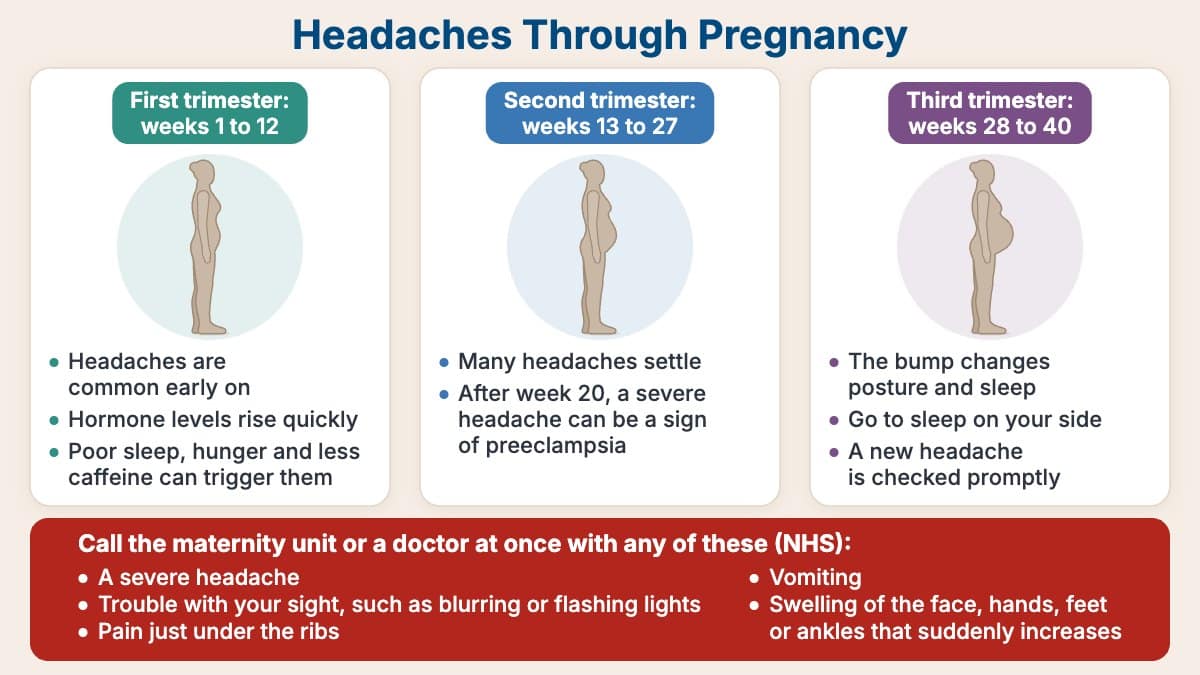
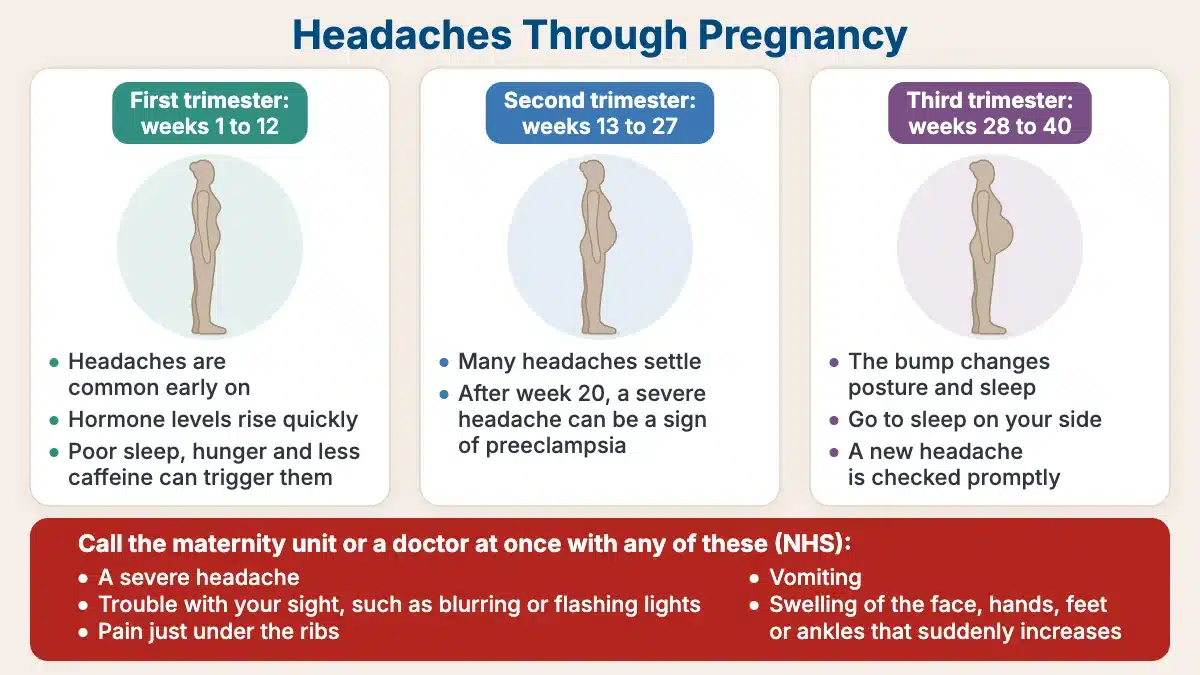
Headaches in pregnancy tend to follow the stages of pregnancy. The chart below shows what is typical in each trimester, and the red band gives the signs that need a call at once.
Headaches in Early Pregnancy
Headaches are common in the first weeks, while hormone levels are changing fast. The NHS notes that hormonal changes in the first 12 weeks can bring tiredness, nausea and strong emotions. A sudden cut in coffee or tea, or long gaps without food because of nausea, can each bring on a headache (ICHD-3, 2018). Too little sleep can add to them, and the NHS advises getting enough sleep.
Is a Headache an Early Sign of Pregnancy?
Headaches are common in early pregnancy, but headache is not on the NHS list of early signs that you might be pregnant. That list includes a missed period, nausea or vomiting, tiredness, sore breasts, urinating more often and a metallic taste. Those signs usually begin at 4 to 6 weeks, and a pregnancy test is how to find out.
Pregnancy Headaches in the Second Trimester
For many women with migraine or tension-type headache, attacks become less frequent by the second trimester, as ACOG's 2022 guideline notes. Daily headaches in these middle months are still worth reporting to your doctor or midwife. A headache that does not go away, or worsens over time, is one of the CDC's urgent warning signs listed below.
When headaches carry on, it is worth asking what has changed: a bigger bump, new sleeping positions, longer screen hours or jaw clenching.
Preeclampsia usually starts after 20 weeks, and the NHS says a headache can sometimes be a symptom of it. A severe headache, or any sign listed below, needs checking immediately.
Third Trimester Pregnancy Headaches
In my view, the weight of the bump in the last months changes posture and loads the upper back and neck. Sleep becomes harder, and the NHS calls going to sleep on your side the safest position, above all after 28 weeks. ACOG counts the third trimester itself among the red flags that doctors weigh, so a new headache now deserves prompt attention.
Hormones Behind a Pregnancy Headache
In my view, three hormones, estrogen, progesterone and relaxin, may each play a part in a pregnancy headache. They prepare the body for the baby, yet they may also influence how joints, ligaments and muscles carry the head and neck.
For many women who already had headaches or migraines, pregnancy brings fewer or milder attacks. In the research I have read, this change is often linked to higher estrogen levels. Others notice new or stronger headaches.
The link between estrogen and headaches during pregnancy is complex. Estrogen takes part in regulating the menstrual cycle, but its role in pregnancy headaches is less well understood. In the research I have read, lower estrogen levels in some pregnant women may contribute to a greater chance of headaches. Progesterone works alongside the other hormones to support the pregnancy. In my view, together they can add tension in the head, upper neck and upper back.
In my view, hormonal balance plays a part in spinal stability, joint flexibility and comfort, and estrogen levels can shed light on these changes. Whether to test them is the obstetrician's decision. What a mother can steady day to day is her sleep, meals, fluids and posture.
Relaxin and Looser Ligaments
Relaxin comes from the corpus luteum, a small gland that forms in the ovary after an egg is released. Its blood level is highest early in pregnancy (Post Uiterweer and colleagues, 2020). In one study of 47 women, relaxin fell by about half between the first and third trimesters (Altman and colleagues, 2025). In my view, it also plays a part in the womb's growth and in the body's adjustments to make room for the baby.
Relaxin loosens the pelvic ligaments for birth, and its receptors also sit in tissues around other joints (Parker and colleagues, 2022). In my view, the looser ligaments of pregnancy can let the joints from the base of the skull to C3, and the jaw, shift slightly. That may add to headaches in some women.
Other Signs of Shifting Estrogen in Pregnancy
In my view, shifting estrogen levels can also show in other ways. Each of these can have other causes, so mention any of them at a prenatal visit:
- Changes in mood or in how stress feels
- Feeling hot, or sweating at night
- Muscles that feel looser or less steady
- Posture changes that alter how the spine moves
- Changes in hair volume or texture
- General aches when moving around
Where a Pregnancy Headache Is Felt
Where the ache sits gives clues, though only an examination can say what it is. A tension-type headache usually presses or tightens on both sides of the head, often across the forehead and temples. Migraine tends to throb, often on one side, and may bring nausea or a dislike of light and sound.
A headache from the neck tends to start at the back of the head and spread forward. Head movement, or pressure on the neck muscles, can set it off (ICHD-3, 2018). In my view, an ache at the base of the skull can come with a stiff upper neck, tight shoulders or a clenched jaw.
When to Worry About a Headache in Pregnancy
Most headaches in pregnancy are not dangerous, but a few need medical care straight away. Each list below comes from one named source and is given in full.
Preeclampsia Signs to Report at Once (NHS)
The NHS page on headaches in pregnancy says to call the maternity unit or a doctor with any of these signs. It says each could be a sign of preeclampsia and needs checking immediately:
- A severe headache
- Trouble with your sight, such as blurring or flashing lights
- Pain just under the ribs
- Vomiting
- Swelling of the face, hands, feet or ankles that suddenly increases
In Malaysia, call your obstetrician or the hospital's maternity unit straight away. If neither can be reached, go to the nearest emergency department or call 999.
Urgent Maternal Warning Signs (CDC)
The US Centers for Disease Control and Prevention lists 15 urgent warning signs for pregnancy and the year after birth. It says to seek medical care immediately with any of them:
- A headache that does not go away, or worsens over time
- Dizziness or fainting
- Changes in your vision
- A fever of 38°C (100.4°F) or higher
- Extreme swelling of the hands or face
- Thoughts of harming yourself or your baby
- Trouble breathing
- Chest pain or a fast-beating heart
- Severe nausea and vomiting
- Severe belly pain that does not go away
- The baby moving less, or stopping moving, during pregnancy
- Vaginal bleeding or leaking fluid during pregnancy
- Vaginal bleeding or discharge after the birth
- Severe swelling, redness or pain in a leg or arm, during pregnancy or up to 6 weeks after birth
- Overwhelming tiredness
Tell the team that you are pregnant, or that you were pregnant within the last year.
Red Flags Doctors Check For (ACOG)
ACOG's guideline lists the features that lead doctors to look for a cause other than migraine or tension-type headache:
- A headache that comes on quickly, or a change from your usual pattern
- Severe pain, or a sudden thunderclap headache
- Raised blood pressure
- Fever
- Being in the third trimester
- A focal neurological deficit, meaning one part of the nervous system is not working normally
- A change in alertness or consciousness
- Abnormal blood tests: platelets too low or too high, raised liver enzymes or raised creatinine
Tell your doctor or midwife if any of them applies to you.
The Neck, Jaw and Upper Back
In my view, the whole neck works as one connected chain, with a domino effect. A strain in the lower neck travels up through the mid-neck, then on to the top joints and the base of the skull. Eventually, the effect reaches the brainstem and the brain.
In my view, long spells looking down at a phone, laptop or tablet load the upper neck and, as much or more, the lower neck. In pregnancy, and later while feeding the baby, it is worth noticing how many hours go this way.
Nerves from the top three levels of the neck share a relay station with the nerves of the head. That is why trouble in the upper neck can be felt as a headache (Bogduk and Govind, 2009). In my view, an upper neck problem can bring headaches or migraines of varying degrees and, in some people, dizziness or mental fog.
Jaw clenching, or bruxism, may become more noticeable in pregnancy. In my view, a chronic problem in either the upper neck or the jaw can lead to trouble in the other. More on this is in the upper cervical guide and the headache and migraine guide.
Pregnancy Headache Care in Kuala Lumpur
How Care Is Planned
When I mention conservative care, I mean focused care. It is a plan built on my examination findings and aimed at the causes they reveal. It takes in the neck, upper back and jaw together and is planned to avoid harm. Run-of-the-mill treatment is not that, and in my view many such forms achieve nothing.
Your obstetrician or doctor leads on blood pressure, preeclampsia, migraine diagnosis and medicines. My part is the neck, upper back and jaw, alongside that medical care and never in place of it. If a headache changes in character or grows worse during care, neck care stops until your doctor has seen you.
Gentle, Non-Rotatory Methods
In pregnancy, my neck care is gentle and non-rotatory, kept within what you can comfortably tolerate. At the atlas (C1), the contact is non-force, with only a slight pressure, angled to suit the person. With a stable neck, chiropractic manipulation that is non-rotatory using the Activator instrument is one option, at level one, its lowest setting. Near the atlas, that cushioned impulse goes to the soft tissues beside it, not to the bone itself. Forceful high-speed twisting is avoided.
Alongside this, physiotherapy brings hands-on soft tissue work for the neck and shoulders, and exercises for the upper back. In my Neck Trigger Points and Exercises video, I show gentle trigger point pressure on the trapezius and the rhomboids. I keep off the front of the shoulder and anything past its top, where major vessels and nerves run. As I say there, check anything I show with your doctor or midwife before trying it.
In Is Chiropractic Safe? 13 Questions Answered, my advice on the two professions comes down to this: “Don't choose between one or the other. Choose both.”
I also answer the safety question there: “It is safe when it's performed by a competent chiropractor who is also registered.” Care must also be condition based, which in pregnancy means ruling out the warning signs first. Possible effects and risks are explained before care begins.
In Neck Cracks Are Dangerous, I explain why forceful neck pulls, such as towel pulls or Ring Dinger-style traction, should not be done. They are never part of my care. In that video, I also name high blood pressure among the reasons for extra caution. In my view, the danger of neck cracking is not only a small risk of stroke. It can also make an existing neck problem worse.
Progress Checkpoints and Fees
Progress is reviewed at the fifth session, and if nothing has changed, I look into why. With still no change at the tenth, we talk it through and agree whether to go on. I describe both checkpoints in Is Chiropractic Safe? 13 Questions Answered.
At either KL center, the CSC quotation dated June 25, 2026 sets an examination at RM100. A chiropractic adjustment on its own is RM150, and RM110 when physiotherapy is given at the same visit. Each standard physiotherapy unit is RM57 to RM180, or RM27 to RM150 when chiropractic is part of the same visit, depending on the service. The final sum follows the examination's findings, the chosen methods and how many visits the plan holds. The chiropractic price in Kuala Lumpur and physiotherapy fees in Kuala Lumpur pages list every item. The fee for a plan is explained and agreed before care begins.
Everyday Steps That Target Common Triggers
These steps target the common triggers. Follow them within the advice of your doctor or midwife:
- Drink fluids through the day, as the NHS advises, and eat small, regular meals so you are not hungry for long.
- Sleep at least six hours, as I say in Neck and Back Self-Help Tips. Where possible, aim for seven to eight unbroken hours, as I advise in my Back Pain to Leg Pain talk.
- Go to sleep on your side, which the NHS calls the safest position, above all after 28 weeks. A pillow between the knees keeps the spine in one straight line.
- With neck trouble, leave the chair every 15 to 20 minutes and walk around for 30 to 60 seconds. The shorter form of this advice, a brief stand every 15 minutes, is in Desk Posture Mistakes.
- Hold the phone nearer eye level, and rest your eyes and neck during long screen sessions.
- If you are cutting down on coffee or tea, taper it, since a sudden stop can bring on a caffeine-withdrawal headache (ICHD-3, 2018). The NHS advises against caffeine in the evening.
- If a painkiller is needed, the NHS names paracetamol as the first choice in pregnancy. Check the dose with your pharmacist, midwife or doctor.
Posture matters whether you sit, stand or lie down. My video Poor Posture Damages Your Spine sums it up: “If you take care of your posture, your spine will take care of you.”
Headaches After the Birth
A new headache after the birth still deserves attention. ACOG's guideline says preeclampsia is considered until six weeks after delivery when a headache comes with raised blood pressure. The CDC warning signs above apply for a full year after birth.
Once the doctor has ruled out other causes, feeding and carrying are looked at. Holding the head bent toward the baby for long periods loads the neck and upper back. Supporting the arms with pillows and bringing the baby up to the chest keeps the neck more upright. More on care after birth is in the prenatal and postpartum guide.
Pregnancy Headache FAQ
Is it normal to get headaches during pregnancy?
Yes. Headaches are common in pregnancy, especially in the first weeks, and the NHS says they usually improve as pregnancy goes on. They do not harm the baby. Common triggers include hormone changes, poor sleep, hunger, too little fluid and cutting down on caffeine. In my view, neck strain, screen time and jaw clenching can add to them. A severe headache needs checking straight away, above all after 20 weeks, when it can be a sign of preeclampsia. A headache that is new for you or unlike your usual pattern also needs a doctor's check.
When do pregnancy headaches stop?
For many women they become less frequent after the first trimester. In one study of 430 new mothers, the improvement showed most clearly once the first trimester ended (Maggioni and colleagues, 1997). ACOG's guideline says up to 80 percent of those with headaches such as migraine have fewer by the second trimester. Some women still have them in the later months, and a few find them worse. Headaches can also return after the birth, with broken sleep and feeding. Any headache that keeps coming back, or changes, is worth raising at your prenatal check.
Why do pregnancy headaches happen in the second trimester?
Many headaches settle in the second trimester, so the ones that continue usually have a reason worth finding. A growing bump changes posture and sleeping positions. Screen hours, jaw clenching and missed meals may still play a part. In my view, the looser ligaments of pregnancy can also let the upper neck and jaw shift slightly. Preeclampsia usually starts after 20 weeks, so check the warning signs before anything else. A blood pressure reading at your prenatal visit is a simple first step.
What if headaches during pregnancy come every day?
Daily headaches are worth reporting rather than waiting out, since many headaches settle as pregnancy goes on. Tell your midwife or doctor, who may check your blood pressure. Call your obstetrician or maternity unit straight away with a severe headache, or with vision problems such as blurring or flashing lights. Do the same for pain just under the ribs, vomiting, or swelling of the face, hands, feet or ankles that suddenly increases. The NHS lists these five as possible signs of preeclampsia. If no one can be reached, go to the nearest emergency department or call 999.
What can I take for a headache when pregnant?
The NHS names paracetamol (acetaminophen) as the first choice of painkiller in pregnancy and advises taking it for the shortest possible time. Your pharmacist, midwife or doctor can advise on the dose. The NHS says to avoid painkillers that contain codeine, and anti-inflammatories such as ibuprofen, unless a doctor prescribes them. Do not stop a medicine your doctor has prescribed because of a chiropractic visit. For the neck and jaw side of a headache, the steps in this guide involve no medicine.
Why is a pregnancy headache worse when lying down?
A headache that changes with position should be described to your doctor or midwife rather than guessed at. NICE, the UK guideline body, counts a headache that changes with posture among the features that need further checks. Note whether it is worse lying flat, on standing or when bending, and how long it lasts. Mention any other symptoms too. Once your doctor is satisfied, a stiff upper neck or an awkward sleeping position can be looked at as a possible contributor.
Can a pregnancy headache come from the neck?
It can. The upper three neck nerves and the nerves of the head meet at one relay point, where the brainstem joins the spinal cord. That is how upper neck trouble can be felt as a headache. In my view, an ache at the skull base that worsens with neck movement or a held posture can involve the upper neck. The shoulders or jaw may add to it. An examination is needed to tell, and the warning signs are always checked first. Where the neck is involved, I use gentle, non-rotatory methods with physiotherapy.
Do migraines change during pregnancy?
For most women with migraine, attacks become fewer in pregnancy, though some still have them in the later months. An aura, the flickering lights or zigzag lines some see before an attack, usually builds over minutes and fades within an hour (ICHD-3, 2018). In pregnancy, a first aura, or a headache unlike your usual migraine, is described to a doctor before anyone calls it migraine. ACOG's guideline counts a change from your usual headache pattern among the features doctors check.
Why do I get a headache while feeding my baby?
Feeding often means holding the head bent toward the baby for long stretches. That position loads the neck and upper back, which can bring on a band-like or neck-related headache. Supporting your arms with pillows and bringing the baby up to the chest lets the neck stay more upright. Short breaks to move the shoulders also count. A new or severe headache in the weeks after birth is different. It needs a doctor first, since preeclampsia can appear up to six weeks after delivery.
Should I see my doctor or a chiropractor first?
See your doctor first if the headache is severe, new or different, or comes with any warning sign on this page. Your obstetrician decides on blood pressure checks, tests and medicines. Once those are settled, a neck, upper back and jaw assessment can look for a mechanical contributor. At CSC, chiropractic and physiotherapy are provided together, and the first visit reviews your prenatal notes before any care. Neither replaces the other, and both can work alongside your prenatal care.
How to Read This Guide
Where I give a view of my own, it is written in the first person. If one of my videos or talks is its source, that title is named. Studies appear with their first author and year, and the full references are listed below. A study reports on a group of people and cannot predict how one pregnancy will go. Reading this guide is not a diagnosis, and your obstetrician's advice comes first.
References and Sources
- Alcantara J, Cossette M. Intractable migraine headaches during pregnancy under chiropractic care. Complement Ther Clin Pract. 2009;15(4):192-197.
- Altman R, Dragovic R, Southcombe J, Granne I, Melo P. Serum relaxin levels and cardiovascular health in pregnancy: a secondary analysis of the Oxfordshire Women and their Children's Health (OxWATCH) study. Eur J Obstet Gynecol Reprod Biol. 2025;315:114729.
- American College of Obstetricians and Gynecologists. Headaches in pregnancy and postpartum: ACOG Clinical Practice Guideline No. 3. Obstet Gynecol. 2022;139(5):944-972.
- Arnold MJ. Headache during pregnancy and breastfeeding: ACOG recommendations. Am Fam Physician. 2023;108(1):97-99.
- Bogduk N, Govind J. Cervicogenic headache: an assessment of the evidence on clinical diagnosis, invasive tests, and treatment. Lancet Neurol. 2009;8(10):959-968.
- Bryans R, Descarreaux M, Duranleau M, et al. Evidence-based guidelines for the chiropractic treatment of adults with headache. J Manipulative Physiol Ther. 2011;34(5):274-289.
- Centers for Disease Control and Prevention. Urgent maternal warning signs and symptoms. HEAR HER campaign. CDC website; May 15, 2024.
- Headache Classification Committee of the International Headache Society (IHS). The International Classification of Headache Disorders, 3rd edition. Cephalalgia. 2018;38(1):1-211.
- Kelman L. Women's issues of migraine in tertiary care. Headache. 2004;44(1):2-7.
- Maggioni F, Alessi C, Maggino T, Zanchin G. Headache during pregnancy. Cephalalgia. 1997;17(7):765-769.
- Marcus DA. Managing headache during pregnancy and lactation. Expert Rev Neurother. 2008;8(3):385-395.
- National Health Service (NHS). Headaches in pregnancy. NHS website; read October 13, 2026.
- National Health Service (NHS). Signs and symptoms that might mean you're pregnant. NHS website; read October 13, 2026.
- National Health Service (NHS). Tiredness and sleep problems in pregnancy. NHS website; read October 13, 2026.
- National Institute for Health and Care Excellence (NICE). Headaches in over 12s: diagnosis and management (CG150). NICE; 2012, updated 2021.
- Nelson CF, Bronfort G, Evans R, Boline P, Goldsmith C, Anderson AV. The efficacy of spinal manipulation, amitriptyline and the combination of both therapies for the prophylaxis of migraine headache. J Manipulative Physiol Ther. 1998;21(8):511-519.
- Parker EA, Meyer AM, Goetz JE, Willey MC, Westermann RW. Do relaxin levels impact hip injury incidence in women? A scoping review. Front Endocrinol (Lausanne). 2022;13:827512.
- Post Uiterweer ED, Koster MPH, Jeyabalan A, et al. Circulating pregnancy hormone relaxin as a first trimester biomarker for preeclampsia. Pregnancy Hypertens. 2020;22:47-53.
- Skarica B. Effectiveness of manual treatment on pregnancy symptoms: usefulness of manual treatment in treating pregnancy symptoms. Med Arch. 2018;72(2):131-135.
- Tuchin PJ, Pollard H, Bonello R. A randomized controlled trial of chiropractic spinal manipulative therapy for migraine. J Manipulative Physiol Ther. 2000;23(2):91-95.
- Weis CA, Stuber K, Murnaghan K, Wynd S. Adverse events from spinal manipulations in the pregnant and postpartum periods: a systematic review and update. J Can Chiropr Assoc. 2021;65(1):32-49.
These sources describe headaches in pregnancy, their warning signs and their care in general. None of them evaluates care at Chiropractic Specialty Center.
The Author of Pregnancy Headache by Trimester: Causes and When to Worry
Pregnancy Headache by Trimester: Causes and When to Worry was written by Yama Zafer, D.C., who has 30+ years in chiropractic and physiotherapy and founded Chiropractic Specialty Center in Kuala Lumpur in 2006.
Last Updated: Pregnancy Headache in KL: Hormones, Posture and Warning Signs
Pregnancy Headache in KL: Hormones, Posture and Warning Signs was last reviewed and updated on October 16, 2026.