
Golfer’s Elbow and Medial Epicondylitis Explained
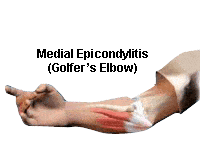
Golfer’s elbow, clinically medial epicondylitis, is pain where the forearm muscles that bend the wrist and fingers attach to the inner side of the elbow. Golf accounts for a small minority of cases. Repeated gripping with the wrist bent downward is the common factor: carrying heavy bags, using a screwdriver, racket sports, and long keyboard hours with the wrist dropped.
A simple resisted test identifies it. With the elbow straight, bending the wrist downward against gentle resistance reproduces pain at the inner elbow when the tendon may be the source. Tendons recover through graded load rather than rest, so a plan typically reduces the aggravating grip for a few weeks and then rebuilds strength slowly across months.
Golfer’s elbow, known clinically as medial epicondylitis, is pain on the inner side of the elbow where the forearm flexor tendons attach. Technique, load and grip usually sit behind it. Chiropractic and physiotherapy care are applied to the tendon load and to how the wrist and grip are being used, with the plan following what the examination shows.
The golfer’s elbow care we provide focuses on managing medial epicondylitis, a condition involving inflammation or microtears of the tendons attached to the inner part of the elbow. Despite its name, this issue isn’t limited to golfers: it often affects anyone who repetitively grips, twists, or lifts with their wrist or forearm. Whether it arises from sports, office work, or household tasks, the pain can interfere with daily routines and functional use of the arm.
If you're dealing with persistent elbow issues, this page provides everything you need to know from causes and risk factors to recovery strategies and long-term management through active participation. This page is designed for those who want to take action now with safe, practical, and medically accepted methods that work with the body, not against it.
This guide to golfer’s elbow, also called medial epicondylitis, its causes and symptoms, is published by Chiropractic Specialty Center, Bukit Damansara (KL) main center: WhatsApp+60 17 269 1873 Call+603 2093 1000
Key Takeaways for Golfer’s Elbow Care
3 Most Important Takeaways (Written for Action & Clarity):
Medial epicondylitis is often caused by repetitive gripping or wrist motion, changing what the wrist and grip are doing matters as much as easing the pain.
Non-invasive care combining chiropractic, physiotherapy, and rehab can help restore function without injections or procedures.
Home-based changes, like modifying activities and improving ergonomics, accelerate recovery and help prevent flare-ups.
Contact Us To Begin Care Today
If you're experiencing symptoms of golfer's elbow, reach out via our contact page to connect with our team of non-invasive spine and joint specialists ready to guide you through integrative care.
Factors Contributing to Golfer’s Elbow
- Repetitive Wrist Movements: Activities that require gripping, lifting, or wrist flexion may strain the tendons.
- Improper Form in Sports or Daily Activities. Using incorrect grip techniques in golf, tennis, or weightlifting may place excessive stress on the elbow joint.
- Carrying Heavy Objects: Holding or lifting weights without maintaining a slight bend at the elbow can lead to irritation.
- Sudden Increase in Activity Levels: Engaging in activities without gradual conditioning may contribute to strain.
Early recognition of symptoms can help prevent further pain and long-term complications.
Common Symptoms of Golfer’s Elbow
- Pain or stiffness in the inner elbow extending toward the forearm.
- Localized tenderness near the bony prominence inside the elbow.
- Reduced grip strength or wrist instability when holding objects.
- Tingling or sensitivity that may travel down the arm, sometimes affecting the pinky finger.
A comprehensive assessment can help identify the root cause and guide targeted support strategies.
A Proactive Approach to Supporting Elbow Health
- Modify activity levels to reduce excessive strain on the elbow.
- Maintain proper form and technique in sports and daily tasks.
- Incorporate stretching and strengthening exercises for wrist and forearm muscles.
- Seek professional guidance for a structured recovery plan.
A holistic, non-invasive approach may help restore function and reduce elbow pain naturally.
Factors That Contribute to Elbow Pain in Golfers
Elbow pain related to golf often stems from repetitive movements, improper technique, and muscle imbalances. Understanding the contributing factors can help prevent and address the condition effectively.
Key Factors That May Lead to Elbow Pain in Golfers
- Muscle Imbalances: Weakness or tightness in the forearm flexor muscles can strain the tendons, increasing susceptibility to pain.
- Overuse of Muscles: Frequent or repetitive swings without adequate rest and recovery may contribute to irritation.
- Improper Golf Swing Technique: Excessive wrist movement or improper grip can place unnecessary stress on the elbow and forearm tendons.
- Inappropriate Golf Equipment: Using clubs that are too heavy, too long, or not suited to your body type may contribute to strain on the elbow joint.
- Lack of Proper Warm-Up & Stretching: Skipping warm-ups, stretching, or cooldowns may increase the risk of strain on the elbow and forearm muscles.
Recognizing these factors early may help reduce strain and promote long-term elbow health.
Preventive Measures to Support Elbow Health
- Use Proper Technique: Maintain correct wrist and arm positioning throughout the swing.
- Modify Practice Routines: Avoid overuse by incorporating rest and recovery periods into training sessions.
- Ensure Proper Equipment Fit: Select golf clubs that match your height, strength, and skill level to minimize stress on the elbow joint.
- Incorporate Strength & Flexibility Exercises. Strengthening and stretching forearm and wrist muscles may help improve resilience.
- Apply Cold Care (if needed): Ice application may help manage pain after prolonged use or repetitive movements.
If pain persists, early assessment and corrective support may help restore optimal function and prevent long-term strain.
Care for Elbow Pain
Elbow pain from overuse, strain, or repetitive movements often responds well to targeted, non-invasive care. Effective management focuses on restoring function and supporting recovery without resorting to invasive interventions.
Key Considerations for Managing Elbow Pain
- Avoid Unnecessary Procedures: Surgery is not typically required for elbow pain from repetitive strain.
- Limit Steroid Injections: While steroids may offer short-term respite, they can weaken soft tissues over time.
- Prioritize Targeted Therapy: A structured care plan that includes corrective exercises, muscle re-education, and manual therapies may provide long-term benefits.
Options for Elbow Support & Recovery
- Gentle Manual Care– Targeted mobilization techniques may help support soft tissue recovery.
- Targeted Rehabilitation: Strengthening exercises for the forearm, wrist, and elbow may improve resilience.
- Cold Therapy (Cryotherapy): Icing the elbow can support recovery without risks associated with steroid injections.
- Ergonomic Modifications: Adjusting grip technique and equipment may reduce unnecessary strain.
By working on the load rather than the sore spot alone, targeted care supports long-term function while minimizing the need for unnecessary interventions.
Targeted Care for Golfer’s Elbow & Inner Elbow Pain
Elbow pain related to overuse, strain, or repetitive movements often responds to targeted, conservative care. Non-invasive care methods, such as focused rehabilitative exercises, manual care, and ergonomic modifications, may support lasting recovery.
How to Minimize Strain & Support Recovery
- Adjust Activity Levels: Limiting repetitive strain, such as excessive practice at the driving range, may prevent worsening.
- Support Proper Biomechanics: Ensuring correct grip and swing technique may reduce unnecessary stress on the elbow joint.
- Gradual Warm-Ups & Cool-Downs: Stretching before and after activities may support soft tissue resilience.
- Cold Therapy (Cryotherapy): Applying a wrapped ice pack for short intervals may provide comfort.
Effective Non-Invasive Options for Elbow Support
- Manual Therapy: Targeted joint mobilization may help restore movement.
- Rehabilitative Exercises: Strengthening the forearm and wrist muscles may reduce repetitive strain on the elbow joint.
- Therapeutic Ultrasound & Electrotherapy: These methods may help support muscle and soft tissue recovery.
- Ergonomic Modifications: Ensuring proper grip and adjusting training habits may prevent recurrence.
With early intervention and a structured care plan, non-invasive care may support long-term function while reducing reliance on temporary measures.
The Loading Program for the Inside of the Elbow
Golfer’s elbow involves the flexor-pronator tendons, which do a different job from the extensor tendons on the outside, so the program is different too.
- Start with grip, not with the elbow. Sustained grip is what loads these tendons, and squeezing a soft ball for holds of twenty to thirty seconds is usually tolerated early.
- Then wrist flexion, slowly. Three seconds down and three seconds up, three sets, most days. Slow is not a detail; it is the method.
- Then forearm rotation under load, because pronation is the movement that provokes this tendon in most jobs and sports.
- Then the task itself. The grip, the club, the tool or the keyboard position that started it, rebuilt rather than avoided permanently.
- Three months is the realistic horizon, and the rule for dose is the same as everywhere: pain during is acceptable, pain worse the next morning is not.
What Else Causes Pain on the Inside of the Elbow
Getting this wrong is the usual reason a program disappoints:
- Ulnar nerve irritation. The nerve runs just behind the bony point on that side. Pins and needles into the little finger, symptoms at night, or a jolt when you knock the area point to the nerve, not the tendon.
- Ulnar collateral ligament injury, which matters in throwing athletes and behaves differently from a tendon problem.
- Referral from the neck. Lower cervical segments refer into the forearm, and an elbow with no local tenderness that does not change with grip testing points that way.
- In an adolescent, a growth plate problem rather than a tendinopathy, which needs assessment rather than a loading program.
When the Elbow Needs a Doctor
- Numbness or weakness in the hand, or visible wasting of muscle.
- A hot, red, swollen elbow, with or without fever.
- Elbow pain immediately after a fall, or an elbow that will not straighten.
- Pain that wakes you consistently and is unrelated to how you used the arm that day.
For planning, the chiropractic prices in Kuala Lumpur and physiotherapy prices in Kuala Lumpur pages set out what each visit costs.
Still have questions? You may find our pages on elbow pain, carpal tunnel syndrome, and carpal tunnel tests helpful too. And for the bigger picture, our neck pain guide brings our neck, upper back and arm topics together in one place.
Peer-Reviewed Medical References Golfer's Elbow Care in KL:
- Amin NH, Kumar NS, Schickendantz MS. Medial epicondylitis: evaluation and management. J Am Acad Orthop Surg. 2015 Jun;23(6):348-55.
- Wilson JJ, Best TM. Common overuse tendon problems: a review and recommendations for treatment. Am Fam Physician. 2005 Sep 1;72(5):811-8.
- Ghai S, Ghai I, Narciss S. Influence of taping on force sense accuracy: a systematic review. BMC Sports Sci Med Rehabil. 2023 Oct 20;15(1):113.
- Masiello F, Pati I, Veropalumbo E, Pupella S, Cruciani M. Ultrasound-guided PRP for tendinopathies: a systematic review and meta-analysis. Blood Transfus. 2023 Mar;21(2):102-12.
- Bruni D, Pierson S, Sarwar F, Ring D, Ramtin S. Are pathologic features of medial epicondylitis related to mucoid degeneration? Clin Orthop Relat Res. [Year, volume, pages missing: please verify source].
- Taylor CR, Hannafin JA. Eccentric exercise for chronic epicondylitis: a prospective randomized trial. J Shoulder Elbow Surg. 2010 Sep;19(6):917-22.
The Author of Golfer’s Elbow: Causes, Symptoms and Assessment
Golfer’s Elbow: Causes, Symptoms and Assessment was written by Yama Zafer, D.C., who has 30+ years in chiropractic and physiotherapy and founded Chiropractic Specialty Center in Kuala Lumpur in 2006.
Last Updated: Golfer’s Elbow and Medial Epicondylitis Explained
Golfer’s Elbow and Medial Epicondylitis Explained was last reviewed and updated on October 3, 2026.
Share with others: