


How a Disc Gets Damaged: Non-Surgical Options
How a disc gets damaged is easier to understand once the disc structure is clear. Each spinal disc has a tough outer annulus made of layered fibers and a softer, water-rich center. Disc change usually develops gradually as those outer fibers are repeatedly loaded, although a sudden injury can sometimes make an existing problem symptomatic.
Repeated bending, twisting under load, prolonged compression and age-related change can all influence the disc, but no single posture or lift explains every case. The clinically important issue is whether symptoms stay local or begin to follow a nerve into an arm or leg, especially when numbness or weakness appears. The detailed discussion covers spinal disc damage, the difference between bulging, protrusion, extrusion and other MRI terms, and what raises intradiscal stress.
This guide to how a disc gets damaged, why degeneration occurs and how disc issues are diagnosed, is published by Chiropractic Specialty Center, Bukit Damansara (KL) main center: WhatsApp+60 17 269 1873 Call+603 2093 1000
Quick Overview: How Spinal Discs Become Damaged
Spinal disc problems usually develop gradually through repeated mechanical stress, together with age-related changes in the disc itself. When the outer fibers weaken, material from the center may shift outward, producing changes described on MRI as a bulge, protrusion, extrusion or sequestration.
When a disc changes shape, nearby nerves may become sensitized. Depending on the level, symptoms may be felt in the neck, shoulders and arms, or in the back, buttocks and legs. Readers exploring slip disc care in Kuala Lumpur will find the non-surgical options explained there.
Key Points About How a Disc Gets Damaged
- Discs change through a combination of age, genetics, repeated loading and sometimes injury.
- Many disc changes seen on MRI cause no symptoms at all.
- Non-surgical care, including chiropractic, physiotherapy and rehabilitation, is the usual first approach for disc-related pain.
- The two-minute Why Spinal Discs Get Damaged video shows how daily loading cracks the outer fibers of a disc and lets its soft center move toward the weakest point of the wall.
Disc Assessment at Our Two KL Centers
If you have neck or back pain with symptoms traveling into an arm or leg, or an MRI report describing a disc change, both centers of Chiropractic Specialty Center can assess how the disc findings match your symptoms. Bring any scan reports with you. Directions are on the Bukit Damansara contact page and the Bandar Sri Damansara contact page.
- Bukit Damansara (KL, main center): Call +603 2093 1000 or WhatsApp +60 17 269 1873 to see the Bukit Damansara / KL center.
- Bandar Sri Damansara (KL): Call +603 6262 5777 or WhatsApp +60 12 455 6939 to see the Bandar Sri Damansara center.
Video: Desk Posture Mistakes That Increase Spinal Disc Stress
Desk setup and long periods of sitting are common everyday sources of load on the neck and lower back. This educational video explains common desk posture mistakes and simple adjustments that may reduce unnecessary spinal load during work or study. The Desk Posture Mistakes video guide has its key moments and an edited transcript.
Key Moments From the Video
- 00:00 Why desk posture matters: how sitting habits load the neck, back and discs.
- 00:18 Choosing the right chair: chair height, seat depth and lumbar support.
- 00:36 Armrests and upper-back support: how armrest height affects shoulder and neck tension.
- 01:05 A common sitting habit that increases disc stress.
- 01:46 Step-by-step sitting setup.
- 02:22 Phone position and neck bending.
- 02:57 Keyboard and wrist setup.
- 04:36 Laptop and monitor ergonomics.
- 05:02 Why long, unbroken sitting adds up.
- 05:28 Movement breaks during the working day.
- 06:15 Multiple monitor setup.
- 07:12 Laptop positioning for the neck and back.
The Role of Spinal Discs
Spinal discs sit between the vertebrae, where they share load, absorb shock and allow movement. There are 23 intervertebral discs in the cervical, thoracic and lumbar spine. Each disc is attached to the vertebrae above and below by thin cartilage endplates, through which nutrients reach the disc.
Why Spinal Disc Degeneration Occurs
Some disc change is a normal part of aging. Genetics play a large part, and repeated heavy loading, injury and smoking may add to it. Adult discs have almost no blood supply of their own, so they depend on nutrients diffusing through the endplates; when that supply falls, the disc cells become less able to maintain the tissue, and the disc gradually loses water and height.
Diagnosing Spinal Disc Issues
Assessment begins with a history and physical examination, including tests of strength, sensation and reflexes. Imaging may then be recommended when it would change the plan:
- X-rays show bone, alignment and disc height, but not the disc itself.
- CT scans show bone in more detail and are used for specific questions.
- MRI shows discs, nerves and other soft tissues without ionizing radiation and is the main test for disc herniation.
Symptoms of Spinal Disc Changes
Many disc changes cause no symptoms. When they do, symptoms may include:
- pain or stiffness in the neck, upper back or lower back
- pain that increases with coughing, sneezing or certain movements
- numbness or tingling in the arms, hands, legs or feet
- weakness in the shoulders, arms, hands or legs
- pain that is worse after prolonged sitting
If you have back or leg pain, new symptoms need attention even when you already know how a disc became damaged. New or worsening numbness around your genitals, between your genitals and anus, or around your anus needs urgent medical attention: a thorough assessment by a competent clinician the same day. New difficulty passing urine needs the same urgent assessment before bladder or bowel control is lost, and a loss of that control is urgent too. Several causes are possible. Some may call for an invasive procedure, but assessment helps determine the next step and does not automatically mean surgery.
Types of Spinal Disc Changes
- Mechanical changes: bulging, protruding or herniated discs, which may or may not cause symptoms.
- Non-mechanical changes: congenital disc variations or infection (discitis), which need medical management.
Stages and Terms Used for Spinal Disc Changes
MRI reports use standard terms to describe how far disc material has moved:
- Bulging disc: the disc extends slightly beyond its normal edge over a broad area. This is very common and often causes no symptoms.
- Protrusion: disc material extends beyond its normal edge in a more focal area, with the base of the displaced portion wider than its tip.
- Prolapsed disc: a general term, often used interchangeably with herniation.
- Herniated disc: an umbrella term for disc material displaced beyond its normal boundary; protrusion, extrusion and sequestration are types of herniation.
- Extruded disc: the displaced material is wider than its base or extends above or below the disc level.
- Fragmented (sequestered) disc: part of the displaced material has separated from the disc.
- Discitis: infection or inflammation of the disc, which needs medical care.
- Rudimentary disc: an underdeveloped disc, usually found at a transitional segment of the spine.
The size of a disc change on MRI does not reliably predict symptoms, and many herniations shrink over time.
Daily Habits That Help Protect Spinal Discs
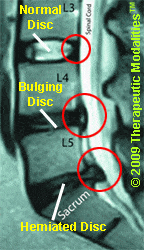
While professional assessment guides care, several steps at home can reduce strain:
- change position regularly rather than sitting or standing for long periods
- keep loads close to the body when lifting and avoid twisting while lifting
- use ice or heat for short periods, whichever eases the pain
- stretch the hamstrings and chest muscles if they feel tight
- do gentle core exercises that avoid painful bending or twisting
- leave yoga out, as it must be avoided once a disc has been damaged
- sleep on your back, or on your side with a pillow between the knees
- take breaks during long drives and desk work
Daily Habits That Help Protect Spinal Discs and Reduce Strain
- Stay active with low-impact movement: walking, cycling and swimming keep the spine moving without heavy load.
- Use guided strengthening: core and back exercises build tolerance to load when progressed gradually.
- Break up long sitting: regular movement breaks reduce continuous load.
- Manage body weight and daily load: excess weight and repeated heavy strain add to spinal load.
- Stop smoking: smoking is associated with faster disc degeneration.
Planning a visit? You can review the current chiropractic price in Kuala Lumpur and physiotherapy fees in Kuala Lumpur before you come in.
How Spinal Discs Get Damaged: Common Questions
What causes spinal discs to become damaged?
A combination of age, genetics, repeated loading and sometimes a specific injury. Smoking and heavy repetitive lifting are associated with faster change.
Do spinal disc problems develop suddenly?
Most disc changes develop gradually. A sudden event often makes an existing change symptomatic rather than creating it from nothing.
Can poor posture affect spinal discs?
Sustained, unchanging positions can load the discs and surrounding tissues, and slumped sitting often aggravates disc symptoms. Changing position regularly matters more than any single perfect posture.
Does prolonged sitting increase disc stress?
Older studies suggested sitting raises disc pressure compared with standing; newer measurements show it depends on how you sit. Long, unbroken periods of slumped sitting are what most people with disc problems find aggravating.
Can walking help support spinal disc health?
Yes. Walking is a low-load way to keep the spine moving and is usually well tolerated.
Do all spinal disc changes cause symptoms?
No. Disc bulges and degeneration are common on MRI in people without any pain, and the proportion rises with age.
When should I get checked for spinal disc issues?
If pain persists, spreads into an arm or leg, or comes with numbness or weakness. New numbness around the genitals or anus, new difficulty passing urine, or loss of bladder or bowel control needs urgent medical attention the same day.
Peer-Reviewed Medical Reference Citations
- Adams MA, Roughley PJ. What is intervertebral disc degeneration, and what causes it? Spine (Phila Pa 1976). 2006;31(18):2151-2161.
- Urban JP, Roberts S. Degeneration of the intervertebral disc. Arthritis Res Ther. 2003;5(3):120-130.
- Smith LJ, Nerurkar NL, Choi KS, et al. Degeneration and regeneration of the intervertebral disc: lessons from development. Dis Model Mech. 2011;4(1):31-41.
- Grunhagen T, Shirazi-Adl A, Fairbank JC, Urban JP. Intervertebral disk nutrition: a review of factors influencing concentrations of nutrients and metabolites. Orthop Clin North Am. 2011;42(4):465-477.
- Fardon DF, Williams AL, Dohring EJ, et al. Lumbar disc nomenclature: version 2.0. Spine J. 2014;14(11):2525-2545.
- Bogduk N. Clinical and Radiological Anatomy of the Lumbar Spine. 5th ed. Edinburgh: Elsevier; 2012.
These references cover disc structure, nutrition, degeneration and the terms used on MRI reports. None of them evaluates a care program at Chiropractic Specialty Center. The journal articles can be checked through their free PubMed records.
The Author of How a Disc Gets Damaged: Causes & Care Options
How a Disc Gets Damaged: Causes & Care Options was written by Yama Zafer, D.C., who has 30+ years in chiropractic and physiotherapy and founded Chiropractic Specialty Center in Kuala Lumpur in 2006.
Last Updated: How a Disc Gets Damaged: Non-Surgical Options
How a Disc Gets Damaged: Non-Surgical Options was last reviewed and updated on October 3, 2026.