


What Are the Causes of a Herniated Disc?
By Yama Zafer, D.C.
The causes of a herniated disc build up over years, long before the lift, bend or sneeze that seems to set off the pain. In a slipped disc, as most people call it, the soft center breaks through outer rings that load has weakened. Once it escapes, it can press on a nerve. From the neck, pain, numbness or weakness can spread toward the shoulder blade, arm or hand. From the lower back, they can spread into the buttock, thigh, calf or foot.
In my experience, a healthy disc does not herniate; the damage always comes first. Sitting presses the body's weight down through each disc, and leaning forward raises that pressure further. When the pressure stays high, fewer nutrients reach the disc, and the bonds that hold its outer rings together weaken.
Care starts with an examination, and with an MRI when a disc problem is suspected. The first visit also records the daily loads behind the damage. Focused conservative care follows, with non-rotatory chiropractic, physiotherapy and exercise. With a damaged disc, the spine is not twisted or cracked, and surgery is the last option. Below, the guide covers the laboratory evidence, the end-plates that feed a disc, age and genetics, the common levels and the examination.
This guide, Causes of a Herniated Disc: Sitting, Lifting, Early Damage, is published by Chiropractic Specialty Center, Bukit Damansara (KL) main center: WhatsApp+60 17 269 1873 Call+603 2093 1000
Causes of a Herniated Disc: Key Takeaways
| Question | Short answer |
|---|---|
| What causes a herniated disc? | Years of axial load, the body's weight bearing down through the spine. My Back Pain to Leg Pain talk names it the most common cause of disc damage. Posture, injuries and repetitive habits add to it. |
| Is a slipped disc the same as a herniated disc? | Yes. Slipped disc is the everyday name for disc damage; a herniated disc is one stage. I admit it in my Back Pain to Leg Pain talk: “I loosely use the word slip disc, but in reality, discs don't slip.” |
| Is a ruptured disc different from a herniated disc? | No. In my Short The Truth About Herniated Discs, herniated and ruptured are interchangeable terms for one stage. The center has broken through the outer ring and is no longer contained, so the causes are the same. |
| Can a slipped disc be put back in place? | No. Nothing slid out of place, so nothing can be pushed back; the center escaped through a torn wall. As I say in Sciatica vs Slipped Disc, a spine with a damaged disc should not be cracked or twisted. |
| Does sitting cause a herniated disc? | Not in one sitting. Long sitting loads a disc, and leaning forward loads it more, as my Back Pain to Leg Pain talk explains. With acute back pain, I advise a break every 15 minutes. |
| Can a herniated disc happen suddenly? | The pain can start suddenly; the damage does not. In my view, even after an accident or a sports injury, the disc that herniates was already damaged. The lift or the sneeze is only the last load. |
| Do genes or age cause disc damage? | Both play a part, but neither acts alone. I have seen a seven-year-old girl with a damaged disc, and people in their 80s with healthy discs. Habits, posture and earlier injuries matter as well. |
Herniated Disc Causes: Sections at a Glance
- Why a Healthy Disc Does Not Herniate
- Finding the Causes at Two KL Centers
- How a Slipped Disc Starts: Load and Pressure
- Why Discs Tear at the Back
- Where Herniated Discs Happen Most
- Age, Genetics and Earlier Injury
- The End-Plates That Feed a Disc
- How Pressure Starves a Disc
- Herniated Disc Chiropractor: What Is Used and Avoided
- Ruptured or Herniated Disc: One Kind of Damage
- Related Disc Pages
- Slipped Disc Causes: Common Questions
- How to Read This Guide
- Peer-Reviewed Reference
Why a Healthy Disc Does Not Herniate
A healthy disc is stronger than the bone around it. Researchers once loaded healthy discs with more and more weight, as I recount in my Back Pain to Leg Pain talk. The tests had to stop every time, because the vertebra collapsed while the disc held. As I put it in that talk, “a healthy spinal disc is stronger than your bone.”
So the damage comes first, and it always does. In my view, that holds even after a road accident or a sports injury: the disc that herniates was already damaged. A review of disc degeneration agrees that some degenerative changes seem necessary before a disc can herniate (Urban and Roberts, 2003). It describes herniation as degenerated fragments moving through tears already present in the outer ring.
In the same talk, I say that a disc “must first get damaged” before it degenerates. The usual reasons I name are posture, injuries and repetitive habits. My Bulging Disc vs Herniated Disc video follows one damaged disc through its stages.
Video Chapters: Bulging vs Herniated Disc
- 0:00 Introduction: disc bulges, herniations and neck and back symptoms
- 0:23 How common disc and joint changes are
- 0:35 What a spinal disc does in bending, twisting and other movement
- 0:46 The nucleus and the annulus
- 1:01 How early disc damage begins
- 1:28 How the outer layer develops a tear
- 1:45 Which comes first, a bulge or a herniation?
- 2:09 The stages, from bulge to herniation to extrusion
- 2:43 How the location of the damage shapes arm or leg symptoms
In the video, I put the order in one line: “A disc bulge is a progression of a degenerated or a damaged disc.” An edited transcript of the whole video is on the Bulging Disc vs Herniated Disc video page.
Finding the Causes at Two KL Centers
At either KL center, the first visit records the daily loads behind a herniated disc. That means hours of sitting and driving, lifting, sport, sleep and any fall or earlier injury. Please bring the actual scans, on CD or film, along with the written reports. Note your questions before you come, since they are easily forgotten in the room. The assessment can take 30 minutes or two hours, depending on the problem, and I do not rush it. CSC Locations in Kuala Lumpur: Two Current Centers gives both addresses and opening hours.
- Bukit Damansara (KL, main center): Call +603 2093 1000 or WhatsApp +60 17 269 1873 to see the Bukit Damansara / KL center.
- Bandar Sri Damansara (KL): Call +603 6262 5777 or WhatsApp +60 12 455 6939 to see the Bandar Sri Damansara center.
How a Slipped Disc Starts: Load and Pressure
The most common cause of disc damage, as my Back Pain to Leg Pain talk puts it, is axial load bearing. That means the body's weight bearing down through the spine, hour after hour. Sitting upright already loads each disc, and leaning forward over a desk or a laptop raises the pressure much further. Too little movement, an unsupported lower back and the move from sitting to standing all add to that load.
In Sciatica vs Slipped Disc, I put it simply: “Mobility is good.” I advise a break every 15 minutes with acute back pain, and every 30 to 45 minutes when there is no back problem.
A small MRI study looked at sitting in 12 office workers, all with past low back pain. After four hours of unbroken sitting, their disc height at L4-L5 fell slightly. On a day when they rose every 15 minutes and briefly moved the lower back, it did not change (Billy and colleagues, 2014). The two days did not differ significantly when compared directly, and the study was tiny.
As I explain in Why Spinal Discs Get Damaged, the weight comes down as the day goes on, and the discs degenerate. Once that degeneration sets in, the fibers tear. In the same video, I trace it to one source: “All of that happens because of poor habits.”
Poor posture works from the outside in. In Poor Posture Damages Your Spine, I describe the order: “Poor posture impacts your muscles. In turn, it impacts your ligaments. That goes on long enough, it will damage your joints, eventually reaching deep into the disc.” Weak muscles, slack ligaments and stiff joints come before the disc gives way.
The gym can add the same loads. In Poor Posture Damages Your Spine, I warn that “twisting movements and bending and free weight lifting” damage the tissues, the joints and nerves included. My Back Pain to Leg Pain talk gives the rule: do not bend or twist, and do not lift and carry while bent or twisted.
Why Discs Tear at the Back
Most herniated discs push backward because the ligament behind the discs is thinner; my Back Pain to Leg Pain talk walks through the anatomy. Two ligaments run along the spine, one in front of the discs and one behind them. The front one is thick and strong. The one at the back has to stay thin, or it would crowd the spinal cord. “That is the weaker point”, as I put it in the talk.
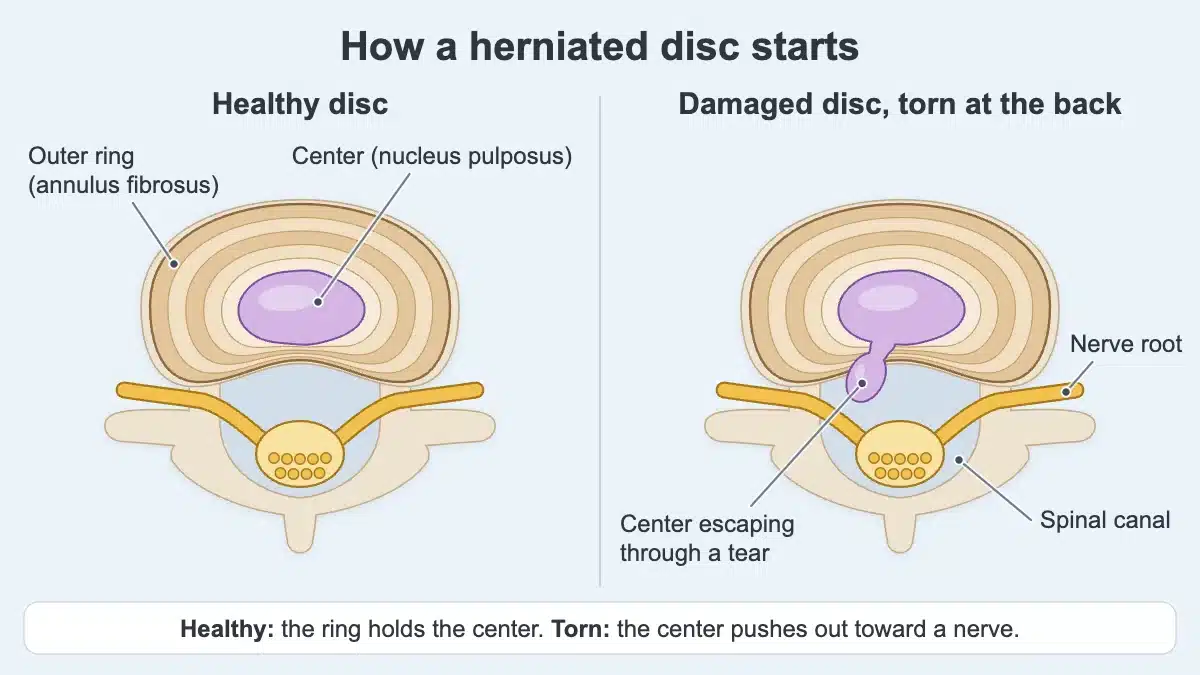
The center follows that path. In Why Spinal Discs Get Damaged, I say the nucleus “always migrates, or slips, bulges or herniates, towards the weakest point!” In Bulging Disc vs Herniated Disc, I explain that a tear at the front is not as significant as one at the back. The back faces the spinal canal and the nerve openings.
The bonds inside the ring matter too. In the talk, I explain that a compound called elastin holds the ring's fibers together. When less elastin is made, the disc degenerates and those bonds break down. The disc is then predisposed to the first stage of a slipped disc, a bulge.
Where Herniated Discs Happen Most
In the lower back, I see herniations most often at L4-L5, then at L5-S1, then at L3-L4. My Back Pain to Leg Pain talk ranks them in that order. The reason, as I put it there, is that when you bend at the waist, “95% of this movement is at L4-L5.” Posture can move the damage higher. I have seen healthy L4-L5 and L5-S1 discs beneath a damaged L3-L4 in people who slouch badly when they sit.
In the neck, C4-C5 and C5-C6 are, in my view, the workhorses, after the joints at the base of the skull. Holding the head forward over a laptop or phone puts them under heavy load. C6-C7 moves less, so it is harder to damage, but heavy loads still often injure it.
Symptoms and Urgent Signs
Where the escaped center presses decides what is felt. A low back disc can send pain, tingling, numbness or weakness into the buttock and leg. A neck disc can send them into the shoulder, arm, hand and fingers, or between the shoulder blades. My Back Pain to Leg Pain talk puts it plainly: “the most common symptom of spinal disc damage is zero.” Damage can sit for decades without pain, and some of my patients come in with weak legs and no back pain at all.
In my view, what matters most is not the pain itself but how long a nerve or the spinal cord stays under pressure. The guide Herniated Disc Treatment in Kuala Lumpur: Signs, Causes and Care covers each symptom.
Even with a disc that has been damaged for years, new symptoms with back or leg pain need attention. New or worsening numbness around your genitals, between your genitals and anus, or around your anus needs urgent medical attention: a thorough assessment at a hospital emergency department straight away, within hours. New difficulty passing urine needs the same urgent assessment before bladder or bowel control is lost, and a loss of that control is urgent too. Several causes are possible. Some may call for an invasive procedure, but assessment helps determine the next step and does not automatically mean surgery.
Leg weakness that keeps getting worse should not be ignored. It calls for a careful assessment by a competent provider, and conservative care can continue only while the weakness itself is improving. As I say in the talk, a neck disc pressing on the spinal cord “can go as far low as your legs.” It can bring weakness or trouble walking, and that needs prompt medical assessment.
Age, Genetics and Earlier Injury
Age is a factor, but in my view it is never the only one. My youngest spinal disc patient was a girl of seven, as I recall in my Back Pain to Leg Pain talk. Many of my disc patients are in their late teens and early twenties, and I have also seen healthy discs in people in their 80s. Genetics, posture, daily habits and earlier injuries all play a part. Together, they can start the damage far earlier than most people believe.
Some damage starts at the end-plate itself. Schmorl's nodes are small pockets where disc material has pushed into the bone above or below. In my view, a disc weakened this way can later herniate horizontally, through its outer ring, as well. The guide Schmorl’s Nodes: What They Are and What They Mean explains them in full.
The End-Plates That Feed a Disc
A disc has no direct blood supply of its own. Blood reaches it only through the end-plates, from the bone above and below; I cover this in my Back Pain to Leg Pain talk. As I put it there, “You cannot have a healthy disc if your bone is not healthy.” The end-plates soak up blood, and the disc draws fluid and nutrients in from them, a process explained in Imbibition: Enhancing Spinal Disc Hydration.
The cartilage end-plate belongs to the disc, not to the bone, and it is usually less than 1 mm thick. In my view, it also anchors the disc to the vertebra. Nutrients must cross it, then the disc's own tissue, to reach its cells. Some of those cells sit up to 8 mm from the nearest blood vessel (Urban and Roberts, 2003). In my experience, injuries and minor spinal problems left neglected disturb the end-plates and interrupt that flow. Continued disruption of it is, I believe, the leading cause of a herniated disc.
Sleep is when a disc refills. Pressure inside it drops when lying down, which is why people are measurably taller in the morning. If a job means sitting all day, I say in the talk, “your disc is not getting rehydrated. The only chance you have is sleep.” My advice is at least six hours of sleep and, where possible, seven to eight unbroken hours.
How Pressure Starves a Disc
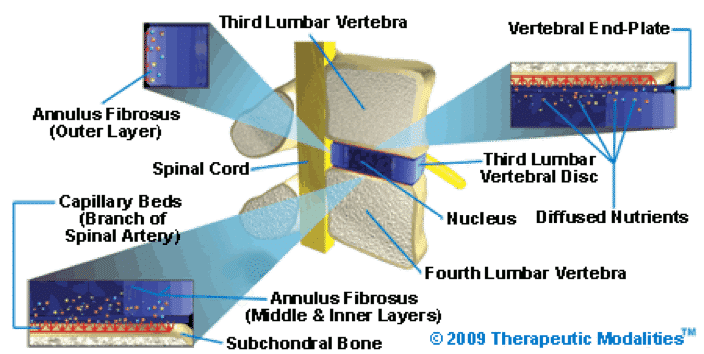
High pressure inside a disc keeps fluid and nutrients out, which is why bending and long sitting matter so much. My Back Pain to Leg Pain talk compares that pressure to a bouncer the size of Hulk at the door. The nutrients carried in the blood cannot get past it. Disc cells make aggrecan, a large molecule that draws in water and holds it like a sponge. They need a steady supply to keep making it.
Only oxygen, amino acids, sugar and water get through. In the talk, I explain that everything else in the blood is kept out. The disc's cells must build their own materials from those few nutrients. High pressure also breaks the aggrecan apart and pushes it out of the disc. I call it a double whammy: the good material leaves, and new nutrients cannot come in.
A review of disc degeneration describes what follows a fall in nutrient supply. The oxygen level falls and the disc becomes more acidic. The cells then make less matrix, the material the disc is built from (Urban and Roberts, 2003). In my view, that starvation is how years of load turn into a herniated disc.
Herniated Disc Chiropractor: What Is Used and Avoided
With a herniated disc, I use chiropractic manipulation that is non-rotatory using the Activator instrument, or flexion-distraction on a moving table, alongside physiotherapy and exercise. Care is kept within what you can comfortably tolerate. Possible effects and risks are explained before care begins.
In Sciatica vs Slipped Disc, I explain that I look for trigger points and myofascial points, because addressing only one part is not enough. Rehabilitation exercise, movement retraining, posture correction and guided strengthening are part of the plan too.
By conservative care, I always mean focused care. I plan it from what the MRI and the examination find; it covers the whole region and does no harm. In my view, many forms of conservative care are useless for a damaged disc, so the plan is aimed at the causes the findings document.
With a damaged disc, the spine is never cracked or twisted. In Sciatica vs Slipped Disc, I say that cracking and twisting “should not be done on the spine that has a damaged disc.” I turn to rotary manipulation only when I am 100 percent certain that no disc is damaged. As I ask in that video, “how can you be sure? So it's better to be safe than sorry.”
In the same video, I call surgery the last option: “Exhaust conservative route.” To me, surgery becomes an option only after focused conservative care, properly given, has not worked. New or worsening numbness around the genitals or anus, new difficulty passing urine, or any loss of bladder or bowel control needs urgent medical attention at a hospital emergency department straight away, within hours.
Avoided With a Damaged Disc
Beyond cracking and twisting, my Back Pain to Leg Pain talk names other things I advise against with a damaged disc:
- Yoga, even when it feels good. Its forward folds and twists repeat the bending and rotation a damaged disc tolerates least well.
- Deadlifts at the gym.
- Swimming laps. Walking in water is gentler, with no twisting and no repetitive movement.
- General stretching, side bending above all, which presses the disc toward any weak point.
- Hot packs. Heat adds to the inflammation inside a damaged disc and around its joints.
Ruptured or Herniated Disc: One Kind of Damage
Ruptured disc and herniated disc are two names for one stage. So the causes of a ruptured disc are the same: years of load on a disc already damaged. In my Short The Truth About Herniated Discs, I call them interchangeable terms for a severe slipped disc that is no longer contained. The soft center, the nucleus pulposus, has broken through the protective outer ring, the annulus fibrosus.
In my order, the stages run like this:
- Bulge: the disc's fibers swell beyond their usual size. In my definition, a true bulge does not compress the spinal cord or nerves.
- Protrusion: the outer fibers still hold, but the center has shifted outward, toward the spinal canal or a nerve opening. It remains contained.
- Prolapse: only a few outer structures still keep the center from rupturing into the spinal canal. It is barely contained.
- Herniation, the same stage as a rupture: the center has broken through the outer ring and is not contained.
- Extrusion: the center is expelled toward the edge of the disc. Prompt assessment is needed, though surgery is not automatic.
- Fragmentation: part of the center breaks away and floats free in the spinal canal. I call it the last and most dangerous stage.
The guide Herniated Disc Treatment in Kuala Lumpur: Signs, Causes and Care explains each stage. The stage that follows a herniation is covered in What Is an Extruded Disc? Meaning, Symptoms and Care in KL.
Related Disc Pages
These guides follow a damaged disc from its first changes to its later stages. They also look at each spine level and at the daily loads that wear a disc down. For a full understanding of disc conditions, you may also find these pages helpful:
Disc Stages
- Herniated Disc Treatment in Kuala Lumpur: Signs, Causes and Care
- Degenerative Disc Disease: Desiccation, Stages and Treatment
- Disc Bulge: Meaning, Symptoms, Treatment & Can It Be Reversed?
- What Is a Disc Protrusion? Meaning, MRI Locations and Care
- What Is a Prolapsed Disc in the Spine? Symptoms, Causes and Care
- What Is an Extruded Disc? Meaning, Symptoms and Care in KL
- Fragmented Disc: Partial or Sequestered, Symptoms and Treatment
- Slip Disc: What the Non-Surgical Options Involve
Spine Levels
Back, Neck and Leg Symptoms
Daily Loads and Disc Health
Session fees are listed on Chiropractic Price in Kuala Lumpur: CSC Fees & Costs and Physiotherapy Price in Kuala Lumpur: CSC Fees and Costs. The fee for a plan is explained and agreed before care begins.
Slipped Disc Causes: Common Questions
A slipped disc develops over years, not in a single moment. The answers below take its causes one question at a time.
Can coughing or sneezing cause a herniated disc?
A cough or a sneeze can be the moment a herniated disc shows itself, but not the cause. In my view, the disc it finds was already damaged by years of load. My Back Pain to Leg Pain talk describes what torn fibers feel like. Turning over at night can wake a person up, and a cough can feel like a knife going through the back. Even laughing can hurt, since each movement sets the torn fibers vibrating. That is why a small sneeze can feel like the start of everything.
Does lifting weights at the gym cause a slipped disc?
Lifting weights at the gym can add to a disc's damage. Free weights, deadlifts and lifting while bent or twisted all load a damaged disc. I tell patients plainly, in my Back Pain to Leg Pain talk, not to do deadlifts at the gym. In the same talk, I say exercises must be age appropriate, condition specific and done only when the body is ready. The guide Deadlifts, Free Weights & Slipped Disc Risk Explained goes through the exercises one by one.
How does sleep affect a damaged disc?
Sleep is when a damaged disc takes in fluid again. Lying down lowers the pressure inside it, and the disc draws water and nutrients in through its end-plates. Position matters too. My advice in the Back Pain to Leg Pain talk is to sleep on the side, the right side if possible. The spine forms one straight line, and the neck is not bent. Many people who think they sleep on their side are half-turned onto the stomach, which twists the spine. On the back, a bolster goes under the knees and a rolled towel under the neck.
Can supplements rebuild a damaged disc?
No. Taken by mouth, glucosamine, chondroitin, MSM and hyaluronic acid do not benefit the disc; I say so in my Back Pain to Leg Pain talk. I add that I have not seen any research on a compound, taken by mouth, that builds the disc up. That is why the loads on the disc, and the sleep that lets it refill, matter more than any capsule. Supplements for general health are a matter for a person's own doctor.
Why do young people get disc damage?
Young people get disc damage because damage follows habits, not birthdays. Long hours of sitting at school and at work load young discs. So do a head held forward over a phone or a laptop, and lifting with poor technique. The damage can stay silent for years, so a young person may feel nothing at first. When it shows itself, it is often in the late teens or early twenties. My Back Pain to Leg Pain talk sums it up: “posture is the most important.”
Can a herniated disc come back after care?
Yes, it can. In Sciatica vs Slipped Disc, I say that recurrent neck and back problems are common. In my view, a disc that has herniated does not return to normal, and the damage is progressive. The habits that damaged it can keep damaging it. What a person can change is the daily load: lowering what harms the disc and raising what feeds it. That means shorter spells of sitting, no bending or twisting, careful lifting and enough sleep. Doing both gives any care a better chance.
New or worsening numbness around the genitals or anus, new difficulty passing urine, or any loss of bladder or bowel control needs urgent medical attention at a hospital emergency department straight away, within hours.
Share with others:
How to Read This Guide
This guide explains how a herniated disc develops; it is education, not a diagnosis. My views appear in the first person, and each one taken from a video of mine or my talk carries its title. The rest come from my written answers. The study is named by its authors and year and listed below. Only an examination can say what caused your own disc problem.
Peer-Reviewed Reference
- Billy GG, Lemieux SK, Chow MX. Changes in lumbar disk morphology associated with prolonged sitting assessed by magnetic resonance imaging. PM R. 2014;6(9):790-795.
- Urban JPG, Roberts S. Degeneration of the intervertebral disc. Arthritis Res Ther. 2003;5(3):120-130.
These papers describe discs and people in general, not the care given at Chiropractic Specialty Center.
The Author of Causes of a Herniated Disc: Sitting, Lifting, Early Damage
Causes of a Herniated Disc: Sitting, Lifting, Early Damage was written by Yama Zafer, D.C., who has 30+ years in chiropractic and physiotherapy and founded Chiropractic Specialty Center in Kuala Lumpur in 2006.
Last Updated: What Are the Causes of a Herniated Disc?
What Are the Causes of a Herniated Disc? was last reviewed and updated on October 15, 2026.