

Chiropractic and Physiotherapy in Malaysia at CSC Kuala Lumpur
Chiropractic and physiotherapy at Chiropractic Specialty Center (CSC) are two separate professions that are planned together for spine and joint problems. Chiropractors focus on how the joints of the spine and limbs move; physiotherapists focus on muscles, strength, balance and movement habits. At CSC both teams share one plan, often in the same session.
CSC has offered chiropractic and physiotherapy together in Kuala Lumpur since 2006, at the Bukit Damansara main center and at Bandar Sri Damansara, and has seen nearly 50,000 patients in that time by my estimate. Care starts with non-drug options such as gentle joint care and exercise. New patients can usually be seen the same day at either center, but call or send a WhatsApp message first.
This page, Chiropractic and Physiotherapy in KL: 6 Clear Facts at CSC, is published by Chiropractic Specialty Center, Bukit Damansara (KL) main center: WhatsApp +60 17 269 1873 Call +603 2093 1000
Chiropractic and Physiotherapy at CSC: Six Facts First
- Two professions, one plan: the assessment covers both disciplines, and the plan is not split between them.
- Either one, or both: chiropractic and physiotherapy can be used alone or together, depending on what the examination finds.
- No twisting of a damaged disc or the neck: chiropractic at CSC uses non-rotatory methods such as the Activator.
- Exercise is central: hands-on care is paired with exercise and advice on daily habits, not used on its own.
- A review point in every plan: if there is no improvement by about the fifth session, the plan is reassessed.
- The same fees at both centers: RM100 for the examination, RM150 for an adjustment, or RM110 when physiotherapy is included.
Why Combine Chiropractic and Physiotherapy?
Many neck, back and joint problems involve both a stiff joint and weak or tight muscles. Chiropractic works on how the joint moves; physiotherapy works on the strength and control around it. When chiropractic and physiotherapy are planned together, the joint work and the muscle work point the same way, and the advice does not pull in different directions.
An adjustment alone cannot reach every tissue at depth; physiotherapy does. That is why I tell people not to choose between a chiropractor and a physiotherapist, but to choose both. Some people need only chiropractic, some only physiotherapy, and some need a medical doctor first, and the examination decides which. More is in chiropractic therapy combined with physiotherapy.
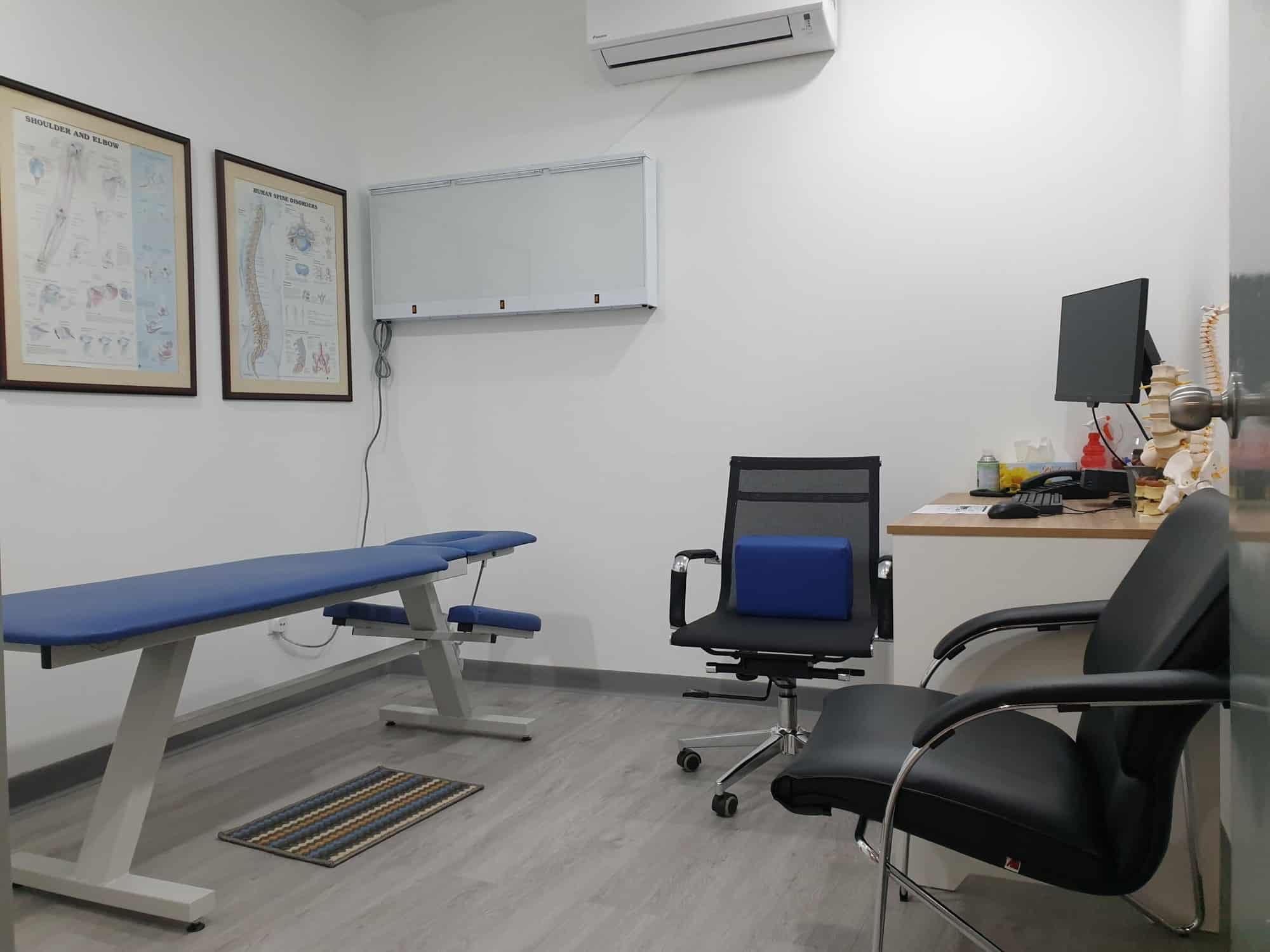
What Chiropractors Do
- Examine the spine and joints: movement, orthopedic and nerve tests, and imaging only when the examination shows a reason for it.
- Adjust stiff joints gently: by hand or with the Activator, a small hand-held instrument, with no fast twisting of the neck.
- Mobilize and decompress: joint mobilization, flexion-distraction and, when indicated, spinal decompression.
- Care for the limbs and jaw too: the shoulder, elbow, wrist, hip, knee, ankle and foot, and the jaw joint.
What Physiotherapists Do
- Work on soft tissue: muscles, tendons and ligaments, by hand and with equipment such as shockwave, laser and ultrasound.
- Build strength and control: graded exercise, balance training and movement retraining.
- Teach a home program: exercises and advice for work, sleep and lifting, checked and progressed at each visit.
- Guide the return to activity: walking further, sitting longer, lifting safely and getting back to sport.
Who Provides Chiropractic and Physiotherapy at CSC
I am the only chiropractor at CSC who holds the Doctor of Chiropractic degree, with more than 30 years in practice. Every other chiropractor holds a Bachelor of Science (Hons) degree, with experience ranging from new graduates to more than 12 years. The physiotherapy team holds degree and diploma qualifications, many with between seven and 16 years of experience.
Both centers use the same examination and the same methods, and the same fees apply. The Bukit Damansara main center also has a full physiotherapy gym, and Bandar Sri Damansara has DTS traction and decompression in addition to the equipment both centers share.
What to Expect at the First Visit
The first visit is a conversation and a physical examination. The chiropractor or physiotherapist asks about your pain, your daily routine and your health history, then checks how you move, your strength and, if needed, your nerves. Any scans you bring are read too. The first visit has no fixed length; it can take 20 minutes or more than an hour.
Imaging is decided only after the examination, never before; please bring films, CDs and reports you already have rather than having a scan taken just for the visit. You then get a plan with clear goals, such as walking further, sitting longer or sleeping better. These goals are measured at the start and checked again during care, and if progress stalls, the plan changes or you are referred elsewhere.
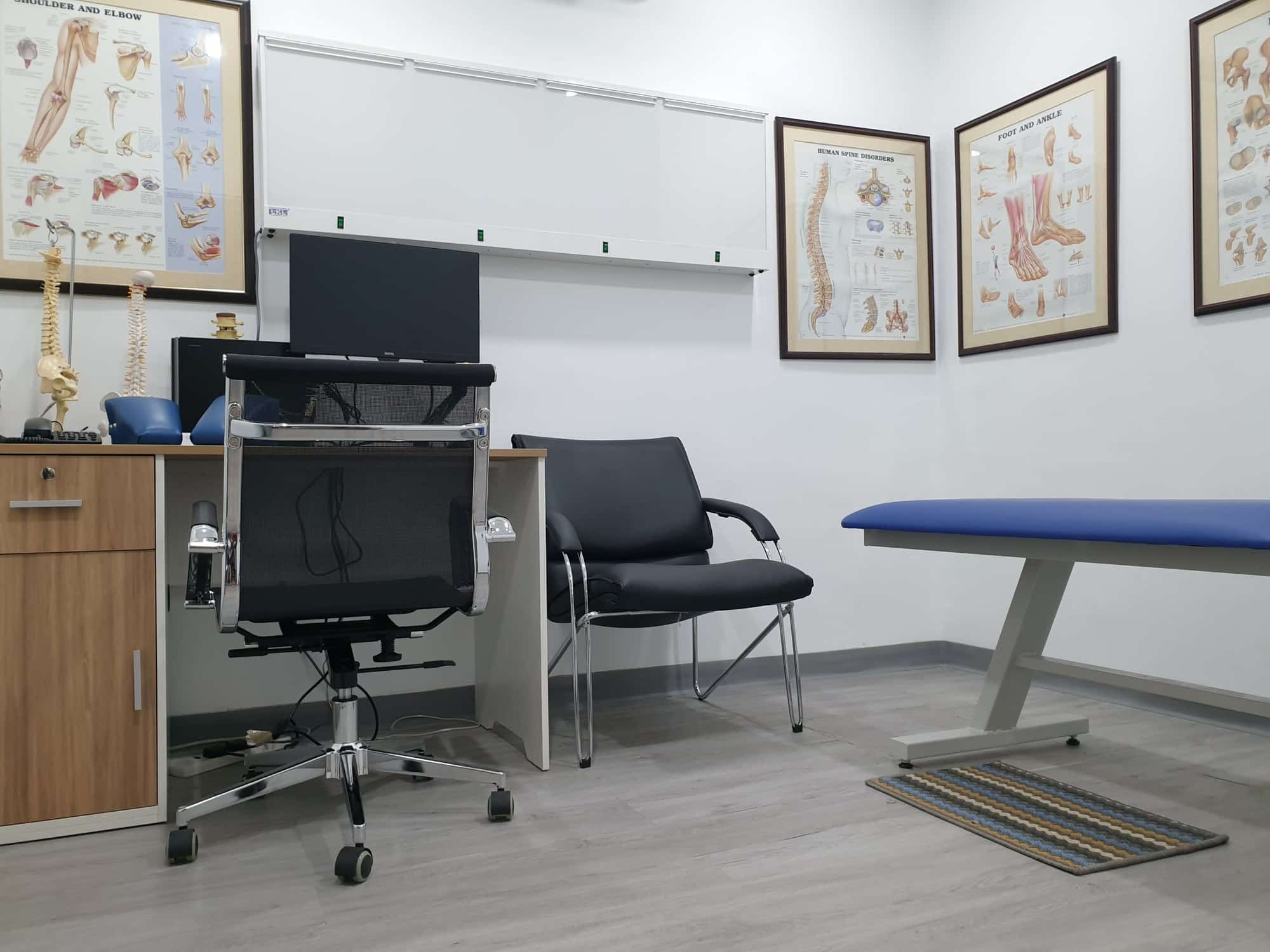
What Chiropractic and Physiotherapy Care May Include
- Chiropractic: gentle adjustments by hand or with the Activator, joint mobilization and flexion-distraction.
- Physiotherapy: soft-tissue work, exercise, balance training and movement retraining.
- Equipment, when the examination supports it: the RxDecom® decompression system, Spinercise®, the FD-3000, high-intensity laser therapy, shockwave, ultrasound and electrotherapy.
- A home program: exercises and advice for work, sleep and lifting.

Chiropractic and Physiotherapy for Common Problems
Low back pain and sciatica: a non-rotatory adjustment for the irritated segment, soft-tissue work for the buttock and thigh, pelvic floor and buttock squeezes from the first day, walking on level ground, and breaks from sitting. Twisting adjustments are not used on a damaged disc.
Neck pain and headaches from the neck: low-force care for the small joints of the neck, never forceful twisting or Y-strap pulls, with exercises for the muscles that hold the head up and changes to screen height and sleep.
Slipped disc: the Activator rather than twisting, spinal decompression when it is indicated, and a slow build of the deep trunk muscles, with advice on sitting, lifting and sleep.
Knee, shoulder and hip problems: gentle joint mobilization or adjustment, soft-tissue work and graded strengthening. For the knee I use my own alignment method, developed with the Activator instrument, with no twisting, yanking or pulling.
Sports injuries: joint care to restore movement, then progressive loading and sport-specific exercise before a return to play.
Chiropractic and Physiotherapy for Desk Workers
Long hours at a desk are behind a large share of the neck, upper back and lower back problems seen at CSC. Chiropractic and physiotherapy for desk workers combine gentle joint care for the stiff segments with exercises for the upper back and shoulders, such as the W, Y, T and L positions, and changes to the workstation.
- Sit back in the chair, with your seat and the top of the belt line against the back support.
- Keep elbows at about 90 degrees and the keyboard close; attach a laptop to a monitor, with your eyes slightly below the top of the screen.
- Stand every 15 minutes if you have neck or back problems, and walk for 10 to 20 seconds.
Chiropractic and Physiotherapy During and After Pregnancy
During pregnancy, rotatory chiropractic methods are stopped, because the hormone relaxin loosens the ligaments; the Activator can be given seated, on the side or face down. Physiotherapy adds pelvic and hip exercises and advice on sleeping, standing and lifting. After birth, chiropractic and physiotherapy look at lower back pain and muscle weakness, with exercise for the strength that daily life with a baby needs.
Chiropractic and Physiotherapy for Older Adults
For older adults, and for anyone with reduced bone density, chiropractic uses low-force methods such as the Activator and S.O.T. blocks, with no rotational techniques. Physiotherapy focuses on strength and balance; the World Health Organization advises older adults to do balance and strength training on three or more days a week to help prevent falls. Age alone does not decide how well someone heals: general health, how long the problem has been there and how closely the advice is followed matter more.
When Chiropractic and Physiotherapy Are Not Enough
CSC is equipped to assess, and where an intervention is needed that CSC is not equipped for, a referral to an appropriate healthcare provider is made. Do not ignore progressive weakness; seek care from a competent provider, conservative or surgical. Conservative care can continue only while the weakness itself is improving, and for as long as it produces results it may still be a reasonable route.
What You Do Between Visits
- Walk on level ground, short and often; walking depressurizes the joints.
- Break up sitting: with acute pain, move for 30 seconds to a minute every 15 to 20 minutes; as it settles, every 30 to 40 minutes.
- Use cold, not heat, on a disc or an inflamed area, cloth-wrapped, for 10 to 15 minutes, two or three times a day.
- Sleep at least six hours, on your side, with a pillow that keeps the spine straight.
- Do the home program every day, and bring questions about it to the next visit.
I see a patient for 30 minutes or two hours. What about the other 22 hours? The best time to change a habit is while it still hurts, because when you are feeling better you are not going to change anything.
How Long Chiropractic and Physiotherapy Care Takes
It depends on the severity of the problem, how long it has been there, your general health and how closely the advice is followed. If there is no improvement by about the fifth session the plan is reassessed; if there is none by the tenth, we discuss whether to continue. Once the active phase is over, a check now and then makes sense for someone who has had episodes before.
For any care to help, the problem first has to be accurately diagnosed, then properly planned, then carried out with as few flaws as possible, and finally topped with changes to posture, habits and daily activities. Recovery comes from increasing what helps the problem and decreasing what harms it, at the same time.
In that short video I explain how chiropractic, physiotherapy and rehabilitation are coordinated at our centers, starting with a thorough assessment.
What the Research Says
Reviews support manual therapy, including spinal manipulation, as a reasonable option for low back and neck pain. For chronic low back pain, a 2019 systematic review found that spinal manipulation produces small, short-term improvements in pain and function, similar to other recommended treatments. For preventing new episodes of back pain, exercise combined with education has the strongest evidence.
The common message is that hands-on care helps most when it leads into exercise and a return to normal activity, which is why chiropractic and physiotherapy are combined at CSC rather than offered as alternatives.
In Is Chiropractic Safe? 13 Questions Answered I explain why I tell people to choose both a chiropractor and a physiotherapist, and when a method that does not twist the spine is the better choice.
Questions to Ask Any Chiropractic and Physiotherapy Center
- Who examines me, and what are their qualifications? You should be able to learn who is a chiropractor and who is a physiotherapist.
- Is there one plan, or two? Chiropractic and physiotherapy work best when one assessment covers both.
- Will you twist my neck or a damaged disc? At CSC the answer is no.
- When will the plan be reviewed, and what will be measured?
- What should I do between visits? If the answer is nothing, the part of care with the strongest evidence has been left out.
To book a visit for chiropractic, physiotherapy or both, contact either Kuala Lumpur center. Directions and hours are on the Bukit Damansara contact page and the Bandar Sri Damansara contact page:
- Bukit Damansara (KL, main center): Call +603 2093 1000 or WhatsApp +60 17 269 1873 to see the Bukit Damansara / KL center
- Bandar Sri Damansara (KL): Call +603 6262 5777 or WhatsApp +60 12 455 6939 to see the Bandar Sri Damansara center
Fees, Packages and Payment
Fees are the same at every CSC center: RM100 for the examination and RM150 for an adjustment, or RM110 when the visit also includes physiotherapy, as listed on the chiropractic price in Kuala Lumpur page, with physiotherapy fees listed separately. Discounted packages of 15 and 20 sessions are available; the main office can explain them on WhatsApp.
CSC accepts cash, card and online transfer. CSC is not listed on insurance panels or corporate schemes; a guarantee letter may be accepted case by case if you ask before your visit. The Bukit Damansara main center has paid parking, including a disabled bay with a ramp to the front door, and buses stop in front.
Chiropractic and Physiotherapy: Common Questions
Is chiropractic and physiotherapy the same thing?
No. They are separate professions with different training. Chiropractors focus on how joints move; physiotherapists focus on muscles, strength and movement.
Should I see a chiropractor or a physiotherapist?
For most spine and joint problems, both. At CSC the examination decides whether you need chiropractic, physiotherapy or both, under one plan.
Can I have chiropractic and physiotherapy in the same visit?
Yes. At CSC both are often given in the same session, and the fee for an adjustment is lower when the visit also includes physiotherapy.
Do I need a referral for chiropractic and physiotherapy in Malaysia?
No referral is needed to book at CSC. Bring any scans and reports you already have.
How much do chiropractic and physiotherapy cost at CSC?
RM100 for the examination and RM150 for an adjustment, or RM110 with physiotherapy. Physiotherapy fees are listed on their own page.
Back and Neck Pages
- Back pain treatment: assessment, causes and care options.
- Lower back pain: which structure produces what.
- Neck pain treatment: what the symptom pattern reveals.
- Slipped disc: causes, stages, symptoms and care.
- Herniated disc treatment: signs, causes and care in Kuala Lumpur.
- Sciatica treatment: what the first weeks involve.
Joint and Method Pages
- Knee pain: causes, symptoms and assessment.
- Shoulder pain treatment: what is assessed.
- Hip pain treatment: where the pain starts.
- Flexion-distraction: for the spine and discs.
- Shockwave therapy: what it treats and how it feels.
- High-intensity laser therapy: what a session is like.
Peer-Reviewed References
- Rubinstein SM, de Zoete A, van Middelkoop M, et al. Benefits and harms of spinal manipulative therapy for the treatment of chronic low back pain: systematic review and meta-analysis of randomised controlled trials. BMJ. 2019;364:l689.
- Bronfort G, Haas M, Evans R, Leininger B, Triano J. Effectiveness of manual therapies: the UK evidence report. Chiropr Osteopat. 2010;18:3.
- Hurwitz EL, Carragee EJ, van der Velde G, et al. Treatment of neck pain: noninvasive interventions: results of the Bone and Joint Decade 2000-2010 Task Force on Neck Pain and Its Associated Disorders. Spine. 2008;33(4 Suppl):S123-S152.
- Steffens D, Maher CG, Pereira LS, et al. Prevention of low back pain: a systematic review and meta-analysis. JAMA Intern Med. 2016;176(2):199-208.
These references describe manual therapy and exercise for spine and neck pain in general. None of them evaluates care at Chiropractic Specialty Center.
The Author of Chiropractic and Physiotherapy in KL: 6 Clear Facts at CSC
Chiropractic and Physiotherapy in KL: 6 Clear Facts at CSC was written by Yama Zafer, D.C., Chiropractor in Kuala Lumpur Since 1996, who founded Chiropractic Specialty Center in Kuala Lumpur in 2006.
Last Updated: Chiropractic and Physiotherapy in Malaysia at CSC Kuala Lumpur
Chiropractic and Physiotherapy in Malaysia at CSC Kuala Lumpur was last reviewed and updated on October 28, 2026.
Share with others: