

Opening a Chiropractic Clinic With the CSC Franchise
Opening a chiropractic clinic starts with deciding who will provide care and which services patients can receive on site, before you choose a building. A chiropractor opening a neighborhood practice may want to begin with a small team. A hospital adding a spine and joint center may already have physiotherapists, referral arrangements and space for rehabilitation. Those are different starting points for choosing premises, hiring staff and selecting equipment.
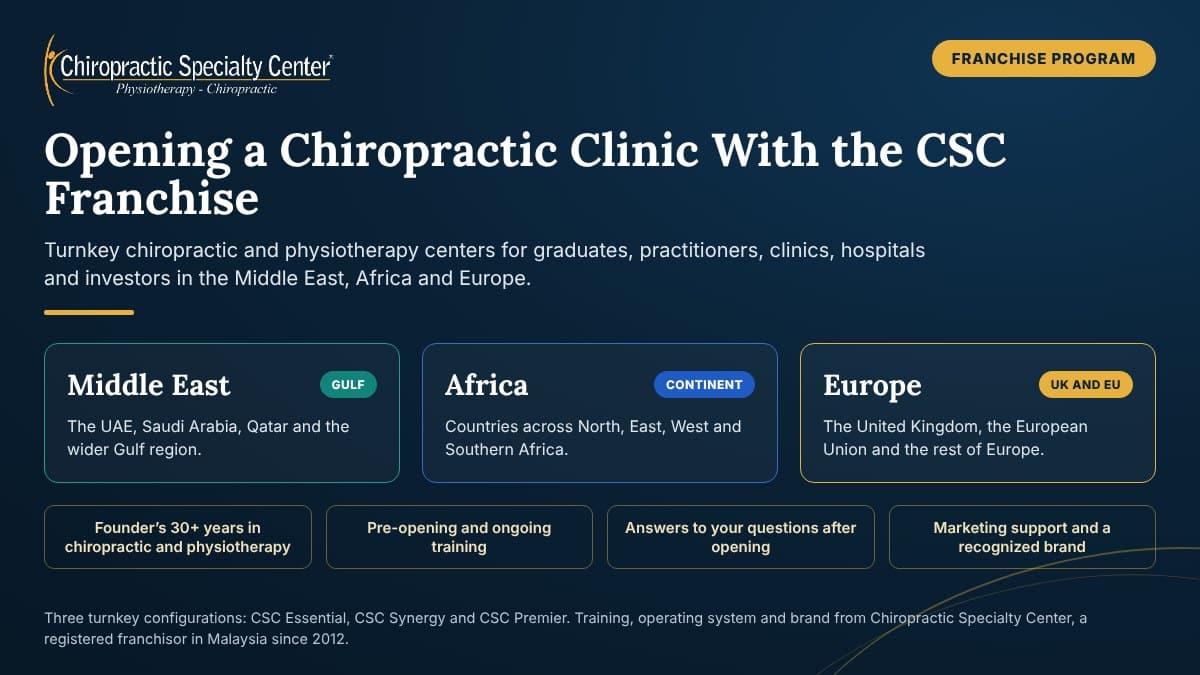
Chiropractic Specialty Center (CSC), founded in Kuala Lumpur in 2006, welcomes franchise inquiries from the Middle East, Africa and Europe, as well as Malaysia and the rest of Asia. Recent graduates, practitioners, clinics, hospitals, wellness centers and investors can propose a single center in their chosen city or discuss a master franchise for a country or region.
WhatsApp for franchise inquiries: +(60)12 730 6950
| Point | Detail |
|---|---|
| Regions | The Middle East, Africa and Europe, as well as Malaysia and the rest of Asia. |
| Who can apply | Recent chiropractic and physiotherapy graduates, practitioners, medical professionals, clinics, hospitals, wellness centers and investors. |
| Three turnkey configurations | CSC Essential, CSC Synergy and the flagship CSC Premier, from RM 586,080 to RM 1,614,830 in Malaysia, with the investment for each country confirmed in the review. |
| NSD Therapy® protocols | Included with CSC Premier, together with its RxDecom® spinal decompression unit. |
| Rights | One approved center, or a master franchise for a country or region. |
| Support | Pre-opening training, answers to your questions after opening, marketing support and the CSC brand. |
| How to start | A WhatsApp message with your country, city and plans. |
Opening a Chiropractic Clinic With or Without Physiotherapy
The practical question is whether patients can see a physiotherapist at your clinic or need a referral elsewhere. Both arrangements can work. Think about the clinicians available in your city, the space you can use and how a patient moves between appointments. The table compares the two models.
| Decision | Chiropractic without on-site physiotherapy | Chiropractic with on-site physiotherapy |
|---|---|---|
| Advantages | A smaller team is easier to recruit and schedule. You can plan the premises around the chiropractor's work and build relationships with local physiotherapists. | Patients who need both professions can attend one location. With consent, clinicians can coordinate handovers, exercise instruction and follow-up. |
| Disadvantages | Patients who need physiotherapy must arrange a separate visit. Your team needs a reliable referral partner and a way to receive progress updates. | You need additional registered staff, suitable rooms or exercise space, and a schedule that keeps both services available when patients need them. |
| What to check locally | The chiropractor's scope, the clinic's permitted services and how the referral arrangement will work. | Each profession's registration, the facility approval for both services, insurance and who is responsible for each patient record. |
This comparison applies to clinic planning generally. CSC's Essential configuration has a smaller equipment list and still includes physiotherapy staff in its staffing model. If you want to open without on-site physiotherapy, tell us at the outset so we can review the proposal and the rules for your market. The Malaysian program is set out on Chiropractic Franchise With Physiotherapy & NSD Therapy® Protocols.
At CSC's Kuala Lumpur centers, chiropractors and registered physiotherapists bring different skills to the same case, and each works within their own scope. See Chiropractic Combined With Physiotherapy in Kuala Lumpur.
How to Open a Chiropractic Center, Step by Step

- Define the service. List what the clinic will do on opening day, who will lead it and which services will need an outside referral. For an existing hospital or wellness center, identify which rooms, staff and systems can be shared.
- Check the licenses. Give the local authorities the proposed address, ownership structure, clinical roles and service list. Ask separately about the premises, each practitioner and any equipment you plan to import.
- Test the premises. Walk the route from the entrance to the treatment room. Check elevator access, door widths, privacy, accessible restrooms, power, equipment delivery and space for supervised exercise. Confirm the permitted use before you sign the lease.
- Recruit and prepare. Verify credentials and insurance. Put someone in charge of appointments, consent, handovers, patient records, emergency arrangements and equipment servicing. Train the team in the work they will actually do.
- Rehearse an appointment. Walk through a visit from booking to follow-up. Confirm that staff know who makes the clinical decision, how a patient reaches a second practitioner and what to do when a medical assessment is needed.
For a real example of how parking, access and the entrance shape a clinic visit, see Chiropractic Specialty Center Bukit Damansara: Contact.
Opening a Chiropractic Clinic as a Recent Graduate
Many new chiropractors and physiotherapists spend three to five years working at an established center to learn the methods and the business side of practice before they open their own clinic. Once they leave, the support they had is often no longer there. The CSC franchise program shortens that path.
Franchisees draw on the experience of the founder, Yama Zafer, D.C., with 30+ years in chiropractic and physiotherapy. CSC trains each franchisee and their team, stays available for their questions after opening, helps them market the center and reach more patients, and gives them the benefit of the CSC brand and name recognition.
Because each configuration is a turnkey operation with a defined investment, a graduate does not have to build a center from nothing and can start at the level that suits their budget.
Who Can Open a CSC Center?
We welcome chiropractors, physiotherapists (also called physical therapists), medical doctors, nurses, recent graduates and other healthcare professionals. Hospitals, rehabilitation providers, wellness centers, business owners and investors can also inquire. In your first message, tell us whether you intend to provide care, run the business or develop a regional network.
A non-clinical owner can propose a structure in which an appointed clinical lead and appropriately registered practitioners provide care, subject to local ownership rules. A qualification in medicine or nursing does not by itself authorize practice as a chiropractor or physiotherapist. Meet the people in those roles at CSC on Integrated Chiropractic and Physiotherapy in KL.
One Standalone Center or a Master Franchise?
A single-center franchise is for someone who wants to run one approved CSC location. That can be a new standalone clinic or, after review, a center within a hospital or wellness facility. A current clinic owner can propose a conversion, and CSC reviews the site, staff, equipment and documentation to identify what can stay and what needs to change. See how CSC reviews an existing clinic.
A master franchise is for an individual, company or healthcare group that wants to develop CSC in a defined country or region. The work may include recruiting operators, coordinating training and supporting local centers. Availability, development milestones, support duties and any rights to appoint subfranchisees are set out in the applicable agreement. See CSC's single-unit, multi-unit and regional growth pathways.
For a single site, bring a city, a service plan and a prospective clinical lead. For a master franchise, also bring a plan for supporting more than one local team. In both cases CSC reviews the market, the local rules and the candidate before approving a location or granting rights.
Three Turnkey Configurations, From Core Equipment to Flagship

Start with equipment your team is ready to use. Owning a device before you have trained staff, suitable space or a local service technician can leave a room sitting idle. CSC offers three configurations, so you can match opening-day services to your team and apply for an upgrade later.
CSC Essential
RM 586,080
The core manual-care configuration: a flexion-distraction table, an Activator® adjustment set with SOT blocks, therapy beds and basic operating equipment, with RM 43,900 of therapy equipment. See Chiropractic Adjustment for All Ages and Joints.
CSC Synergy
RM 1,008,830
Builds on Essential for a team of chiropractors and registered physiotherapists, adding shockwave, high-intensity laser, therapeutic ultrasound, interferential current and exercise equipment, with RM 277,700 of therapy equipment. See Chiropractic Services and Physiotherapy in KL.
CSC Premier
RM 1,614,830
The flagship: the Synergy equipment plus an RxDecom® spinal decompression unit and the NSD Therapy® protocols, with RM 883,700 of therapy equipment. See RxDecom® Spinal Decompression Care in Malaysia.
Each amount is a turnkey figure from the Malaysian program. It includes the RM 75,000 initial franchise fee, the therapy equipment, computers and IT, furniture and signage, the renovation and its architectural fees, rental deposits and down payments, rent during the renovation, salaries during pre-opening training, opening marketing and advertising, and six months of overhead to cover the center's expenses. Taxes, financing and costs that depend on the particular site are not included.
For a center outside Malaysia, rent, salaries, equipment shipping and licensing differ, so the investment for your country is confirmed during the review. When you are ready to expand, CSC reviews staffing, premises, training, insurance and local requirements before approving an upgrade. Compare the three side by side on CSC's configuration comparison.
NSD Therapy® Protocols and Non-Surgical Spine Care
CSC's team decides which parts of the service belong in a patient's plan from the examination, each professional's scope and local clinical guidance. That may include non-rotatory chiropractic, flexion-distraction, physiotherapy by registered physiotherapists or guided rehabilitation. The Spinercise® system is one example of equipment used for supervised spine and joint exercise; see Spinercise® Spine & Joint Exercise System.
CSC Premier includes the NSD Therapy® protocols, CSC's non-surgical protocol for disc-related spine problems, which patients can consider, after assessment, before deciding on spine surgery. Its components are mechanized spinal decompression, flexion-distraction, targeted soft-tissue work, non-twisting chiropractic and specific rehabilitation exercise, and examination findings decide which of them apply. Read NSD Therapy®: Components, Suitability and the Care Framework.
A clinician's responsibility is to decide whether conservative care is appropriate and to arrange a medical or surgical assessment when it is indicated. A hospital considering a CSC center should agree on a referral contact before opening, so that a patient who needs a specialist opinion has a clear next step. See Non-Surgical Slipped Disc Treatment in KL: Surgery or Not?
What Changes When You Choose a Country and City?
Malaysia. Chiropractic is a recognized practice area under the Traditional and Complementary Medicine framework, and physiotherapists register separately with the Malaysian Allied Health Professions Council. Check each practitioner's registration and practicing certificate. CSC's Bukit Damansara headquarters is a working example of a center with both professions.
The rest of Asia. In Singapore, chiropractors are not under a statutory registration regime; the Ministry of Health leaves standards to the professional associations, while physiotherapists register with the Allied Health Professions Council. In Hong Kong, chiropractors register with the Chiropractors Council and physiotherapists with the Physiotherapists Board.
The Middle East. In the United Arab Emirates, the license comes from the health authority for the emirate where the center opens; in Dubai Healthcare City, the regulator's complementary and alternative medicine guidelines include separate chiropractor license titles. In Saudi Arabia, the Saudi Commission for Health Specialties classifies and registers health practitioners. In Qatar, the Department of Healthcare Professions' 2026 standards set the qualifications and scope of practice for chiropractors.
Europe. The European Chiropractors' Union reports that chiropractic is regulated in 20 European nations, through specific legislation or general law, and that its status is unclear in five. In the United Kingdom, chiropractors must register with the General Chiropractic Council and physiotherapists with the Health and Care Professions Council. In Denmark, chiropractors trained outside the EU apply to the Danish Patient Safety Authority, which includes a Danish language test.
Africa. In South Africa, chiropractors register with the Allied Health Professions Council of South Africa and physiotherapists with the Health Professions Council of South Africa. In Namibia, the Allied Health Professions Board publishes the regulations for registering chiropractors. For another country, start with the national authority and the local office responsible for the site. Download the clinic licensing worksheet with the official sources.
What CSC Provides Before Opening and Afterward
We help the owner plan the site, select a configuration, recruit the right roles and train the team. Reception staff learn scheduling and handovers, and clinicians work through assessment, documentation, communication and referral decisions. CSC's practitioner training sessions show how those standards are taught.
In the Malaysian program, pre-opening training lasts one month for CSC Essential and two months for CSC Synergy and CSC Premier. For a center outside Malaysia, the training location and timetable are confirmed during the review. After opening, support includes operational guidance, quality reviews, approved marketing materials, system updates and a contact for your questions. See franchise training for chiropractors and physiotherapists.
After your inquiry, the usual sequence is an initial qualification review, a discovery call and a confidential review of the proposed center or territory. Qualified applicants receive the disclosure document to review with independent advisers, and signing and onboarding follow if both sides decide to proceed.
CSC became a registered franchisor in Malaysia in 2012, and the current registration as a franchisor is valid until November 2031, at which time CSC intends to re-register. Read About Chiropractic Specialty Center (CSC): Who We Are and How We Work.
On August 24, 2016, CSC published an account of a Malaysia-UAE franchise forum at which Yama Zafer, D.C., in chiropractic and physiotherapy since 1996, spoke about developing centers in the Middle East. CSC is now planning franchise expansion outside Malaysia, and applicants can propose a city or region for review. See Our Chiropractic and Physiotherapy Center in Malaysia: How It Began.
Questions From Prospective Clinic Owners
What can a recent graduate prepare before choosing a site?
Bring the country that awarded your qualification, your current registration status and the city where you want to practice. Write down the work you can do independently and where you would value supervision or business training. If someone else will manage the practice, ask them to join the discussion, so clinical and management responsibilities are divided from the start. CSC's training and support after opening are built for exactly this stage.
What should a hospital or wellness center bring to a site review?
Identify an available room or department, the services already licensed there and the person responsible for clinical governance. A floor plan helps the reviewer see how patients, staff and equipment would move through the space. Also explain whether records, appointment systems or reception staff would be shared. CSC's Bandar Sri Damansara center is an example of a different clinic layout from its headquarters.
Can an investor appoint someone else to run the clinic?
Yes. Tell us who would own the local business, who would manage it day to day and who would take responsibility for clinical services, since those may be different people. Local advisers should review the ownership arrangement and each clinician's authorization. For a master franchise, also identify who would support future operators when a site needs help with recruitment, training or an operational issue.
Can an existing center keep its equipment?
Prepare an inventory with the make, model, installation date, maintenance history and local regulatory status of each device, with the servicing contact and the trained operator. CSC then reviews which items suit the proposed configuration and which would need replacement or further approval. Get that review before you move equipment or commit to a new lease, so the conversion plan and the premises match.
How do we decide when to bring physiotherapy on site?
Review how many patients your clinicians refer, the reasons for those referrals and whether patients manage to attend an outside appointment. Then check whether you have a suitable registered physiotherapist, enough space and a realistic weekly schedule. That gives you a practical basis for the decision. In a CSC center, a change to the operating plan also needs the franchisor's approval.
What should I say in my WhatsApp message?
Tell us the country and city, whether you plan to open a new center or convert an existing one, and whether you want one site or a master franchise. Add your professional or business background and the services you want to offer. A short introduction is enough for the franchise team to route your inquiry. Keep patient records and identity documents out of this first message.
Contact CSC About Your Proposed Center
For a standalone center, tell us the city you have chosen. For a master franchise, name the country or region you would like to develop. Your message goes to the CSC franchise team.
WhatsApp for franchise inquiries: +(60)12 730 6950
You can also email [email protected].
For the franchise overview before you call, request CSC franchise information.
Page Review
Franchise details were checked against CSC's program materials, and the licensing worksheet links to the regulators' own pages, checked November 19, 2026. CSC's Professional Information: Who Writes and Reviews explains its editorial process. Investment figures are estimates; the franchise agreement and disclosure document govern.
Last Updated: Opening a Chiropractic Clinic With the CSC Franchise
Opening a Chiropractic Clinic With the CSC Franchise was last reviewed and updated on November 19, 2026.
I've metacarpal syndrome. It's disturb my workday activities.it is save to do da chiropractic?
Taking the likely intended condition first: symptoms in the hand that interfere with work most often turn out to be carpal tunnel syndrome, where the median nerve is compressed at the wrist. Its pattern is specific. Numbness and tingling in the thumb, index, middle, and half of the ring finger, characteristically worse at night, often waking you, and typically relieved by shaking the hand out. If your little finger is involved instead, that is a different nerve and a different problem.
On whether it is safe: manual treatment of the wrist, forearm, and neck is generally appropriate for this presentation, provided two things are true. The diagnosis has been confirmed rather than assumed, and there are no signs of advanced nerve compromise. The signs that change the answer are constant numbness that never fully lifts, and visible wasting of the muscle bulge at the base of the thumb compared with the other hand. Either of those indicates the nerve has been compressed long enough to cause loss, and that warrants a surgical opinion promptly, because recovery becomes less complete the longer it continues.
One thing worth checking before treatment is directed at the wrist at all. The same symptoms can be produced by the C6 or C7 nerve root in the neck, or by compression higher up in the forearm or at the shoulder. Where the source is higher and the treatment is aimed only at the wrist, nothing improves. Neck movement changing your hand symptoms, or symptoms extending above the wrist into the forearm, points upward. A nerve conduction study settles the question when the examination is unclear.
Where it is genuine carpal tunnel syndrome without those warning signs, conservative care addresses the load on the nerve: modifying the hand positions and repetitive tasks that provoke it, treating the forearm and wrist soft tissue, restoring movement of the nerve where it has become restricted, and addressing neck and upper rib mechanics when they contribute. General health factors matter too, since pregnancy, thyroid problems, and diabetes all raise the risk and change how the problem behaves.
An examination is what tells you which of these you have, and that should come before any treatment is chosen.