

The causes of TMJ pain are largely matters of load rather than damage. The jaw joint and the muscles that close it work throughout the day, and a small set of ordinary habits increases that work substantially. The pain is felt in front of the ear, in the cheek or temple, or under the chin, often with clicking or a tired jaw. The causes include clenching, gum chewing, nail biting, resting the chin on a hand, and sleeping face down with the jaw pressed into a pillow. Care begins with a careful look at the jaw joint, its muscles and the upper neck. Gentle hands-on work, ice and changes to those habits follow.

tissue
Causes of TMJ Pain: Jaw Concerns You Should Know
For more information about the causes of TMJ pain, contact either Kuala Lumpur center:
Clenching is the most significant of those habits, and it usually goes unnoticed. The reference point is simple: the teeth should not touch except during eating. Stress, sleep quality and desk posture all feed into it. Injuries, arthritis and problems inside the joint account for most of the rest. Ten sessions of neck mobilization and exercise lowered jaw muscle pain and widened pain-free opening in 19 adults (La Touche and colleagues, 2009). The sections below cover the research, everyday habits, the neck, the joint, the jaw muscles and when to see a doctor.
Causes of TMJ Pain: Key Takeaways
| Topic | What to know |
|---|---|
| Load, not damage | Most TMJ pain comes from load on the joint and its muscles: clenching, grinding, gum chewing, nail biting and resting the chin on a hand. |
| The digastric muscle | This small muscle under the chin helps open the jaw. It can ache along with the other jaw muscles and with a forward head posture. |
| Retrodiscal tissue | The soft, nerve-rich pad behind the disc can become inflamed when the disc slips forward or the jaw is pushed back. |
| The ear | TMJ pain is often felt in or in front of the ear, because the joint sits right in front of the ear canal. |
| Neck and jaw | Neck pain is more common in people with jaw symptoms, so the upper neck is examined too (Ciancaglini and colleagues, 1999). |
| Ice, not heat | A sore jaw is iced rather than heated, and the habits that load it are changed. |
| Jaw claudication | Jaw pain that builds while chewing, in an adult over 50 with scalp tenderness, needs a doctor the same day. |
| Conservative care | Chiropractic, physiotherapy and specific exercises look after the jaw without surgical intervention. |
| Posture | Keeping the head over the shoulders and taking regular movement breaks lowers the strain on the jaw. |
Causes of TMJ Pain: What the Research Shows
The studies below look at what raises the chance of jaw pain and what hands-on care of the neck achieved. Researchers call these problems TMD, for temporomandibular disorder. None of the studies examined care given at Chiropractic Specialty Center (CSC).
- Mortazavi and colleagues (2023) pooled 20 studies. People who clenched or ground their teeth had about 2.25 times the odds of TMD. Clenching by day raised the odds 2.51 times, and grinding in sleep 2.06 times.
- Ciancaglini, Testa and Radaelli (1999), writing in the Scandinavian Journal of Rehabilitation Medicine, surveyed the general adult population. Troublesome neck pain in the past year affected 47.4% of people with jaw symptoms, against 28.6% of those without. The link was strongest with face and jaw pain.
- Häggman-Henrikson and colleagues (2025) pooled studies of people after a whiplash injury. Jaw pain was found in 18.9% soon after the injury and in 26.8% in the long term, against 5.7% in people without whiplash.
- La Touche and colleagues (2009) gave 19 adults with jaw muscle pain ten sessions of neck mobilization and exercise over five weeks. Pain fell and pain-free opening widened, and the change held at 12 weeks. There was no comparison group.
Having the Jaw Joint Looked At
If the jaw has been bothering you for more than a few weeks, our team can go through the findings with you. Each option is explained before anything is decided.
To arrange a jaw assessment, see the Bukit Damansara contact page and the Bandar Sri Damansara contact page, or call either center directly:
- Bukit Damansara (KL, main center): Call +603 2093 1000 or WhatsApp +60 17 269 1873 to see the Bukit Damansara / KL center.
- Bandar Sri Damansara (KL): Call +603 6262 5777 or WhatsApp +60 12 455 6939 to see the Bandar Sri Damansara center.
The first visit covers the jaw joint, its muscles and the upper neck in one examination. Bring any jaw or neck scans you have, with both the pictures and the reports.
Table of Contents: TMJ Pain
Understanding TMJ-Related Pain and Non-Invasive Solutions
TMJ-related pain, often called jaw dysfunction, is pain in or around the jaw joint and the muscles that move it. Because the joint sits right in front of the ear canal, the pain is often felt in or in front of the ear.
TMJ-related pain may come with:
- A sore or tired jaw, especially after chewing.
- Neck stiffness or neck pain.
- Changes in posture, such as the head held forward, that alter how the jaw sits.
TMJ Ear Pain and Fullness
The middle ear and the jaw joint are joined by small ligaments. One, the discomalleolar ligament, runs from the tissue behind the disc to a tiny bone of the middle ear (Anastasi and colleagues, 2020). This helps explain why jaw problems can bring ear fullness, ear pain or ringing in the ears (tinnitus).
At Chiropractic Specialty Center (CSC), chiropractic and physiotherapy are combined to look after the jaw joint and posture together.
Common Factors Contributing to TMJ-Related Pain
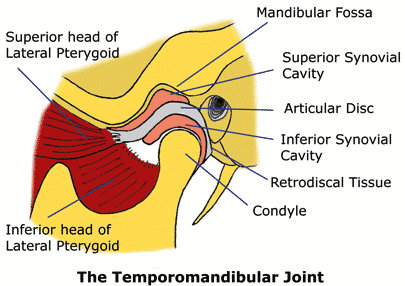
TMJ pain usually has more than one cause. Finding the ones that apply is the first step in planning care.
The main contributing factors are:
- Joint inflammation: swelling inside the joint, which makes movement sore.
- Structural changes: a disc that has slipped, or a joint that sits out of line.
- Wear and tear: changes to the joint surfaces that build over the years.
- Posture: a forward head and a stiff upper neck, which change how the jaw sits.
Causes inside the joint are called intra-articular. Causes outside it, in the muscles and posture, are called extra-articular. Both kinds are covered below.
TMJ Pain From Clenching, Grinding and Daily Habits
Clenching presses the teeth together, and grinding slides them against each other. Many people clench without knowing it, and most learn they grind from a partner or family member. In pooled studies, clenching by day raised the odds of jaw problems a little more than grinding in sleep (Mortazavi and colleagues, 2023).
Chewing gum, biting nails or pens, and chewing mainly on one side all keep the jaw muscles working. Resting the chin on a hand presses the jaw back into its socket. In our founder's words, it turns the jaw into a weight-bearing joint. Sleeping face down with the jaw pressed into a pillow does the same for hours.
Wide Opening and Long Spells With the Mouth Open
A very wide yawn, biting into a whole apple, or a long procedure with the mouth held open all stretch the joint capsule. Wisdom tooth removal is one such procedure, as the questions further down explain.
Stress, Sleep and the Desk
Stress, poor sleep and long hours at a desk all raise the tension in the jaw muscles, and clenching often follows. A head that drifts forward over a keyboard adds to the load on the jaw.
Causes of TMJ Pain in Children
In children, grinding the teeth is one of the most common drivers of jaw problems, and it often gets worse under stress such as exams. Grinding is common and cannot be stopped. Its impact on a growing jaw joint can be reduced with a night guard made by a dentist and gentle, non-force care. Teeth grinding in children is covered in more detail in the guide to chiropractic care for children.
The Influence of Cervical Spine Movement on TMJ Function
The neck and the jaw joint work closely together, and a problem in one often affects the other.
- Movement of the upper cervical spine can change how the jaw sits and moves.
- Long chewing or grinding strains the jaw joint and the muscles of the upper neck alike.
Neck pain is far more common in people with jaw symptoms, as the survey in the research section shows. In a 2015 study, the more the jaw limited daily life, the more the neck did too (Silveira and colleagues, 2015).
For that reason, the upper neck is assessed at every jaw visit at CSC. Both the joint and the muscles are considered in each plan.
CSC's Non-Invasive Jaw & TMJ Care
TMJ pain that limits chewing, jaw opening or sleep is assessed before any care is planned. The jaw joint, the neck and the muscles around them can each play a part.
At CSC, physiotherapy and chiropractic are combined into one plan for the jaw, and what is used follows the examination findings.
Care centers on gentle hands-on work: mobilization of the jaw and neck, and trigger point work on the chewing muscles. Where needed, laser is used on the upper neck, or shockwave on the trapezius. Exercises for the jaw follow once the joint has settled.
For our founder, Yama Zafer, D.C., upper cervical care is the most important part of jaw care. Upper cervical care at CSC uses non-force methods for C1, as set out on the page about an upper cervical chiropractor in KL.
Since 2006, CSC has worked with many people on jaw function and the movement patterns around it. Each plan addresses both the jaw and posture. A dentist is involved only to make a night guard, where clenching or grinding calls for one.
Intra-Articular Considerations in Jaw Joint Movement
Intra-articular causes are changes inside the jaw joint itself. Finding them early helps plan care for the jaw's movement and posture over the long term.
Synovitis: An Irritated Joint Lining
The synovium is the thin lining that makes the joint's fluid. When it is inflamed, the joint aches and feels stiff, especially in the morning or after chewing. The jaw may also move less freely.
Internal changes in the joint come from direct injury or from strain built up over time. Repeated chewing, grinding and a strained posture are the common sources.
Retrodiscal Tissue Inflammation and TMJ Pain
Behind the disc lies the retrodiscal tissue, a soft pad full of blood vessels and nerves. When the disc slips forward, the head of the jaw bone can press on this pad instead. The result is a deep ache just in front of the ear, often worse when the back teeth are clenched. A blow to the chin can bruise the pad in the same way.
Articular Disc Displacement
The disc cushions the joint and glides forward with the jaw as the mouth opens. If it slips forward and returns on opening, this is disc displacement with reduction, often heard as a click.
If it stays in front, this is disc displacement without reduction. People with it may notice:
- The jaw swinging toward the affected side on opening.
- Limited opening without a click.
- The jaw locking now and then, sometimes with a sound.
When the disc shifts, the tissues that hold it are strained. The disc can also slip toward the inner or outer side, with a mild popping sound.
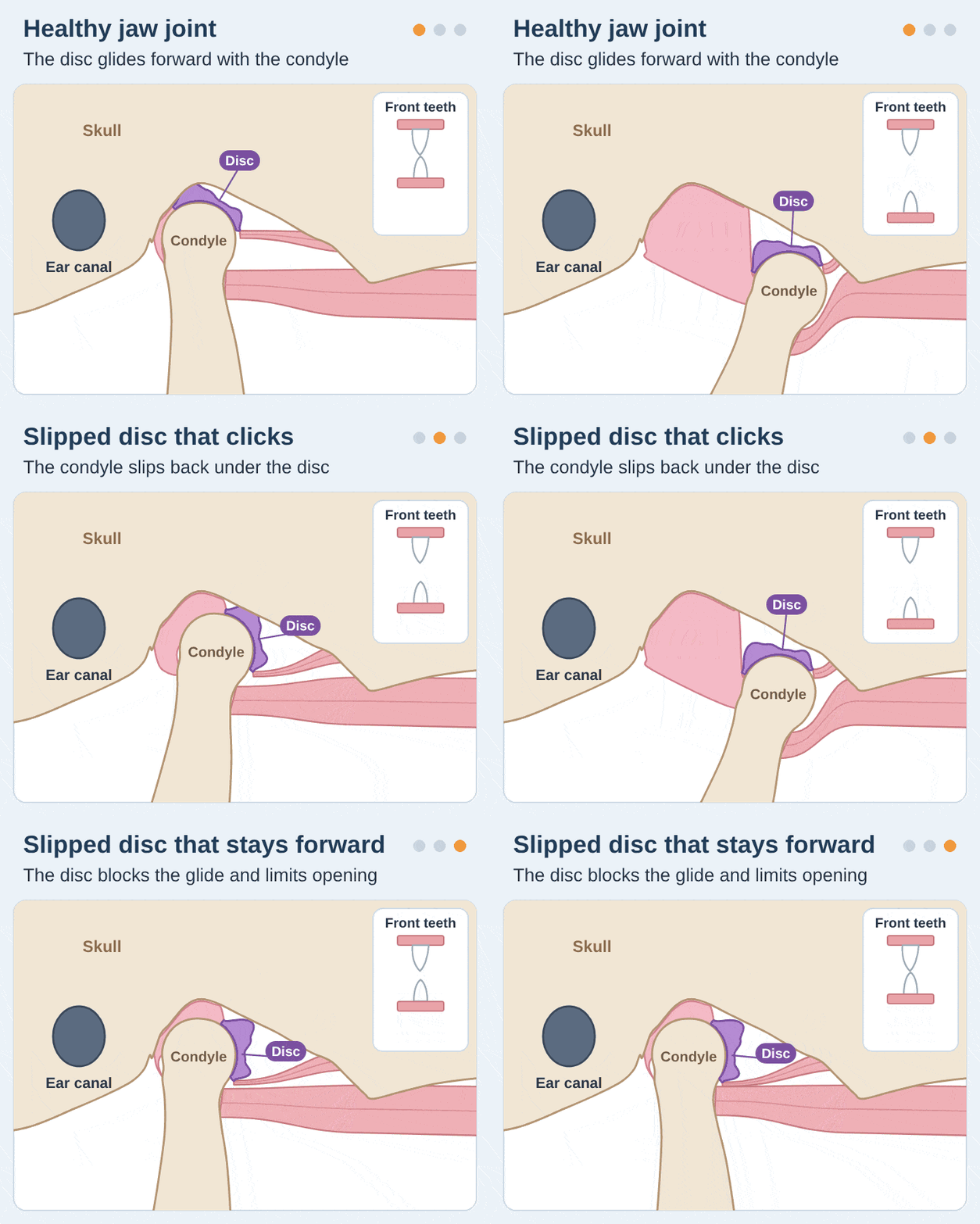
In the early stages there may be little or no pain, even as the disc moves further out of place. Our founder sees that silence as part of the joint's design, not a fault. Why clicking deserves an examination is explained on the page about TMJ disorders and jaw clicking.
Whether the disc can go back, and how it is cared for, is covered in the guide to a slipped disc in the jaw.
Arthritis and Jaw Joint Function
Arthritis can change the shape of the jaw joint and how it moves. Two main forms affect the jaw:
- Degenerative arthritis (osteoarthritis): the more common form, which builds over years. Scans may show the head of the jaw bone flattened or its surface worn. It is most often seen after 50, though younger people with earlier jaw problems can show it too.
- Inflammatory arthritis: seen with rheumatoid arthritis, ankylosing spondylitis or gout. It often brings soreness, swelling or a jaw that moves less freely.
Joints that open too far, again and again, showed more wear on scans over time in one study (Dijkstra and colleagues, 1993). Gentle care for jaw movement is started early, with the aim of keeping the jaw moving as well as possible.
Extra-Articular Influences on Jaw Mobility and Comfort
Extra-articular causes lie outside the joint, in the muscles, tendons and posture around it. Common ones include:
- How the jaw muscles are used, such as clenching or long chewing.
- Neck and posture changes.
- Changes in the tendons of the jaw muscles.
- Earlier jaw injuries or procedures.
An assessment looks at these as well as the joint itself, so that no cause is missed.
Jaw Muscle Adaptations and Mobility Care
The jaw muscles move and steady the joint. When they tighten and stay tight, opening becomes limited, a state called trismus.
The main jaw muscles are:
- Masseter: closes the jaw and powers chewing, at the angle of the cheek.
- Temporalis: closes the jaw and steadies it, fanning out over the temple.
- Pterygoid muscles: the lateral pterygoid pulls the jaw forward and helps open it, and the medial pterygoid helps close it.
These muscles tire and tighten with:
- Stress and the muscle tension that comes with it.
- Long chewing, clenching or grinding.
- A posture that holds the jaw in a strained position.
Tight spots in the temporalis and nearby neck muscles, called trigger points, can refer pain into the head. That pattern is seen in many headaches (Fernández-de-las-Peñas and colleagues, 2007).
Digastric Muscle Pain and TMJ
The digastric muscle runs under the chin in two parts. Its front part, the anterior belly, connects the jaw to the hyoid bone in the throat. It helps open the mouth and lifts the hyoid when you swallow.
Its back part runs to the base of the skull behind the ear. It lies close to the styloid process, the thin spike of bone that Eagle syndrome involves.
Digastric pain is usually felt under the chin or just below the angle of the jaw. It often goes with tightness in the other jaw muscles and with a forward head posture, so all of them are checked together. A swollen, tender lump under the jaw is different: it can be a gland or an infection and needs a doctor first.
Postural Adaptations and Jaw Function
How the head sits on the neck changes the load on the jaw. Forward head posture and a neck held extended can:
- Add pressure on the jaw joint.
- Pull the jaw out of its usual position.
- Change how the jaw moves over time.
Long spells with the head forward, such as hours at a screen or leaning over a desk, are worth cutting down. That lowers the load on the jaw and steadies posture.
Temporal Tendon Considerations in Jaw Function
Temporal tendinopathy is irritation of the tendon of the temporalis, where it attaches to the jaw bone beneath the cheekbone. Grinding and repeated heavy use of the jaw are common triggers.
People with temporal tendinopathy may notice:
- Pain at the temple, on the side of the head.
- Changes in how the jaw moves.
- Strain in the posture that holds the jaw.
Jaw Structural Concerns and Their Influence on Mobility
Injuries to the jaw can change how it moves long after the injury itself.
- Mandibular fractures: breaks of the lower jaw bone, which can leave the jaw moving differently once healed. A fresh fracture belongs in a hospital emergency department. It is the one situation in which our founder sees a clear place for jaw surgery.
- Condylar neck fractures: breaks just below the head of the jaw bone, which can limit opening or shift the jaw to one side.
Whiplash and Blows to the Chin
A whiplash injury or a blow to the chin can strain the jaw joint and its muscles even without a fracture. Jaw pain is common after whiplash, as the research section shows, so the jaw is examined early rather than left to settle.
Additional Factors Contributing to Jaw Mobility Concerns
Some conditions limit jaw movement without a problem in the joint itself, while others start in the joint.
- Pseudo-hypomobility: limited opening from outside the joint, such as tight or guarded muscles, scar tissue after an earlier jaw procedure, sore soft tissues or posture.
- True hypomobility: limited opening from inside the joint, such as lasting changes after surgery, a stiff joint or tight connective tissue.
Knowing which kind is present shapes the plan for jaw movement and posture.
General information like this helps, but self-diagnosis is not advised. An examination by a professional trained in the muscles and joints shows which cause applies.
At Chiropractic Specialty Center (CSC), our chiropractors and physiotherapists plan each person's care around the findings.
Lifestyle Recommendations for Maintaining Jaw Mobility
Simple changes to daily habits lower the strain on the jaw.

Ways to look after the jaw:
- Eat softer foods, such as pasta and soups, while the jaw is sore.
- Cut food into smaller pieces to avoid heavy chewing.
- Keep the neck in a neutral position and limit long spells with the head bent.
- Avoid long chewing, including chewing gum, which tires the jaw muscles.
- Cut back on hard foods, such as raw vegetables, nuts and hard candies.
- Avoid crunching ice and opening very wide when yawning.
- Limit caffeine, as it may add to muscle tension.
- Eat a balanced diet that includes foods rich in vitamin C and magnesium.
- Use ice rather than heat on a sore jaw. At CSC, each person is shown a specific way of icing the jaw.
- Massage the temple area lightly for five to ten minutes.
If jaw symptoms persist, an examination is the next step. At CSC, chiropractors and physiotherapists plan care for the jaw and posture together.
When Jaw Pain Needs a Doctor First
Some jaw pain comes from causes outside the jaw joint. These signs need a doctor before any jaw care:
- Jaw pain that builds while chewing and eases with rest, in an adult over 50, especially with scalp tenderness or new headaches. This is jaw claudication, which can signal an inflamed artery and needs same-day medical review.
- Pain in the jaw during exertion, or alongside chest pressure, breathlessness or sweating. It can come from the heart: call 999.
- A swollen face or neck with fever, which can mean an infection.
- A jaw that locks open after a wide yawn and cannot close.
- A blow to the jaw followed by a bite that no longer fits, which can mean a fracture.
The jaw pain guide lists the signs that need a hospital in full.
Costs are set out on the chiropractic fees in Kuala Lumpur and physiotherapy price in Kuala Lumpur pages. Chiropractic charges are the same at every CSC center, and physiotherapy charges are the same at both Kuala Lumpur centers.
Further Reading: Jaw Examination, Treatment Options and Care
It often helps to read about the causes of TMJ pain alongside these guides:
- Temporomandibular Joint Dysfunction Care By Jaw Experts: the TMJ capsule and each test of a jaw examination.
- TMJ Treatment in Malaysia: How Options Are Decided: the order in which jaw care options are chosen.
- Jaw Chiropractor in KL: TMJ Care Guide: how a chiropractor assesses and cares for the jaw.
- Jaw and TMD in Malaysia: Non-Invasive Care Options: care that treats the jaw, its muscles and the upper neck as one.
TMJ Pain Causes: Questions People Ask
Can TMJ pain be on one side only?
Can gout affect the jaw?
Can stress cause TMJ pain?
Can wisdom tooth removal cause jaw pain?
This page describes the common causes of TMJ pain in general terms. Which of them apply to your jaw can only be shown by an examination.
Peer-Reviewed Medical References
- La Touche R, Fernández-de-las-Peñas C, Fernández-Carnero J, Escalante K, Angulo-Díaz-Parreño S, Paris-Alemany A, Cleland JA. The effects of manual therapy and exercise directed at the cervical spine on pain and pressure pain sensitivity in patients with myofascial temporomandibular disorders. J Oral Rehabil. 2009;36(9):644-652.
- Ciancaglini R, Testa M, Radaelli G. Association of neck pain with symptoms of temporomandibular dysfunction in the general adult population. Scand J Rehabil Med. 1999;31(1):17-22.
- Mortazavi N, Tabatabaei AH, Mohammadi M, Rajabi A. Is bruxism associated with temporomandibular joint disorders? A systematic review and meta-analysis. Evid Based Dent. 2023;24(3):144.
- Häggman-Henrikson B, Lövgren A, Wu WY, Peck C, Westergren H, List T. Prevalence of temporomandibular disorder symptoms after whiplash trauma: a systematic review and meta-analysis. Eur J Pain. 2025;29(3):e4792.
- Anastasi MR, Rizzo G, Nicita F, et al. Microscopic reconstruction and immunohistochemical analysis of discomalleolar ligament. Heliyon. 2020;6(8):e04651.
- Silveira A, Gadotti IC, Armijo-Olivo S, Biasotto-Gonzalez DA, Magee D. Jaw dysfunction is associated with neck disability and muscle tenderness in subjects with and without chronic temporomandibular disorders. Biomed Res Int. 2015;2015:512792.
- Dijkstra PU, de Bont LG, de Leeuw R, Stegenga B, Boering G. Temporomandibular joint osteoarthrosis and temporomandibular joint hypermobility. Cranio. 1993;11(4):268-275.
- Fernández-de-las-Peñas C, Simons D, Cuadrado ML, Pareja J. The role of myofascial trigger points in musculoskeletal pain syndromes of the head and neck. Curr Pain Headache Rep. 2007;11(5):365-372.
- Huang GJ, Rue TC. Third-molar extraction as a risk factor for temporomandibular disorder. J Am Dent Assoc. 2006;137(11):1547-1554.
This list includes reviews, a population survey, anatomy work and clinical studies. None of these studies looked at care given at Chiropractic Specialty Center. Every reference links to its free PubMed record, apart from one that links to the journal.
The Author of Causes of TMJ Pain: Jaw Concerns You Should Know
Causes of TMJ Pain: Jaw Concerns You Should Know was written by Yama Zafer, D.C., who has 30+ years in chiropractic and physiotherapy and founded Chiropractic Specialty Center in Kuala Lumpur in 2006.
Last Updated: Causes of TMJ Pain: Jaw Concerns You Should Know
Causes of TMJ Pain: Jaw Concerns You Should Know was last reviewed and updated on October 25, 2026.