

Tennis Elbow Care Without Injections
Tennis elbow care makes more sense once the mechanism is clear. The tendons on the outside of the elbow belong to the muscles that extend the wrist, and those muscles contract during any grip in order to stabilize it. Gripping therefore loads the painful tendon even when the wrist itself is not moving at all.
That yields one immediately useful change: lifting a cup, a kettle or a bag with the palm facing up rather than down removes much of the load, and some people notice an early difference. Reducing sustained gripping for a few weeks settles it further. The tendon then needs graded loading to rebuild, because complete rest leaves it weaker and the problem recurs.
For more information about tennis elbow care, contact the Bukit Damansara (KL) main center: WhatsApp+60 17 269 1873 Call+603 2093 1000
Key Takeaways
- Tennis elbow, or lateral elbow tendinopathy, is an overload problem of the wrist extensor tendons where they attach to the outside of the elbow.
- It is common in people who grip, lift or use tools repeatedly, and most people who have it do not play tennis.
- Most cases improve over months. Load management and graded exercise are the core of care, and manual therapy can add short-term relief.
- Corticosteroid injections relieve pain in the short term, but trials found worse results and more recurrence at one year than placebo or wait-and-see.
What Tennis Elbow Is
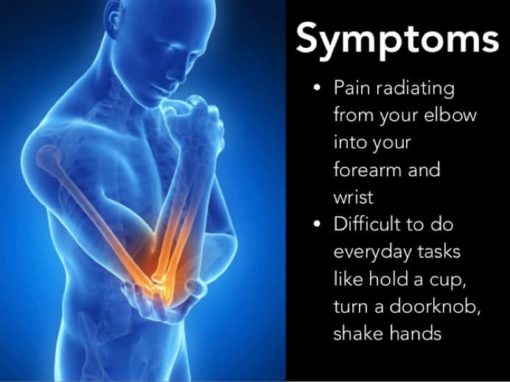
Tennis elbow is pain at the lateral epicondyle, the bony point on the outside of the elbow, where the tendon of the extensor carpi radialis brevis and neighboring wrist extensors attach. Despite the older name lateral epicondylitis, the tendon usually shows degenerative change and a failed healing response rather than ongoing inflammation, which is why the term tendinopathy is now preferred.
It most often affects adults between about 35 and 55, in the dominant arm, and is linked to repetitive gripping and wrist extension: tool use, carpentry, gardening, lifting, keyboard and mouse work, and racquet sports.
Tennis Elbow Assessment at Two KL Centers
If gripping, lifting or shaking hands brings on pain at the outside of your elbow, an assessment can confirm the source and set out a loading plan. You can reach either center through the Bukit Damansara contact page and the Bandar Sri Damansara contact page, or call directly:
- Bukit Damansara (KL, main center): Call +603 2093 1000 or WhatsApp +60 17 269 1873 to see the Bukit Damansara / KL center.
- Bandar Sri Damansara (KL): Call +603 6262 5777 or WhatsApp +60 12 455 6939 to see the Bandar Sri Damansara center.
Symptoms
- Pain on the outside of the elbow, sometimes spreading into the forearm.
- Pain when gripping, lifting with the palm down, turning a doorknob or shaking hands.
- Reduced grip strength.
- Tenderness over the bony point on the outside of the elbow.
- Stiffness or aching after activity or in the morning.
How It Is Assessed
Assessment includes the history, tenderness at the lateral epicondyle, and pain on resisted wrist or middle-finger extension and on gripping. Grip strength is often measured with the elbow straight and bent. The examination also screens the neck and shoulder, because nerve irritation from the cervical spine and radial nerve entrapment in the forearm can produce similar symptoms. Imaging is usually unnecessary unless the picture is unusual or care is not helping.
Who Is at Risk
- Office workers with long periods of mouse and keyboard use.
- Manual workers, carpenters, mechanics, cooks and cleaners who grip tools repeatedly.
- Gardeners and people doing home renovation.
- Players of tennis, badminton, squash and other sports with repeated gripping.
Pain on the inside of the elbow is a different condition, golfer’s elbow, which affects the wrist flexor tendons. Both belong to the wider group of tendon problems that respond to load management; see also tendinitis care.
Care Options
Load Management
Reduce the tasks that provoke pain rather than stopping all use. Lift with the palm facing up, use a lighter or thicker-handled tool, take breaks from sustained gripping, and adjust mouse and keyboard position. A counterforce strap worn just below the elbow helps some people during heavier tasks.
Graded Exercise
Exercise is the core of long-term care. A typical progression starts with gentle, pain-limited holds, then moves to slow wrist extension exercises with a light weight, and then to grip and forearm strengthening and task-specific training. Mild pain during exercise that settles within a day is usually acceptable. A supervised program and a home program both produced improvement in one trial.
Manual Therapy
Mobilization with movement at the elbow and chiropractic or physiotherapy manual techniques can reduce pain in the short term. In a large trial, mobilization with movement plus exercise was better than wait-and-see at six weeks, while results at one year were similar, which fits the general pattern that most cases settle with time.
Corticosteroid Injection
Injections relieve pain for several weeks, but several trials found that people who had them did worse at six months to one year, with more recurrence, than those who had placebo or a wait-and-see approach. For this reason many guidelines no longer recommend them as a first choice. The decision belongs to you and your doctor.
Surgery as a Last Resort
Surgery is considered only for the small number of people whose pain continues despite at least six to twelve months of good conservative care.
Alongside tennis elbow, you may also want to read about carpal tunnel syndrome.
When to See a Doctor
- Elbow pain after a fall or a heavy blow, with swelling or inability to straighten the arm.
- A hot, red, swollen elbow, especially with fever.
- Numbness, tingling or weakness in the hand, or pain spreading from the neck.
- Pain that is getting worse despite several weeks of reduced load and exercise.
Where the Name Comes From
Lateral elbow pain was described in the 1870s, and the phrase lawn-tennis elbow appeared in the medical literature in the early 1880s as the sport became popular. The name stuck, although most people with the condition today develop it from work and daily tasks rather than tennis.
Readers who want to know costs first can check the chiropractic price in Kuala Lumpur and physiotherapy price list in Kuala Lumpur pages.
Frequently Asked Questions
How long does tennis elbow last?
It varies widely. Many people improve within a few months, and most cases settle within a year. Load management and exercise aim to shorten that time and reduce recurrence.
Should I rest my arm completely?
No. Complete rest tends to leave the tendon weaker. Reduce the tasks that provoke pain and begin graded loading as advised.
Do braces help?
A counterforce strap helps some people during heavier tasks. It is an aid while the tendon is loaded progressively, not a treatment by itself.
Can I keep playing sport?
Often yes, with changes. Reduce volume, check grip size and technique, and build back gradually as strength returns.
References
- Smidt N, van der Windt DA, Assendelft WJ, Devillé WL, Korthals-de Bos IB, Bouter LM. Corticosteroid injections, physiotherapy, or a wait-and-see policy for lateral epicondylitis: a randomised controlled trial. Lancet. 2002;359(9307):657-662.
- Bisset L, Beller E, Jull G, Brooks P, Darnell R, Vicenzino B. Mobilization with movement and exercise, corticosteroid injection, or wait and see for tennis elbow: randomised trial. BMJ. 2006;333(7575):939.
- Coombes BK, Bisset L, Vicenzino B. Efficacy and safety of corticosteroid injections and other injections for management of tendinopathy: a systematic review of randomised controlled trials. Lancet. 2010;376(9754):1751-1767.
- Coombes BK, Bisset L, Brooks P, Khan A, Vicenzino B. Effect of corticosteroid injection, physiotherapy, or both on clinical outcomes in patients with unilateral lateral epicondylalgia: a randomized controlled trial. JAMA. 2013;309(5):461-469.
- Vicenzino B, Cleland JA, Bisset L. Joint manipulation in the management of lateral epicondylalgia: a clinical commentary. J Man Manip Ther. 2007;15(1):50-56.
- Stasinopoulos D, Stasinopoulos I, Pantelis M, Stasinopoulou K. Comparison of effects of a home exercise program and a supervised exercise program for the management of lateral elbow tendinopathy. Br J Sports Med. 2010;44(8):579-583.
These references describe tennis elbow and the published results of exercise, manual therapy and injection in general. None of them evaluates care at Chiropractic Specialty Center.
The Author of Tennis Elbow Care: Loading, Grip and Recovery
Tennis Elbow Care: Loading, Grip and Recovery was written by Yama Zafer, D.C., who has 30+ years in chiropractic and physiotherapy and founded Chiropractic Specialty Center in Kuala Lumpur in 2006.
Last Updated: Tennis Elbow Care Without Injections
Tennis Elbow Care Without Injections was last reviewed and updated on September 25, 2026.
Share with others: