


Temporomandibular Joint Dysfunction Care By Jaw Experts
Temporomandibular joint dysfunction covers disorders of the jaw joint, which sits immediately in front of each ear. That joint has an unusual feature: a small fibrous disc lies inside it and must glide forward with the jaw as the mouth opens. Much of what is experienced as clicking, catching or locking arises from that disc moving out of step.
Normal opening is roughly three stacked fingers between the front teeth, which makes it straightforward to record. A jaw that clicks but still opens fully is common and frequently needs nothing. A jaw in which the click has stopped while opening has reduced is the change that carries significance. The upper cervical spine is examined at the same time, because neck and jaw problems occur together.
This guide to temporomandibular joint dysfunction, the difference between TMJ and TMD and where surgery fits, is published by Chiropractic Specialty Center, Bukit Damansara (KL) main center: WhatsApp+60 17 269 1873 Call+603 2093 1000
Key Takeaways
- Measure, do not guess: maximum comfortable opening between the front teeth is recorded and tracked over time.
- Conservative care first: jaw exercise and stretching, mobilization, trigger point work, posture exercise and education have the strongest guideline support for chronic jaw pain.
- Neck and jaw together: the upper neck is examined alongside the jaw, and care is coordinated with your dentist where needed.
Table of Contents: Temporomandibular Joint Dysfunction
TMJ and TMD: Getting the Terms Right

Temporomandibular disorder (TMD) is an umbrella term for problems of the jaw joint and the chewing muscles. TMJ refers to the joint itself, the temporomandibular joint, while TMD refers to a disorder or dysfunction of that joint or its muscles. You may hear either term used for jaw pain; at CSC, the problem is described as TMD.
TMD includes several distinct problems: pain arising mainly from the chewing muscles, pain from the joint itself, displacement of the disc inside the joint (with or without locking), and degenerative change. Because these behave differently, the assessment aims to identify which is present rather than grouping every case under one label. Recognized diagnostic criteria (DC/TMD) are used to guide that process (Schiffman et al., 2014).
Arranging a Jaw Assessment at CSC
To arrange a jaw assessment, see the Bukit Damansara contact page and the Bandar Sri Damansara contact page, or call either center directly:
- Bukit Damansara (KL, main center): Call +603 2093 1000 or WhatsApp +60 17 269 1873 to see the Bukit Damansara / KL center.
- Bandar Sri Damansara (KL): Call +603 6262 5777 or WhatsApp +60 12 455 6939 to see the Bandar Sri Damansara center.
Working With Your Dentist
Dentists are qualified to assess and manage temporomandibular disorders, and jaw problems at CSC are often managed alongside the patient’s dentist. Our chiropractors and physiotherapists focus on the joint, the chewing muscles and the neck, while the dentist looks after the teeth and the bite.
Some people are given a night guard (a reversible oral splint) by their dentist, particularly for tooth grinding. For chronic TMD pain, a 2023 international guideline made a conditional recommendation against reversible splints compared with placebo, so the reason for a splint and what it is expected to achieve are worth discussing with your dentist (Busse et al., 2023).
Where Surgery Fits
Jaw surgery carries real risks, including nerve injury, damage to the joint and facial muscle weakness. It has a place in a narrow set of situations, such as complicated fractures or where a specialist assessment finds a clear structural indication.
For chronic pain associated with TMD, the 2023 international clinical practice guideline made strong recommendations in favor of cognitive behavioral therapy, therapist-assisted mobilization, manual trigger point therapy, supervised postural exercise, and supervised jaw exercise and stretching. It made strong recommendations against irreversible oral splints and discectomy (Busse et al., 2023). That is why conservative care is the reasonable starting point for jaw pain, and why procedures that permanently alter the joint or the bite are a last resort.
Why Jaw Problems Are Sometimes Missed
Jaw problems do not always feel like jaw problems. TMD can be felt as pain in the face, temple or ear, and it often occurs together with upper neck pain and headaches. Some people also report ear fullness or tinnitus. Because these symptoms overlap with other conditions, a jaw problem can go unrecognized, particularly when the main complaint is headache or neck pain.
For that reason, the assessment covers the jaw, the chewing muscles and the upper neck together, and looks for findings that point to another cause and need a doctor or dentist first.
How Jaw Problems Are Managed at CSC
Care is built around what the assessment shows is driving the pain or limitation. At our spine and joint care centers, chiropractic and physiotherapy are planned together, and the combined chiropractic and physiotherapy approach explains how the two roles fit.
A typical program includes gentle jaw mobilization, manual trigger point work on the chewing muscles, controlled jaw exercise and stretching, posture and upper-neck work, and education on habits such as clenching and resting jaw position. Where an earlier course of care has not helped, we begin by asking what was tried and for how long. Progress is judged by measured opening and function rather than by impressions.
The Jaw Joint, Articular Disc and TMD

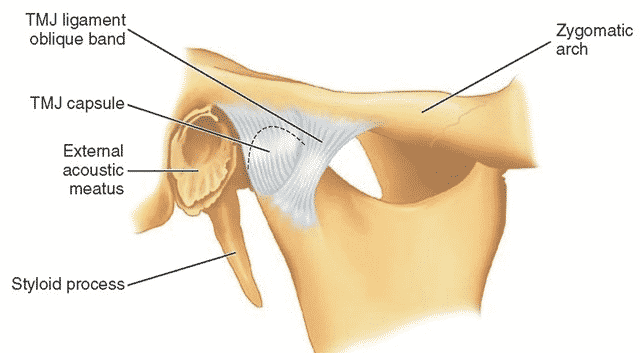
The joint capsule: a fibrous sleeve that surrounds the temporomandibular joint and attaches around the joint surfaces of the skull and the jaw bone (mandible).
The articular disc: the distinctive feature of this joint. It is a firm, oval pad of fibrocartilage that sits between the temporal bone of the skull and the head of the mandible, dividing the joint into upper and lower compartments. It is thinner in the middle and thicker at the front and back (biconcave), which helps it stay seated as the jaw glides forward on opening.
How disc problems arise: if the disc sits too far forward, it may click back into place as the mouth opens (disc displacement with reduction). If it no longer returns, the click may stop and opening becomes limited (disc displacement without reduction). A click with full, pain-free opening is common and often needs no treatment; a new reduction in opening is the change worth having assessed.
What a Jaw Program Looks Like in Practice
The guideline recommendations translate into specific work, and knowing the specifics lets you judge whether you are getting them.
- Controlled opening, not forced opening. Slow opening within a comfortable range, several short sessions a day, rather than one hard stretch. The jaw responds to frequency, not to force.
- Tongue position as the anchor. Tongue resting on the palate, teeth apart, lips together. Most people discover their teeth are touching far more of the day than they realized.
- Trigger point work on masseter and temporalis. Often the source of what feels like joint pain, and the part that responds fastest.
- Neck and postural work. The upper neck and the jaw share a great deal, and a jaw program that ignores the neck misses part of the problem.
- Load management for two to four weeks. Softer food, cut food smaller, no gum, no biting into hard things, and warn your dentist before a long appointment.
Track Your Opening, Not Your Impressions
Measure the distance between your front teeth with a ruler at maximum comfortable opening. Around 40 mm is typical. Record it twice a week. Whether the number is rising is the most reliable signal you have that the joint is adapting, and it is far more useful than how the jaw felt on any given day. Bring the record to your appointments.
One thing worth knowing: clicking without pain, with full movement, is common and does not by itself need treatment. Chasing a noise leads to treatment nobody needed.
When Jaw Symptoms Need a Doctor or Dentist First
- A jaw that locks closed and will not open, or locks open and will not close.
- Facial swelling, fever, or pain centered on a tooth, which suggests infection.
- Jaw pain brought on by exertion, or with chest pain or pressure, breathlessness or sweating. Treat that as a cardiac emergency.
- Scalp tenderness with jaw pain on chewing in an older adult, which needs same-day medical review.
- Numbness of the lip or chin, or a bite that has changed suddenly.
The chiropractic price list in Kuala Lumpur and physiotherapy fees in Kuala Lumpur pages list every fee before care begins.
It often helps to read about temporomandibular joint dysfunction alongside how TMJ treatment options are decided.
Peer-Reviewed Medical References
- Schiffman E, Ohrbach R, Truelove E, et al. Diagnostic Criteria for Temporomandibular Disorders (DC/TMD) for clinical and research applications. J Oral Facial Pain Headache. 2014;28(1):6-27.
- Busse JW, Casassus R, Carrasco-Labra A, et al. Management of chronic pain associated with temporomandibular disorders: a clinical practice guideline. BMJ. 2023;383:e076227.
- Wright EF, North SL. Management and treatment of temporomandibular disorders: a clinical perspective. J Man Manip Ther. 2009;17(4):247-254.
- Al-Moraissi EA, Conti PCR, Alyahya A, et al. The hierarchy of different treatments for myogenous temporomandibular disorders: a systematic review and network meta-analysis of randomized clinical trials. Oral Maxillofac Surg. 2022;26(4):519-533.
These sources describe temporomandibular disorders in general; none of them evaluates care at Chiropractic Specialty Center.
The Author of Temporomandibular Joint Dysfunction: Assessment
Temporomandibular Joint Dysfunction: Assessment was written by Yama Zafer, D.C., a graduate of Cleveland University - Kansas City with 30+ years in chiropractic and physiotherapy.
Last Updated: Temporomandibular Joint Dysfunction Care By Jaw Experts
Temporomandibular Joint Dysfunction Care By Jaw Experts was last reviewed and updated on September 25, 2026.