


Fragmented Disc: Partial or Sequestered, Symptoms and Treatment
Fragmented Disc: Key Takeaways
| Question | Short answer |
|---|---|
| Is a sequestered disc serious? | Yes. In The Shocking Truth About Fragmented Discs, I call it the last and most dangerous type of slipped disc. How serious one case is depends on what the loose piece presses on. |
| Does a sequestered disc require surgery? | It can. In my view, a sequestered disc is a severe case, where a surgeon's opinion may be needed sooner. The decision weighs symptoms and nerve function as much as the scan. |
| What are the symptoms of a sequestered disc? | They depend on where the piece sits: sciatica down one leg from the lower back, or pain into the shoulder and arm from the neck. A piece that has torn free can shift, so symptoms may come and go. |
| Is an extruded disc fragment the same thing? | Not quite. In an extrusion, the center is forced out to the edge of the disc. A fragment forms when part of that extruded material breaks off, and it is sequestered once fully torn free. |
| Which signs are urgent? | New numbness around the genitals or anus, new difficulty passing urine, or loss of bladder or bowel control needs urgent medical attention at a hospital emergency department straight away, within hours. |
| What decides the next step? | An MRI read with a full examination of movement, reflexes, sensation and strength. I never judge a fragmented disc from the report alone, because a final diagnosis should never be a guess. |
| Can disc damage be silent? | Yes. A review looked at the scans of people with no back pain. Among 20-year-olds, 29 percent had disc protrusions and 19 percent had tears in the outer ring (Brinjikji and colleagues, 2015). |
Fragmented Disc Guide: Sections at a Glance
- Partial or Full: Two Kinds of Fragmented Disc
- Disc Assessment at Two KL Centers
- Disc Damage Stages: From a Bulge to Sequestration
- Bulge vs Herniation: My 3-Minute Disc Video
- Symptoms and Urgent Signs of a Sequestered Disc
- What Causes Disc Fragmentation?
- Structure of a Healthy Spinal Disc
- Disc Pressure in Daily Positions
- Fragmented Disc Treatment Without Surgery
- When Surgery Becomes an Option for a Fragmented Disc
- Daily Habits and What to Avoid With a Damaged Disc
- My Full Talk on Disc Damage, From Back to Leg
- Related Guides on Disc Stages, Symptoms and Fees
- Fragmented and Sequestered Disc Questions
- Peer-Reviewed References
Partial or Full: Two Kinds of Fragmented Disc
I separate two kinds. A partially fragmented disc is officially a fragmented disc. Part of its nucleus pulposus, the gel-like center, has broken away but is still partly attached. When that piece tears away completely, the disc is 100 percent fragmented. A fully fragmented disc is also called a sequestered disc, so one condition goes by two names.
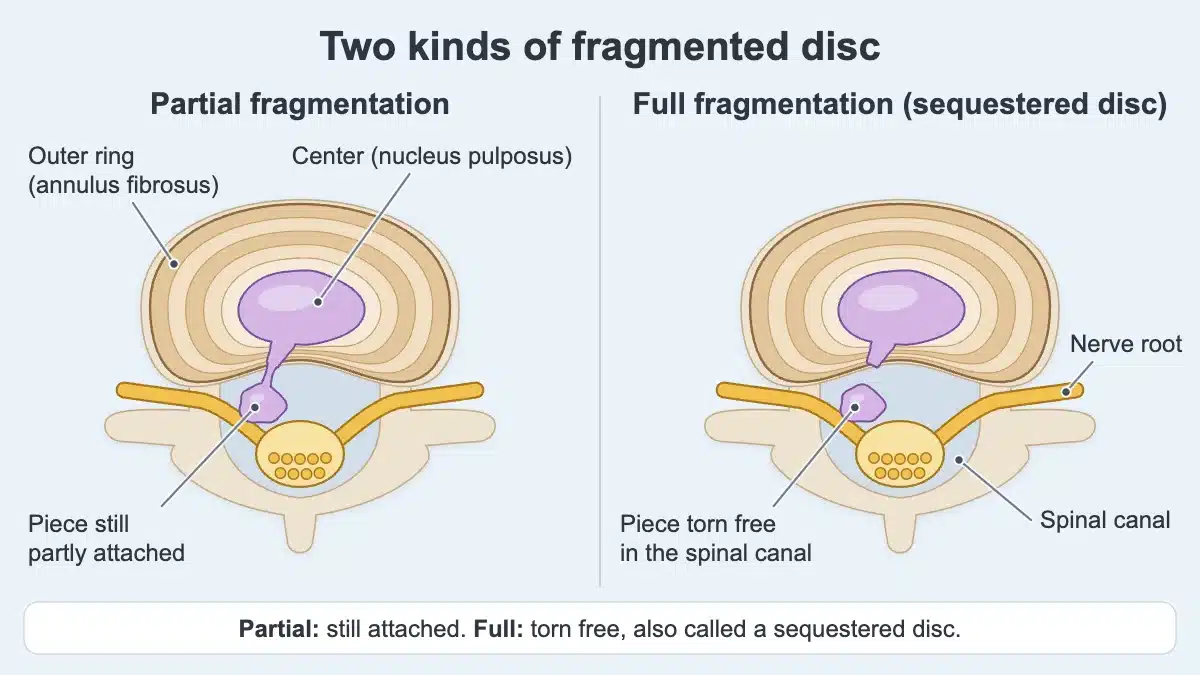
| Partial fragmentation | Full fragmentation (sequestered disc) | |
|---|---|---|
| The broken piece | Still partly attached to the disc, but displaced | Torn away completely, free to move within the spinal canal |
| Its names | The fragmented disc in its official meaning | A fully fragmented disc, or a sequestered disc |
| Focused conservative care | May still respond, but only after a thorough assessment finds none of the urgent signs | A severe case, where surgery may be needed |
The word on a scan report describes the shape and position of the disc material. On its own, it does not tell how severe the symptoms will be or whether surgery is needed. The decision rests on symptoms and nerve function as much as on the MRI. Pain traveling into a leg or arm, numbness, weakness, reflex changes and the direction symptoms are moving in all count.
The words extruded disc fragment join two neighboring stages. In my Short Why Extruded Discs Aren't As Bad As You Think, an extruded disc is the progression of a ruptured or herniated disc. Its nucleus pulposus is expelled from the center to the edge of the disc. These large herniations need prompt assessment, which does not automatically mean surgery and can include conservative care. With any of the urgent signs listed below, that assessment is at a hospital emergency department straight away. Fragmentation is the next stage, when a piece of that herniated disc material breaks away from the parent disc.
Disc Assessment at Two KL Centers
Either KL center can assess a fragmented or sequestered disc. The visit begins with your story: when the pain started, what makes it worse and what you have tried. A full examination of movement, reflexes, feeling and strength comes next, and the MRI itself is read against it. Please bring the scan images on a CD or film, as well as the written report. The CSC locations page gives the address, directions and opening hours of each center.
- Bukit Damansara (KL, main center): Call +603 2093 1000 or WhatsApp +60 17 269 1873 to see the Bukit Damansara / KL center.
- Bandar Sri Damansara (KL): Call +603 6262 5777 or WhatsApp +60 12 455 6939 to see the Bandar Sri Damansara center.
CSC also holds spinal disc health talks in Kuala Lumpur from time to time. They are paused at the moment; for the next date, send a WhatsApp message to the Bukit Damansara main center at +60 17 269 1873.
Disc Damage Stages: From a Bulge to Sequestration
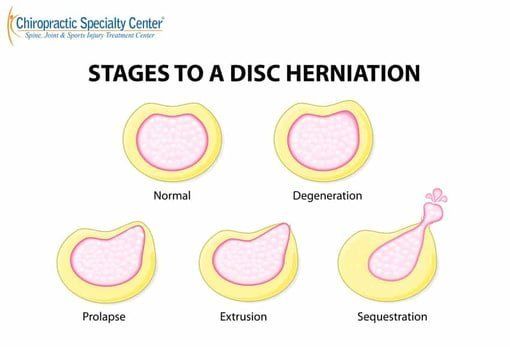
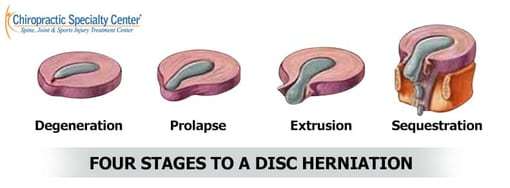
Every fragmented disc has a history. In my Back Pain to Leg Pain talk, I state it plainly: a bulging, protruded, prolapsed, herniated or extruded disc cannot exist without degeneration first. From there, each stage is a progression of the one before. As I say in the same talk, “Once you have a damaged disc, it can go rapidly or it can take years.” My short stage videos define six of these steps, and this list follows their order:
- A degenerated or damaged disc: the outer fibers lose their hold on one another, and the center begins to dry out.
- Bulge: the disc fibers swell beyond their usual size. Even so, a true bulge puts no pressure on the spinal cord or nerves (Bulging Discs: Explained in 20 Seconds).
- Protrusion: the center migrates outward, toward the spinal canal or a nerve exit, while the outer fibers stay unbroken. It is still contained (Protruded Disc: What You Need to Know).
- Prolapse: the disc is barely contained. A few remaining outer fibers are all that stop the center from rupturing into the spinal canal (Prolapsed Disc: A Simple Explanation).
- Herniation, the same thing as a rupture: the last intact fibers tear, and the disc is no longer contained. The center comes into contact with whatever lies in the spinal canal or a nerve exit (The Truth About Herniated Discs).
- Extrusion: the center is expelled to the edge of the disc (Why Extruded Discs Aren't As Bad As You Think).
- Partial fragmentation: part of the center breaks off but stays partly attached. This is the fragmented disc in its official meaning.
- Full fragmentation, the sequestered disc: the piece tears away completely and becomes free-floating in the spinal canal (The Shocking Truth About Fragmented Discs).
In that last Short, I call this free-floating stage the last and most dangerous type of slipped disc. In my Back Pain to Leg Pain talk, I term it sequestration, “where the whole thing chips off”. Some people call it a chipped disc. Slip disc is the everyday name for all of these stages.
Symptoms and Urgent Signs of a Sequestered Disc
The symptoms of a fragmented disc, partial or sequestered, depend on where the piece sits and what it touches. They can include:
- Pain in the lower back, or in the neck when the damaged disc is there.
- Pain that travels into the buttock and down one leg. When the sciatic nerve is inflamed, that is sciatica. From a disc in the neck, pain can travel into the shoulder and arm.
- Numbness, tingling or pins and needles along the same path.
- Weakness in the affected leg or arm.
- Limited movement, or difficulty standing and walking.
In my view, a piece that has torn free can shift position. Its pressure on a nerve can then come and go, and the symptoms can vary with it. Back pain that lasts longer than 7 to 12 weeks is sometimes called chronic, though definitions vary (Andersson, 1999).
Pain alone is a poor guide. As I say in my Back Pain to Leg Pain talk, “the most common symptom of spinal disc damage is zero.” In the same talk I add, “Pain is not a yardstick. Pain is a symptom.”
In my experience, many people who reach fragmentation have had disc trouble for years, sometimes decades. Often they tolerate pain well, or the milder stages gave them no symptoms at all. So a scan can show a fragment in someone who never knew the earlier stages were there.
With a fragment in the neck, a disc pressing on the spinal cord can affect more than the arms. In my Back Pain to Leg Pain talk, I point out that it “can go as far low as your legs”. Weakness and trouble walking or standing can follow, and that needs prompt assessment.
With a fragmented lumbar disc, partial or sequestered, back or leg pain calls for one more check. If numbness develops or worsens around your genitals, between your genitals and anus, or around your anus, get urgent medical attention. That means a thorough assessment at a hospital emergency department straight away, within hours. New difficulty passing urine needs the same urgent assessment. Loss of bladder or bowel control does not have to occur first, and if it does occur, it is urgent too. These symptoms have several possible causes. Some may call for an invasive procedure, but the assessment determines what care is appropriate, rather than assuming surgery is necessary.
Leg weakness that keeps getting worse should not be ignored. It calls for a careful assessment by a competent provider, and conservative care can continue only while the weakness itself is improving.
What Causes Disc Fragmentation?
Disc fragmentation is the last stage of disc damage, and in my view load drives it. Every hour of slumped sitting, and every bend and twist under weight, raises the pressure inside the disc. Over time its outer fibers tear, and the center escapes through them toward the weakest point. As I put it in Why Spinal Discs Get Damaged, “All of that happens because of poor habits.”
Disc problems such as a bulge, herniation, extrusion or fragmentation can develop gradually. Common contributing factors include:
- Long hours of desk sitting, the pattern behind office syndrome, above all with poor posture.
- Repeated bending or twisting at the waist.
- Lifting with poor technique, or lifting while bent or twisted.
- Falls, accidents and other injuries.
- Disc dehydration (desiccation) and lost elasticity. Age is one factor here, beside genetics, daily habits, earlier injury and posture.
- General stretching and side bending on a damaged disc. In my Back Pain to Leg Pain talk, I give this warning: “That protrusion can end up with a fragmentation or partial tear.”
When the disc's structure weakens, small tears can form in its outer layer, the annulus fibrosus. The inner core, the nucleus pulposus, can then shift through them and, in time, break apart.
Research on painful discs points the same way. A study examined discs removed during fusion surgery from 15 people with disc-related low back pain. Tissue rich in new blood vessels had grown along tears in the outer ring, reaching into the center. Its authors concluded that a painful disc's degeneration may begin with injury to that outer ring (Peng and colleagues, 2006).
Structure of a Healthy Spinal Disc
A spinal disc has two parts. The annulus fibrosus is the tough outer ring, made of woven bands of fibers that give the disc stability. They connect one vertebra to the next and keep the center in place. The nucleus pulposus is the gel-like center, which absorbs shocks and spreads pressure as the spine moves.
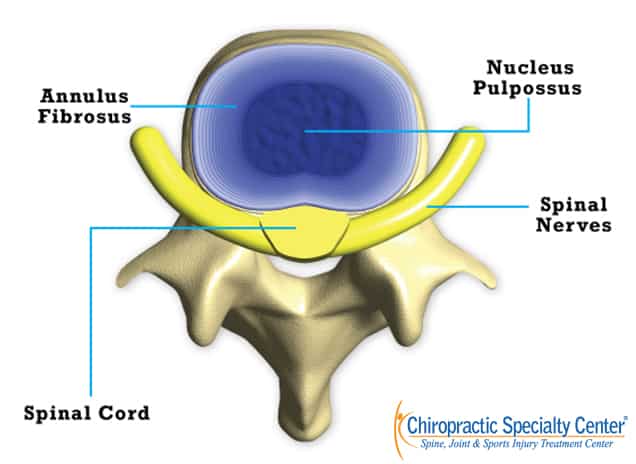
These rings, as I describe them in my Back Pain to Leg Pain talk, are criss-crossed and tightly bound. A neck disc has about 15 of them, and a lower back disc about 25, though some have more or fewer. Healthy discs have many such layers, which keep them durable and flexible. Excess stress can crack or tear them, and that leads to bulging, herniation and, in the end, fragmentation.
As I say in Bulging Disc vs Herniated Disc, “The most important function is to allow us mobility.” Bending and twisting both depend on the disc, which is why the habits that load it matter so much.
Disc Pressure in Daily Positions
A spinal disc needs balanced pressure inside it. Too much pressure reduces the nutrients a disc can absorb, and that leads to degeneration. A disc's cells depend on blood vessels at its edges for nutrients. A review says failure of that supply is thought to be one of the main causes of disc degeneration. Abnormal loading is thought to be another pathway (Urban and Roberts, 2003).
These are the disc pressure figures I use, from lying down to slouching:
- 25 mmHg (lying down)
- 100 mmHg (standing upright)
- 140 mmHg (sitting with proper posture)
- 220+ mmHg (bending forward)
- 250+ mmHg (slouching while sitting)
Prolonged high pressure weakens disc structures and raises the risk of fragmentation. Rest and sleep are what bring that pressure down, a point I make in my Back Pain to Leg Pain talk. The guide to increased intradiscal pressure and slipped disc damage looks at this pressure in more depth.