



Slipped Disc in the Jaw: TMJ Displacement, Causes & Care Options
A slipped disc in the jaw is usually noticed as a click on opening, a catch, or pain in front of the ear. In clinical terms it is TMJ disc displacement: the small cartilage disc in the jaw joint has slipped forward off the ball of the jaw. A click means the disc slips back as the mouth opens. Locking means it stays in front and stops the mouth opening fully.
In my experience, most cases follow strain on the joint, repeated or sudden, and I see them mostly in people who clench or grind their teeth. Whiplash injuries, long dental visits or medical procedures with the mouth held open, and stress add to the strain.
As I see it, a slipped disc in the jaw is seldom a problem of the jaw alone, because C1, the top bone of the neck, often needs attention on the same side. So care starts with an examination of the jaw, its muscles and the upper neck. Gentle hands-on care comes first, with exercises once the joint is stable and a dentist's night guard where needed. The sections below cover a five-year trial of surgery against care without it, the types of displacement, whether the disc can go back, dislocation and care for children.
For more information about a slipped disc in the jaw, contact the Bukit Damansara (KL) main center: WhatsApp+60 17 269 1873 Call+603 2093 1000
Slipped Disc in the Jaw: Key Takeaways
| Point | What to know |
|---|---|
| Can it go back in place? | With reduction, it does so each time the mouth opens: that is the click. Without reduction it stays in front, so care works on pain, opening and the load on the joint rather than forcing the disc. |
| Is it serious? | Usually not. A click with full, comfortable opening is very common, and the international diagnostic criteria call it probably without consequence unless pain, limited opening or trouble chewing comes with it. In my view it still deserves an examination, because a slipped jaw disc can bring other problems with it. |
| Does it mean surgery? | Rarely as a first step. In a trial of 106 adults with a locked jaw, all four groups improved over five years. The authors advised starting without surgery to avoid unnecessary operations. |
| Beyond the jaw | In my experience, it can come with headaches, neck pain, dizziness, fullness in the ears or ringing in the ears. The joint sits just in front of the ear canal. |
| Grinding and clenching | In my experience, grinding during sleep is probably the most common cause. A review of 20 studies found that grinding or clenching roughly doubled the odds of a jaw joint disorder, whether it happened awake or asleep. |
| Night guards | CSC does not make them; a dentist does, for people who clench or grind. A guard lessens the strain on the disc and the joint capsule but does not stop the habit. |
| Exercises and TENS | Jaw exercises usually start after the third to fifth session, once the joint is stable. TENS is used only when the jaw is significantly tender. |
| The upper neck | In my experience, trouble travels both ways between the jaw and the top of the neck. So the upper neck is cared for at the same time, with a non-force method at C1. |
| A jaw stuck open | That is a dislocation, not a slipped disc: the ball of the jaw has left its socket. It needs a hospital emergency department straight away. |
Slipped Disc in the Jaw: Page Guide & Key Sections
- TMJ Disc Displacement Surgery or Conservative Care? What a Five-Year Trial Found
- Arranging a Jaw Joint Assessment in KL
- Symptoms of a Slipped Disc in the Jaw
- Is There a Disc in the Jaw Joint? How It Normally Moves
- Disc Displacement With and Without Reduction
- Can a Slipped Jaw Disc Go Back in Place?
- What Causes a Slipped Disc in the Jaw?
- How TMJ Disc Displacement Is Assessed
- Slipped Disc in the Jaw Treatment Without Surgery at CSC
- Slipped Disc or Dislocated Jaw? How They Differ
- Daily Habits for a Slipped Jaw Disc
- When Jaw Symptoms Need a Doctor or Dentist First
- What You Can Measure at Home
- Related Jaw and TMJ Guides
- Frequently Asked Questions on a Slipped Disc in the Jaw
- How to Read This Slipped Disc Guide
- References
TMJ Disc Displacement Surgery or Conservative Care? What a Five-Year Trial Found
A randomized trial at the University of Minnesota compared four approaches in 106 adults whose jaw had locked, with the slipped disc confirmed on MRI. They received medical management, rehabilitation, keyhole surgery on the joint (arthroscopy) with rehabilitation afterward, or open joint surgery (arthroplasty) with rehabilitation afterward. An examiner who did not know who had which treatment measured jaw function and joint pain for five years.
All four groups improved, and neither type of surgery did better than the approaches without surgery, at any point, for jaw function or for pain. The authors concluded that the first treatment for a locked jaw should be medical management or rehabilitation, an approach that "will avoid unnecessary surgical procedures."
What Each Group Received
- Medical management: education with reassurance and a self-care program. Medicines were a six-day course of an oral steroid, then anti-inflammatory painkillers for three to six weeks. Muscle relaxants or other painkillers were added when needed.
- Rehabilitation: everything above, plus a mouth splint and physical therapy with joint mobilization, other physical methods and home exercises. Cognitive behavioral therapy worked on oral habits.
- Keyhole surgery (arthroscopy): the joint was washed out, adhesions inside it were freed and a steroid was injected, under general anesthesia.
- Open surgery (arthroplasty): the surgeon tried to reposition the disc, and removed it where the tissue had worn too far.
The trial tested these approaches, not the care at CSC. In it, surgery, including open surgery that tried to reposition the disc, did no better than care without surgery.
When Surgery Is Considered
Surgery is considered only when locking, limited opening or pain continues after focused conservative care, properly given, has not worked. I regard it as a distant last resort, and a keyhole is still an incision. I do not recommend steroid injections into the jaw joint either. Surgery also carries risks of its own. In the trial, three people who had surgery needed a repeat operation, and one had a nerve injury that later resolved completely. The jaw surgeon explains the risks of each operation before it is planned.
Research on Hands-On Care for Jaw Pain
A review of eight randomized trials looked at hands-on care for jaw pain. Massage and myofascial release of the jaw muscles, and manipulation or mobilization of the upper neck, did better than control treatments. The strength of that evidence ranged from low to high depending on the technique, and the authors called it widely varying.
In a randomized trial of 40 people with jaw-muscle pain, TENS did better than a placebo device. Pain and the tenderness of the jaw and neck muscles improved more over the 48 hours measured.
The neck matters too. In a small study without a comparison group, 19 people with jaw-muscle pain had ten sessions of manual therapy and exercise for the neck. Their jaw pain fell and their pain-free opening rose, both after treatment and 12 weeks later. The authors concluded that such care may be beneficial. At C1 itself, I use only a non-force method, because in my view a firmer one may not suit the atlas.
These studies looked at jaw-muscle pain rather than at the disc itself. Their findings fit the order of care at CSC. Gentle hands-on care and daily habits come first, and exercise follows once the joint is stable. Procedures that permanently alter the joint or the bite are a distant last resort.
Arranging a Jaw Joint Assessment in KL
A click, a catch or limited opening can come from the disc, the jaw muscles, the teeth or the upper neck. The first visit sorts out which are involved. It measures how far and how freely the mouth opens and listens for joint sounds. It also examines the jaw muscles and the upper neck, and any MRI is reviewed before care is discussed. Bring any X-rays of the jaw, teeth or neck too, and MRI images on a CD or film. Either Kuala Lumpur center can arrange it:
- Bukit Damansara (KL, main center): Call +603 2093 1000 or WhatsApp +60 17 269 1873 to see the Bukit Damansara / KL center.
- Bandar Sri Damansara (KL): Call +603 6262 5777 or WhatsApp +60 12 455 6939 to see the Bandar Sri Damansara center.
Directions and opening hours for both centers are on CSC Locations in Kuala Lumpur.
Symptoms of a Slipped Disc in the Jaw

The symptoms of a slipped disc in the jaw depend on whether the disc slips back as the mouth opens. The common ones are:
- A click, pop or snap in front of the ear when opening, closing or chewing
- A catch partway through opening, or a jaw that slips when eating
- Locking: the opening suddenly becomes smaller and the mouth will not open fully
- Pain in front of the ear, in the cheek or at the temple, often worse when chewing or talking
- Stiffness or tightness in the jaw on waking
- A feeling that the jaw, or the bite, is out of place on one side
A click on its own, with full and comfortable opening, is very common. The international diagnostic criteria treat it as probably without consequence unless pain, limited opening or trouble chewing comes with it. In my experience, the click sounds louder to the person than to anyone near them, and many feel self-conscious about it at quiet meals.
Headaches, Neck Pain and Ear Symptoms
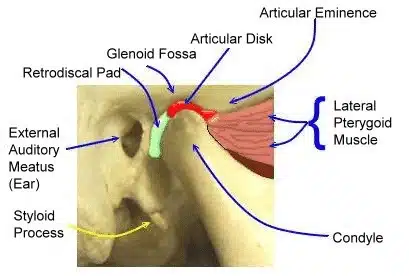
In my experience, a slipped disc in the jaw can also bring headaches, neck pain and dizziness. Fullness or ringing in the ears can come with it too, along with aching or tightness in the cheek and temple muscles. In my view, a jaw joint disorder can also worsen Eagle-like symptoms when an upper neck problem sits beside a slightly long styloid bone, the thin spike of bone below the ear.
The jaw joint sits just in front of the ear canal, as the image above shows. The guide to tinnitus and the neck explains how the neck and jaw can play a part in ear symptoms.
How Jaw Tension Reaches the Upper Neck
As I see it, the two feed each other: jaw trouble can unsettle the top of the neck, and a long-standing problem there can bring on jaw trouble. Tension in the jaw muscles can spread to the small muscles at the base of the skull. Tight or spasming muscles there can affect the joint between the skull and the first neck vertebra (the occiput and atlas, C0-C1). They can also affect the joint between the first two neck vertebrae (the atlas and axis, C1-C2). The upper neck then needs gentle care at the same time as the jaw.
Is There a Disc in the Jaw Joint? How It Normally Moves
Yes. Each jaw joint (temporomandibular joint, or TMJ) holds a small disc of fibrocartilage, sometimes called the jaw's meniscus. It sits between the ball of the lower jaw (the condyle) and its socket in the temporal bone of the skull. A capsule and ligaments hold the joint together, and the jaw muscles move it.

The disc moves with the jaw. As the mouth opens, the ball of the jaw glides forward with the disc on top of it, as the drawing shows. As the mouth closes, both glide back. The disc lets the joint move smoothly and spreads the load of chewing and speaking. Its collagen fibers run front to back and top to bottom, but far fewer run top to bottom. In my view, that is why frequent, repetitive chewing, such as hours of chewing gum, can damage it.
This is a different kind of disc from those in the spine. Articular discs like this one are found in a few joints, such as the jaw, the wrist and where the collarbone meets the breastbone. Spinal discs sit between the vertebrae.
When the disc no longer sits or moves in its usual position, the change is called internal derangement, or disc displacement.
Disc Displacement With and Without Reduction
The international diagnostic criteria (DC/TMD) sort a slipped disc in the jaw into four types. They depend on whether the disc returns to its place as the mouth opens and whether opening is limited.
With Reduction: A Click as the Disc Slips Back
The disc slips forward but returns as the jaw opens, usually with a click, pop or snap, and slips forward again as the mouth closes. When it sometimes fails to return, the jaw locks for a moment and then unlocks. The criteria call this disc displacement with reduction with intermittent locking.
Without Reduction: Limited Opening and a Stuck Feeling
The disc stays in front of the ball and can block the joint as it glides. When the opening measured in the examination is under 40 mm, counting the overlap of the front teeth, the opening is limited. This type, disc displacement without reduction with limited opening, is often called closed lock. With 40 mm or more, it is the type without limited opening. In my experience, a healthy jaw opens about 45 to 50 mm between the front teeth, and a disc that stays in front often brings that down to 30 mm or less. A disc that clicks back can also, when it is neglected, progress to one that stays in front.
Can a Slipped Jaw Disc Go Back in Place?
With reduction, it already does, each time the mouth opens: the click is the disc slipping back onto the ball of the jaw. It slips forward again as the mouth closes. Without reduction, the disc stays in front of the ball.
Putting the disc back is not the only route to a jaw that works well. In the five-year trial above, open surgery that tried to reposition the disc did no better than care without surgery, for pain or jaw function. So care at CSC aims at what can change: pain, how freely the mouth opens and the load on the joint through the day.
My care for a slipped disc in the jaw never forces the mouth open or pulls the jaw to pop the disc back. The jaw joint and its soft tissues are worked on with very gentle manipulation and manual therapy instead, within what the patient can comfortably tolerate.
What Causes a Slipped Disc in the Jaw?
In my experience, a slipped disc in the jaw follows strain on the joint, repeated or sudden. The common sources are:
- Clenching and grinding (bruxism): in my experience, advanced jaw problems such as slipped discs are seen mostly in people who clench or grind their teeth, and night-time grinding is the usual pattern. A review of 20 studies found that grinding or clenching roughly doubled the odds of a jaw joint disorder, awake or asleep.
- Injury: after whiplash, the neck injury of a car crash, a review found jaw pain in about 19% of people in the early stage. After more than three months it was 27%, against about 6% of people without that injury.
- Long dental visits and procedures: in my experience, long appointments with the mouth held open can strain the jaw, including those of a course of braces, and so can a long procedure through the mouth such as an endoscopy. A study followed 34,491 young people for at least five years. Those who had wisdom teeth removed had a 1.6 times higher risk of a later jaw joint disorder.
- Stress: it makes clenching and grinding worse, by day as well as at night, and exam periods can bring on more forceful grinding in children.
- Repetitive or loaded chewing: hours of gum chewing, and devices that make the jaw bite against resistance. In my view, the jaw muscles get enough exercise from talking and eating, and loading them can injure the ligaments, the muscles and the disc.
A child's jaw joint is still developing, which makes grinding matter more; the section on jaw problems in children explains why.
How TMJ Disc Displacement Is Assessed
In my view, the most important thing to know about a slipped disc in the jaw is that it can lead to a host of related conditions. So each person's examination and assessment has to be highly individual, especially for the symptoms and conditions that come with it.
Assessing a slipped disc in the jaw sorts out whether the disc, jaw muscles, teeth or upper neck are behind the symptoms. It usually involves:
- A detailed history: when the clicking or locking started, what makes it worse, and habits such as clenching, gum chewing or long dental appointments.
- A physical examination: jaw opening in millimeters, the path the jaw takes, joint sounds, the jaw muscles and the upper neck.
- Imaging when it will change the plan: MRI, which I call the gold standard in Is Chiropractic Safe? 13 Questions Answered, shows the disc and the joint's soft tissues without radiation, while an X-ray shows only bone.
Many clinicians follow the Diagnostic Criteria for Temporomandibular Disorders (DC/TMD), an international protocol with a standard history and examination. It identifies a locked jaw with limited opening reliably from the examination alone. For the other types, the examination can only suggest the diagnosis, so MRI is used when a definite answer would change the treatment plan.
Slipped Disc in the Jaw Treatment Without Surgery at CSC
Treatment for a slipped disc in the jaw is planned after the assessment and combines chiropractic and physiotherapy. I advise combining the two rather than choosing between them; in the words of my video Is Chiropractic Safe? 13 Questions Answered, "Choose both." Manual therapy of the jaw joint and its soft tissues is at the core. It is used for a jaw that clicks, a mouth that will not open fully and pain when chewing or talking. Depending on what the assessment finds, care can include:
- Chiropractic care: very gentle manipulation of the jaw joint, from outside the mouth and, where suitable, from inside it, with non-rotatory care of the base of the skull and the neck.
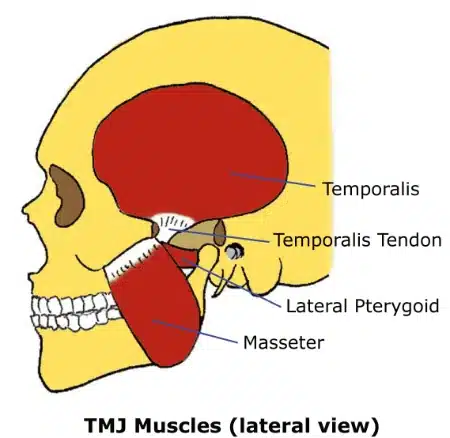
- Physiotherapy: manual therapy, trigger point therapy and myofascial release for the temporalis and masseter, the main muscles that close the jaw. The neck and shoulder muscles are included, as far down as the trapezius and sternocleidomastoid.
- Machine-based therapy: therapeutic ultrasound over both jaw joints, the upper neck and the sternocleidomastoid at the side of the neck; laser for the upper neck or shockwave for the trapezius where needed; and TENS (transcutaneous electrical nerve stimulation) only when the jaw is significantly tender. TENS is stopped if the next session shows no change.
- Self-care at home: self-massage and specific ways of icing the jaw, taught at the center and aimed at settling inflammation in and around the joint.
- Exercises for the jaw and neck, usually from the third to fifth session, and only once the jaw joint is stable enough for them.
- Daily habits: advice on the load on the joint through the day, set out below.
Care is kept within what you can comfortably tolerate, for children and adults alike. Discomfort during care means it is being done too aggressively, so tell the clinician at once. My motto, from the same video, is "No pain, more gain." Progress is checked by repeating the first visit's measures, such as how far the mouth opens. If they have not improved by the fifth session, the plan is reviewed, and by the tenth session the next step is decided together.
Icing the Jaw at Home: My Method
For the jaw joint itself, I ask patients to fill a few small party balloons with water, to a little bigger than a golf ball, and freeze them. Someone at home then massages each jaw joint with one in small circles for 5 to 7 minutes, two or three times a day, and never sooner than two hours after the last round. For the neck, a reusable ice pack wrapped in a cloth goes on for 10 to 15 minutes, timed with a phone. On a jaw that has just been strained, I choose cold over heat.
Upper Neck Care at the Same Time
A slipped disc in the jaw often needs close attention at C1, the top bone of the neck, and C1 can also be a problem on the same side as the jaw. In my experience, C1 then calls for either combined chiropractic and physiotherapy care, or a non-force, non-rotatory upper cervical chiropractic adjustment, given in parallel with care of the jaw. When the examination shows a need, the rib joints and the lower neck are adjusted at the same visits.
Night Guards for Clenching and Grinding
A night guard is useful only when there is clenching or grinding, and for these patients a custom-made guard is very often encouraged. CSC does not make night guards or splints. When one is needed, CSC refers to a dentist, who makes a guard for the person's condition, usually within five to seven days in Malaysia. The dentist's instructions on wearing it are followed, and night guards and splints bought online are discouraged.
Night guards are usually worn during sleep. Some people also clench or grind by day, often in stressful jobs. For them, wearing the guard during waking hours in stressful periods is recommended as a preventive step. People who clench hard or grind a lot may need a new guard every six months or sooner.
A night guard on its own does not fix a jaw problem, and it does not stop clenching or grinding. It can lessen their impact on the disc and the joint capsule. That is why it works alongside hands-on care and exercise rather than in place of them.
Jaw Problems in Children
Jaw problems are common in children, especially those who grind their teeth a lot. Grinding is common and cannot be stopped, but its impact on the jaw can be reduced. Stress makes it worse, and exam periods can bring on more forceful grinding. Along with jaw pain, a child may have headaches and a stiff neck.
Braces can also bring on jaw problems when dental visits are long, because the mouth is held open for a long time. During a course of braces, at any age, the jaw joint and the muscles around it can be cared for alongside the orthodontic treatment.
This matters more in children, since their jaw joints are still growing along with the face.
In my experience, heavy clenching or grinding during these years can erode and misshape the joint's cartilage. It can also damage the disc and the ligaments around the joint. That can lead to long-standing jaw and upper neck problems, with frequent headaches and dizziness. A night guard made by a dentist matters even more for a child who clenches or grinds.
Care for children is extremely gentle, because their joints are still developing. It combines manual physiotherapy methods with gentle, non-force and non-rotatory chiropractic care. For teenagers, chiropractic manipulation that is non-rotatory using the Activator instrument may be used. Machine-based therapy such as ultrasound may not be warranted for a growing child. Children are cared for with hands-on or instrument-assisted methods that do not disturb the growth of their joints and cartilage.
The guide to chiropractic care for children lists the other problems children are often seen for and how care is adapted at each age.
Slipped Disc or Dislocated Jaw? How They Differ
In a slipped disc, the ball of the jaw stays in its socket and the small disc moves. In a dislocated jaw, the ball itself leaves the socket, most often coming to rest in front of the bony ridge ahead of it. The mouth is then stuck open.
- What it looks like: the mouth stays open and the front teeth cannot meet. When both sides dislocate, the chin juts forward; when one side does, the chin shifts toward the other side.
- Common triggers: an injury, in about 60% of cases in a review of published reports. Otherwise, very wide opening from yawning, laughing or a long dental or medical procedure.
- Partial or complete: a dislocation the person can put back is called a subluxation. One that needs someone else to put it back is a luxation.
A jaw stuck open needs a hospital emergency department straight away, where a doctor puts it back, usually by hand. It is a medical emergency, not a reason for a chiropractic visit.
Daily Habits for a Slipped Jaw Disc
Daily habits decide more of the recovery than any treatment does, a point I stress near the end of my talk Back Pain to Leg Pain. With a slipped disc in the jaw, these habits change the load on the joint more than any single session does:
- Resting position: teeth slightly apart, lips closed and the tongue resting on the roof of the mouth, with the teeth touching only when eating.
- Food: smaller bites and softer food during flares, and no chewing gum or tough, chewy food for now.
- Chewing: on both sides rather than favoring one.
- Yawning: support the chin with a hand.
- Movement: use the jaw within a comfortable range and do not force it wide open. Jaw exercises wait until they are prescribed, once the joint is stable.
- Clenching: notice it while concentrating, driving or asleep, and ask a dentist to check the wear on the teeth if night clenching is suspected.
When Jaw Symptoms Need a Doctor or Dentist First
Some signs are not typical of a slipped disc in the jaw and need a doctor or a dentist before any jaw care:
- A jaw stuck open that will not close: a hospital emergency department straight away.
- Jaw pain brought on by exertion and eased by rest, or with chest discomfort, breathlessness or sweating: a hospital emergency department straight away. The pain can come from the heart.
- Swelling, warmth or redness of the face or jaw, fever, or tooth pain: a dentist or doctor promptly, since these can point to an infection.
- Numbness of the lip, chin or face, or weakness of the face: a doctor first.
- A bite that has changed suddenly, especially after a fall or a blow to the face: a dentist or doctor first.
- New hearing loss, or a discharge from the ear: a doctor first.
Jaw pain from the heart is easy to miss. In a review, about 4 in 10 people with reduced blood flow to the heart felt pain in the face or jaw area. Up to 4% of people having a heart attack felt it only there.
What You Can Measure at Home
A few simple records show whether the jaw is moving in the right direction:
- Mouth opening: measure between the edges of the upper and lower front teeth with a ruler, at the same time each week. A rising number matters more than today's figure. In the examination, an opening under 40 mm, counting the overlap of the front teeth, counts as limited.
- Where and when it hurts: note whether the pain is at the joint in front of the ear, in the cheek or at the temple. Note too whether it is worst on waking or late in the day.
- Load: note chewing gum, hard foods, long dental appointments and clenching while concentrating or driving.
These are the same measures I repeat at the center. If they have not changed by the fifth session, the plan is reviewed.
Planning a visit? You can review the current chiropractic price in Kuala Lumpur and physiotherapy fees in Kuala Lumpur before you come in.
Frequently Asked Questions on a Slipped Disc in the Jaw
Is jaw disc displacement serious?
Jaw disc displacement is usually not dangerous, though in my view it still merits an examination, since related problems can come with it. A disc that clicks back into place is very common. The international diagnostic criteria treat it as probably without consequence unless pain, limited opening or trouble chewing comes with it. It matters more when the jaw locks, the opening stays limited or pain keeps returning, and those are the times to have it examined. It is urgent only when the jaw is stuck open and will not close. That is a dislocation, which needs a hospital emergency department straight away.
How do I know if my TMJ disc is displaced?
Most people first notice a click or pop, a catch partway through opening, or an opening that suddenly shrinks. Jaw muscle pain and dental problems can feel similar, so only an examination can say whether the disc is involved. A locked jaw with limited opening can be identified reliably in the examination itself. A click can be confirmed as a displaced disc only on MRI, which is used when a definite answer would change the treatment plan. Noting when each sign happens, and measuring the opening each week, makes the examination more useful.
Is a slipped jaw disc the same as TMJ?
Not exactly. TMJ is the name of the joint itself, the temporomandibular joint, although many people use it for any jaw problem. The problems are called temporomandibular disorders (TMD). The international diagnostic criteria list twelve common ones. They include jaw muscle pain, joint pain, four types of disc displacement, wear of the joint and headache linked to the jaw. A slipped disc is one of them. A person can have a disc problem and muscle or joint pain at the same time, so the examination looks at all of them.
Why does my jaw feel out of place on one side?
A slipped disc on one side can make that side feel out of place. The disc can catch as the joint moves, so that side clicks or catches while the other does not. Tender or tight chewing muscles on one side can give a similar feeling. A bite that has changed suddenly, especially after a fall or a blow to the face, needs a dentist or doctor first. Otherwise, an examination of both jaw joints, the jaw muscles and the upper neck shows which side is involved and why.
Who should check my jaw: chiropractor, physiotherapist or dentist?
Each has a part. A registered chiropractor and a physiotherapist examine the joint, the jaw muscles and the upper neck and plan hands-on care. My advice is to use both rather than pick one, a point I make in my video Is Chiropractic Safe? 13 Questions Answered. A dentist checks the teeth and the bite, treats tooth problems and makes a night guard when clenching or grinding is part of the picture. A doctor comes first for the warning signs listed above, and a hospital emergency department for a jaw stuck open.
How long can a dislocated jaw go untreated?
A dislocated jaw should not wait: a jaw stuck open needs a hospital emergency department straight away. In a review of published cases, dislocations seen within about two weeks could usually be put back by hand. After about two weeks, the jaw muscles tighten and shorten, putting the jaw back by hand becomes difficult, and some cases need surgery. A slipped disc is different and is not an emergency. Still, a jaw that has suddenly locked, so that the mouth will not open fully, should be examined soon.
Can a clicking jaw get worse over time?
It can. In my experience, a disc that clicks back into place can, when it is neglected, progress to one that stays in front and limits opening. Signs of that change are clicking that stops while the pain grows, catching that lasts longer, and an opening that shrinks. A weekly measurement of the opening shows the change early, and any of those signs is a reason to have the jaw examined soon.
Should I use a jaw exerciser or chewing device?
No. In my view, the jaw muscles get all the exercise they need from talking and eating each day. A device that makes you bite against resistance loads the muscles, the ligaments and the small disc in the joint, and it can bring on clicking or locking. Jaw exercises in my care are gentle, chosen for the person and started only once the joint is stable, usually after the third to fifth session.
Will braces or clear aligners fix a slipped jaw disc?
Not on their own, in my view. Braces and aligners straighten teeth, but they do not stabilize a slipped jaw disc. A course of them also means many long appointments with the mouth held open, which can strain the jaw, so ask for shorter sessions with breaks. For grinding, a night guard made by a dentist lessens the load on the disc, and the joint itself can be cared for alongside the dental treatment.
What should I do next?
Write down when the clicking or locking started, what sets it off and whether it is happening more often. Measure the opening with a ruler once a week. Bring any MRI report and the images to the examination. If clenching or grinding is suspected, ask a dentist to check the wear on the teeth. If the jaw is stuck open, or the jaw pain comes with chest discomfort or breathlessness, go to a hospital emergency department straight away instead.
How to Read This Slipped Disc Guide
This guide explains a slipped disc in the jaw for education. It cannot diagnose anyone or assess a person's own jaw. So it does not replace an examination by a registered practitioner, or a dentist's check of the teeth and bite.
References
1. Schiffman EL, Look JO, Hodges JS, et al. Randomized effectiveness study of four therapeutic strategies for TMJ closed lock. J Dent Res. 2007;86(1):58-63.
2. Schiffman E, Ohrbach R, Truelove E, et al. Diagnostic Criteria for Temporomandibular Disorders (DC/TMD) for Clinical and Research Applications: recommendations of the International RDC/TMD Consortium Network and Orofacial Pain Special Interest Group. J Oral Facial Pain Headache. 2014;28(1):6-27.
3. Calixtre LB, Moreira RF, Franchini GH, et al. Manual therapy for the management of pain and limited range of motion in subjects with signs and symptoms of temporomandibular disorder: a systematic review of randomised controlled trials. J Oral Rehabil. 2015;42(11):847-861.
4. Ferreira AP, Costa DR, Oliveira AI, et al. Short-term transcutaneous electrical nerve stimulation reduces pain and improves the masticatory muscle activity in temporomandibular disorder patients: a randomized controlled trial. J Appl Oral Sci. 2017;25(2):112-120.
5. La Touche R, Fernández-de-las-Peñas C, Fernández-Carnero J, et al. The effects of manual therapy and exercise directed at the cervical spine on pain and pressure pain sensitivity in patients with myofascial temporomandibular disorders. J Oral Rehabil. 2009;36(9):644-652.
6. Mortazavi N, Tabatabaei AH, Mohammadi M, Rajabi A. Is bruxism associated with temporomandibular joint disorders? A systematic review and meta-analysis. Evid Based Dent. 2023;24(3):144.
7. Häggman-Henrikson B, Lövgren A, Wu WY, et al. Prevalence of Temporomandibular Disorder Symptoms After Whiplash Trauma: A Systematic Review and Meta-Analysis. Eur J Pain. 2025;29(3):e4792.
8. Huang GJ, Rue TC. Third-molar extraction as a risk factor for temporomandibular disorder. J Am Dent Assoc. 2006;137(11):1547-1554.
9. Akinbami BO. Evaluation of the mechanism and principles of management of temporomandibular joint dislocation. Systematic review of literature and a proposed new classification of temporomandibular joint dislocation. Head Face Med. 2011;7:10.
10. Kreiner M, Okeson J, Tanco V, Waldenström A, Isberg A. Orofacial Pain and Toothache as the Sole Symptom of an Acute Myocardial Infarction Entails a Major Risk of Misdiagnosis and Death. J Oral Facial Pain Headache. 2020;34(1):53-60.
These references describe jaw joint disorders, their care and conditions that can feel similar, in general. None of them evaluates care at Chiropractic Specialty Center.
The Author of Slipped Disc in the Jaw: Signs, Symptoms & Treatment
Slipped Disc in the Jaw: Signs, Symptoms & Treatment was written by Yama Zafer, D.C., who has 30+ years in chiropractic and physiotherapy and founded Chiropractic Specialty Center in Kuala Lumpur in 2006.
Last Updated: Slipped Disc in the Jaw: TMJ Displacement, Causes & Care Options
Slipped Disc in the Jaw: TMJ Displacement, Causes & Care Options was last reviewed and updated on October 16, 2026.
Dear Dr Zafer, I have a the TMJ slipped disc issue for a few years; physiotherapy approach (from 2 different providers) caused more pain, and chiropractic adjustment only temporarily improves condition and ever so slightly... I have been researching treatment options online and have come across your article which I loved, and it is lovey to see you taking time replying to commends and giving advice. I would be booking in for the appointment with you if I lived in the area, but I am based in Australia; However, I hope you don't mind if I take an opportunity and ask for a recommendation from you (just in case you know) a good TMJ clinic that is located in Brisbane, QLD, Australia. Thank you for your time.
Thank you for your kind words, Marina. I cannot recommend a particular clinic, but I can tell you what to check when you choose one in Brisbane:
Call or message the clinics you are considering, describe your jaw, and ask how they would assess it.
Hello Dr Zafer. Can you help? A year ago i broke jaw in cycling accident. Plates were put on mandibule fractures. Théy couldn't understand why i Never regained normal speech or ability to chew, saying it was stuff jaw muscles. 9 months later another hospital (Montpellier, France) discovered condyle fractures and broken discs 'displaced without réduction.'. I'm AT a loss what to do. Thé maxillo facial surgeon doesn't want to operate. I'm so glad you agréé with this. Hé suggests botox in muscles. But will that do any good if thé problèm is mechanical not muscular? Thé plates have to Come out as they've irritated all Year and I Wonder if they contribute to difficulty speaking. I'm Desperate as I'm a teacher and havent been able to teach. IS botox enough? Should i Ask for joint washing, disc plication ? I sée lots of surgical options. I have clicking, crepitus, pulling sensation in right tmj. Left one, nothing. Opening AT best IS 33mm. Thanks.
Your jaw and both condyles were fractured. The condyles are the rounded tops of the jaw that sit in the joints. Decisions about the plates, Botox, joint washing (arthrocentesis) or disc plication belong with your maxillofacial surgeon, who has your scans. Ask what each option is meant to change in your case. Botox acts on muscles, so your question about a mechanical problem is a fair one to put to your surgeon.
In my view, injections and procedures on the joint are later options, considered only after focused conservative care, properly given, has not worked. That fits your surgeon's caution about operating. Once your surgeon confirms that the bones have healed, gentle care of the jaw can begin.
A slipped disc in the jaw often comes with related conditions. So the examination should be specific to you: both joints, the jaw and neck muscles, and C1, the top bone of the neck, on the same side as the clicking joint. In my experience, C1 then calls for chiropractic and physiotherapy combined, or a non-force, non-rotatory upper cervical chiropractic adjustment.
Your 33 mm opening is under the 40 mm that the international diagnostic criteria count as limited. Measuring it weekly shows whether it is changing. For your speech, ask your surgeon about a speech therapist.
Hello, i have Two displaced discs without réduction due to a cycling accident 10 months ago. Thé first few months i couldnt open more than a cm. Thén i got to 2 1/2 cm. I'm seeing an orthodontiste who spécialisés in discs. She's given me a custom night guard to help rest the muscles which spasm and are so tight. Eating and speaking have been so difficult since thé accident. I've been told about botox and surgery with a mitak instrument that ours discs back on condyle. Thé clicking, popping, crunching on one side IS so Bad. I have appointment with surgeon maxillo facial next week and am so nervous about what he'll want to do. My orthodontiste is against physiotherapy believing it to damage thé discs. I live in France. I dont know any chiropracters. What should m'y treatment bé to help me eat and speak again? Thanks
I cannot tell you what your treatment should be without examining you, Steph. After an accident like yours, your surgeon's findings come first. What I can share is how I approach it.
Your opening has already improved from 1 cm to 2.5 cm, which is worth knowing as you weigh the options. In my view, surgery and injections such as Botox are later options, considered only after focused conservative care, properly given, has not worked. A keyhole is still an incision. In a five-year trial of 106 people with a locked jaw (Schiffman and colleagues, 2007), those cared for without surgery did as well as those who had surgery on the joint. Care without surgery meant medicines and self-care in one group, and the same plus physical therapy, a splint and cognitive behavioral therapy in the other.
A cycling accident jars the neck as well as the jaw. A slipped disc in the jaw can also bring other conditions with it. So your examination should be specific to you, including C1, the top bone of the neck, on the same side as the worse joint.
Gentle jaw physiotherapy by someone experienced with the jaw is different from forceful stretching. It stays within what you can comfortably tolerate. It is worth asking your surgeon whether it suits you. Keep a weekly record of your opening in millimeters between the front teeth.
Good Evening Dr. Zafer,
Our 80 lb. rescue hound head-butted me on the right side of my face (jaw area) in April 2023. I experienced a vitreous detachment but didn't think much about my jaw, even though it hurt. Fast forward to August, I experience an SS hearing loss (Sudden Sensory hearing loss) with tinnitus.
First, it was thought to be eustachian tube dysfunction. The MRI concluded it was advanced TMJ. The first DMD did a panoramic dental x-ray, which showed the curvature of my right TMJ. He also reviewed the MRI and acknowledged the degenerative changes, grading them at 3/10 (10 being the worst). I then followed up with the DMD my dentist referred me to, who said I needed surgery. She said it was Avascular Necrosis and showed me where the disc was displaced. I'm confused at this point about how two doctors could be that far apart in their impressions. My jaw is sore, and I have click/pop with an infrequent lock; it is more like a joint hesitation. Your thoughts would be appreciated.
Two clinicians reading the same images can differ, and a good tie-breaker is the radiologist's own written MRI report. Ask for a copy and see what it says about the condyle (the ball of the jaw), the disc and the bone. Then ask the clinician who advised surgery which findings in that report support it. If surgery is still advised, a further opinion from an oral and maxillofacial surgeon is reasonable before you decide.
In my view, surgery on the jaw joint is a distant last resort, considered only after focused conservative care, properly given, has not worked, and a keyhole is still an incision. Your own description, soreness, clicking and an occasional hesitation rather than a jaw that stays locked, belongs at the center of that decision.
Sudden hearing loss is a separate condition that needs an ear, nose and throat doctor's assessment, and jaw care does not treat it. Please make sure that assessment has been completed.
A blow to the side of the face also jolts the neck. In my experience, the upper neck and the jaw muscles can feed pain into the jaw, the ear and the side of the head, and they are worth examining after an injury like yours. Care at our centers for that is gentle: manual therapy and myofascial work for the jaw muscles, non-force care of the upper neck, and icing and self-massage taught for home, always within what you can comfortably tolerate.
Meanwhile: teeth apart and the tongue on the roof of the mouth at rest, small bites, no gum, chewing on both sides and a hand under the chin when you yawn.
Hi,
Just a quick question. I was at the dentist getting an impression made for an implant I'm getting. I also had an X-ray. I felt no jaw pain during this visit. I believe my right TMJ started clicking when chewing a couple of days late. This is the side on which the procedure was carried out. I have full jaw movement and no other pain.
What would be the best way to proceed here? My dentist was going to refer me to a specialist about this during my checkup, but I'm currently delaying this. This has been happening for around a month, and there has been no change in the condition (perhaps I don't notice it so much now through adaptation). Should I see the specialist, or should I try some jaw exercises?
A painless click with full, comfortable opening is very common. The international diagnostic criteria treat it as probably without consequence unless pain, limited opening or trouble chewing comes with it, so this is not urgent.
In my experience, long dental appointments with the mouth held open can strain the jaw. Tell your dentist about the click before the next stage of your implant, and ask for shorter working periods with breaks to close and rest the jaw.
Please hold off on jaw exercises for now. In our care, jaw exercises are prescribed only once the joint is stable, usually after the third to fifth session, and a painless click on its own does not call for them. Keeping the specialist referral is sensible if the click persists, and especially if it starts to hurt, catches, or your opening becomes smaller.
Meanwhile: teeth apart and the tongue on the roof of the mouth at rest, chewing on both sides, no gum and a hand under the chin when you yawn. Measure your opening with a ruler once a week, so any change is easy to see.
I've been to two specialists and have been given opposing treatment options. My jaw pain is on my right side and is caused by a slipped disc in my jaw and severe arthritis that has caused bone-on-bone action, causing the grinding and sanding noise.
I have a limited range of motion, making it difficult to eat, and when I open my mouth too far, it feels like it clicks out of place and is pretty painful. I also have had tinnitus for the past five years, fullness and popping constantly in my right ear, and dizziness.
When my jaw flared up a couple of months ago, the volume of the ringing dramatically increased. I have been given two different options to treat my problem, and I'm confused about what I need to do. One doctor wants to try a custom guard with laser therapy and a stretching program. The cost is $6,000 upfront and insurance will not cover anything.
The other doctor told me not that I have so much damage to the bone (jagged edges and such) that my only option is a total joint replacement and that I would be wasting money trying other treatments. The other kicker is that my insurance will not cover it, and the surgery is around $30,000.
When two clinicians disagree, it helps to ask each of them the same questions and compare the answers. What is this option meant to achieve, less pain or more opening? What opening do you expect afterward? What happens if I wait? What is the plan if it does not work? Also measure your own opening between the front teeth with a ruler; under 40 mm, counting the overlap of the front teeth, counts as limited.
In my view, joint replacement is a distant last resort, considered only after focused conservative care, properly given, has not worked, because it cannot be undone. In a five-year trial in people whose jaw had locked from a slipped disc, those treated without surgery did as well as those who had joint surgery. If replacement is still advised, a further opinion from an oral and maxillofacial surgeon is worth having.
At our centers, care for a jaw like yours is gentle and hands-on: manual therapy of the jaw joint and its muscles, myofascial work on the temporalis and masseter, gentle non-force care of the upper neck, TENS only when the jaw is significantly tender, and icing and self-massage taught for home. Nothing goes beyond what you can comfortably tolerate, and stretching is never forced. If you clench or grind, a dentist can make a night guard to lessen the strain on the joint.
Your ringing, fullness and dizziness should also be checked by an ear, nose and throat doctor, so that nothing in the ear itself is missed. In my experience, jaw and upper neck problems can add to these symptoms, which is one more reason the neck is examined too.
hi
i have been suffering from TMJ for a long time along with other pains related to prolonged TMJ.. as i am not a malaysian, i want to know for how long i have to be in malaysia and your consultation charges as well.
Thank you for asking, Niuma. How long you would need to stay depends on what the examination finds, so no one can give a number before it. A long-standing jaw problem often comes with related conditions, and the plan is built around yours. At the first visit, the findings, the plan, its likely length and its fees are explained before any care begins. Progress is reviewed at about the fifth and tenth sessions.
Our fees come from the CSC quotation dated June 25, 2026. Chiropractic fees are the same at every CSC center, and physiotherapy fees at both Kuala Lumpur centers:
The full lists are on our chiropractic price page and physiotherapy fees page. The fee for a plan is explained and agreed before care begins. The numbers and opening hours are on our contact page. Please bring any scans and reports you already have.
Right side articular disc displacement
Right side seem like swalled
Pooping soubd from left side
Some time ringing sound in right ears
Right side neck seem upward or hard swelled
Neck pain or pain below neck and neck disalignment slightly
Nose bone position not normal when I exhale it feel more amount of air come from left nostril
Thank you for listing your symptoms, Ashfaq. They show why a slipped disc in the jaw has to be examined as part of a bigger picture. In my experience, it can lead to a host of related conditions, and yours include the neck and the ear on the same side.
Two of them need a doctor first. Swelling on the side of the face or neck is not typical of a jaw joint problem. A doctor should check it, especially if it is new, growing, warm or painful. Ringing in the ear and the change in airflow through your nose are for an ear, nose and throat doctor.
For the jaw and the neck, the examination should cover both jaw joints, the jaw and neck muscles, and C1, the top bone of the neck. C1 is often involved on the same side as the jaw. When it is, I recommend either chiropractic and physiotherapy combined, or a non-force, non-rotatory upper cervical chiropractic adjustment.
Care stays within what you can comfortably tolerate. Progress is checked by repeating the first visit's measures, such as how wide the mouth opens. If you are in Kuala Lumpur, you can call or WhatsApp either of our centers to ask about an assessment.
Hi,
My jaw has been locked for over 9 months now. Before this, my jaw would sometimes click especially when eating and I had a few occasions in which it would pop and I would unlock it by yawning slowly. However, after it permanently locked I called my doctor and was recommended to massage it with ibuprofene gel. Needless to say, I have tried every at-home measure (night guards, massaging, watching youtube videos to try and unlock it) with no results and have been referred to maxfax, but the waiting list can be up to 40 weeks with the NHS.
Do you have any advice on what I should do in the meantime or if I should more urgently seek help? It does significantly impede my quality of life.
A jaw that clicked and caught for a while and then stayed locked usually means the disc has slipped forward and stayed there. It blocks full opening, which is called a closed lock. It is not an emergency in itself. A jaw stuck open that will not close is, and needs a hospital emergency department straight away.
Yours has gone on a long time and limits eating and speaking. It is worth asking your GP to tell the maxillofacial team how much it affects your daily life.
While you wait, I would stop trying to unlock it with maneuvers from videos, and let no one force it open. In a five-year trial of 106 people with a locked jaw (Schiffman and colleagues, 2007), those cared for without surgery did as well as those who had surgery on the joint. Care without surgery meant medicines and self-care in one group, and the same plus physical therapy, a splint and cognitive behavioral therapy in the other. Every group improved.
A slipped disc in the jaw can lead to related conditions, so look for an examination specific to you. It should cover the jaw joint, the jaw muscles, and C1, the top bone of the neck, on the same side. In my experience, C1 then calls for chiropractic and physiotherapy combined, or a non-force, non-rotatory upper cervical chiropractic adjustment. Measure your opening between the front teeth each week, so whoever sees you can tell whether it is changing.
Dear Dr Zafer,
Three months ago, I woke up with (1) pain on the left side of my face, (2) my mandible shifted slightly to the right so that my teeth became misaligned (top not matching bottom), and (3) difficulty opening the mouth. I have not recovered – there has been some improvement but my teeth are still not back to the proper bite, I can open more but it is not comfortable/normal (about 35mm comfortably), and I have had sudden gum recession on the teeth that are most affected by the misalignment. Based on a recent CT scan, it appears the right tmj disc is displaced. Is there a way to get my mandible back to the correct position so that my teeth realign? The tmj specialist I consulted suggested shifting my teeth (over the course of a year) to fix the bite instead.
Thanks!
A bite that changes suddenly, with pain on one side and limited opening, needs a careful look at both jaw joints and the muscles. That should come before anything permanent is done to the teeth. No one can promise that the jaw will move back, and I cannot judge your case from here.
A CT scan shows bone well but not the disc. An MRI shows the disc and the joint's soft tissues, and it is used when the answer would change the plan. Your 35 mm of comfortable opening is under the 40 mm that the international diagnostic criteria (DC/TMD) count as limited.
A slipped disc in the jaw can lead to a host of related conditions. So the examination should be specific to you: both joints, the jaw muscles, and C1, the top bone of the neck. In my experience, C1 is often involved on the same side as the jaw.
Moving teeth is permanent. So it is reasonable to ask your specialist whether the joint and muscles can first have focused, gentle care, properly given, and how the bite will be watched during that time. The gum recession is one for your dentist or a gum specialist (periodontist).
Hello!
I’ve been reading your articles and your responses to others, and apparently, these jaw things may affect your airways. I started having internal derangement with a reduction in September 2022. They slowly progressed into short episodes of internal derangement without reduction; they would last an hour or a few at first, and then it was days; and now it has been three months since my jaw has been back into place. I have seen my TMJ specialist, and I finally got an appointment for an MRI, and I have my follow-up in a few days, but I’m wondering if this could be connected to my snoring. I NEVER snored until this all started happening. Should I be worried?
The pattern you describe, a click first and then locking episodes that grow longer, is the reason to keep your specialist appointment and the MRI. A jaw that has stayed locked for three months deserves a full assessment now rather than later.
On the snoring, I cannot tell from here whether it is connected. New snoring, waking unrefreshed or daytime sleepiness should be raised with your doctor as a question of its own, since sleep problems have their own assessment.
For the jaw, care at our centers is gentle and hands-on: manual therapy of the jaw joint and its muscles at the core, gentle manipulation of the jaw and the neck where suitable, trigger point and myofascial work for the temporalis and masseter, TENS only when the jaw is significantly tender, and icing and self-massage taught for home. Exercises wait until about the third to fifth session, once the joint is stable, and nothing goes beyond what you can comfortably tolerate. In a five-year trial of people with a locked jaw, those treated without surgery did as well as those who had joint surgery.
Meanwhile, do not force the jaw open when it locks. Take small bites of soft food, avoid gum, chew on both sides and support your chin when you yawn. Measure your opening weekly; under 40 mm, counting the overlap of the front teeth, counts as limited. If the jaw locks open and will not close, go to a hospital emergency department straight away. Swelling or fever needs a dentist or doctor promptly.
Hi, I recently was just eating as normal when I heard a sudden crunching sound come from my left TMJ. It hurt in the moment and I immediately paused eating. It then felt okay so I just cautiously continued. However, the next day pain started in my inner cheek and right at the back by my wisdom tooth. This pain worsens when chewing, so I am wondering if would just be a good idea to rest the muscles by avoiding large/chewy foods for a while. I have made a doctors appointment, but they can't see me for three weeks! So, in the mean time I am looking for anything I can do at home to relieve it myself. I find it's a lot worse in the morning and when I chew. I also have a swollen lymph node under my jaw for some reason which has never happened before.
A sudden crunch, then pain near a wisdom tooth and a new swollen gland under the jaw, is worth showing to a dentist or doctor sooner than three weeks. Swelling or a swollen gland is not typical of a jaw joint problem. A wisdom tooth or gum infection can also make chewing painful.
Ask for an earlier appointment, or see a dentist. Fever, swelling that spreads, or difficulty swallowing or breathing needs a hospital emergency department straight away.
Until then, resting the jaw is sensible. Eat soft food in small bites and chew on both sides. Avoid gum and chewy food, and put your hand under your chin when you yawn.
If the jaw joint itself turns out to be involved, remember that a slipped jaw disc can bring related conditions with it. The examination should then be specific to you. It should cover both jaw joints, the jaw muscles, and C1, the top bone of the neck, on the same side as the sore joint.
I started having jaw issues within the past 1 - 1.5 years. The problem started on my right side with overall jaw pain from clinching at night (and periodically throughout the day). It felt as if I couldn't get my jaw to relax. This led to a loud popping noise that others could hear, easily, when I opened my mouth. Sometimes I would wake up with my jaw locked off to that right side. However, the problem has shifted completely to my left side now, with new symptoms/issues. The inability to relax my jaw during eating and conversations got almost unbearable - and my doctor prescribed me muscle relaxers to help it calm down. I believe those eventually helped with about 60% of the daytime clinching. However, I still will wake up with my jaw locked out to the left side. Additionally, my left side pops almost every time I open my mouth; but a different pop than what was on the right side. Now it is only a pop that I can hear, and it feels like it's a "deeper" pop. Also, my jaw seems to almost "settle" into what feels like 'settling into a groove' off center to the left. Also, I continue to experience the tightness of jaw when eating and talking that I just can't seem to relax. I finally went to an oral surgeon here in Alabama, Dr. Michael Koslin, and he ordered X-rays and an MRI due to the suspicion that I had caused damage to the joint and/or displaced a disc.
The MRI results came back showing a displaced disc on at least my left side (and maybe also my right). Additionally, there was fluid buildup on my left side, indicating damage/ injury to the joint. I can't remember what all was said about the right side - but that, to my surprise, that side looked worse off. Also, during the MRI, there were images taken with my mouth open (biting down on an object) to see the range of motion. These images showed that my jaw is quite hyper-mobile.
(Side note: All of my joints tend to have hypermobility and I am actually in the process of getting tested for Marfan and Ehlers_Danlos Syndrome, through my Rheumatologist.)
Dr. Koslin's plan of action is to have arthroscopic surgery and I guess fix the placement of the disc(s). (I kind of zoned out after hearing surgery). Although I do remember him talking about tightening the joint, or something, to reduce the range of motion to that of a normal range.
My questions are: based off of the information I have given you...does it seem like surgery is the best option? Does physical therapy seem like it could help? Do you have any other suggestions? I am a bit desperate and would rather not have surgery unless really necessary.
I do not have a mouth guard; nor have I been told I should get one. I have had braces and my wisdom teeth removed. I do not have an overbite or an underbite.
I am unsure of the root cause of the excessive clinching - Dr. Koslin did recommend seeing a psychologist in hopes to get to the root cause, in addition to the surgery.
Thank you so much for your insight!
-Savannah, 24 y/o female
Thank you for the detail, Savannah. The decision about surgery is yours to make with your surgeon, and I cannot judge your case from here. What I can share is how I look at it.
In my view, surgery is a distant last resort, considered only after focused conservative care, properly given, has not worked. Even arthroscopy is still an incision. In a five-year trial of 106 people with a locked jaw (Schiffman and colleagues, 2007), those cared for without surgery did as well as those who had surgery on the joint. Care without surgery meant medicines and self-care in one group, and the same plus physical therapy, a splint and cognitive behavioral therapy in the other. Your locking and hypermobility differ from the people in that trial. So it gives you questions to ask rather than an answer.
A slipped disc in the jaw seldom comes alone; it can bring a host of related conditions. Hypermobility is one more reason the examination must be specific to you. It should cover both joints, the clenching, the neck, and C1, the top bone of the neck, on the same side as the worse joint.
For a hypermobile jaw, care must be gentle and non-force, with no twisting and no stretching to gain range. In my experience, that means chiropractic and physiotherapy combined, or a non-force, non-rotatory upper cervical adjustment where C1 is involved. Stabilizing exercises come only once the joint is ready.
A night guard made by a dentist can lessen the strain of clenching at night, though it does not stop the clenching itself. Two questions for your surgeon: which conservative care should come first, and what would change the plan?
I am having a DDWR. My jaw got locked after shouting and then I forced opened it a little and the disc is slightly displaced..when I open my mouth and the click happens my jaw comes in the normal position and then on closing it comes to abnormal position..it's on the right side.. I'm undergoing treatment it happened just 1 week ago . I did cbct scan and also nothing came there..it's articular disc problem.. doctor gave me medicine and told to report him after 5 days and to give hot water bag on the problematic place.. I'm just tensed when will my disc come to it's place..
A jaw that clicks back into line on opening and slips again on closing fits a disc that moves forward and back (disc displacement with reduction). A CBCT scan shows bone, not the disc. So a clear CBCT does not rule out a disc problem. An MRI shows the disc, and it is used when the answer would change the plan.
No one can say when, or whether, a disc will settle back fully. But a disc that slips and clicks back is very common. The international diagnostic criteria (DC/TMD) describe it as probably without clinical consequence, unless it brings pain, limited opening or trouble chewing.
Each person's examination is different, because a slipped disc in the jaw can lead to related problems. Two to check are tight jaw muscles and C1, the top bone of the neck, on the same side as the jaw.
Meanwhile, follow your doctor's plan and take small bites of soft food. Support your chin when you yawn, and please do not force the jaw open again. I prefer cold to heat on a newly strained joint, so ask your doctor whether a cold pack suits you in the first days.
Hello, I had an injury in which my teeth snapped together, and both of my TMJ discs shifted forward, detaching. 10 months and a million appointments later, I am still unable to open my mouth and am full of pain. I was told that surgery was the only option, is this not true?
Thank you
I am sorry these ten months have been so hard, Mollee. Surgery is not the only option for many people with a locked jaw.
In a five-year trial of 106 people with a locked jaw (Schiffman and colleagues, 2007), those cared for without surgery did as well as those who had surgery on the joint. Care without surgery meant medicines and self-care in one group, and the same plus physical therapy, a splint and cognitive behavioral therapy in the other. Every group improved.
In my view, surgery is a distant last resort, considered only after focused conservative care, properly given, has not worked. Even keyhole surgery is still an incision.
That trial cannot decide your own case. An injury that snaps the teeth together jars the neck as well as both jaw joints. A slipped disc in the jaw can also bring other conditions with it. So your examination needs to be specific to your symptoms, including C1, the top bone of the neck, on the same side as the worse joint.
Measure the opening between your front teeth once a week. Under 40 mm counts as limited in the international diagnostic criteria (DC/TMD). Please do not force the mouth open. If the jaw ever locks open and will not close, go to a hospital emergency department straight away.
I have had issues with the disc in my left jaw (articular disc in the jaw) for some time, but in the spring had several surgeries that made it worse. My dentist advised going with Invisalign or something similar to fix my overbite, which she thought would help with my jaw disc problems, including grinding my teeth. What are your thoughts on that? It can get expensive, and the positive side is straight teeth, but I need something to fix my jaw. Would this help?
Straight teeth are a good reason for clear aligners. Whether aligners will help your jaw disc or your grinding is a question to put to your dentist directly: ask what result she expects for the joint and for the grinding, and what happens if your bite shifts afterward.
After several surgeries, your joint may still be settling. In my experience, long dental appointments with the mouth held open can strain the jaw, and a course of aligners or braces adds many of them. If you go ahead, ask for shorter sessions with breaks to rest the jaw. The jaw joint and the muscles around it can be cared for alongside the orthodontic treatment.
For the grinding, a night guard made by a dentist lessens its impact on the disc and the joint capsule; it does not stop the grinding itself. Stress makes grinding worse, so it is worth noticing when yours is at its worst.
For the jaw itself, care at our centers is gentle and hands-on: manual therapy of the jaw joint and its muscles, myofascial work on the temporalis and masseter, gentle care of the upper neck, TENS only when the jaw is significantly tender, and icing and self-massage taught for home. Everything stays within what you can comfortably tolerate. Measure your opening between the front teeth each week, so changes are easy to see.
Good morning!
I have some questions about my TMJ. I have had an MRI that shows the disc is displaced and not going back even upon opening. The dentist said that I needed surgery to get the disc back on. My biggest issues are all ear related versus my jaw. I have jaw pain, but I am most concerned about the ear pressure, ear pain, and tinnitus. Please let me know if you think there is a way to heal this without surgery. Thank you!
Surgery is not the only route, and in my view it is a distant last resort, considered only after focused conservative care, properly given, has not worked. In a five-year trial of 106 adults whose jaw had locked from a slipped disc, those treated without surgery did as well as those who had joint surgery, including surgery that tried to reposition the disc. The authors advised starting without surgery.
Your ear symptoms deserve attention in their own right. In my experience, a slipped disc in the jaw can bring ear pressure, ear pain and ringing; the joint sits just in front of the ear canal. Even so, an ear, nose and throat doctor should check the ears first, so that nothing in the ear itself is missed.
At our centers, care for a displaced disc is gentle and hands-on: manual therapy of the jaw joint and its muscles, myofascial work on the temporalis and masseter, gentle non-force care of the upper neck, TENS only when the jaw is significantly tender, and icing and self-massage taught for home. Exercises come after about the third to fifth session, once the joint is stable, and nothing goes beyond what you can comfortably tolerate. Progress is measured against your first visit, including how far your mouth opens.
If surgery is still advised, a second opinion from an oral and maxillofacial surgeon is reasonable before you decide.
Hi,
I've been experiencing TMJ disorder from early 2020 until now (2022). I had clicking and popping sounds in my jaws. In the past, clicking lasted 1-2hrs, but it has become continuous as of late. I did visit a dentist who related the condition may have resulted from problems I have. The dentist did give me some treatments, and clicking is better. But now, I have more pain and cannot open my mouth fully, making meals difficult as I experience discomfort when I jew food. My jaw pain is getting worse, and I suspect it has to do with my articular disc. Is there anything your center can do to help me?
Yes. Both of our Kuala Lumpur centers see jaw problems like yours. One detail in your message matters: when clicking eases while pain grows and the mouth opens less, the disc may be staying in front of the joint instead of slipping back. That deserves an examination soon rather than later.
The first visit measures how far and how freely your mouth opens, listens for joint sounds and examines the jaw muscles and the upper neck. Under 40 mm of opening, counting the overlap of the front teeth, counts as limited in the international diagnostic criteria. Bring your dentist's notes on what was treated.
Care is planned from those findings and combines chiropractic and physiotherapy. Manual therapy of the jaw joint and its soft tissues is at the core, with gentle manipulation of the jaw and the neck, trigger point and myofascial work for the temporalis and masseter, and TENS only when the jaw is significantly tender. Exercises come once the joint is stable, usually after the third to fifth session, and everything stays within what you can comfortably tolerate. If you clench or grind, a dentist can make a night guard to lessen the strain on the disc; we do not make guards ourselves.
Meanwhile: soft food in small bites, no gum, chewing on both sides and support for your chin when you yawn. If the jaw locks open and will not close, go to a hospital emergency department straight away.
Hello, about a year or two ago, I purchased the "Jawxrsize." It turns out this was a HUGE mistake. I would use the Jawxrsize daily, and it would get to the point where I would chew on it without even realizing it. Well, there were a couple of times when all of a sudden, my jaw just locked up, and I couldn't open my mouth for a few seconds.
After this happened several times, I threw it away and never used it again. Since then, my jaw pops whenever I open it and will occasionally feel stuck. My dentist says my bottom jaw is "sinking" back towards my throat if that makes sense. It gets significantly worse when I lay down. Some mornings I wake up and can only open my mouth halfway. It will take some massaging and warming up before it allows me to open my mouth. Do you have any idea of how much damage I have caused my jaw? I am desperate for feedback.
Stopping the device was the right call. Chewing hard against resistance every day, often without noticing, loads the jaw-closing muscles and the small joint they move. In my experience, advanced jaw disc problems are seen mostly in people who clench or grind, and a chewing device adds the same kind of strain.
How much damage there is cannot be judged from a description; only an examination can tell. The brief locking that released, the popping and the morning stiffness fit a disc that slips out of place and back, but the jaw muscles can cause similar signs, so they are checked too. MRI is used only when the answer would change the plan. Ask your dentist to explain the comment about your lower jaw sitting back, since the bite is a dental question.
At our centers, care for this starts with gentle manual therapy of the jaw joint and of the temporalis and masseter, with the upper neck checked and cared for gently where needed. Self-massage and specific icing are taught for home, and jaw exercises are added only after about the third to fifth session, once the joint is stable. Please do not take up any device that resists jaw closing.
Meanwhile: teeth apart and the tongue on the roof of the mouth at rest, small bites, no gum, chewing on both sides and a hand under the chin when you yawn. Measure your opening between the front teeth with a ruler each week; under 40 mm, counting the overlap of the front teeth, counts as limited. If the jaw locks and does not release, have it examined promptly.
I have a night guard for bruxism. I have disc slip without reduction in my right TMJ.
Is the night guard I had custom made prior to the acute episode sufficient?
Should I be getting a specific device whose goal is to recapture the disc? Are those effective? Safe?
Your existing guard is the kind I would expect to help: a night guard for grinding lessens the strain that clenching puts on the disc and the joint capsule. It does not stop the grinding and does not fix the joint, but it remains useful. Because it was made before the jaw locked, ask your dentist to check that it still fits well.
A device meant to recapture the disc is a dental question, so put these questions to the dentist who would make it. What is it meant to achieve for a disc that no longer slips back? How long would you wear it? How would your bite be checked during that time? Could it change how your teeth meet?
For the joint itself, care at our centers is hands-on and gentle: manual therapy of the jaw joint and its muscles at the core, gentle manipulation where suitable, myofascial work on the temporalis and masseter, care of the upper neck, and icing and self-massage taught for home. Jaw exercises wait until about the third to fifth session, once the joint is stable. We do not make night guards ourselves; a dentist does, and guards bought online are discouraged.
Measure your opening between the front teeth each week; under 40 mm, counting the overlap of the front teeth, counts as limited in the international diagnostic criteria. That number shows whether things are moving in the right direction.
Hello I am Muhammad junaid from Pakistan I did a jaw exercises from YouTube for a double chin for a months and then after I realized that I worsen my jaw I went to dentist they examine and said that I have a jaw reduction I feel like my jaw is stuck at one side I went to dentist who offer me night guard but it didn't help I also have problem in neck the dentist prescribed me some precautions and said that I will take time I said about chiropractic treatment but he Said that follow my isn't ructions and never go to a chiropractor I am suffering from 2 years what should I do here in Pakistan very few people knows about chiropractic treatment and I also feel fear that may be they will worsen it
Thank you for writing, Muhammad. Two years is a long time to live with a jaw that feels stuck on one side. Your worry about making it worse is understandable.
A slipped disc in the jaw can lead to a host of related conditions. So each person's examination has to be specific to their own symptoms, and your neck problem is one of them. In my experience, a slipped disc in the jaw often needs close attention at C1, the top bone of the neck. C1 can be affected on the same side as the jaw.
Please stop the double-chin exercises, since your jaw became worse with them. Where you live, look for a registered practitioner who examines both the jaw and the neck before any treatment. They should explain the findings and use gentle methods, with no forcing or twisting. Where C1 is involved, I recommend either chiropractic and physiotherapy combined, or a non-force, non-rotatory upper cervical chiropractic adjustment.
Keep your dentist informed too. A night guard is made by a dentist. It can lessen the strain on the jaw at night, though it does not fix the problem on its own.
Twenty-five years ago, In a motor vehicle accident, the seatbelt hit my right jaw. The right TMJ was damaged, and a maxillo-facial surgeon gave me cortisone injections to ease the pain. The pain in my right ear and jaw region flared up occasionally but has now become a chronic problem. My doctor referred me to my dentist, who made an excellent mouthguard which I use every night and then to an ENT specialist, who referred me first to an audiologist and then to a maxillo-facial surgeon.
All medical tests and scans have shown no ear damage, but the articular disc does not move to cushion my jaw against my skull. The maxillo-facial surgeon told me that he refuses to operate on the TMJ and will not inject anything into it. He strongly advises me never to go that route with anyone else. He referred me to a physiotherapist specializing in TMJ problems, but his treatment aggravated the pain. I am left with pain management. I cannot use the Tramacet-family of drugs or NSAIDs, so my options are limited. Codeine helps for two or three hours but has addiction problems, and paracetamol is useless. What pain-management measures can I take?
Your surgeon's caution matches my own view: surgery is a distant last resort, and a keyhole is still an incision. That still leaves more than painkillers. Medicines are a decision for your doctor, so here is what conservative care can add.
A seatbelt blow to the jaw jolts the neck as well. The joints at the top of the neck and the muscles at the base of the skull can send pain into the jaw, the ear and the side of the head. After 25 years, they are often the part nobody has examined. In my experience, jaw and upper neck problems often bring ear symptoms even when the ear itself tests normal, as yours did.
A flare after physiotherapy does not rule out hands-on care; it is a sign to keep the care well within what the joint can tolerate. At our centers, care is kept within what the patient can comfortably tolerate, and you tell us at once if anything hurts. My motto has always been "No pain, more gain." For a jaw like yours, that means gentle manual therapy and myofascial release for the temporalis and masseter, gentle non-force care of the upper neck, TENS only when the jaw is significantly tender, and specific icing and self-massage taught for home. If there is no improvement by the fifth session, the plan is reviewed.
Keep wearing the guard your dentist made. Through the day, rest the jaw with the teeth apart and the tongue on the roof of the mouth, take small bites, avoid gum and chew on both sides.
I have a locked jaw my dentist tried to manipulate, but it's too painful and hard for me to tolerate, and besides, it has not helped. I am suffering from jaw pain, especially when I eat, can you help?
I am sorry the manipulation was so painful, Joselito. Care for a locked jaw should never be forced. At our centers, care is kept within what you can comfortably tolerate, and you tell us at once if anything hurts. My motto has always been "No pain, more gain."
A slipped disc in the jaw can bring a range of related conditions, so the examination comes first and is specific to you. It covers both jaw joints, the jaw muscles, and how wide the mouth opens and the path it takes. It also covers C1, the top bone of the neck, which often needs close attention on the same side as the jaw.
Depending on what it finds, care includes gentle manual therapy and myofascial release for the jaw muscles. It can include very gentle manipulation of the jaw and neck where suitable. For C1, it is either chiropractic and physiotherapy combined, or a non-force, non-rotatory upper cervical chiropractic adjustment. Exercises wait until about the third to fifth session, once the joint is stable.
Meanwhile, take small bites of soft food and chew on both sides. If you are in Kuala Lumpur, you can call or WhatsApp either of our centers to ask about an assessment.
Hi, my jaw has been out of place for the past week. I suspect a displacement of my jaw's disc. I've been to many places like the doctors and the dentist who has given me a splint but won't receive of for two weeks, and my osteopath who has just massaged my jaw, neck, and head. Do you have any advice for me? I'm not in any pain apart from trying to open my mouth fully, which I cannot do. I've been looking at what to do and came across this website and was hoping for some advice.
Thanks
A jaw that suddenly will not open fully, with little pain otherwise, often means the disc in the jaw joint has slipped forward and stayed in front, blocking the joint. This is called a closed lock.
Two notes will help whoever examines you. Write down whether the jaw clicked before and whether the clicking stopped when the opening became limited. And measure the opening between your front teeth with a ruler each week: in the international diagnostic criteria, under 40 mm, counting the overlap of the front teeth, counts as limited.
Please do not force the jaw open or let anyone pull on it to make the disc pop back. At our centers, a locked jaw is cared for very gently. Manual therapy of the jaw joint and its muscles is at the core, with gentle manipulation of the jaw and the upper neck where suitable, and specific icing and self-massage taught for home. Exercises wait until about the third to fifth session, once the joint is stable, and everything stays within what you can comfortably tolerate. The splint your dentist is making can lessen the strain on the disc if you clench or grind, but it does not fix the problem on its own.
In a five-year trial of people with a locked jaw, those treated without surgery did as well as those who had surgery on the joint.
Meanwhile, take small bites of soft food, avoid gum and support your chin when you yawn. If the jaw ever locks open and will not close, go to a hospital emergency department straight away. Swelling, fever or tooth pain needs a dentist or doctor promptly.