


Chiropractic Therapy Combined With Physiotherapy: How It Works
Chiropractic therapy combined with physiotherapy means a chiropractor and a physiotherapist work on the same problem, in the same plan. The chiropractor frees up stiff joints; the physiotherapist rebuilds the muscles and movement that keep those joints working well. At Chiropractic Specialty Center (CSC), hands-on care and exercise are used side by side, rather than one after the other.
Chiropractic therapy on its own can loosen a stiff joint, but it does not strengthen the muscles that stopped protecting it, and exercise alone can struggle against a joint that will not move. New patients can usually be seen the same day at either Kuala Lumpur center, but call or send a WhatsApp message first.
This page, Chiropractic Therapy With Physiotherapy: 5 Clear Steps, is published by Chiropractic Specialty Center, Bukit Damansara (KL) main center: WhatsApp +60 17 269 1873 Call +603 2093 1000
Chiropractic Therapy With Physiotherapy in Five Steps
- The examination: the chiropractor asks about the problem, tests movement, nerves and strength, and reads any scans.
- The plan: the findings decide how much chiropractic therapy, how much physiotherapy and which exercises.
- The session: joint work and muscle work are done in the same visit, so each supports the other.
- The home part: a few simple exercises and habit changes carry the work between visits.
- The review: progress is checked, and the plan is changed as you improve or if something is not working.
A person can also choose chiropractic only or physiotherapy only after the examination.
What Chiropractic Therapy Is
Chiropractic therapy is care for the joints of the spine and limbs, and for the nerves and muscles around them, without drugs or surgery. People also search for it as chiro therapy or therapeutic chiropractic. Its main tool is the adjustment, a controlled movement applied to a joint that is not moving as it should, but it also includes mobilization, traction and advice on posture and daily habits.
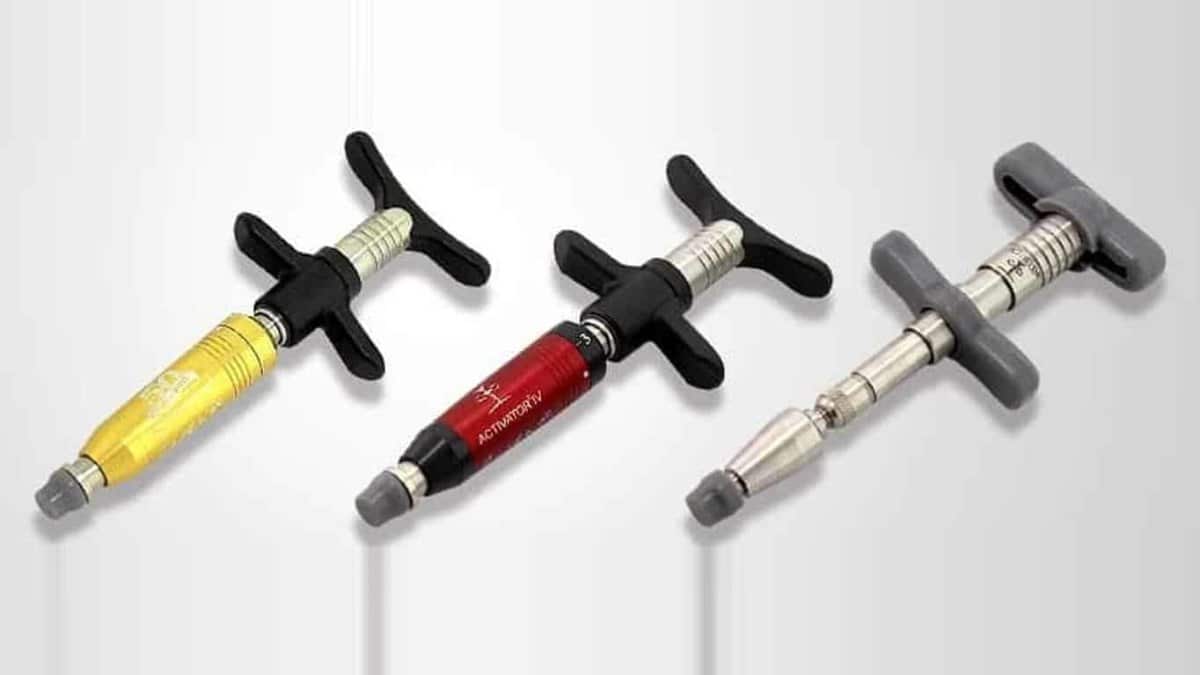
At CSC chiropractic therapy uses non-rotatory methods, so there is no twisting of the neck and no sudden jerk. Common tools include the Activator, a small hand-held instrument; sustained-pressure adjusting; a drop table; and flexion-distraction, a slow bending motion on a special table. For some disc problems, spinal decompression gently takes pressure off the disc.
What the Chiropractor Does
- Examines each joint of the spine and finds the stiff or irritated ones, with orthopedic and nerve tests.
- Chooses the method for that joint and that person: the Activator for a slipped disc, after spine surgery once cleared, and for older adults.
- Adjusts or mobilizes gently, one segment at a time, with no forceful twisting, Y-strap pulls or towel yanks.
- Decides when imaging is needed: only after the examination, never before.
What the Physiotherapist Does
The physiotherapist looks at muscles, soft tissue and the way a person moves, sits and lifts. Care includes hands-on soft-tissue work, stretching and exercise, with posture and movement training. Equipment such as high-intensity laser therapy or shockwave therapy is used only when the examination calls for it. The clinical physiotherapists in Kuala Lumpur also set a short home exercise routine and check it at each visit.
Why Chiropractic Therapy and Physiotherapy Are Combined
A large review of trials found that spinal manipulation works about as well as the other care guidelines recommend for long-term low back pain, with side effects that were mostly mild and short-lived. For new low back pain, pooled trial data tie spinal manipulation to modest improvements in pain and function. A Cochrane review found that exercise probably reduces long-term back pain too.
So the point is not that two treatments beat one. Chiropractic therapy and exercise each work on a different part of the problem: the joint that will not move, and the muscles and habits that let it stiffen. That is why I tell people not to choose between a chiropractor and a physiotherapist, but to choose both.

What a Combined Visit Looks Like at CSC
A typical visit starts with a short check of how you have been since the last session and how the problem area is moving. The chiropractor then gives the chiropractic therapy for the stiff segments, usually with the Activator or a drop table. The physiotherapist follows with soft-tissue work and exercise, and the home program is checked and progressed. The visit ends with clear instructions for the rest of the day: how to sit, when to walk, and what to avoid.
Equipment That May Be Used
Each device is used only when the examination calls for it. The RxDecom® applies measured decompression to one spinal segment at a set angle. The FD-3000™ is a flexion-distraction table for the neck and low back. Spinercise® is a spine rehabilitation device. DTS traction and intersegmental traction are used for some mechanical spine problems. Equipment supports chiropractic therapy and exercise; it does not replace them.
Problems Often Seen With Chiropractic Therapy and Physiotherapy
Combined care is used most for spine and joint problems, such as a herniated or slipped disc, sciatica, neck pain, back pain, scoliosis-related pain and sports injuries. For disc problems of the spine, CSC's own program, NSD Therapy®, brings together spinal decompression, non-rotatory chiropractic, focused physiotherapy and rehabilitation exercise. More is on the NSD Therapy page.
Chiropractic Therapy for a Slipped Disc
For a slipped disc, chiropractic therapy at CSC means no cracking, twisting or yanking on the damaged disc, because twisting a damaged disc can make it worse. The Activator is used instead, with decompression when it is indicated. Physiotherapy starts with pelvic floor squeezes and buttock squeezes from the first day, and other exercises are added when retesting shows the disc has settled. Walking on level ground is encouraged from the start.
Chiropractic Therapy for Neck Pain
Neck care must be safe, focused and specific, and never needs to be aggressive. Chiropractic therapy for the neck at CSC uses low-force methods for the small joints, and the top of the neck is always adjusted gently, whatever the age or health of the person. Physiotherapy adds exercises for the muscles of the upper back and shoulders, such as the W, Y, T and L positions, and advice on screen height and sleep.
In that two-minute video I show a non-rotatory Activator adjustment next to the side-posture twist I do not use for joint or disc problems.
Chiropractic Therapy at Every Age
- Children: non-force methods only, with no twisting, cracking or popping.
- Adults without degeneration: manual methods such as Gonstead or Diversified can be appropriate, though low-force methods are still preferred.
- Adults in their 40s and older with degenerative changes, bone spurs or nerve impingement: no method that produces an audible crack; the Activator is better.
- Older adults and weak bones: the Activator and S.O.T. blocks, with no rotational techniques.
- Pregnancy: rotatory methods are stopped; the Activator can be given seated, on the side or face down.
Chiropractic Therapy for the Lower Back and Sciatica
For low back pain and sciatica, chiropractic therapy is given face down or on the side, often on a drop table or a flexion-distraction table that takes the load off the joint. The side-posture twist many people picture is not used for a disc or joint problem. Physiotherapy then works on the buttock and thigh muscles that tighten around an irritated nerve, and the first exercises start early: pelvic floor squeezes and buttock squeezes, side-lying leg lifts, cat and camel with core canister breathing, and a wall-assisted squat when the body is ready.
Chiropractic Therapy for Joints of the Arms and Legs
Chiropractic therapy is not only for the spine. The shoulder, elbow, wrist and thumb, the hip, knee, ankle and foot, and the jaw joint can all be adjusted with small, controlled movements. For the knee I use my own alignment method, developed with the Activator instrument, with no twisting, yanking or pulling of the knee. Physiotherapy then strengthens the muscles that control the joint, so the improvement holds.
Imaging Before Chiropractic Therapy
Not every patient needs a scan, and ordering one before the examination gets the order wrong. Imaging is requested only after a thorough examination, and only when it is indicated. For neck and back problems, sectional X-rays of the area are usually enough; full spine X-rays are reserved for scoliosis. An MRI shows discs, ligaments, muscles and the space around the nerves with no radiation, while an X-ray is cheaper and shows bone only. Bring any films, CDs and reports you already have.
What Chiropractic Therapy Does Not Do
Chiropractic therapy is care for the musculoskeletal system. It is not a treatment for conditions outside it, and claims in that direction are not supported. It does not push bones back into place either: small misalignments are common in people without pain, and the aim of an adjustment is better movement at a restricted joint. It is not a promise of a result, and it is not a fixed package; the plan follows the findings and is reviewed as you go.
Questions to Ask Before Chiropractic Therapy
- What is the working diagnosis, and what else could it be?
- Which method will you use, and why that one? It should be tied to what the examination found.
- Will you twist my neck or a damaged disc? At CSC the answer is no.
- When will the plan be reviewed, and what will be measured?
- What should I do between visits? If the answer is nothing, the part of care with the strongest evidence has been left out.
Choosing a Chiropractor in Malaysia
Chiropractic therapy is safe when it is performed by a competent chiropractor who is registered. In Malaysia, chiropractic is a recognized practice area under the Traditional and Complementary Medicine Act 2016, and practitioners must be registered after a university degree program. Someone who cracks backs without that education is not giving chiropractic therapy at all; that is bare manipulation. It is the chiropractor, not chiropractic, who makes mistakes, so it is fair to ask any practitioner where they trained and whether they are registered.
At CSC, I am the only chiropractor who holds the Doctor of Chiropractic degree; every other chiropractor holds a Bachelor of Science (Hons) degree and is registered in Malaysia, and all of us use the same examination and the same methods.
Chiropractor or Physiotherapist First?
At CSC, the chiropractor does the first examination, and the plan then brings in physiotherapy as needed. For a side-by-side look at the two professions, see chiropractic or physiotherapy.
How Long Chiropractic Therapy Takes
It depends on the severity of the problem, how long it has been there, your general health and how closely the advice is followed. If there is no improvement by about the fifth session the plan is reassessed; if there is none by the tenth, we discuss whether to continue. Once the active phase is over, a check now and then makes sense for someone who has had episodes before.
For any care to help, the problem first has to be accurately diagnosed, then properly planned, then carried out with as few flaws as possible, and finally topped with changes to posture, habits and daily activities. Recovery comes from increasing what helps the problem and decreasing what harms it, at the same time.
What You Do Between Visits
- Walk on level ground, short and often; walking depressurizes the joints.
- Break up sitting: with acute pain, move for 30 seconds to a minute every 15 to 20 minutes.
- Use cold, not heat, on a disc or an inflamed area, cloth-wrapped, for 10 to 15 minutes at a time.
- Sleep at least six hours, on your side, with a pillow that keeps the spine straight.
I see a patient for 30 minutes or two hours. What about the other 22 hours? Chiropractic therapy works best when the hours between visits support it.
In Is Chiropractic Safe? 13 Questions Answered I explain when a manual technique is appropriate and when a method that does not twist the spine is the better choice.
To ask whether chiropractic therapy and physiotherapy together suit a back, neck or joint problem, contact either Kuala Lumpur center. Directions and hours are on the Bukit Damansara contact page and the Bandar Sri Damansara contact page:
- Bukit Damansara (KL, main center): Call +603 2093 1000 or WhatsApp +60 17 269 1873 to see the Bukit Damansara / KL center
- Bandar Sri Damansara (KL): Call +603 6262 5777 or WhatsApp +60 12 455 6939 to see the Bandar Sri Damansara center
Fees are the same at every CSC center: RM100 for the examination and RM150 for an adjustment, or RM110 when the visit also includes physiotherapy, as listed on the chiropractic price in Kuala Lumpur page, with physiotherapy fees listed separately.
Chiropractic Therapy: Frequently Asked Questions
What is chiropractic therapy?
Care for the joints of the spine and limbs, and the nerves and muscles around them, without drugs or surgery. Its main tool is the adjustment.
Is chiropractic therapy the same as physiotherapy?
No. They are separate professions. Chiropractic therapy works on how joints move; physiotherapy works on muscles, strength and movement.
Does chiropractic therapy hurt?
Most people feel pressure and a stretch rather than pain. Mild soreness for a day or two is common, much like after unfamiliar exercise.
Is chiropractic therapy safe for a slipped disc?
With non-rotatory methods such as the Activator and no twisting of the spine, it is a gentle way to care for a disc problem, combined with physiotherapy.
How many sessions of chiropractic therapy will I need?
That is set after the examination. If there is no improvement by about the fifth session, the plan is reassessed.
Related Reading
- Chiropractic combined with physiotherapy: when one plan uses both.
- Chiropractic adjustment: how an adjustment is chosen for each age and joint.
- Chiropractic treatment: six methods compared.
- Physiotherapist in Kuala Lumpur: what physiotherapy at CSC involves.
Peer-Reviewed References
- Rubinstein SM, de Zoete A, van Middelkoop M, et al. Benefits and harms of spinal manipulative therapy for the treatment of chronic low back pain: systematic review and meta-analysis of randomised controlled trials. BMJ. 2019;364:l689.
- Paige NM, Miake-Lye IM, Booth MS, et al. Association of spinal manipulative therapy with clinical benefit and harm for acute low back pain: systematic review and meta-analysis. JAMA. 2017;317(14):1451-1460.
- Hayden JA, Ellis J, Ogilvie R, et al. Exercise therapy for chronic low back pain. Cochrane Database Syst Rev. 2021;9(9):CD009790.
- Steffens D, Maher CG, Pereira LS, et al. Prevention of low back pain: a systematic review and meta-analysis. JAMA Intern Med. 2016;176(2):199-208.
These references describe research on back pain care in general. None of them evaluates care at Chiropractic Specialty Center.
The Author of Chiropractic Therapy With Physiotherapy: 5 Clear Steps
Chiropractic Therapy With Physiotherapy: 5 Clear Steps was written by Yama Zafer, D.C., Chiropractor in Kuala Lumpur Since 1996, who founded Chiropractic Specialty Center in Kuala Lumpur in 2006.
Last Updated: Chiropractic Therapy Combined With Physiotherapy: How It Works
Chiropractic Therapy Combined With Physiotherapy: How It Works was last reviewed and updated on October 28, 2026.