

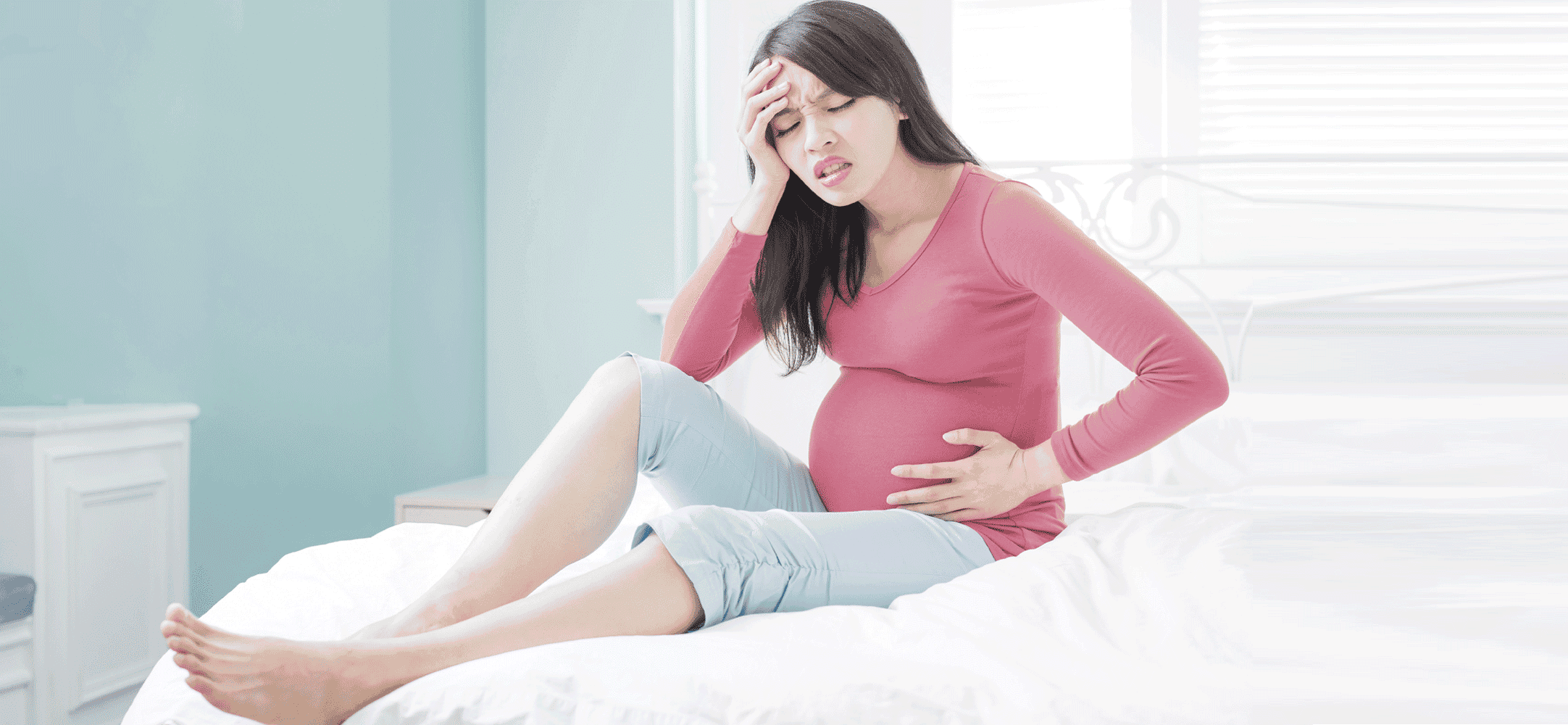
Pelvic Pain During Pregnancy in KL
Pelvic pain in pregnancy, often termed pelvic girdle pain, arises at the sacroiliac joints behind and the pubic symphysis in front as those joints loosen under hormonal influence. It sits low, commonly on one side or over the pubic bone, and it flares with movements that load one leg at a time.
Stairs, getting out of a car, rolling over in bed and standing on one leg to dress are the characteristic triggers. Keeping the knees together through exactly those movements reduces symptoms for most women within days, alongside sitting to dress and a pillow between the knees at night.
Pregnancy-related pelvic girdle pain can be felt near the pubic symphysis, sacroiliac region, groin, buttock or upper thigh and may be aggravated by walking, stairs, rolling in bed or standing on one leg. Pelvic or lower-abdominal pain can also have obstetric, urinary, gastrointestinal, vascular or other causes, so warning-sign screening comes first.
Pelvic and lower-abdominal pain is not automatically musculoskeletal
Do not use a support belt, exercise, chiropractic procedure or manual therapy to delay assessment of a symptom that may be obstetric, urinary, gastrointestinal, vascular, infectious or neurologic.
This guide to pelvic pain during pregnancy, how it differs from hip or back pain and how it is assessed, is published by Chiropractic Specialty Center, Bukit Damansara (KL) main center: WhatsApp+60 17 269 1873 Call+603 2093 1000
What is pregnancy-related pelvic girdle pain?
Pregnancy-related pelvic girdle pain, often shortened to PGP, is a descriptive term for pain and activity limitation around the joints and tissues of the pelvic girdle. The main regions are the sacroiliac joints at the back of the pelvis and the pubic symphysis at the front. Symptoms may also spread into the groin, buttock, hip or upper thigh.
PGP does not mean that the pelvis is out of place, permanently unstable or damaged. The symptom experience can be influenced by load transfer, movement strategy, muscle function, previous symptoms, fatigue, activity, sleep and the changing demands of pregnancy. RCOG notes that walking, stairs and turning in bed are common aggravating activities.
What activities commonly make pelvic girdle symptoms noticeable?
| Activity | Commonly reported pattern | Practical assessment question |
| Walking | Pain near one or both sacroiliac regions, pubic area or groin that increases with distance. | Does pace, stride length, surface or rest change the symptom? |
| Stairs | Symptoms during single-leg loading or pushing through one leg. | Is one direction worse, and is a handrail or slower pace helpful? |
| Rolling in bed | Pain at the pubic or posterior pelvic region during rotation or leg separation. | Does moving the trunk and legs together reduce the symptom? |
| Getting into a car | Pain when stepping wide, pivoting or loading one leg. | Does turning the whole body and keeping the knees closer reduce the trigger? |
| Standing on one leg | Pain during dressing, shoes or stepping. | Can the task be done seated or with hand support? |
| Prolonged sitting or standing | Increasing ache, stiffness or fatigue around the pelvis and lower back. | How often does a position change help, and is the symptom worsening overall? |
How does pelvic girdle pain differ from hip, back or round-ligament symptoms?
The regions overlap, so the distinction is based on the full pattern rather than a single location. Pubic pain, posterior pelvic pain and activity-related difficulty with stairs or rolling suggest a pelvic-girdle question. Outer-hip pain during side lying may be more local to the hip region. Back-dominant pain with leg tingling or weakness requires a spinal and neurologic screen. Lower abdominal or groin pain described as “round ligament” requires obstetric differential before any musculoskeletal conclusion.
How is pelvic pain assessed?
Assessment starts with pregnancy and medical history, then examines the activities that matter to the patient. No single palpation point, posture photograph or alignment test can prove the cause. The goal is to identify a consistent pattern, rule in or out the need for referral, and establish a baseline for function.
- Clarify the exact region, onset, symptom behavior, walking tolerance, sleep disruption and pregnancy or postpartum stage.
- Review obstetric instructions, bleeding, fluid leakage, fetal movement, fever, urinary or bowel symptoms, trauma, swelling and neurologic signs.
- Observe tasks such as sit-to-stand, rolling strategy, gait, step-up or supported single-leg loading only when appropriate and tolerable.
- Assess the lower back, hips and neurologic function when the symptom pattern overlaps those regions.
- Discuss whether a medical, obstetric, imaging or registered pelvic-health referral is required.
- Choose measurable goals, such as easier bed turning or a specific walking distance, and review them.
What conservative options are supported by current guidance?
Current guidance emphasizes education, activity modification, exercise advice and, for some people, a non-rigid lumbopelvic support belt. NICE recommends considering referral to physiotherapy services for exercise advice and/or a non-rigid belt. Its evidence review found insufficient evidence that manual therapy alone benefits PGP.
CSC's own approach takes that finding at face value: for PGP, manual therapy is never used alone. The pubic bone, sacrum and pelvis are adjusted with an Activator instrument, gently and at specific points, and this is combined with gentle manual and fascial work on the round ligament and the hip adductor muscles near the groin. Yama Zafer, D.C. has worked this way for over three decades.
RCOG patient guidance describes early assessment, advice, exercises and other multidisciplinary options. Manual-therapy systematic reviews report limited and varied evidence for pregnancy-related back and pelvic symptoms. Therefore, a balanced plan should not depend on adjustment alone, and no practitioner should promise alignment, stability, prevention or a specific timeline.
| Option | How it may fit | Limit |
| Education and task modification | Reduces repeated aggravating movements and helps preserve useful activity. | Should not become a long list of unnecessary restrictions. |
| Registered physiotherapy | Exercise advice, movement strategies, graded activity and belt assessment when indicated. | Pelvic-floor specialization may be needed for continence, prolapse or complex postpartum concerns. |
| Non-rigid lumbopelvic belt | May help selected patients during particular activities. | Not a universal answer; fit and response should be reviewed. |
| Chiropractic or manual care | May address selected joint or soft-tissue findings as part of a broader plan. | Limited evidence; no realignment, universal safety or birth-outcome claim. |
| Medical or obstetric care | Required for internal, traumatic, neurologic, infectious, vascular or pregnancy-specific concerns. | Must not be delayed by conservative care. |
How may chiropractic care be described accurately?
Chiropractic care may include assessment-informed, pregnancy-adapted methods for selected musculoskeletal findings around the lower back, sacroiliac region or related joints. The purpose may be to improve tolerance for a movement or support a broader rehabilitation plan. It should not be described as putting the pelvis back into place, correcting uterine tension, preventing dysfunction or preparing the pelvis for delivery.
The Webster Technique may be considered by a chiropractor for sacral or pelvic musculoskeletal findings, but it does not treat internal pelvic organs, pelvic-floor injury or fetal presentation. Read the Webster Technique evidence and limits guide for the full distinction.
How can daily activities be modified without avoiding all movement?
Choose changes that address the task that repeatedly triggers symptoms. The goal is to make movement manageable, not to protect the pelvis from normal movement indefinitely.
- Use a handrail and a slower pace on stairs. During a flare, reduce unnecessary repeated trips rather than banning stairs completely.
- Sit to put on clothing or shoes when standing on one leg is painful.
- When rolling in bed, try moving the shoulders, pelvis and knees as one unit and use the arms for support.
- For car transfers, turn the whole body and use a comfortable step width instead of forcing a wide pivot.
- Alternate sitting and standing before symptoms build sharply, and divide long tasks into shorter blocks.
- Keep carried items close and split heavier loads. Ask for help when a task exceeds current capacity.
Are Kegel exercises always appropriate for pelvic pain?
No. Pelvic-floor muscle training can help certain continence-related outcomes, but not every person with pelvic pain needs more pelvic-floor contraction. Some may have difficulty relaxing, coordinating or sensing the muscles, and others may have birth injury, prolapse symptoms or another condition requiring specialist assessment.
Generic instructions such as a fixed number of Kegels, bridges or squats should not be prescribed from a webpage. A registered pelvic-health physiotherapist or relevant medical clinician may be appropriate for urinary leakage, bowel symptoms, pelvic heaviness, pain with pelvic-floor activity, birth injury or persistent postpartum concerns. Chiropractic care does not rebuild the pelvic floor.
What happens after childbirth?
Pelvic symptoms may improve, persist or first become noticeable after birth. Recovery is influenced by the birth, tissue healing, sleep, feeding, carrying, stairs, abdominal-wall function, activity and previous symptoms. The person should not be told that the pelvis must be “realigned” after delivery or that care restores a pre-pregnancy body.
When the presentation is musculoskeletal and medically stable, care may focus on graded activity, movement confidence, practical tasks and appropriate referral.
What questions should you ask a practitioner?
- How did you distinguish pelvic-girdle symptoms from hip, back, abdominal, urinary or obstetric causes?
- What finding would make you stop care or refer me?
- What role do exercise, pacing, a belt or self-management have in the plan?
- How will we measure progress in walking, rolling, stairs or another meaningful task?
- Who provides physiotherapy and pelvic-health services, and what registration do they hold?
- Are you making any claim about alignment, fetal position, labor, prevention or guaranteed recovery? A responsible plan should not.
If You Are Closer to Bandar Sri Damansara
Northwest Kuala Lumpur is served by a second center. You can read about our Bandar Sri Damansara center. That center provides chiropractic together with physiotherapy.
The address, telephone number and opening hours are listed on contact details for Bandar Sri Damansara. Travel details for the main center are on contact details for the Kuala Lumpur headquarters.
Contact Chiropractic Specialty Center
For a pregnancy-sensitive musculoskeletal assessment, use the verified center and contact routes below. Urgent obstetric, medical or emergency symptoms should be directed to the appropriate medical service rather than an appointment request.
| Center | Address / location route | Telephone | Hours | |
| Bukit Damansara: Kuala Lumpur | No. 71, Jalan Medan Setia 1, Plaza Damansara, Bukit Damansara, 50490 Kuala Lumpur | +603 2093 1000 | +60 17 269 1873 | Monday-Friday 8:00 AM-8:00 PM; Saturday-Sunday 8:00 AM-6:00 PM |
| Bandar Sri Damansara | See the verified branch contact page for the current address and map pin | +603 6262 5777 | +60 12 455 6939 | Monday-Friday 8:00 AM-8:00 PM; Saturday-Sunday 8:00 AM-6:00 PM |
Bukit Damansara headquarters contact details | Bandar Sri Damansara contact details | CSC services
Planning a visit? You can review the current chiropractic price in Kuala Lumpur and physiotherapy fees in Kuala Lumpur before you come in.
Questions About Pelvic Pain During Pregnancy
Pelvic symptoms can come from several regions. These answers explain common patterns and referral boundaries without diagnosing the individual reader.
Is pregnancy-related pelvic girdle pain the same as pubic symphysis dysfunction?
Pubic symphysis symptoms can be one part of pregnancy-related pelvic girdle pain. PGP can also involve one or both sacroiliac regions and may spread into the groin, buttock or thigh.
Why does turning in bed hurt?
Rolling combines trunk rotation, leg movement and pelvic load. The symptom may involve the pubic region, sacroiliac area, hip or back. A movement strategy can be assessed, but severe or unusual pelvic or abdominal symptoms still require medical consideration.
Can pelvic girdle pain harm the baby?
A musculoskeletal PGP diagnosis concerns the mother’s pain and function, but a webpage cannot determine whether pelvic symptoms are musculoskeletal. Bleeding, fluid leakage, reduced fetal movement or severe abdominal or pelvic pain require obstetric assessment.
Can chiropractic care realign the pelvis?
That wording is too certain. Chiropractic care may address selected joint and movement findings, but routine examination does not prove that the pelvis is out of place. Goals should focus on function and response.
Does a support belt cure pelvic girdle pain?
No. A non-rigid belt may help selected people during certain activities, but fit, comfort and response should be reviewed. It is one possible component, not a cure.
Should I rest until the pain is gone?
Complete rest is not automatically helpful. Activity may need temporary modification, but the aim is usually to preserve manageable movement and gradually restore capacity. Severe or rapidly worsening symptoms need assessment.
Can pelvic symptoms continue postpartum?
Yes. Symptoms may persist because of recovery, activity, feeding and carrying demands, or another condition. Persistent pelvic-floor, continence, prolapse or birth-injury concerns require appropriate specialist assessment.
Can care continue close to the due date?
Only if the person remains medically and obstetrically appropriate for the proposed care and the method and position remain comfortable. There is no automatic rule that care is suitable up to delivery.
References
References support the specific educational statements cited in this page. They do not establish that every intervention is appropriate for every pregnant or postpartum patient.
- Centers for Disease Control and Prevention. Urgent Maternal Warning Signs. Hear Her Campaign. Accessed July 29, 2026.
- Ministry of Health Malaysia, Medical Development Division. Handbook of Obstetrics Guideline. Putrajaya: Ministry of Health Malaysia; 2024. MOH/P/PAK/535.24(GU)-e.
- Royal College of Obstetricians and Gynaecologists. Pelvic girdle pain and pregnancy. Patient information. Accessed July 29, 2026.
- National Institute for Health and Care Excellence. Antenatal care. NICE guideline NG201. Published August 19, 2021; current online guidance accessed July 29, 2026.
- National Institute for Health and Care Excellence. Antenatal care: rationale and impact for management of pelvic girdle pain in pregnancy. NICE guideline NG201. Accessed July 29, 2026.
- Hall H, Cramer H, Sundberg T, Ward L, Adams J, Moore C, et al. The effectiveness of complementary manual therapies for pregnancy-related back and pelvic pain: a systematic review with meta-analysis. Medicine (Baltimore). 2016;95(38):e4723.
- Weis CA, Pohlman KA, Draper C, daSilva-Oolup S, Stuber K, Hawk C. Chiropractic care for adults with pregnancy-related low back, pelvic girdle pain, or combination pain: a systematic review. J Manipulative Physiol Ther. 2020;43(7):714-731.
- Woodley SJ, Lawrenson P, Boyle R, Cody JD, Mørkved S, Kernohan A, Hay-Smith EJC. Pelvic floor muscle training for preventing and treating urinary and faecal incontinence in antenatal and postnatal women. Cochrane Database Syst Rev. 2020;5(5):CD007471.
- World Health Organization. WHO recommendations on maternal and newborn care for a positive postnatal experience. Geneva: World Health Organization; 2022.
The Author of Pelvic Pain During Pregnancy in KL | Patient Guide
Pelvic Pain During Pregnancy in KL | Patient Guide was written by Yama Zafer, D.C., who has 30+ years in chiropractic and physiotherapy and founded Chiropractic Specialty Center in Kuala Lumpur in 2006.
Last Updated: Pelvic Pain During Pregnancy in KL
Pelvic Pain During Pregnancy in KL was last reviewed and updated on October 3, 2026.