
Chiropractor in Malaysia: Training, Methods and First Visit
A chiropractor in Malaysia has to be registered under the Traditional and Complementary Medicine Act 2016 before treating anyone, and that registration is the first thing worth checking. Registered chiropractors in Malaysia complete a university degree program; a person who cracks backs without one is doing bare manipulation, not chiropractic.
What separates one chiropractor in Malaysia from another after that is the examination and the method. I have practiced for more than 30 years, in the United States and, since 2006, in Kuala Lumpur, and the care I teach starts with a thorough assessment, uses gentle non-rotatory methods for joints, discs and nerves, and runs side by side with registered physiotherapy. New patients can usually be seen the same day at either Kuala Lumpur center, but call or send a WhatsApp message first.
This page, Chiropractor in Malaysia: 5 Clear Facts Before Your Visit, is published by Chiropractic Specialty Center, Bukit Damansara (KL) main center: WhatsApp +60 17 269 1873 Call +603 2093 1000
The sections below cover how a chiropractor in Malaysia is registered and trained, how a chiropractor differs from a tit-tar practitioner or bonesetter, the methods that avoid twisting, chiropractic with physiotherapy, the first visit, fees and common questions.
Chiropractor in Malaysia: Key Takeaways
- Registration: every chiropractor in Malaysia registers with the T&CM Council under the Traditional and Complementary Medicine Act 2016, after a university degree program.
- Training differs: a Doctor of Chiropractic (D.C.) is a professional doctorate, usually about four years of full-time study after earlier university work; a chiropractor in Malaysia trained locally usually holds a BSc (Hons) degree.
- Assessment first: history, examination and, only when it shows a reason, imaging; never a long course of care committed to before anyone has examined you.
- Method matters: non-rotatory methods such as the Activator, flexion-distraction and drop-table work protect a damaged disc, a compressed nerve or a worn joint; a twist does not.
- Two professions, one plan: in my view you should not choose between a chiropractor and a physiotherapist; choose both.
Registration and Training: What the Title Means Here
Chiropractic in Malaysia is regulated as a practice area under the Traditional and Complementary Medicine Act 2016. Every chiropractor in Malaysia registers with the T&CM Council, and the law expects a university degree program behind that registration. Chiropractic itself has more than 130 years of history, and the profession has changed a great deal since it began in the United States.
Training is not the same everywhere. A Doctor of Chiropractic is a professional doctoral degree awarded in countries such as the United States and Canada, with several years of clinical assessment, spinal biomechanics, diagnostic imaging and supervised practice. I earned my D.C. at Cleveland University-Kansas City and practiced in Overland Park, Kansas, for ten years before founding CSC. A chiropractor in Malaysia trained locally usually holds a BSc (Hons) in chiropractic; at CSC, I am the only D.C., and every other chiropractor holds a BSc (Hons).
A degree is the starting point, not the finish line. I personally trained every CSC chiropractor in the Activator® adjusting instrument and in the non-rotatory methods we use, because owning a method is not the same as knowing when to use it. More on the degree itself is on the Doctor of Chiropractic page.
Chiropractor, Tit-Tar or Bonesetter: The Differences
Tit-tar (跌打), bonesetting and chiropractic are three of the most common choices people in Malaysia make for neck pain, back pain and a slipped disc, and they are not the same thing. Tit-tar and bonesetting are traditional crafts, usually learned by apprenticeship under a master, and they do not require a university degree. Traditional Chinese Medicine itself is taught at university level, with herbal and dietary care, acupuncture, moxibustion, cupping, tuina and some joint manipulation.
A registered chiropractor in Malaysia is trained to examine before treating: to tell a muscle strain from a joint problem, a joint problem from a disc problem, and a disc problem from a nerve root under pressure. That matters because a forceful pull or twist that a stiff muscle might tolerate can make a bulging, herniated or extruded disc worse. If you choose manipulation of any kind, choose someone with the education and training to diagnose what is being manipulated.
Methods That Avoid Twisting, and Why I Use Them
There are hundreds of chiropractic techniques. Gonstead and Diversified are well established and good for mobilizing joints, and in a young person with no degeneration and no disc damage they can be appropriate. Many of their adjustments rotate the spine, though, and for moderate or severe degeneration, a damaged disc or a compressed nerve I use care that does not twist the spine at all. Not every chiropractor in Malaysia works this way, so ask which method will be used before any adjustment:
- The Activator technique: a hand-held, spring-loaded instrument that gives one light, quick impulse to a precise point, with no twisting and no cracking. More on the Activator technique page.
- Flexion-distraction and drop-table methods: gentle motion and a small, controlled drop that work on a segment without rotation.
- A non-force upper cervical method: for the top of the neck, from the skull to C2, where the joints are small and the vertebral arteries are close.
- Soft-tissue work: muscles, ligaments and trigger points around the problem, by hand or with the instrument.
I strongly oppose the ring dinger, the Y-strap and towel neck pulls. The neck has small joints, nerves and arteries running through narrow openings beside the bones, and a yank on a neck that already has a disc bulge, bone spurs or instability is the wrong load. The cracking sound itself is only gas released from the joint fluid; it is not a sign that anything was put back in place.
In that two-minute video I show both kinds of adjustment on a patient: the non-rotatory Activator and the side-posture twist I do not use for joint or disc problems. The transcript is on the Rotatory vs Non-Rotatory Adjustment video page.
Straight, Mixer or Combined Care
A straight chiropractor works only with the adjustment, by hand, following the original theory that a vertebra out of place pinches a nerve and that putting it back relieves the nerve. That idea is not entirely wrong, but it is more than 130 years old, and it leaves out the muscles, ligaments, tendons and discs that most spine and joint problems involve. I am not aware of a straight chiropractor in Malaysia.
My approach is a combined one. The method of adjustment is chosen by the diagnosis, and the adjustment is one part of a plan with physiotherapy, exercise and changes to daily habits. What it is not is one-size-fits-all care, the repeated "lie on your side and have your back twisted" routine given to every patient in the same way.
A Chiropractor in Malaysia and a Physiotherapist: How the Roles Divide
The two professions overlap, and at CSC they are used together. Roughly, the work splits like this:
- Chiropractic: how a joint moves and restoring the movement it has lost, by gentle, specific adjustment of the spine, pelvis and joints such as the knee, shoulder, wrist and jaw.
- Registered physiotherapy: the strength, endurance and control of the muscles around the joint, with manual therapy, graded exercise and machines such as therapeutic ultrasound, electrotherapy, shockwave and high-intensity laser where the examination calls for them.
- Together: every registered chiropractor at CSC works on one plan, one shared case file, and a review against the findings of the first examination.
As I say in my video Is Chiropractic Safe? 13 Questions Answered: do not choose between one or the other; choose both. An adjustment alone cannot reach every tissue at depth, and physiotherapy alone does not restore a restricted joint the way an adjustment can.
What a First Visit With a Chiropractor in Malaysia Covers
- History: when the problem started, what makes it better or worse, where it spreads, and any numbness, tingling or weakness.
- Examination: posture, movement, orthopedic tests, muscle strength, reflexes and, where the symptoms point to them, the nerves.
- Imaging, only when indicated: not every patient needs an X-ray or MRI, and ordering one before an examination is the wrong order. Bring any films, CDs and reports you already have, but please do not have a scan taken just for the visit.
- The findings explained: what is involved, a muscle, a joint, a disc or a nerve, usually with two or three options and their benefits and shortfalls; you decide.
- A plan with a review point: what will be retested, and when.
The first visit has no fixed length. It takes as long as your problem needs, from about 20 minutes to an hour or more.
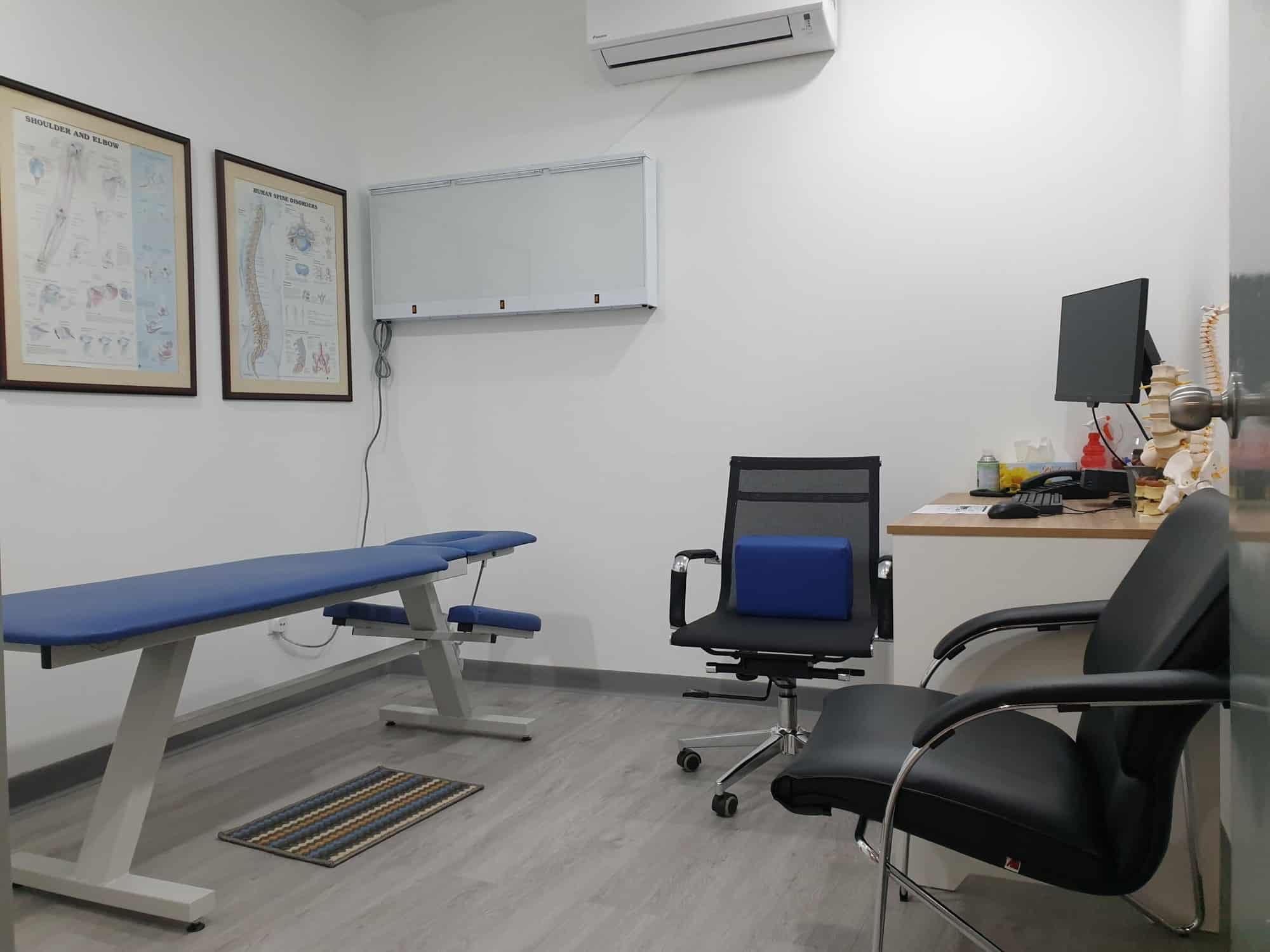
Both CSC centers in Kuala Lumpur follow the same assessment and the same methods, and fees are the same at every center. Directions and hours are on each center's contact page, or call or message either center:
- Bukit Damansara (KL, main center): Call +603 2093 1000 or WhatsApp +60 17 269 1873 to see the Bukit Damansara / KL center
- Bandar Sri Damansara (KL): Call +603 6262 5777 or WhatsApp +60 12 455 6939 to see the Bandar Sri Damansara center
Problems a Chiropractor in Malaysia Commonly Sees
As a chiropractor in Malaysia, I look after every joint, muscle and ligament, not only the spine. The problems I see most often include:
- neck pain and stiffness, including upper neck problems and headaches that start in the neck
- lower back pain, a slipped disc in the neck or lower back, and sciatica
- pelvic, sacroiliac and tailbone pain, including during and after pregnancy
- shoulder, elbow, wrist and thumb problems, including tendon problems and carpal tunnel-type symptoms
- hip, knee, ankle and foot problems, often linked to how weight is transferred through the legs
- jaw problems, together with the upper neck
- scoliosis, posture strain from desk and phone work, and sports injuries
Most of the neck patients I see are in their 20s and 30s, the first generation to use phones and tablets since childhood, or in their 30s to 50s and at a laptop all day. Many of the disc patients are in their 30s and have been told their pain is "mechanical" when the disc itself is involved.
Conservative Care First, and What It Actually Means
Most spine and joint problems are best managed the same way anywhere: an examination, then the least invasive plan that could reasonably work, then an honest review of whether it is working, and a good chiropractor in Malaysia follows that order. I would never advise surgery or an injection unless the care I provide is not helping; invasive options are always a distant last.
The order is often skipped. The Lancet low back pain series described first-line care being underused, alongside heavier use of imaging, rest, opioids, spinal injections and surgery than the evidence supports. A 2021 Cochrane review found that exercise therapy probably reduces pain in chronic low back pain compared with no treatment, usual care or placebo, which is why exercise belongs in a plan from the start, chosen for the condition and the age.
To recover, you need to increase everything that helps your condition and, at the same time, decrease everything that harms it. For care to have a good chance of a positive outcome, the problem must be accurately diagnosed, the plan properly made, the care carried out without flaws, and the whole thing topped with changes to posture, habits and daily activity.
How Many Visits, and When to Review
No number of visits can be set before the examination, by me or by any registered chiropractor in Malaysia. How long it takes depends on what is involved, how long it has been there, your general health, how closely the advice is followed and how well your body repairs itself. If there is no improvement by about the fifth session, the plan is reassessed; if there is none by the tenth, we discuss whether to continue.
Once the active phase is over, a maintenance visit now and then makes sense for someone who has had episodes of neck, back or joint trouble before. If you have no symptoms and no history, you may not need chiropractic at all. If it is not broken, do not fix it.
Fees for a Chiropractor in Malaysia at CSC
What you pay a chiropractor in Malaysia varies from clinic to clinic; at CSC, fees are the same at every center: RM100 for the examination, RM150 for an adjustment, or from RM110 for the adjustment when the visit also includes physiotherapy. Packages of 15 and 20 sessions are available, and the full list is on the chiropractic price in Kuala Lumpur page.
Is a Chiropractor in Malaysia Safe?
Chiropractic care is safe when it is performed by a competent, registered chiropractor. It is the chiropractor who makes mistakes, not chiropractic, and not all chiropractors are equal, just as surgeons, medical doctors and dentists are not. Care should never be uncomfortable: my motto has always been no pain, more gain, and if a visit is uncomfortable, tell the chiropractor.
If you are seeing a chiropractor in Malaysia for back or leg pain, get urgent medical attention, a thorough assessment by a competent clinician the same day, for new or worsening numbness around your genitals, between your genitals and anus, or around your anus. The same applies to new difficulty passing urine, even if you still have bladder and bowel control, and to any loss of that control.
Several causes are possible. Some may call for an invasive procedure, but an assessment helps establish what is happening and what care is appropriate; surgery is not automatically required.
In Is Chiropractic Safe? 13 Questions Answered I go through registration, techniques, imaging, the cracking sound and how progress is reviewed.
Chiropractor in Malaysia: Common Questions
Is a chiropractor in Malaysia a doctor?
A chiropractor who holds a Doctor of Chiropractic (D.C.) has a professional doctoral degree, but is not a medical doctor and does not prescribe medicine or operate. A chiropractor in Malaysia trained locally usually holds a BSc (Hons) degree. All must be registered under the Traditional and Complementary Medicine Act 2016.
How do I find the best chiropractor in Malaysia?
No clinic is the best for everyone. Check registration and training, whether an examination comes before any treatment, whether imaging is ordered only when needed, whether the methods avoid twisting where a disc or nerve is involved, and whether physiotherapy is part of the plan. The good chiropractor guide sets out nine checks.
Does a chiropractor in Malaysia crack the neck?
Some do. I do not use rotatory neck manipulation where a disc problem is suspected or confirmed, and I never use the ring dinger, Y-strap or towel pulls. Neck care at CSC is non-rotatory and specific, with a non-force method at the top of the neck.
Can I see a chiropractor the same day?
Usually, yes. New patients can usually be seen the same day at either Kuala Lumpur center, but call or send a WhatsApp message first so a chiropractor is free when you arrive.
How much does a chiropractor cost in Malaysia?
At CSC the examination is RM100 and an adjustment RM150, or from RM110 when the visit also includes physiotherapy; fees are the same at every center. Fees at other clinics vary.
Should I see a chiropractor or a physiotherapist?
In my view, choose both. A chiropractor restores how a joint moves; a physiotherapist builds the strength and control to hold it. At CSC both work on one plan.
Related Reading for Choosing Care
- Chiropractic in Malaysia: how the profession works here, and my view on wellness and maintenance care.
- Chiropractors in Kuala Lumpur: how they work and differ across the city.
- Chiropractic treatment: how the method is chosen: the techniques compared.
- Chiropractic and physiotherapy in Malaysia: why the two work best together.
Peer-Reviewed References
- Foster NE, Anema JR, Cherkin D, et al. Prevention and treatment of low back pain: evidence, challenges, and promising directions. Lancet. 2018;391(10137):2368-2383.
- Hayden JA, Ellis J, Ogilvie R, Malmivaara A, van Tulder MW. Exercise therapy for chronic low back pain. Cochrane Database Syst Rev. 2021;9(9):CD009790.
- Rubinstein SM, de Zoete A, van Middelkoop M, et al. Benefits and harms of spinal manipulative therapy for the treatment of chronic low back pain: systematic review and meta-analysis of randomised controlled trials. BMJ. 2019;364:l689.
- Dagenais S, Gay RE, Tricco AC, Freeman MD, Mayer JM. NASS Contemporary Concepts in Spine Care: spinal manipulation therapy for acute low back pain. Spine J. 2010;10(10):918-940.
These references describe low back pain care and spinal manipulation in general. None of them evaluates care at Chiropractic Specialty Center.
The Author of Chiropractor in Malaysia: 5 Clear Facts Before Your Visit
Chiropractor in Malaysia: 5 Clear Facts Before Your Visit was written by Yama Zafer, D.C., Chiropractor in Kuala Lumpur Since 1996, who founded Chiropractic Specialty Center in Kuala Lumpur in 2006.
Last Updated: Chiropractor in Malaysia: Training, Methods and First Visit
Chiropractor in Malaysia: Training, Methods and First Visit was last reviewed and updated on October 28, 2026.